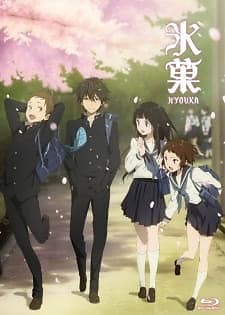
Alternative TitlesSynonyms: Hyou-ka, Hyouka: You can't escape, Hyou-ka: You can't escape, Hyoka Japanese: 氷菓
Information
Type: TV
Episodes: 22
Status: Finished Airing
Aired: Apr 23, 2012 to Sep 16, 2012
Duration:
25 min. per episode Rating:
PG-13 - Teens 13 or older
L represents licensing company
StatisticsScore: 8.261 (scored by 42937 users)
Ranked: #2292
Popularity: #108
Members: 89,026
Favorites: 1,963 1 indicates a weighted score
My Info
Popular Tags
No tags found |
SynopsisOreki Houtarou is a minimalistic high school boy. One day, he joins the Classic Literature Club at his elder sister's request.
There he meets Chitanda Eru, Fukube Satoshi, and Ibara Mayaka. Chitanda is a calm beautiful girl but she turns into an embodiment of curiosity once she says, "I'm interested in it (Watashi, Kininarimasu)". Fukube is a smiling boy with a fantastic memory who calls himself a database. Ibara is a short girl and is strict with others and herself. She loves Fukube, but he always dodges her approaches.
They begin to investigate a case that occurred 45 years ago. Hints of the mystery are buried in an old collection of works of the former members of Classics Club. The collection is titled "Hyouka." |
Related AnimeAdaptation: Koten-bu Series Side story: Hyouka: Motsubeki Mono wa
Characters & Voice Actors
Staff
Reviews
|
|
Veronin
292 of 541 people found this review helpful
|
22 of 22 episodes seen
|
| Overall |
8 |
| Story |
6 |
| Animation |
10 |
| Sound |
8 |
| Character |
8 |
| Enjoyment |
8 |
"I don't do anything I don't have to. What I have to do, I do quickly."
For most people, the short years spent in highschool are often the turning point and highlight of their lives; a time filled with introspection and change, where some dreams end and others are born to take their place. On the other hand, there are some who reject this notion and choose to spend their days as uneventfully and routinely as possible, never straying too far from their comfort zone and established lifestyle. After all, why waste the energy on trivial matters?
Oreki Houtarou is one of these individuals.
Set during the dull and grey life of Oreki's first year in highschool, the story begins with an important change to his individual status quo — the joining of the school's Classics Club, albeit out of obligation rather than choice. Receiving a letter from his older sister asking him to join the club to keep it from being disbanded from lack of membership, he solemnly accepts his duties and sends in a club registration form, which appropriately causes surprise for his close friend Satoshi. For an individual uninterested by studying, sports, and socalizing, joining a club can be an arduous and painful ordeal. And indeed, if not for a certain girl immediately joining the club, Oreki could very well have maintained his status quo of living dully and freely.
But perhaps change isn't always a bad thing.
This changing force is Chitanda Eru, serving as the contrast to Oreki's behavior. Shortly after their first exchange, Chitanda drives Oreki into a set of mysteries involving the club and its later two members, a repeated occurence often instigated by her eyes lighting in excitement and being followed by her catchphrase, "I can't stop thinking about it!". These mysteries are what form the bread and butter of the story, so it's a fortunate thing then that the mysteries themselves are varied; involving fairly interesting situations such as a room being locked or ghost sightings during a hot springs trip, and trivial events such as why a student was suddenly called to the office after school. No two mysteries are the same, and while several of the episodes are independent stories, three distinct arcs constitute the bulk of the episodes and the development of the characters.
Fortunately (and not so fortunately) the fairly lighthearted formula established in the self-contained stories is mostly reversed into something more dramatic and serious in the main story arcs once things finally get heated. It provides a refreshing contrast between the two and prevents things from feeling too repetitive or stale. Problems unfortunately come as a result with this change in tone, however. The dialogue can sometimes come across as being cheesy with overdramatized and exaggerated reactions to some of the events, such as Chitanda gasping in shock like the world has just ended when a book is missing from the clubroom, Oreki yelling and giving a death glare when his senior manipulates him a little bit, or the other three members of the Classics Club treating Oreki as some kind of savant for solving what are often very simple mysteries. Considering the trivial and often lighthearted nature of these mysteries, the overdramatization in the script is something that stands out as being very inconsistent with the overall tone of the series.
Another flaw exists with the mysteries themselves, and those watching the series primarily for that aspect are very likely to find themselves disappointed or bored, especially with the self-contained stories whose mysteries are often so trivial and juvenile that they are more equivalent to a curious question than anything else. They lack the depth necessary to truly become something well-written and engaging, and have very little in common with the mystery novels that the anime frequently references. Though these mysteries don't qualify as being bad, they're mostly mediocre and certainly don't stand well on their own. Instead, much of the appeal and enjoyment of Hyouka comes from the relationship between the characters and their interactions with one another.
Similar to the dynamic between Sherlock Holmes and Watson, three of the main characters in Hyouka each fill a specific role in the club: Chitanda instigates the mystery, Satoshi provides information, and Oreki deduces. While the early episodes may give an impression of this being formulaic, the characters soon break from the mold and begin to do things that don't strictly pertain to their accepted role and behavior. For example, Oreki may decide to instigate the mystery himself or in one specific case Satoshi attempts to be the one to unravel and deduce. One main character even ends up being the culprit in one episode which makes for a fairly surprising conclusion.
Luckily, there's enough substance to their interactions that they come across as normal human beings rather than simple stereotypes, though Chitanda's eccentric traits and curiosity are often exaggerated for comedic effect. The characters all show a wide spectrum of emotion and get disappointed or angry depending on the situation (despite problems with the aforementioned overdramatization) or joke around and playfully criticize one another when things are going well. What mainly shines, though, is Oreki's and Chitanda's relationship, stemming from how heavily their personalities and behavior contrast with each other. Seeing him react and deal with her curious and capricious behavior always makes for some endearing and amusing scenes, with blushing and romantic moments abound.
Then again, none of this would be very interesting in the first place if these characters didn't stand out by themselves or possess any distinguishing qualities. It's thanks to the writers' aptitude that the main characters undergo a considerable amount of development over the course of the series, resulting in something that is fundamentally more complex and dynamic. The majority of this development is focused on the protagonist, Oreki, as his dull life slowly changes into something more colorful and vibrant. At the start he's very reluctant to expend energy on anything that isn't absolutely necessary which is what causes him to repeatedly rebuke Chitanda for roping him into these situations. Mainly a result of the enjoyable time he has with Chitanda and the Classics Club, Oreki begins to realize that being involved and competent with something might not be such a bad thing after all. He starts to willingly pursue these mysteries through his own effort and curiosity, without the need of Chitanda urging him to investigate. For a person so bent on doing nothing with his days and conserving all time and energy possible, it's only natural for the rest of the club members to point out his change in behavior.
Change isn't only evident in Oreki, though, as Chitanda, Satoshi, and Mayaka also experience it to varying extents. In particular, Satoshi — often serving as the comic relief — becomes unsatisfied with his role and lack of recognition in comparison to Oreki. For several episodes he trails off into the mystery by himself in a mostly unsuccesful effort to duplicate or better Oreki's deductive skills. The jealousy being portrayed in some scenes is a somewhat unneeded and perhaps cliche, but this arc in the story provides a pleasant change to Satoshi's character and is successful in fleshing him out much more than in the early episodes. The second-to-last episode takes this further as well with even Satoshi understanding his change and becoming happy with his new lifestyle. Mayaka also gets some much needed screentime during the third arc which involves her status in the Manga Society club and her relationship with its members, with the outcome of this sidestory being something fairly satisfying and conclusive. Chitanda on the other hand changes surprisingly little over the course of the series though perhaps it's for the best. After all, she fills a necessary and important role in the story as the foil of Oreki and catalyst for his change and development. If Chitanda wasn't her usual self, where would Oreki be?
Now, there's one thing that can be agreed upon in regards to Hyouka, and that is that Kyoto Animation has made this show absolutely stunning visually.
The presentation of Hyouka is one of the most outstanding aspects about the series. Mood and atmosphere is set by the prominent lighting and by the events and monologues which are heavily stylistic and surprisingly abstract at times, occasionally taking the viewer away from the normality of the situation and into a place much more surreal. There's a distinct visual element present in Oreki's thought process with the layer of each mystery being carefully mapped out to the viewer, which serves not only to make the mystery more clear but to provide a much more immersive experience than the characters simply speaking to each other. Some scenes also possess a very dreamlike quality, with a couple particular examples including Chitanda's first inquisitive moment which succeeds in captivating Oreki or the dozens of little curious Chitandas crawling and tugging on him in the sixth episode. This type of dichotomy between the normal and the abstract is what makes Hyouka a very unique experience.
The underlying animation and designs are also phenomenal. KyoAni has long been lauded for the standard of detail and animation set in their works and this is taken even further with Hyouka, with the entirety of the anime feeling very much movie-quality throughout of all its episodes. The realistic and lifelike movements of the characters is praiseworthy but what stands out most is the focus on eyes and facial expressions. The characters of Hyouka are easily some of the most visually expressive seen in an anime for quite some time. Even the side or background characters receive much of the same detail to animation and character design, making nobody seem bland or the derivative of another. It's surprising then that KyoAni managed to keep to this level of quality for all 22 episodes, with no noticeable decrease visual nor artistic quality. The seemingly limitless attention to detail here is really something commendable.
But it's not all about visuals technically, either. Hyouka boasts a very fitting and eloquent soundtrack that accentuates the atmosphere set by the visual design. Composed mostly of classical tunes and eerie or quizzical melodies, the music is what creates the inherent sense of intrigue within Hyouka. It perfectly manages to capture the principal feeling of mystery in both the relaxed and dramatic moments of the series, never feeling overbearing nor out of place.
In the end, Hyouka does fall short of some of its potential due to issues with the script, but what the anime lacks in mysteries it more than makes up for with its characterization and presentation. It's just a bit of a shame that many people will choose to write the anime off and treat it as something weak and disappointing because the mystery aspect didn't hold up to their expectations. A misconception exists where people treat Hyouka as a strictly mystery title, and while it does hold true to some extent, these mysteries are instead used to develop the characters and have them interact in a remarkable manner, distinctive manner. This is an anime that essentially amounts to mundane events presented in a stylized and intriguing way. For those looking for something fresh in an age of uninspired rom-coms and homogeneity, Hyouka is a title that is easily worth your attention.
There's this sweeping notion that deep and action-oriented storytelling is necessary for a quality experience, but titles like Hyouka can safely disprove that line of thought. read more
|
|
Stark700
173 of 344 people found this review helpful
|
22 of 22 episodes seen
|
| Overall |
9 |
| Story |
7 |
| Animation |
10 |
| Sound |
7 |
| Character |
9 |
| Enjoyment |
9 |
Alright folks, let's talk some Hyouka. Time to exercise your brains and turn that curiosity light bulb ON.
Hyouka (also the same name of the first volume of the Classic Literature Club that's also a implied term of “Ice Cream”) is an anime series adapted from the mystery novel written by Honobu Yonezawa. The story? Well, if you're curious like a certain purple eyed girl in the series, Hyouka details the Kamiyama High School's Classic Literature Club and its members having fun while solving mysteries and enjoying the time of their boring lives.
It all begins with the unenthusiastic young boy by the name of Oreki Houtarou. He is the type of guy that is hard to make friends with because Oreki in his minds and his friend describes him as someone who is not keen in joining clubs, play sports, or socializing. Despite this, he is very intelligent and observant of the tinest events as well as having an insightful intuition. After joining the club reluctantly by his elder sister, the mysteries, fun and, Hyouka stories begin.
Of course, Hyouka wouldn't be much fun without the other members of the club, right? We have the calm and happy girl with the keen curiosity. With those large purple moe eyes, she is curious about various events and mysteries that often involves others and goes “watashi kininarimasu!” (I'm curious!). She is a fun and happy go girl who despite being annoying at times brings the fun and entertainment in the story. On other hand, there's her best friend Mayaka Ibara who calls her affectionately “Chi-chan”. Mayaka is sort of the opposite of Chi-chan as she seems to be the type of girl who wants to avoid confrontations and if possible, end it as peacefully and swiftly as possible. Last but certainly not least is Satoshi Fukube. He's the happy guy who is carefree about life but deep down a great guy as he cares about others' well being. With a powerful memory, he is a useful as well as a compatible partner of Oreki who balances out the cheerfulness and moody mood of the duo/club.
Now at this point, you might be as curious as Eru Chitanda herself or even had a thought of “watashi kininarimasu!” on whether the series is worth to watch.
Overall, the arcs and story is well crafted. Detection fiction stories involving a group of friends is never new in the anime industry. Series such as Detective School Q, Heaven's Memo Pad, and Spiral: The Bonds of Reasoning also have such elements. What makes the series more interesting seems to be the interactions between the four main members of the club with each other that goes beyond the typical mysteries. The actors plays their roles well with their voice acting that reflects the personalities of the characters. With nearly all the characters having different characteristics, it's amusing to see how they all get along in the club. Surprisingly though, it actually does work well. But of course adaptation an anime always has its problems of the script not flowing or losing its touch in some of the filler like episodes. Personally though, it works out fine.
Because the series takes place at a school life setting, there are other characters in Hyouka that interacts with the club. These are often included in some of the mysteries and requires the clubs' various skills to crack that case.
If animation was part of a popularity poll this year, Hyouka would take the grand prize. Kyoto Animation (Clannad, K-On!, The Melancholy of Haruhi Suzumiya) does a pretty damn good job with its production quality and that's not an understatement. I remember watching the first episode and the first thing that popped into my mind was “wow, that animation is out of this world!” No but seriously, the production quality is top notch and Kyoto Animation does not disappoint. It even includes word play illustrated in the minds of Oreki and some of the other characters during cases to depict clues in a more realistic way of telling the story. With its gorgeous artwork and beautiful style of presenting the characters, it goes on without say that “a picture is worth a thousand words”.
The soundtrack of the series is smooth that is well coordinated. When a mystery case scene is presented, the soundtrack flows. When a comedy scene (usually involving our curious girl Eru Chitanda), an OST of rhythm is played. Even when Oreki is bored, it shows that he really is bored through the soundtrack. Talk about unenthusiastic. The two opening songs are also well orchestrated in the series. The first OP song, "Yasashisa no Riyuu" by Choucho presents a smooth flowing song that gives us a lighthearted feeling of Hyouka. The second OP song "Mikansei Stride” by Saori Kodama presents a more humorous way of the series with Oreki peeking around with curiosity himself. (somewhat similar to Medaka Box's Opening). And of course, the ED songs are also there to make us feel the mystery. Well, not exactly. The first ED song seems to be quite naughty to say the least. Chitanda and Mayaka in those curious positions?! Turn that imagination bulb ON. The second ED song though fits more within the mystery genre and is generally entertaining to watch.
Overall, Hyouka is one of those lighthearted series to watch by the end of a long weekend. The series does have flaws such as the the repetition in some of the intertwined arcs as well as mindless word plays that goes on in some episodes that can be bothersome to watch. Chitanda's signature phrase “watashi kininarimasu!” is also infectious at times and gets annoying. Additionally, some of the mysteries are a bit dull and not realistic as it seems. If it's a real mystery, why not involve some real murders and crimes? Needless to say, it's why Hyouka is rated PG-13.
Hyouka is a school mystery series that involves...guess what, mysteries. If you're not into detective fiction or that sort of genre, then hit that drop button. No one is stopping you. But if you're curious like Eru Chitanda, then sit back, relax, and watch some mysteries as well as the members of the Classic Literature Club do what they do best at.
Curiosity kills the cat but Hyouka is what kills the boredom. read more
Recommendations
|
|
Judged by how character setting is almost man-to-man similar, can't refuse that it will make the overall mood and tone similar too. That's how it's happening.
The leading male and narrator, Kyon and Oreki Houtarou, are made from the same mold. Average, not standing out, and does not want to take initiative whatsoever in school activities. And guess what, they are getting pushed around by girl of course, The ultimate reason why any straight man go out of their comfort zone.
The story of Hyouka revolve around solving mystery, not a grand one, but very well made. Well made enough to be believable, even when portrayed by 2D fictional character and produced by a studio responsible for one of the most surreal, unbelievably insane jokes show ever.
For watching these shows, you got two things to enjoy. First, how the story develop, how the string of mysteries is getting solved, and how the world around main characters reacts. And second, you get to see the development in attitude of the main character, how he sees and reacts to everything changed little by little. We don't see that in every anime. Most of character in animated series are cold-cast and do not change for the rest of the show. So if you want to see a person that is inspired to change themselves, even if they are fictional characters, look no further. You might found some inspiration of your own.
Basically both are about school club doing stuff because the club president wants to (solving mysteries in Hyouka & searching for supernatural in Haruhi), male protagonists are very similar, + both are by KyoAni
Haruhi has more action & little bit of sci-fi , while Hyouka is kinda slow and more realistic, but this 2 series are very alike
As main characters, Kyon and Houtarou have similar demeanors in which they approach school activities. Their interactions with fellow club members are also similar.
Similarities:
- It's a mystery based inside of a school about a certain character's past.
- It's based around a club
- The main MAIN characters are 1 female, and 1 male.
- There's a fairly moe female character
- There's a certain kind of sadness, which is hard to describe.
- Quirky solutions to the mysteries
Differences:
- Most of the characters in the Melancholy of Haruhi Suzumiya are some what extroverted, at least there is a seemingly big difference in the extroversion and introversion of the characters.
- MHS has more of an alien solution, like an alien was here watching over- as the solution of the problem. Where as in Hyouka there are more practical solutions and leaving you sitting there thinking "... I should've thought of that." Given a little more time, to think about it you'd be able to figure it out sooner or later. However if you do manage to figure out what happens then you wouldn't be as impressed.
Same kind of feel. Both KyoAni production. Clubs are involved, with Hyouka having a more realistic, serious tone and atmosphere.
Oh the parallels. If you like one premise, you'll probably like the other.
Similarities:
-KyoAni
-high school
-literary club turned SOS brigade-esque, seeking to help others/solve problems or mysteries
-cutie female lead/ Genki Girl
-apathetic male lead/ Deadpan Snarker
-typical male student + somewhat abnormal girl who’s interested in EVERYTHING
-There is a girl who likes books.
-mysterious unfinished confession by second episode
-some big plot mystery in the making
The setting of both is a Japanese high school, and both deal with club activities. The male protagonists of both series slowly get pulled into the worlds of the female protagonists. The male protagonists also start out as people who want to conserve energy and remain ordinary.
Hm...somehow the atmosphere around forming a club reminded me of the brigade in Haruhi Suzumiya. Also the main character's personality of both animes were similar. And each member of the club had a unique skill!
Each series has a lazy, snarky male lead character, and an eccentric, upbeat female character.
Both have a mystery aspect to them: Hyouka has outright mysteries that the characters solve. Haruhi has more of an air of mystery, because the viewer doesn't know all about the supernatural happenings.
Both are animated in a similar way, a bit moe and with smooth animation.
Both are set in a high school setting, particularly, a high school club setting.
Same animation company and art style. Both have relatively passive male leads that narrate the show and inadvertently drive the show in a particular direction with their interior monologue. Both have very enthusiastic and likable female leads that mesh well with the aforementioned male lead. Hyouka leans more on the slice-of-life mystery and Haruhi is more of a comedy school life, but overall the vibe that one gets from both shows [Focus is on fairly avant-garde clubs [SOS brigade and classics club], two lead characters that clearly like each other but show little romantic interactions, clubroom hangout].
Both have an apathetic male lead and hyper/curious female lead. Both involve a group of unique friends who go on various adventures or solve mysteries. Both have strong artwork and soundtracks. Both also include hints of romance, drama, and comedy.
Somewhat they give me the same vibes.... like Haruhi and Chitanda being pushy and... Kyon and Satoshi is somewhat pro Haruhi and Chitanda... while Kyon and Hotarou is somewhat lazy and kinda being forced to do things they don't want to do....
Hiperactive girl and her eternal lazy lackey. Houtarou is the boy that can't unfollow the eyes and curiosity of chitanda. (very similar about kyon and Haruhi, but maybe haruhi is most freaky than eru).
The characters are similar and the Mysterious theme is present.
- Both done by KyoAni
- Feature a high school club
- Haruhi has some mystery elements, Hyouka is full mystery
- Both are slice of life
- Kyon and Houtarou are both snarky, and want nothing to do with the club at first
- Haruhi and Chitanda both constantly try to get Kyon/Houtarou to do something
Both are non-romance shows with a sense on comedy.
Both are clubs formed by the main girl and the boy is forced in.
My opinion -- For both I wish they were romance .
What the clubs are about are different though. I like Suzumiya more.
Deadpan, snarky protagonists that want to do little more than live out their average, ordinary lives until a strong spirited girl forcefully drags them out of their shells.
Solving mysteries in both, although Hyouka doesn´t have any supernatural characters. The style of both shows is also similar, with big changes in the personalities of main characters (mostly Kyon and Houtarou, they are basically the same). I greatly recommend both.
|
|
|
When looking at the artwork for Kokoro Connect and Hyouka, the artwork looks strikingly similar to each other, despite being animated by differing studios. Hyouka's artwork is a marvel to look at since it was animated by KyoAni, but Kokoro Connect's artwork is also very good.
Kokoro Connect, synthesizes comedy and drama in a very appealing way. It does not rely on straight gags, and it doesn't try too hard for laughs. This is a positive, because it doesn't seem forced like in other anime. The drama is not over the top and does not seem forced at all. There are also slice of life elements in Kokoro Connect, but is not the central focus for this anime.
Hyouka is marketed as a Mystery anime, but it does have some supernatural, comedic and dramatic components as well. The mysteries that are solved in most of the episodes may be trivial, but the process isn't boring at all. The mystery solving process is done through continued interactions between the characters.
If the mysteries were solved straight away... then what would be the point of having entire episodes? Just to force laughs out of the person watching, like some other anime do? Hyouka paces the mystery solving very well, and also contains slice of life and some romance to mix things up.
If you liked Hyouka and also a great mix of comedy, drama, with some romance and supernatural... without seemingly forced... then give Kokoro Connect a try!
Daily life anime (actually an acceptable name of a genre in Japan, being called nichijou which literally mean daily life,) but with a teaspoon of supernatural touch.
Kokoro Connect actually have somethings extraterrestrial taking place (body switching) but refuses to treat itself as a supernatural anime. Instead it always goes on like it is no big deal.The mood and tone of the show resembles other daily-life anime where sci-fi or supernatural elements cannot be found.
Hyouka on the other hand actually have no sci-fi context or supernatural power whatsoever, but is being treated as having one. There are sequences that look otherworldly, but no, there are nothing outside Physics law.
It is also worth noting that while production quality is not as stellar, Kokoro Connect character design (not about they look or personalities, but how they are drawn by animator) closely resembles that off KyoAni's Hyouka. Which possibly be another reason you might like the show. There are plenty of people who prefer anime with certain styles of art regardless of genre, so if you like K-On, Hyouka or other KyoAni goodness, why not give this a try.

Both Anime aired around the same time, both have a school setting, both have a mystery element and they have similar styles. They also deal with clubs that are rather minor and simply print a particular publication which isn't typically a big deal for the rest of the school.
I just have this feeling they are similar to each other since strange things/phenomena happen with both clubs although Hyouka is more on solving mysteries. But still when I see Kokoro Connect, it reminds me of Hyouka.
Both series revolves around a group of friends at a school life setting with a mixture of comedy and drama.
In both series, there is a slice of life style theme as the students breeze through the typical days.
Both series also contain a mystery like theme with questions that needs answers.
Additionally, both series has great artwork and a fitting soundtrack to go along with the mix.
Both anime are similar in the sense that they don't force you to like them from the start. Rather they slowly pull you in and get you hooked before you even realise it. Both are quite simple but at the same time are very interesting.
They both start on a K-ON artwork + slice-of-life framework, but develop their premise in an inspired and convincing fashion on top of it. Both have elements of mystery and drama and are heavily character-driven. Hyouka is somewhat more episodic and self-contained with different cases to be solved in each episode/arc. Kokoro Connect has more of a single thread of plot, although it's still very slice-of-life in that, while each episode leads to the next in an interconnected fashion, there's not much going on externally. For both, much of what happens is internal - within and between the characters.
Both have some mystery in them and very interesting changes.
Both, on the surface, seem to have a very typical slice-of-life with a twist feel to it but are both beginning to explore this twist deeper then usual.
The style of drawing imo is very similar. Both anime's are mostly about a boy and his day-day relationships with other people (though in Kokoro Connect theres a weird twist). This is a very good pickup for anyone who likes how a main character comes to love somebody. However, almost no romantic scenes exist in this anime until the very end, so if you're super into romantic stuff, then turn away now. However, if you're interested into how a boy eventually comes to realize his feelings in the very last episode, watch it. ;)
|
Opening Theme#1: "Yasashisa no Riyuu (優しさの理由)" by Choucho (eps 1-2, 4, 6-8, 10-11) #2: "Mikansei Stride (未完成ストライド)" by Saori Kodama (eps 13-16, 18-20, 22)
Ending Theme#1: "Madoromi no Yakusoku (まどろみの約束)" by Satomi Satou & Ai Kayano (eps 2-4, 6-11) #2: "Kimi ni Matsuwaru Mystery (君にまつわるミステリー)" by Satomi Satou & Ai Kayano (eps 12-14, 16, 18, 20-22)
Fansubbing Groups
Which fansubbers do you like the best? Click + to approve of their subs for this show. Click - if you don't think they did such a great job.
Related ClubsAnime Buddies!, Tomokazu Sugita Fanclub, Lyos Anime Gif, All the Hot Guys from A&M 2, ChavaKotomiChan's Club, Classics Club, Hyouka!, ♥Yuuichi Nakamura Fanclub♥ [member cards are available], Minako Kotobuki FC, School Life Club, The White Waters, Satoshi Fukube Fanclub, World of Animes (W.O.A.), Yui Ogura and Kaori Ishihara Fan Club, Go Kyoto Animation!, Tsundere is Not Annoying , Chitanda Eru Fans Club!~, Sick and Tired Club (STC), Eru Chitanda Central.~, Spring 2012 Game: Will it get dropped?Ryou Hirohashi Fan Club, ~*Insignificant classmates & background characters*~ (IS~BG), ~✬Tsuzuku✬~ ☯The Anime/Manga Connection☯ ~{Currently under slow remodeling}~, Anime Revolution ♡, Moe Moe Kyun Tea Cafe, Random Anime Cards Emporium (R.A.C.E.), ~+{Yui Makino Fanclub}+~, Wonderland of Roses, Terashima Takuma FC!, Anime Cards Brigade {A.C.B}, Recommendation Club, Oreki x Chitanda, Ai Kayano Fanclub!, ❤ The Best Friends Forever Club ❤, Sweet Anime World (S.A.W.), Mayaka Ibara Fan Club!~, debates de animes temporada, The Fukuyama Jun Fanclub, Yukiyo Club♥, We love them with Brown hair and green eyes !, Houtarou Oreki Fanclub, Classics Club, Miyu Irino Fans!!, Hayami Saori Fanclub, Purple Eyes Fanclub, Silk Spider Association -chat-, Cardinal Leger Anime Club 2012-13, Thigh Highs FC, Lyos Anime, Hyouka see all
Recently Watched By|
19 seconds ago |
6 minutes ago |
8 minutes ago |
11 minutes ago |
13 minutes ago | |
19 minutes ago |
45 minutes ago |
50 minutes ago |
1 hour ago |
1 hour ago |
|
|