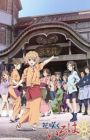
Information
Type: TV
Episodes: 13
Status: Finished Airing
Aired: Jul 1, 2012 to Sep 23, 2012
Duration:
24 min. per episode Rating:
PG-13 - Teens 13 or older
L represents licensing company
StatisticsScore: 7.591 (scored by 16790 users)
Ranked: #11212
Popularity: #522
Members: 33,603
Favorites: 202 1 indicates a weighted score
My Info
Popular Tags
No tags found |
SynopsisThe last year of high school is always a time of both looking forward and looking back. Before you lives the future, alternately bright and scary. Behind you lie memories, both happy and sad. And somehow, in the course of one year, you have to reconcile those two and decide where your life is going to go.
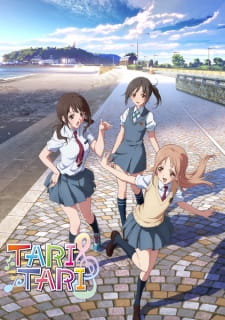
For Wakana Sakai, who had started studying music, it's time to face the tragedy that made her abandon that path. For Sawa Okita, it's about her dreams of riding professionally. And for Konatsu Miyamoto, it's about bringing her friends together through the magic of a song. Can something as simple as the formation of a choir club really help solve the hurts and pangs that come with growing up? Can music bring people together despite their differences?
(Source: Sentai Filmworks) |
Related AnimeAdaptation: Tari Tari
Characters & Voice Actors
Staff
Reviews
|
|
Veronin
101 of 193 people found this review helpful
|
13 of 13 episodes seen
|
| Overall |
7 |
| Story |
7 |
| Animation |
8 |
| Sound |
6 |
| Character |
7 |
| Enjoyment |
7 |
For a long time, people have argued whether originality truly plays a role into the quality of a title. In any media where there is an audience and a profit to be made, it's natural for many writers and artists to take inspiration from a tried and true formula. Though they may take steps to break from the circle of homogeneity and establish their own identity, deriving elements from other successful titles is inevitable.
Being a part of the conventional genre of high school drama, Tari Tari is certainly no stranger to this pattern.
The story takes place during the final year of high school for Wakana and her friends Sawa and Konatsu. Immediately after receiving a scolding from the strict vice principal, Konatsu decides to quit the choir club and start a new one by herself with the aid of her friends, as well as the later addition of two male characters: Taichi, a diligent badminton player, and "Wien", a peculiar transfer student from Austria. Of course, things don't go as smoothly for Konatsu as she was hoping they would, receiving an initially hostile reaction from Wakana who accuses her of fooling around and treating music as a game. In an attempt to show overcome her stress, Konatsu sings outdoors in public and gathers the attention of her aforementioned friends - finally assembling enough members to establish the club and push forward with her ambitions.
On the surface, Tari Tari seems like a standard coming of age story with a musical focus. Though the music remains a principal aspect of the anime, it primarily serves as the catalyst to bring the characters together and force them to overcome their own individual issues. For Wakana, these issues involve the regret surrounding her deceased mother, an accomplished musician who taught her how to sing and play piano. For Sawa, it involves her equestrian passions and love for horseback riding, much to the disagreement and discord with her parents. For Taichi it follows his ambition for badminton, while for Wien it is about his desire to preserve justice.
While the series is focused on teenage drama, what it excels at is making each character's issue relevant and believable by using the strengths and weaknesses of the characters to evoke emotion from the viewer, instead of relying on the tired routine of melodrama. Much of the episodes focus on Wakana's previous passion for music, with her past and the relationship between her mother being explored as her story arc progresses. Her avoidance of music is given explanation and reason, while the revival of her passion feels meaningful as she comes to terms with the past and begins to see things in a new, positive light. Each question is answered and each issue is resolved, while new ones are carefully set to take their place and give reason for the viewer to be interested in subsequent episodes. A frequent problem with teenage drama in fiction has always been the reliance on trite dialogue and melodrama instead of a coherent narrative, but Tari Tari manages to feel realistic while capturing the important stage in one's life between adolescence and adulthood. The 13 episodes here have been used in a highly productive fashion which succeeds in giving each character substance.
Sadly, the same amount of detail and depth isn't given to all of the characters. Taichi in particular receives very little growth over the course of the series, resulting in his own passions and issues being seldom explored. Aside from filling the necessary role as the fifth member of the club, Taichi ultimately adds very little to the story aside from developing a romantic interest in Sawa that is only vaguely hinted towards. Other issues in the characterization come from Wien's backstory and story arc, and while he's given sufficient character development in the later episodes, the resolution is surprisingly trivial given the amount of foreshadowing earlier in the series. His childish desire to defend justice is sympathetic but the lack of consistency obstructs his story arc from wrapping up in a satisfying manner. It's fortunate that Wien himself is a unique and exciting character, being an amusing transfer student that frequently misuses and exaggerates Japanese gestures, often with comedic results. It's hard not to grow attached to him over the course of the series.
Another common element in Tari Tari is the presence of an antagonist: the vice principal, who strongly opposes the club for what she perceives as them simply fooling around. As with most stories, she's initially portrayed as being cold and unlikeable to build up conflict, though remarkably her character is given just as much growth and backstory as any of the main cast. By the end of the story, her cold behavior makes full sense and she herself learns to overcome her past issues as a result of another character's own growth. Rather than simply serving as a plot device, the vice principal develops into a realistic and believable as well, which makes her cooperation with the main characters during the final episode all the more significant and meaningful.
Being that Tari Tari is an anime focused on music, it's a bit disappointing that the quality of the music itself is nothing outstanding or noteworthy. The background music is rarely noticeable and the songs that the characters perform are all fairly juvenile and amateur, though the emotionally-driven "Kokoro no Senritsu" is a great addition to the soundtrack. The climactic song performed in the final episode is also well-executed, having full instrumentation to back it up and give it a more professional approach. A clever trick is also used during the ending track, with Wakana pensively sitting apart from the rest of the main cast until her passion for music is revived in the later episodes.
Though not visually superb, Tari Tari benefits from its complex and detailed scenery which is based and modeled upon real locations. The school and the area in which the characters all live in feels very much authentic and distinctive, with impressive lighting and many dynamic camera tricks used to further accentuate the scenery. Many titles involve a high school setting but Tari Tari is one of the few that effectively build the school environment. For an anime that focuses on realistic characters, a realistic depiction of the setting is paramount, and luckily this important detail is not forgotten. The end result is an anime that looks and feels polished, with very few off-model scenes.
Tari Tari is a title that stands out not for its setting, nor its story, or even its well-developed characters. What sets it apart from the multitude of other similar titles is how it manages to synthesize all of these elements and convey a story with eloquence and reason. It exemplifies exactly how teenage drama should be conducted in a story. When so many series subscribe to the notion of "the more crying and yelling, the better", a title such as this is a breath of fresh air and proof of how effective this genre can be when executed efficiently. It certainly has its share of mis-steps and doesn't achieve excellence in any one aspect, but it would be hard not to recommend Tari Tari as a solid title and one of the more noteworthy in recent times. Why not cast aside the preconceptions and enjoy the ride? read more
|
|
ladyhaman
7 of 15 people found this review helpful
|
13 of 13 episodes seen
|
| Overall |
8 |
| Story |
7 |
| Animation |
8 |
| Sound |
9 |
| Character |
7 |
| Enjoyment |
9 |
I feel the need to review this since it has such a low popularity rating on MAL and it doesn't recieve too much attention. This anime is very underrated, and I hope this review will help others discover this anime and give it a chance.
Story: The premise of the anime is simple, a group of friends start a choir club and unintentionally/implicitly compete against the schools chorus club who's sponsor is the vice principal who's an alleged **** The anime's plot is so simple and it's nothing to write home about, but it's so enjoyable for it's simplicity. The anime slowly unravels and develops each character and this may be a slight tear-jerker. 7/10
Art: The animation is great, though character design may seem blandish, the characters WILL grow on you. The backgrounds make the anime's world seem very immersive and realistic 8/10
Sound: This anime is all about music, so what can you expect? Don't compare this to k-on!, it's nothing like it. The anime's approach on music is much more beautiful, seeing how totally different people can all come together and relate their problems through the expression of music. Although the songs may not be as catchy as you might expect, by the end you'll be humming the tunes all day and night 9.5/10
Characters: The characters in this anime aren't cookie-cutter simple, but not too involving either. The anime is so simple so don't expect some deep, mind boggling or heart-wrenching shit, but I gurantee you'll love the characters in the end as mentioned before. 7/10
Enjoyment/Overall: This anime is so heart-warming you will NOT regret watching this one. You'll notice the anime is so entertaining and seemless to watch. Don't have second thoughts on this because this just may be one of your favorites. 8/10
Also, for those into anime chicks, Sawa may be the love of your life, just sayin read more
Recommendations
|
|
Both Anime have beautiful Animation, the characters are amazingly diverse and the story is driven by the emotions of the characters and one can feel like they are really there. It is also slice of life that carefully picks what it is going to be about and focuses primarily on that with the little extras on the side
P.A. Works made both of these gorgeous shows. Characters also are quite similar.
High quality art and animation, colourful, adorable, shining characters
Both series are from the same company, P.A. Works, and have similar atmosphere, music, and character designs. I can't help but see Ohana from Hanasaku Iroha in Konatsu, due to their similar looks, their lovable determination, and silly actions. Sakai also looks similar to Minko and has already shown that she can disagree just as loudly, though perhaps less violently.
This show does center around High School and include male characters more than Hanasaku Iroha, but I'm sure that fans of the first will find at least some of the charm in this show as well.
Both series has a slice-of-life stylish theme in the story. The characters design are similar as P.A. Works is involved in both series.
Both series are also realistic and explores every day life.
Additionally, Tari Tari and Hanasaku Iroha has the similar feeling of wanting to accomplish something in life with the help of their friends.
Both have the same style of artwork (animated by P.A. Works).
The characters have very similar personalities: Ohana and Miyamoto both have the energetic determined personality; Nako and Sawa are both the quite good friends, and Minko and Sakai are both cold and tsundere.
They have the same school setting as well.
Both are focused on a group of close friends making the genre slightly slice-of-life but with a bit of deeper meaning to them.
The art is Very similar, both produced by the same studio ( PA.works)
They both have a story line based on slice of life and drama
Although Hanasaku Iroha is more romance drama, Tari Tari is more personal Drama ( drama that is about the character only for example trauma) with slight comedy.
|
|
|
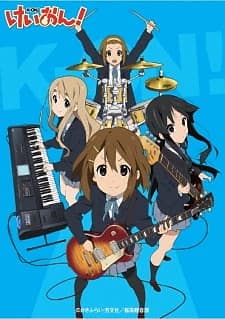
High school clubs about music. In K-On it's the light music club, and in Tari Tari it's choir. Both series also feature quite the quirky cast, although the main character lineup in K-On is significantly derpier and more geared toward "cute girls doing cute things," while the lineup in Tari Tari is more relatable to the viewer and is mixed, i.e. both guys and girls.
Both animes are about a group of highschool students trying to recruit enough people to create a club related to music, and go through performances
They are similar to each other because it's about club of music. XD that's all.
"Cute girls doing cute stuff" Both series have music and friendship as the main focus. Nice perfomances in both of them.
Although Tari Tari have 2 boys in the gang its story is centered in the girls. Wien and Taichi work sometimes as supportive characters like Sawa-chan and Nodoka. K-ON! story also differs from Tari Tari for being much more easygoing avoiding those tear-jerking moments.
Music clubs in school!! Also a very friendly atmosphere :D
Both have cute girls doing cute things with music. K-On! has a slower, slice-of-life pace while Tari Tari has a bit more of a plot going with it's music themes. Both are still pretty similar to one another and have the presence of singing in 'em.
Both are related to music
Both of the series' characters dedicated themselves to music from the beginning
Great soundtracks
Both animes feature a slice of life-style genre with the addition of music as a main feature: choir for Tari Tari and "Light-music" for K-ON!. They feature a distinct cast, too, each character having clear personalities. For example, Both Mio and Wien are somewhat clueless and childish, yet very passionate about their friends and interests.
|
Opening Theme"Dreamer" by AiRI
Ending Theme#1: "Shiokaze no Harmony (潮風のハーモニー)" by Shirahamazaka Koukou Gasshou-bu (白浜坂高校合唱部) (eps 1, 3-5, 7-12) #2: "Kokoro no Senritsu (心の旋律) (#02 ED ver.)" by Konatsu Miyamoto (Asami Seto) & Sawa Okita (Saori Hayami) (ep 2) #3: "Kokoro no Senritsu (心の旋律) (#06 ED ver.)" by Shirahamazaka Koukou Gasshou-bu (白浜坂高校合唱部) (ep 6) #4: "Shiokaze no Harmony (潮風のハーモニー) (#13 ED ver.)" by Shirahamazaka Koukou Gasshou-bu (白浜坂高校合唱部) (ep 13)
Fansubbing Groups
Which fansubbers do you like the best? Click + to approve of their subs for this show. Click - if you don't think they did such a great job.
Related ClubsTsundere is Not Annoying , Minako Kotobuki FC, ♫ The Music Genre ♫, P.A Works, Overrated or Underrated Animes and Mangas, Moe Moe Kyun Tea Cafe, The Girls of Tari Tari Appreciation Society, Mutirão Brasil - Ver. Summer Season 2012, Hayami Saori Fanclub, PA Works, All or Nothing - Fansub, ~*Insignificant classmates & background characters*~ (IS~BG), Tari Tari, Slice of Life Club
Recently Watched By|
37 minutes ago |
39 minutes ago |
2 hours ago |
2 hours ago |
3 hours ago | |
3 hours ago |
3 hours ago |
3 hours ago |
3 hours ago |
3 hours ago |
|
|