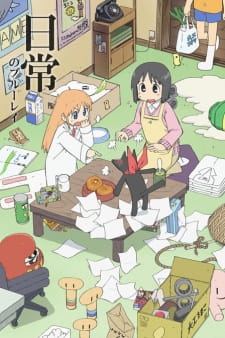
Alternative TitlesEnglish: My Ordinary Life Synonyms: Everyday Japanese: 日常
Information
Type: TV
Episodes: 26
Status: Finished Airing
Aired: Apr 3, 2011 to Sep 25, 2011
Duration:
23 min. per episode Rating:
PG-13 - Teens 13 or older
L represents licensing company
StatisticsScore: 8.431 (scored by 15751 users)
Ranked: #1182
Popularity: #332
Members: 33,759
Favorites: 1,058 1 indicates a weighted score
My Info
Popular Tags
No tags found |
SynopsisWhile the title suggests a story of simple, everyday school life, the contents are more the opposite. The setting is a strange school where you may see the principal wrestle a deer or a robot's arm hide a rollcake. However there are still normal stories, like making a card castle or taking a test you didn't study for. |
Related AnimeAdaptation: Nichijou, Helvetica Standard Prequel: Nichijou Episode 0 Side story: Nichijou: Tanken Nichijou no Machi
Characters & Voice Actors
Staff
|
Ishihara, Tatsuya
Director, Episode Director, Storyboard |
|
Tsuruoka, Yota
Sound Director |
|
Takemoto, Yasuhiro
Episode Director, Storyboard, Key Animation |
|
Yamada, Naoko
Episode Director, Storyboard, Key Animation |
Reviews
|
|
Ryhzuo
110 of 155 people found this review helpful
|
26 of 26 episodes seen
|
| Overall |
10 |
| Story |
|
| Animation |
|
| Character |
|
| Enjoyment |
  |
Conventional wisdom has always taught us that more is usually better. We think that the more expensive car should have more completely unrelated features, the better ice-cream sundae should have a bigger pile of fresh fruit on top, and the better statistics report should be able to pull more numbers out of it’s arse. We compare phones by the multitude of apps it can run, our enjoyment of horror films is based on how many different ways the various victims die, and we often rate anime by how many story arcs, characters, subplots and themes it can cram into it’s 26 episode season.
As the modern entertainment sector continues to emphasize excess and surplus, Nichijou is a much welcome, and frankly much needed throwback to a more old-school approach to entertainment. Nichijou’s frugal yet distinct style reminds us that something is perfect, not because there’s nothing more to add to it, but because there is nothing more to take away.
Nichijou brings to us a fusion of gag, moe, slice-of-life and slapstick comedy. It’s humor is very reminiscent of Azumanga Diaoh while it’s art style borrows heavily from the distinctly colorful palette of Lucky Star. Nichijou adopts a very light-hearted approach with it’s tone; it’s jokes are played fast and loose, and while there is a constant shift of pacing throughout each episode, Nichijou never seems to take itself very seriously.
Perhaps the most noteworthy thing about Nichijou is it’s production value. Frankly speaking, Nichijou is GORGEOUS to look at; it’s animation so incredibly fluid and it’s art so crisp and vivid that it actually puts other supposedly competent studios to shame. The artwork selects it’s palette very sparingly, with a result that is both vibrant yet easy on the eyes. This gentle tone is then frequently punctuated by segments of metaphorical (and in some cases literal) animation explosions, showcasing KyoAni’s talent with a huge variety of styles from gritty realism to crayon slapstick.
One can’t help but wonder if KyoAni isn’t deliberately showing off their workmanship with this anime. Many originally very short panels from the manga are translated into incredibly imaginative and stunning sequences of animation that simply scream “because we can.” Show off or not, Nichijou’s cinematography is nothing short of outstanding; it’s liberal interpretation of the original source material has really allowed the creativity of director Ishihara Tatsuya and the KyoAni animators to shine through like nothing we’ve ever seen before.
Special mention to Nichijou’s OP and ED songs, which are creative shorts (incredibly well sync’d I might mention) in their own right. As a fun fact, both of Nichijou’s OPs are sung by Hyadain, who is ONE guy. No female backing vocals at all, he does it all himself. Seriously I’m not joking, go look it up.
The aforementioned dynamic pacing forms the basis of Nichijou’s entertainment value. Each episode tackles it’s structure with a large degree of unpredictability. You never know what’s going to happen next, be it a humorous dialogue scene, a fast paced action sequence, an amusing random still image or a hilarious but completely unrelated skit. Despite this seemingly chaotic approach, Nichijou still manages to find a good balance between all it’s various styles so that no episode feels too weighted. While such a haphazard approach may seem counter-intuitive for a slice-of-life anime, this style ends up working greatly in Nichijou’s favor, adding another layer to it’s texture of absurdity.
The humor itself is very simplistic, almost to a fault, and one would normally attribute this as one of Nichijou’s flaws. That is of course until you remember that “Nichijou” translates to “My Ordinary Life” and as such, the simplicity of the jokes are a fitting homage to the show’s title and premise. Many of the jokes are simply exaggerated normal events like missing the train or a waiter forgetting your order, relying on witty dialogue delivery and clever timings to get the humor across. Some may consider this a hit-or-miss sort of comedy, which is only a fair judgement. All the same, you don’t necessarily have to laugh at jokes like these to appreciate them, which is one of the main reasons why slice-of-life can have such a widespread appeal (remember K-On?)
The characters are very likable, despite the obvious utilization of moe in many of their design. If you can shed that manly exterior and look past the few excessively “cute” scenes, there’s actually an abundance of things to enjoy about Nichijou’s characters. Conventional archetypes are few and far between in this anime, and all the characters harbor their own quirky habits and flaws that you’ll quickly grow fond of.
The best thing about Nichijou’s characters however, isn’t their individuality, but how they interact with each other. The personalities of various character groups clash, contrast and complement each other in extremely interesting ways; the conversations and activities of the two golden trios of Nichijou: Yuuko/Mio/Mai and Hakase/Nano/Sakamoto make up the abundance of material in each episode and just their hilarious adventures by themselves could probably carry an entire show. This is furthered by the great voice acting that the Nichijou provides; Nichijou is one of the rare shows where the seiyuus genuinely sound like they’re enjoying themselves. Dialogues are delivered with copious amounts of enthusiasm which really helps sell the spirited relationships that the various characters enjoy with each other.
With all that has been said though, I would like to come back to that idea I mentioned when we began, that idiom of “less is more.” The thing I love most about Nichijou, isn’t the amazing artwork, the clever cinematography, the light-hearted humor or even the imaginative characters. What I love most about Nichijou is the fact that, behind all the technicalities and production values, lies a very simple ideal. Everything about Nichijou revolves around this central principle of being enjoyable. All that it does, every scene, every character, every line of dialogue alludes back to this principle. Because at the end of the day, all Nichijou wants you to do is one thing; it wants you to enjoy yourself. With Nichijou, there is no story, no subplots, no recurring themes, no character development, no product placement, no lessons to be learnt, no obscure references to pander to a niche audience, no obvious fan-service pandering or ploys to sell related merchandise.
Fun is the only thing that matters, and it's this frugality, this ingenious simplicity, that allows everything to just click together like magic.
When you finally get home after a long tiring day, the only thing Nichijou wants to do is to give you an excuse to prop your feet up after and wash that blue feeling away as it slowly puts that grin back onto your face. read more
|
|
ToxxicTeardrop
53 of 82 people found this review helpful
|
26 of 26 episodes seen
|
| Overall |
9 |
| Story |
7 |
| Animation |
9 |
| Sound |
8 |
| Character |
9 |
| Enjoyment |
10 |
Nichijou is to me, one of a kind. It emphasizes what seems to be the essence of slapstick comedy, but induces your favorite lighthearted scenario all within the same episode. If you were keen of Lucky Star, Azumanga Daioh, Hidamari Sketch, or Pani Poni Dash, then you would definitely know what I'm talking about. Except, Nichijou, or "EveryDay", takes a twist and turn every now and then to let you know this is not so ordinary, and from there, you're on a wonderful ride to a pure fun and blownout comedy.
Story: 7/10
Not at any point, did I criticize Nichijou for its direction of plot, because first of all, I knew what I was getting myself into, whoever reads the synopsis, or look at the cover even, can obviously expect slice of life and nothing else. It baffles me that there are still idiots (trolls) out there who complain and complain about these shows as if they expected some sort of abysmal plot (I know I might be feeding them at this very moment lol). That's besides the point, Nichijou is episodic, and it's good at it too, that's that.
Art/Animation: 9/10
This. If it did not have this, such a high production value, the enjoyment to this show would be severely cut in half. From your principal wrestling a random wild deer, to chasing down your best friend to retrieve a notebook that contains indecent sketches of your crush you accidentally handed over, it is all done, with the utmost 'epic' of animations I have ever seen in a slice of life, and given that there's no plot, this is a strong and important point to my overall enjoyment.
Sound: 8/10
First thing that caught my attention, wow that opening song, I didn't have to watch it a second time to know that it would become something that will eventually be like a broken replay button stuck in my own head. It's cute, catchy, fun and it captures the feel of the show perfectly. Other than the brilliant OP's, the sound effects for small things, like pouring a cup of tea, or the clear brilliance of using almost every famous and hardcore VA to voice-over an assemble of no-faced soldiers who are just a figment of Yuuko's (The airhead of our show) stupidity. No complaints.
Characters: 9/10
This show is character driven, it is almost impossible to dislike any character, because he or she provides you with entertainment despite what they might be doing. This show is separated into segments for the most part, meaning within the episodes of this episodic show, its episodic within itself. You switch from the school life of Mio, Mai and Yuuko, 3 best friends who let us wander upon their lollygagging, all to just live in the moment. Then we go to the home of the Professor and her robot friend, who she created herself, and happens to be about 8 years old, where the light-hearted part of the show shines, if you can't "Awww" at least once to the Professors' charades then I think your moe button needs to be repaired immediately. There is an extreme variety of characters, so you will be entertained.
Enjoyment: 10/10
An honest score, to say the least. I truly am happy I stumbled upon this show because for one, I saw the entire thing with my girlfriend, and she loved it, and now the both of us are sad that it's over, and two, there just needs to be more animes out there like this. I know, I know! It's too much to ask for more than one brilliant anime a year but come on, be real, it's what we want!
Overall: 9/10
So If you want a good laugh, or more than a laugh.. If you want to "lmao", then yup, I recommend!
read more
Recommendations
|
|
Similar humour and episode layout/development. However, Azumanga has a stronger storyline than Nichijou, which is literally just clips from the character's obscure lives.
Flagship comedy of Japanese animation. These names are pretty-much Mr.Bean of anime world at its time. High-profile, funny, not plotless but whogivesashit, feature stereotypical moe girl of its era, and appeal to majority male anime audiences (a.k.a. freaky otaku.)
Both are random humored anime with slice of life involved.
Random is my name, chaos is my game.
Slice of Life and Randomness :D
If you enjoyed watching either one, I'm sure you'll enjoy the other one as well!
but Nichijou is a little bit more random though, but they almost have the same wavelength
Both of them revolve around the everyday life of several school girls and the weird happenings that they get into. They have similar humor, so I think you'd definitely like one if you liked the other. Nichijou is a little more weird and it has more characters, while Azumanga Daioh spends more time focusing on one group of characters.
Randomness... But nichijou is more just randomness and azumanga has a story... a bit.
Simillar art, except that Nichijou uses a more colorful art than Azumanga Daioh.
A lot of randomness here. Slice of Life randomness as well.
If you enjoyed Azumanga Daioh, you won't be disappointed with Nichijou.
Nichijou and Azumanga Daioh are both high school comedies that follow a segmented format (where each episode is divided into a number of "mini-episodes"). Both rely more on physical comedy and non-sequitur or absurdness than wit as the base of their humor. Neither of the two pay very dedicated attention to realism, with Nichijou in particular being quite surreal for certain segments.
A cast of female characters in a school setting. Both contain very little, if any, storyline, but rather focus on pure comedy. Nichijou is much more random in comparison, but both pull off jokes extremely well.
Both are amazing slice-of-life anime about....well.....nothing really. Though Azumanga is relaxed and Nichijou is hyperactive.
The cuteness and randomness make these two animes similar in style.
similar artwork and over to hilarious comedy XD
Both are extremly funny, randomness, the character staffs are really similar, main characters are girls, crazy teachers and moe :33
The same plot with the same sense of humor and funny characters.
I feel that Nichijou is the spiritual successor to Azumanga Daioh in that Nichijou is like Azumanga Daioh on crack. Some of the character designs are reminiscent of Azumanga Daioh, and it has a similar short-skit kind of feel to it, but Nichijou's art, cast of characters, and jokes are more fast-paced and crazy, showing how the genre has progressed over the 9 years difference between the two.
Both are about everyday life of a very likeable group of high school girls dealing with a bunch of pseudo-random and funny moments.
|
|
|
Two major qualities are fitted into both shows. First, they are the exemplary Japanese "high-tension" comedy, meaning characters in it got ADHD and turn the comedy into something fast-paced, fast-forward Mr.Bean video if you fail to understand. Second, both feature mild sex sale, the real identity of what they call moe.
The comedy part, both are considered fast-paced-high-tension comedy because you know why. They play jokes fast, get it fast, and move on to the next joke fast. Difficult to follow but considered funny if you have some mental rewind ability, or get yourself a remote and a easy-to-read fansub. If you feel a serious need to understand unserious joke, study Japanese.
Oh and the moe part, both are considered mild sex sale because Lucky Stars give character traits that are likable in its era, specifically this era. Boke(airhead), megane(glasses), tsundere(googleit), and otaku-girl stereotype are becoming more prominent as moe anime lead. Nichijou has got some different stereotype but should be considered equally likable. I interchangeably use the word moe and sex-sale in case you have not yet notice.
Both anime series revolve around the every day life in a comical way. They each have the "cute school girls" who do funny, yet common things we can relate to.
Also a funny slice of life comedy.
They're both funny and slice of life, the animation style seems similar, even some of the characters seem similar. If you liked one you should definitely like the other.
A lot of Randomness and Comedy.
Both shares the Slice of Life genre.
Lucky Star && Nichijou have similar style of random comedy regarding everyday life.
They both are slice of life and random, in a funny way. The characters are great and adorable. If you want comedy, i highly recommend both Lucky Star and Nichijou
-occasional references to pop-culture
-form: short scenes, sometimes, very short
-characters are mostly females
-child-looking characters
-lot of humor, sometimes irrational jokes
Both made by the same people. Both are moe high school girl slice-of-life comedies, where the main characters deal with everyday things: school, boys, food, family, friends... whatever. They are extremely similar in almost every way, except a few:
1. The main character archetypes are radically different.
2. The humor in Nichijou is more random, silly, and dumb. The humor in Lucky Star is more intelligent, and is almost entirely embedded in conversations.
3. The main characters in Lucky Star receive 99.9% of the focus, whereas the side characters in Nichijou get a good chunk of attention by themselves.
Both is about the daily of high school girls. Both are rich in comedy and are relaxing. Nichijou is a lot more random than Lucky Star and does not contain as much parodies as Lucky Star does.
Characters, artstyle are very similar to eachother, you might like Nichijou if you love Lucky star.
|
Opening Theme#1: "Hyadain no Kakakata☆Kataomoi - C" by Hyadain (Kenichi Maeyamada) (eps 1-6, 8-13) #2: "Hyadain no Joujou Yuujou (ヒャダインのじょーじょーゆーじょー)" by Hyadain (eps 14-16, 18-23, 25)
Ending Theme#01: "Zzz" by Sayaka Sasaki (eps 1, 3-5) #02: "Zzz (Bossa Nova version)" by Sayaka Sasaki (eps 2, 10-13) #03: "Zzz (Acapella version)" by Sayaka Sasaki (eps 7-9) #04: "Tsubasa wo Kudasai (翼をください)" by Sayaka Sasaki (ep 14) #05: "Kikyuu ni Notte Dokomademo (気球にのってどこまでも)" by Nano Shinonome, Hakase & Sakamoto-san (Shizuka Furuya, Hiromi Konno & Minoru Shiraishi) (ep 15) #06: "My Ballad (マイバラード)" by Sayaka Sasaki (ep 16) #07: "Kaijuu no Ballad (怪獣のバラード)" by Yuuko, Mio & Mai (Mariko Honda, Mai Aizawa & Misuzu Togashi) (ep 17) #08: "Green Green (グリーングリーン)" by Sayaka Sasaki (ep 18) #09: "Yasei no Uma (野生の馬)" by Takasaki-sensei, Sakurai-sensei, Nakamura-sensei, Makoto Sakurai, Yuria Sekiguchi, Haruna Annaka & Ogi (Tetsu Inada, Mami Kosuge, Kaoru Mizuhara, Takahiro Hikami, Ai Hirosaka, Kaori Sadohara, Ryouta Takeuchi) (ep 19) #10: "Ano Subarashii Ai o Mou Ichido (あの素晴らしい愛をもう一度)" by Sayaka Sasaki (ep 20) #11: "Sudachi no Uta (巣立ちの歌)" by Sasahara, Misato, Nakanojou, Weboshi & Fecchan (Yoshihisa Kawahara, Chika Horikawa, Kazutomi Yamamoto, Youko Tamaoki & Yumi Higuchi) (ep 21) #12: "Aogeba Toutoshi (仰げば尊し)" by Sayaka Sasaki (ep 22) #13: "Sora ga Konna ni Aoi to wa (空がこんなに青いとは)" by Hakase & Mai (Hiromi Konno & Misuzu Togashi) (ep 23) #14: "Yuuki Hitotsu wo Tomo ni Shite (勇気一つを友にして)" by Sayaka Sasaki (ep 24) #15: "Let's search for Tomorrow" by Yuuko, Mio & Mai (Mariko Honda, Mai Aizawa & Misuzu Togashi) (ep 25) #16: "Tabidachi no hi ni (旅立ちの日に)" by Yuuko, Mio, Mai, Nano, Hakase & Sakamoto-san (Mariko Honda, Mai Aizawa, Misuzu Togashi, Shizuka Furuya, Hiromi Konno & Minoru Shiraishi) (ep 26)
Fansubbing Groups
Which fansubbers do you like the best? Click + to approve of their subs for this show. Click - if you don't think they did such a great job.
Related ClubsNichijou FC, Shiroku✰Highschool, Daisuke Ono Fan Club!, Gundere, LOLICON DEFENSE ARMY, Manchester Anime Legion, The Fukuyama Jun Fanclub, Shinonome Nano Fanclub, Hakase Shinonome Fan Club, The Moe Brigade, Anime Power Rankings, えええええええええええええええええ!?, Nichijou, Бессюжетные девочки, Cute Girls Doing Cute Things, SeitoCast Anime Podcast, Go Kyoto Animation!, Stuff That Needs to Come out of Japan, ★☆hyadain☆★ヒャダイン★☆, Rikugou.orgIgo soccer club, Sakamoto Club see all
Recently Watched By|
24 minutes ago |
34 minutes ago |
35 minutes ago |
44 minutes ago |
51 minutes ago | |
53 minutes ago |
56 minutes ago |
1 hour ago |
1 hour ago |
2 hours ago |
|
|