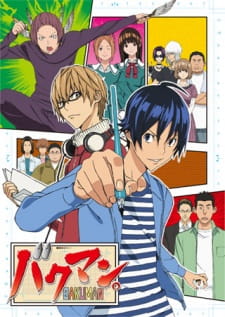
Alternative TitlesJapanese: バクマン。
Information
Type: TV
Episodes: 25
Status: Finished Airing
Aired: Oct 2, 2010 to Apr 2, 2011
Duration:
24 min. per episode Rating:
PG-13 - Teens 13 or older
L represents licensing company
StatisticsScore: 8.361 (scored by 46108 users)
Ranked: #1562
Popularity: #115
Members: 84,215
Favorites: 1,782 1 indicates a weighted score
My Info
Popular Tags
No tags found |
SynopsisMoritaka Mashiro and Akito Takagi are pretty much foils of each other. Mashiro, an average 9th grade student but talented artist, and Takagi, an overall advanced 9th grader and aspiring writer. After great convincing, Takagi convinces Mashiro to join him in becoming the greatest mangakas Japan has ever seen. Takagi, with his gift of writing, hopes to become a successful mangaka, and Mashiro, with his gift of art, hopes to marry the girl of his dreams, Azuki Miho.
(Source: ANN) |
Related AnimeAdaptation: Bakuman. Sequel: Bakuman. 2 Summary: Bakuman.: Deraman.
Characters & Voice Actors
Staff
Reviews
|
|
8thSin
90 of 147 people found this review helpful
|
25 of 25 episodes seen
|
| Overall |
10 |
| Story |
10 |
| Animation |
7 |
| Sound |
7 |
| Character |
9 |
| Enjoyment |
10 |
'Bakuman.'
The true meaning of the title was never revealed, but most speculators believe it's short for 'BAKUchi MANga.' (Gambling Manga). It is a simple tale of two middle school guys setting out to become professional manga artists. The story progresses like any other sports or music anime, where ordinary guys aim for the top, facing many challenges and rivals on the way. However, I consider this to be the greatest shounen/seishun (coming of age) genre anime I have ever encountered, because it analyzes what makes a manga good in a coherent way, and more importantly, it practices what it preaches.
This is a review by EIGHTHSin, and contains many spoilers. Read it at your own risk.
According to 'Bakuman.', there are SEVEN major steps to manga creation - Name, under-sketch, inking, filling, effects, screen tone, and whiteout. I'm no expert in manga drawing, but with this series being a manga about manga (which actually got serialized), I have no doubt this is correct. Of course, this anime alone is not nearly enough to teach you about how to draw manga, but it is quite enough to entertain a casual viewer like me. The show also emphasizes the difficulty of the process, that one cannot hope to succeed half-heartedly.
As the character mentioned in the first episode, "Manga is the Japanese cultural heritage popular across the globe."
This NHK series is extremely educational not only in introducing the process of manga creation, it also debates many other aspects of mang such as: how things work in a weekly manga publisher; the selection process; how artist stay serialized; the importance of target demographics; and argues how things ought to be in the industry. In addition, famous classic and current manga series and their authors are mentioned throughout this series without alteration of any sort, which functions as a masterpiece suggestion for new manga readers. It even directly quotes them, re-enacts DBZ "fusion", and uses quirks like Naruto's "-dattebayo". I take this to be a stamp of approval from those authors, and also to pressure themselves to create a masterpiece worthy of mentioning those names. The show uses real-life examples as case studies to explain its theories.
According to 'Bakuman.', there are SIX key elements to a successful shounen manga - A world that pulls the readers in, clear reason why protagonists are fighting, battles where it's easy to tell what's happening, equally or even more intriguing antagonist, a cute heroine, and some laughs or tears.
The first episode had an extremely strong pull - The tested and tried "average joe whose life changed by a trigger event", in this case, Takagi's request to be a partner. The turn of events leads to a promise of marriage upon realization of dreams, which serves as the clear reason why the protagonist wants to get his manga serialized, which is the first step to getting an anime series.
The story then goes on to show them making manga, meeting their 'opponents' in manga contests, and their manga are actually shown... even with a clear ranking measurements to determine a winner - easy to tell what's happening in the battle.
Then, there is Niizuma Eiji, the prodigy archrival of the protagonists, who is extremely intriguing, and happens to follow the "Introduce an enemy character, he's even stronger than protagonists, but turns out to be an ally" as mentioned during the 'CROW' production.
There's the cute heroine in Azuki, and the show has many comedy and tear-jerker moments to keep the audience interested throughout the series.
I find it interesting that the shows makes many observations that we probably don't consciously realize when casually reading manga, and even more interesting that if we pay close attention, almost EVERY observations of a successful manga made in this series are actually reflected in the series itself. In fact, it was also mentioned that most shounen protagonists wield swords, and if you think about it, the protagonists in this show brandish their pens in "battle".
The protagonists make FIVE manga series in the first anime series - 'The Two Earths', 'A Millionth of', 'The World Runs on Money and Wits', 'Angel Days', and 'Quasi-Detective TRAP'.
'The Two Earths' is their very first manga. It serves as introduction to the manga creation process.
'A Millionth of' shows the difficulty of getting a prize in manga contests, and introduction of various styles of manga.
'The World Runs on Money and Wits' functions as their confidence booster, as well as their gateway to future successes.
'Angel Days' is used to show the qualities of typical shounen manga, and the importance of choosing manga that fits each author style.
Finally, 'Quasi-Detective TRAP' is their success of the series, and its production process emphasizes the bond and friendship between the two main characters.
The story follows the standard shounen format with many seishun elements. The good guys work hard to realize their dreams while encountering one obstacle after another. After clearing each obstacle, they "level up" by becoming better artists and attain better understanding of themselves. Like all seishun sports or music anime, there are consistent themes of awkward youth love, challenges of being a student, and the importance of friendship.
The protagonists set FOUR years as their goal for their anime debut. This is the prime reason why Mashiro is always in such a rush to make manga, and frequently shows his impatience.
The main characters in this series are extremely human, and they act according to their own desires to make their dreams come true.
Takagi has the ambition of becoming rich and famous, and he gave up the "mainstream" path of elites (get good grades to get into a prestigious university) for his love of manga and became a true "gambler".
Azuki follows her dream of becoming a seiyuu and moves to Tokyo, while stubbornly limits interaction with Mashiro to motivate both herself and Mashiro.
Miyoshi truly acts on her desires, and can't help but reveal secrets of others and butting into their business.
Niizuma also acting on his desires, but in a different way, drawing what he pleases and doesn't care what others think about him.
Hattori sees promise in Ashirogi, and does everything, even some "dirty adult tricks" to make them succeed.
What I'm trying to get at, is that the characters are interesting, and they "move on their own" according to their desires. I have to say, they are *too* human at times, and causes their actions and motivations to detach from reality, but as a fantasy and dreams shounen series, this is totally acceptable.
According to 'Bakuman.', there are THREE requirements for a successful mangaka - Conceit (Confidence), Effort, and Luck.
One of the major themes in the series is to have "Confidence" in yourself to follow your dream.
To follow that dream, the protagonists put a lot of "Effort" into manga, sacrificing sleep, school, and even time for girls in order to become successful.
Further more, "Luck" is prevalent in this series. However, it remains realistic due to many setbacks they face, just as they would in the harsh reality. The protagonists consists of a relative of a mangaka and a guy who's getting the best grades in school yet interested in manga. Right off the bat, they have been dealt pocket aces as "gamblers". Still, they don't become an overnight success. It took a lot of sacrifices and effort, and after 5 manga series, they finally made it to an authentic weekly magazine.
This series isn't just a fairy tale. It successfully shows the difficulty of making a living with manga, and shows the harsh reality that only the most talented *and* hardworking succeed. They were dealt another lucky card in getting Hattori as the editor, who truly cares about the authors and preciously "raises" them as mangaka.
As a shounen manga, a convenient setting is actually preferred. The key is how realistic the story develops given the fantasy-filled premise.
I especially loved a subtle snippet of reality in Mashiro's family. Where the breadwinner and the eldest of the family call the shots in home, like when father and grandpa straight up shut off the mother in roundabout ways, with the "Decision-making process" in his home and "Please get me seconds (refill my bowl)" by grandpa. It's outdated and somewhat sexist, but the harsh reality in Japanese culture.
According to 'Bakuman.', there are TWO types of successful mangaka - "The Genius-Type", and "The Calculating-Type".
The anonymous author of this series is the same as that of 'Death Note' series, and it is also clear in this series that the storyteller is the "Calculating-Type" just like the protagonists. In other words, he "calculates the laughs and tears in a way that doesn't seem to be calculated, through calculation." Obviously, this is not going to work on everyone, so we will all have different opinion, but the story is extremely well-constructed, and the anime direction presented the plot in very interesting ways. It's easy to sympathize with the characters.
I believe the ONE single most important theme in 'Bakuman.' is the love for manga. Both protagonist and antagonists in this series really have passion for manga. It really shows how much love the author has for this series, and manga in general.
The series points out flaws in Shounen Jump ("Shounen Jack" in series), the only real-life title altered in the anime. The show communicates to producers in the real life through its characters.
For example, there shouldn't be any politics in manga selection, like rejecting student submission or favoring popular authors - "Anything interesting will be published."
The potential incompetence of editors, in their heavy reliance of survey to determine which series gets cut off - "Manga written for votes rather than true quality."
The need for manga to have a strong pull early due to selection process of using names of first three weeks and the threat of cancellation due to votes - "The lack of series that slowly draws the audience in, and consequently series being approved without long-term prospects."
Manga published in order of popularity - "Creates unfairness for new and aspring authors."
How audience like stereotypical stuff that stifles creativity - "All popular series have swords"
The young mangaka depicted in this series have hinted how they wanted to change Shounen Jack when they get popular. Perhaps the author of 'Bakuman.' wanted to do the same with this show as well.
'Bakuman.' is the "mainstream among mainstreams" in terms of shounen anime, but has the dreams, the inspiration, the depth, the entertainment value, and of course, the laughs and tears unmatched by any other. It also has the uniqueness in being a manga about manga and an anime about anime. In terms of contribution to the industry, this easily ranks among the most significant series to be aired in this century so far, and I have enjoyed every minute of it. read more
|
|
Sallymancan
38 of 74 people found this review helpful
|
25 of 25 episodes seen
|
| Overall |
8 |
| Story |
8 |
| Animation |
8 |
| Sound |
7 |
| Character |
8 |
| Enjoyment |
9 |
Anime Review #2 - Bakuman
Let me start by clarifying that this review is only for the anime series of Bakuman and although it may mention some references to the manga, I will try my best to focus on what is shown in the anime.
“Moritaka Mashiro and Akito Takagi are pretty much foils of each other. Mashiro, an average 9th grade student but talented artist, and Takagi, an overall advanced 9th grader and aspiring writer. After great convincing, Takagi convinces Mashiro to join him in becoming the greatest mangakas Japan has ever seen. Takagi, with his gift of writing, hopes to become a successful mangaka, and Mashiro, with his gift of art, hopes to marry the girl of his dreams, Azuki Miho.” – MAL/ANN
Story
The plot of the story focuses on Mashiro and Takagi working hard on manga to make their dreams come true. The genre of the story is a hybrid of slice of life with some romance with themes revolving around friendship, teamwork, dreams and competition which are mostly seen in shounen animes. Throughout the anime, the narrative concentrates on the duos road to serialization in Shounen Jack (Shounen Jump in the manga), starting with one-shot mangas and entering competitions to work their way up as an author with other mangakas attempting to block their path. Although the anime resembles other romance animes, the conventions are broken from the start when Mashiro and Azuki, the female protagonist, decide to get married after the team have an anime.
Each episode will make you want to watch the next.
Character
We have a range of characters, the main protagonists of the anime here are Moritaka Mashiro, a character who is determined to do well and spends a lot of his time trying to improve his art, he illustrates the art. He is the conventional character seen in most animes who is shy when he is around the girl he loves. Takagi Akito, is the central character who attracts Mashiro into becoming a mangaka. He is an intelligent character who gets the highest grades but because he has the passion for manga, he decides to perceive that as his career and writes the stories for the manga. We then have the two female character, Azuki Miho who has mutual feelings with Mashiro and wants to become a seiyuu (voice actress), she is a shy character but also has the determination to take on the obstacles blocking her from what she wants to do. There is also Miyoshi Kaya, Azuki’s best friend, who is a violent character and is sometimes displayed as stupid. She also becomes Takagi’s girlfriend with in the anime and motivates the two mangakas to advance in their work.
To provide a bit of movement in the theme of romance, there is also Kawaguchi Taro, Mashiro’s uncle who taught Mashiro everything about manga and has a similar story to Mashiro’s when the anime starts.
We also have the antagonists such as Niizuma Eiji, who is only a year older than the main protagonists but is considered a genius after becoming serialized at the age of 15, sparking a fire within Mashiro and Takagi, making them desperate to get serialized as soon as they can. There is also Fukuda, Aoki, Nakai and Koogy who compete with the duo and attempt to obtain serialization.
The last set of characters is the editors who provide constructive criticism and advise the mangakas on their work. For the duo there is Hattori, who becomes a character the team can trust and although he is a bit unsure whether the two should be serialized at a young age, he decides that they can pull it off. There is also Yujiro, Fukuda and Eiji’s editor who seems to be a rival to Hattori, possibly because Eiji and Ashirogi Muto (the 2 characters pen name) consider each other as rivals as well.
Art
The art is expected to be good as the mangaka for this manga is that of Death Note, which shocked me at first. The anime’s art shows a great amount of detail yet still maintaining that slice of life environment in the anime. Something which intrigued me the most, in terms of the art, was the displaying of the stories each mangaka made. By animating the storyline and having a narrator explaining the information in the manga, improved the anime.
Sound
Soundtrack resembling that of stuff like Honey and Clover, a very slow and mellow opening and the the first ending is similar to the opening, the second ending is a bit more heavier but still maintaining the romantic element of the anime, a bit like Toradora! Etc. There is narration when each one-shot or idea for a manga is displayed, explaining the story and dialogue in the manga. This anime isn’t really the type where you have to follow the dialogue completely like Gungrave or Death Note but still it helps understand the story, so I suggest you watch the anime properly without having to skip bits.
Enjoyment
There is probably a lot more I can say about this anime in this review but then everyone would be bored of reading this, if you aren’t already. I really enjoyed the anime and can’t wait for it’s sequel which has already been announced. I do recommend it, but I also recommend the audience reading the manga as it’s pretty awesome. In whatever order is upto you.
Enjoy! read more
Recommendations
|
|
Both of them are about people setting goals and trying to achieve them. They are great and make me feel warm and fuzzy inside. You will find nothing like this on american tv.
Two stories about the dream of two boys and a path to achieve it. A great humor and the atmosphere. Nice characters.
People trying to archive their dreams, making you feel what they feel and cross your fingers for them.
THIS is the absolute same kind of anime. Except Bakuman has a slightly more shounen feel to it, while Uchuu is a bit more inclined to drama. BUT they both have two very close man male characters who try to achieve their childhood dreams. They both have this empowering nd motivational feel to it and have a lot of funny and hilarious moments that bring you closer to the characters. Both deal with main characters competing with other characters for being the best in what they do.
somehow I found these two anime similar.. though the themes are totally different (manga-space). however, if you like this series then you MUST watch Bakuman (whether if you liked Uchuu Kyoudai or not, I would still highly recommend Bakuman for you) They have similar style of comedy and most importantly they tell stories about people who work really hard in order to achieve their dreams.
|
|
|
From the same creators as Death Note, Bakuman will certainly not dissapoint you. There are some small similarities in the story, as it's all about reaching your goals, and there is also a lot of rivalry between the characters. If you have an interest in maybe slightly autistic characters (as far as I know it was never really confirmed), Eiji Nizuma from Bakuman makes me think of L from Death Note.
Same authors, and the one of main characters is similar to one main character of Death Note in terms of appearance, intelligence and determination. Both have interesting stories - both have a goal they want to achieve. Death note is a thriller, Bakuman has a story closer to reality.
Both are from the same authors. Both main characters have a similar way of thinking, and determination. Both have little action but great plot. The atmosphere is different since Death Note is more dark and concentrates on mystery, and Bakuman is more light and kinda concentrates in slice of life.
Both are based on original works by Tsugumi Ohba and Takeshi Obata.
If you've seen either one of them, and not the other, then this other is a must. They're absolutely different: from plot to soundtrack. The one thing they have in common is the fact that this two series are animations of the two and only colaborations (this far) by authors Tsugumi Ohba and Takeshi Obata. They're both quite good and unique in their own way. In 'Bakuman', you're pulled into the very essence of anime: its original form, manga. On the other side, 'Death Note' has an incredible element of suspense that will draw you into the next chapter without the will to stop.
|
Opening Theme#1: "Blue Bird" by Kobukuro (eps 1-24) #2: "Genjitsu to iu Na no Kaibutsu to Tatakau Mono Tachi (現実という名の怪物と戦う者たち)" by Yuu Takahashi (高橋優) (ep 25)
Ending Theme#1: "BAKUROCK ~Mirai no Rinkakusen~ (BAKUROCK 〜未来の輪郭線〜)" by YA-KYIM (eps 1-13) #2: "Genjitsu to iu Na no Kaibutsu to Tatakau Mono Tachi (現実という名の怪物と戦う者たち)" by Yuu Takahashi (高橋優) (eps 14-24) #3: "Blue Bird" by Kobukuro (ep 25)
Fansubbing Groups
Which fansubbers do you like the best? Click + to approve of their subs for this show. Click - if you don't think they did such a great job.
Related ClubsBakuman FanClub and Reviews, Recommendation Club, Fans of anything, Tsugumi Ohba FC, Anime and Manga Ideas, Genre of the Arts Fanclub!, Okamoto Nobuhiko FC, Obata Takeshi FC, Akito Takagi Fanclub, Kickapoo Fansub, The Fukuyama Jun Fanclub, The Games Creation Club, Official Mashiro Moritaka Fanclub, N.S Headquarters, , Manga Suyu, Anime Land, Romance High, ღ Paramour Paradise ღ, ♥ Coffee Lovers Unite! ♥J.C. Staff, Watch Anime Together Club Headquarters, Scrumdiddlyumptious Food in Anime, Character Manager, ★ Лучший аниме проект в сети - AniMedia.TV ★, Eiji Niizuma FC, SunLink@AnimeManga, Saori Hayami's Fan Club, Hayami Saori Fanclub, World of Animes (W.O.A.), Hiramaru FC - 平丸 一也, Sayuri Yahagi Fanclub, VOMIC (MAY SOM CARDS R UP 4 GRABS!!!), English Dub Fanclub, Royal Goo Fansub, Anime Songs , N.S Headquarters, L'Arc~en~Ciel - "...The Twenity Universe", ~*Insignificant classmates & background characters*~ (IS~BG), Satoshi Hino Fans, Shinta Fukuda FC, The Best Anime PL, Realistic Anime, N.S. headquaters, Manga Anime League (MAL), Miho Azuki Fan Club, Lyos Anime, Love Cards, N.S Headquarters, Romance+, Polski FC Bakuman'a, Anime Experience, !~~tsubasalover's Friendships~~!, Takagi, Akito (Shujin) FC, The White Waters, Shinta Fukuda Fanclub, Anime Pairings Cards Club :3, ★Pictorial Culture Miscellany★, Bakuman Fan Club, Anime and Manga Romance Club, Suwabe Junichi Fan Club, Anime Otaku Corner, Dark Legends fan club!, Random Anime Cards Emporium (R.A.C.E.), Mashiro and Azuki Fanclub, Purple and Blue Haired Characters see all
Recently Watched By|
7 minutes ago |
9 minutes ago |
11 minutes ago |
11 minutes ago |
21 minutes ago | |
32 minutes ago |
42 minutes ago |
57 minutes ago |
58 minutes ago |
1 hour ago |
|
|