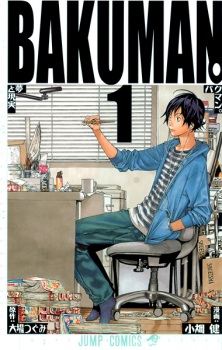
Alternative TitlesEnglish: Bakuman Japanese: バクマン
Information
Type: Manga
Volumes: 20
Chapters: 176
Status: Finished
Published: Aug 8, 2008 to Apr 23, 2012
StatisticsScore: 8.551 (scored by 17912 users)

Ranked: #1072
Popularity: #11
Members: 30,588
Favorites: 3,961 1 indicates a weighted score
My Info
Popular Tags
comedy shounen slice of life |
SynopsisBakuman follows the story of high school student Moritaka Mashiro, a talented artist who does not know what he wants to do with his future. One day, Mashiro draws a picture of Miho Azuki, a girl he is secretly fond of, during class but forgets the notebook at school. He comes back to find that his classmate Akito Takagi is waiting for him with his notebook. Takagi tries to convince Mashiro to become a mangaka, a manga artist, with him, leading to Mashiro's disagreement. Mashiro goes home and thinks about his mangaka uncle, who had only one successful series before he died in obscurity. Mashiro is interrupted by a phone call from Takagi, who says that he is going to tell Azuki that Mashiro likes her. Mashiro runs down to Azuki's house to find Takagi waiting for him. Once Azuki comes out to meet them, Takagi tells her that he and Mashiro are aiming to be mangaka. Mashiro then learns that she wants to be a seiyuu, a voice actor, and has shown promise in the field. Mashiro, once again thinking about his uncle, accidentally proposes to Azuki who accepts. However, she will only marry him after they achieve their dreams. In addition, they cannot see each other until then.
(Source: Wikipedia) |
Related MangaSpin-off: Otter 11 Adaptation: Bakuman, Bakuman 2, Bakuman 3
Reviews
|
|
Yammin
170 of 204 people found this review helpful
|
176 of 176 chapters read
|
| Overall |
8 |
| Story |
8 |
| Art |
10 |
| Character |
9 |
| Enjoyment |
10 |
Shounen Jump. When we think of the famous boy’s manga company, titles such as “Bleach”, “Naruto” and “Gintama” usually comes to mind. Most of which are of the ‘battle’ genre. Bakuman is no different; but instead of picking up their swords to rush off to battle, Akito Takagi and Moritaka Mashiro are picking up their pens to rush for their deadlines. A story of making your dreams come true, fighting for the one you love and overcoming the many obstacles that stand in your way – all of which that can adhere to your typical shounen title. Only that it is not your typical shounen manga.
Death Note duo Takeshi Obata (art) and Tsugumi Ohba (story) collaborate once again to present to us yet unique addition to the manga world: the journey of two upcoming mangakas exploding their way into Shounen Jump; their aim to become the biggest mangakas in their company. The idea itself is quite simple, but it is one that can stretch very far, with many twists, turns, events and new facts learnt along the way. It is obvious that the story is influenced by Obata’s and Ohba’s own past experiences, making the manga all the more amusing to read as you feel as though you’re reading an exaggerated version of their autobiography.
If anything, Bakuman shows off the level of Ohba’s skill. Even people who disliked Death Note could enjoy this because of the complete 180 turn he (or she) has taken since his (or her) previous work. Bakuman is anything but dark and thought provoking, but Ohba still manages to create a catalysed chemical reaction within Bakuman’s world – a near perfect balance between comedy, romance, drama and that subtly blended in slice-of-life quality (which is so rare in Shounen Jump works).
But ‘near perfect’ is not ‘perfect’. The twists and turns that are presented are a little weak in comparison with Death Note (although I would like to make it clear that Bakuman should be considered as a SEPERATE work). For example, the most major turn-of-events you are most likely to get is simple, like the revelation of the reader’s poll results or the introduction of another mangaka. Such twists are to be expected in such a manga though, as there isn’t much to expand on the ‘exciting’ lives of authors and editors. The twists and cliff-hangers, simple as they may be, are effective and exciting nevertheless and to be honest, are much better than the cliff-hangers of other shounen titles (such as Naruto).
Another (minor) nitpick I have with the story is the ‘everlasting’ romance between Azuki and Mashiro. I am not particularly fond of the “love at first sight” cliché, but what further aggravates me is the strength of their love despite there being almost no basis for it. Then again, I guess most teen love is like that. Despite their arbitrary romance it does become one of the highlights of Bakuman, providing some of the sweetest parts and funniest moments.
Being a story about making manga in one of the most successful franchise, Shounen Jump/Shuiesa, it is no surprise that you would learn volumes about the industry, and the process of making manga. Each and every little trivia learnt has become one of the many delights of reading Bakuman; especially because of the depth it goes into and relevance it has to the entire story. Bakuman has very heavy dialogues; it is not like the other battle manga where most of the chapters are full of action.
The setting is anything but claustrophobic, as some would think it to be. It differs all the time, from their studio to even the zoo and sometimes to all over town when trying to trail a person (yes, I’m serious here). One time Mashiro simply enjoy a Christmas party round his friends’ house. This all adds to the slice-of-life aspect to the manga which I have enjoyed tremendously.
The colourful cast of Bakuman has a very wide range in terms of age, personality, shapes and sizes. One of my favourite things about the characters and story is that it does not solely focus on Takagi and Mashiro’s quest to become the best but shifts its focus onto other editors and authors stories and involvement throughout each chapter. These fluid transitions of focus are matched by Ohba’s skill of juggling all the character’s personalities and making it well balanced.
Again however, women seem to be the victim of misogyny by Ohba. Most of the women portrayed in Bakuman are either stupid or stuck up, with the exception of Azuki who lacks so much personality she is basically just a pretty face. As of late however the cynicism to women does lighten, you could call it character development, especially with girls such as the female mangaka Aoki realising her faults and struggling to change.
Although the cast is fun to read about and likeable, you can see how some of the characters are ‘copy and pasted’ from Death Note: we have the quirky antagonist where the line between friendship and rival is often blurred; the stuck-up and prideful female classmate and bouncy love-struck girl for Takagi. Even Mashiro, the primary lead is lost in the quirk-filled and humorous cast. Nevertheless, the fact that the cast is as wide as it is compensates for this; it almost feels like it’s a hustle and bustle – just like how mangakas and editors lives are.
In addition, Bakuman’s ‘slice of life’ aspect is played mainly through the characters own growth and development. Interestingly enough, Bakuman starts off with two 14 year-old boys but as of recent chapters follows two 20 year-old college students. Yes, they grow! Not just in height but as people too as they take on other challenges in life such as marriage. They literally grow before your eyes.
Ohba’s charismatic story and characters are equally matched (once again) by Takeshi Obata’s excellent art. His style in Bakuman has changed since Death Note to better suit the lighter, more shounen tone of the story, but it still retains that high level of detail and clean cut edge in his drawings. Obata does exhibit a weak point when it comes to drawing female characters though. But his weakness is another artist’s forte; even though I have just classed it as a weakness it is still so good, that it can exceed another manga artist on their best day.
I was also surprised at how well Obata can employ comic drawings as well as serious ones. His silly gag drawing actually evoked some hearty laughs from me (of course it was Ohba who wrote them up – who knew both of them could be so funny?). Close ups and tones are all very well used to create an atmosphere or effect of the moment – be it funny or serious. Or seriously funny. Or a serious funny. Okay, okay, I’ll stop.
Obata’s style at panelling makes each chapter a joy to read. He does not allow each panel to restrict his drawings, which is a personal favourite aspect of his panelling of mine; how the drawings themselves come out of the box and extends further. Of course, this technique would have been meaningless without Obata’s fluent artistic skills.
I think the main problem with Bakuman is its reader’s expectations. Unfortunately, it is overshadowed and constantly compared to by its predecessor, Death Note. But Bakuman is just as entertaining and unique as its authors’ previous work and is just as wonderful a read in its own right. As a reader of both works it is quite obvious that there are some influences, the most notable ones lay in the characters; however there is one definite similarity between the two: they are no ordinary shounen. Yes, Bakuman may have the formula for one (Childhood love? Check; Rivals? Check; Quirky characters? Check; Hot girls? Check) but it still displays a lot of characteristics not found in Shounen Jump’s works: Growing up, multiple character storylines, excellent character interaction and life in general. Most importantly, the arcs are never dragged out! (Here’s looking at you Bleach).
If you do read Bakuman, read with an open mind and forget about Death Note, for it is not every day we get a work like Bakuman and for it to be ridiculed or downplayed because of its origins would be a sad waste of an excellent work like this. For its genre it is probably the best out there with charm and charisma practically oozing out of the pages.
Every week Mashiro and Takagi are closer to realizing their dream, and every week we are there with them in their exciting journey. We explore the world of mangakas, editors and voice actors alike and to all that are close to them. So as they grab their pens to rush for that deadline I shall be rushing to the store to grab my copy of this week’s Shounen Jump. read more
|
|
Splitter
19 of 25 people found this review helpful
|
176 of 176 chapters read
|
| Overall |
9 |
| Story |
9 |
| Art |
10 |
| Character |
8 |
| Enjoyment |
10 |
Anyone who has ever written a novel, drawn a picture, made a movie will tell you the creative process is fraught with blood, sweat and tears. It requires courage to put your name out there, trusted friends who will give you honest critique and advice, and a relentless dream to see your vision through. Courage, friendship and dreams... so why did it take so long for someone to realize the creative process could easily be turned into a manga for Shounen Jump? No worries, because now we have Bakuman, a manga about writing manga that fits the ticket in spades
Following the story of Moritaka "Saikou" Mashiro and Akito "Shujin" Takagi, two boys who meet in middle school and strive to become successful mangaka in the world under the pen name "Ashirogi Muto", they strive against insurmountable odds to make their dreams come true, and in Mashiro's case, make a manga so good it becomes an anime so the girl of his dreams Miho Azuki can voice the heroine, and then marry her. There's nothing complex or challenging about it. The story, at its heart, is pure straightforward Jump ideology, rewarding perseverance and guts tenfold, but its the subtext behind Bakuman that really bring the story to its full potential.
Aside from its main goal-driven narrative of Ashirogi Muto becoming the best mangaka in Japan and Mashiro marrying Azuki. Bakuman is an unflinching critique of the manga industry that gives readers some serious glimpses into the pros and cons of publishing manga. Clashing with editors, dealing with copycat authors, the hectic schedules of weekly publishing, how much control the publisher has over how long you have to keep writing the same manga, and those ever important RANKINGS all get exposed. The point-of-view is generally positive, but still eye-opening for most casual fans of the medium. And even outside all that, many of the in-story manga, especially Classroom of Truth, have incredible and intriguing plots that beg to be turned into manga here in real life.
However, it is a Jump manga, so there is quite a bit of misogyny, especially early on. Female characters aren't portrayed strongly until well into the manga, and Miho especially comes off as a very sexist MacGuffin at the beginning. The series works hard in the back end of things to round out the female characters and give them ample time to shine, but it feels more like author Tsugumi Ohba gives them that growth half-heartedly. The male characters are given a far more vast range of characterization traits and personalities, many of which are memorable, especially bizarro genius Eiji and pessimistic slacker Hiramaru.
Forgiving the story for its misogynistic leanings though is incredibly easy when you get down to artist Takeshi Obata's share of the work. It starts off detailed as can be, but gets much simpler by the final chapters, but even that can be forgiven when one takes into account the multiple and numerous art shifts he single-handedly performs over the course of the series. We see no less than ten, if not closer to twenty different Jump manga from all different artists portrayed with varying art styles. It is astounding to see one man create multiple unique art styles for his characters, and most importantly, sell us on the authenticity. Reading Bakuman is worth it for that alone.
Don't get me wrong. This manga isn't without its weaknesses, but its strengths far outweigh them. With a decent straightforward main story, many ingenious in-story manga, characters that all grow in their own ways, and the underlying critique of the workings of the manga industry, Bakuman is a can't-miss manga for anyone who loves the medium.
Overall, I give Bakuman a 9/10. read more
|
|
Similar stories, students wanting to be the best at something (Go for Hikaru no Go and Manga for Bakuman). They have rivals that are better than them, though the main characters practice a lot to reach their dream. Even though the stories are about Go and Manga, there is a lot of character drama in each.
Takeshi Obata does the illustrations for both manga series.
Both Hikaru no Go and Bakuman are series about following your dreams and becoming a professional at an unconventional career. Both series feature the protagonists trying to live up to and become better than a prodigy in their field and are pretty motivational stories about chasing after your dreams.
Not only that, but both feature art by Obata, which is always a plus.
Well, besides both being designed by Takeshi Obata-sama (Obata Takeshi-sama XD), both talk about kids who have a goal following a dream in Hikaru no Go, the main character, Hikaru Shindou ends up becoming interested in Go, after meeting Fujiwara no Sai, the spirit of a great Go player. On Bakuman, Moritaka Mashiro and Takagi Akito go to great lengths to make a success of their manga, and, Mashiro is driven to his promise to the young Azuki Miho, that when it is voice actor and manga Mashiro and Takagi win anime (and Azuki dub the protagonist xD), they marry.
In Hikaru no Go, Hikaru must confront their "rivals" in the world of Go, as well as Mashiro and Takagi compete with the other mangaka's. XD
Both have rival characters that are ahead of the main character in their respective fields. The Go battle somewhat is similar to the weekly rank battle.
Piece of life kind of manga. They both tell us about a journey to become the best and how they suffer through the road.
Great art by same manga artist, Takeshi Obata who is also the managa artist who made death note.
Stories about chasing dreams. Both main characters are very passionate and determined about their dreams (Mashiro being manga artist, Hikaru becoming pro Go player). Both Hikaru and Mashiro efforts fueled by their wish to surpass their rivals (Nizuma and Toya) and both have partner who always support them (Takagi and Sai). Hikaru no Go have more serious atmosphere, Bakuman is more comedic. If you like Bakuman, you will probably like Hikaru no Go too.
|
|
|
Same authors: Obata, Takeshi (Art), Ohba, Tsugumi (Story).
Both are good.
Both manga and both authors ;)
Same Author and Same Artist, both are shounen manga
Both have very similar designs
Both are by the same author
|
Related Clubs#*~The Blue Haired Anime Characters Club ~*#, *~Expressing YOUr Self~*, *~MomoHime125's House of Goodness~*, Akito Takagi Fanclub, Anime & Manga Recommendation, Anime and Manga Ideas, ANIME Artists Club, Anti-Miyoshi Alliance, Argentina, Atarashi Otaku, autism club, Bakuman Club, Bakuman Fan Club, Bakuman FC, Brasil Discussões, Eiji Niizuma FC, Entertainment Industry Genre, Genre of the Arts Fanclub!, Hiramaru FC - 平丸 一也, Honya Fancuru! <3, How to Read Manga!, HURRAY BOOBIES!!, IZUMI64's World ~俺様の世界~, Katsuri Fanclub, Legendary - Anime & Manga !, MAL anonymous, Manga > Anime, Manga Experience, Manga Fans of the World, Manga Marketplace, Manga Masterpieces Club, Manga-hasa, Manga-ka Unite!!, Mangabreaker, Mashiro and Azuki Fanclub, Miho Azuki Fan Club, My favorites, Neo Elite, Nice Shades ~ The Sunglasses Fanclub, Obata Takeshi FC, Official Mashiro Moritaka Fanclub, Polski FC Bakuman'a, Purple and Blue Haired Characters, Recommendation Club, RENAGADE Animators, russian shounenfags!, Shinta Fukuda Fanclub, Shinta Fukuda FC, Shonen Beam, Sugoi Desu, Takagi, Akito (Shujin) FC, the best of anime , The Fukuyama Jun Fanclub, The Games Creation Club, Tsugumi Ohba FC, Untitled Club, Yon Toko Otaku
|
9 minutes ago |
31 minutes ago |
50 minutes ago |
51 minutes ago |
1 hour ago | |
1 hour ago |
2 hours ago |
3 hours ago |
5 hours ago |
5 hours ago |
|
External LinksMangaUpdates, Wikipedia
|
|