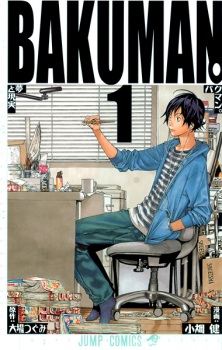
Alternative TitlesEnglish: Bakuman。 Japanese: バクマン。
Information
Type: Manga
Volumes: 20
Chapters: 176
Status: Finished
Published: Aug 8, 2008 to Apr 23, 2012
StatisticsScore: 8.551 (scored by 23980 users)
Ranked: #1042
Popularity: #10
Members: 40,169
Favorites: 4,981 1 indicates a weighted score
My Info
Popular Tags
comedy shounen slice of life |
Similar Recommendations Submitted by Users
|
|
Similar stories, students wanting to be the best at something (Go for Hikaru no Go and Manga for Bakuman). They have rivals that are better than them, though the main characters practice a lot to reach their dream. Even though the stories are about Go and Manga, there is a lot of character drama in each.
Takeshi Obata does the illustrations for both manga series.
Both Hikaru no Go and Bakuman are series about following your dreams and becoming a professional at an unconventional career. Both series feature the protagonists trying to live up to and become better than a prodigy in their field and are pretty motivational stories about chasing after your dreams.
Not only that, but both feature art by Obata, which is always a plus.
Well, besides both being designed by Takeshi Obata-sama (Obata Takeshi-sama XD), both talk about kids who have a goal following a dream in Hikaru no Go, the main character, Hikaru Shindou ends up becoming interested in Go, after meeting Fujiwara no Sai, the spirit of a great Go player. On Bakuman, Moritaka Mashiro and Takagi Akito go to great lengths to make a success of their manga, and, Mashiro is driven to his promise to the young Azuki Miho, that when it is voice actor and manga Mashiro and Takagi win anime (and Azuki dub the protagonist xD), they marry.
In Hikaru no Go, Hikaru must confront their "rivals" in the world of Go, as well as Mashiro and Takagi compete with the other mangaka's. XD
Both have rival characters that are ahead of the main character in their respective fields. The Go battle somewhat is similar to the weekly rank battle.
Piece of life kind of manga. They both tell us about a journey to become the best and how they suffer through the road.
Great art by same manga artist, Takeshi Obata who is also the managa artist who made death note.
Stories about chasing dreams. Both main characters are very passionate and determined about their dreams (Mashiro being manga artist, Hikaru becoming pro Go player). Both Hikaru and Mashiro efforts fueled by their wish to surpass their rivals (Nizuma and Toya) and both have partner who always support them (Takagi and Sai). Hikaru no Go have more serious atmosphere, Bakuman is more comedic. If you like Bakuman, you will probably like Hikaru no Go too.
|
|
|
Koimoku is Bakuman with less detail on the manga creation process and more boobs. In spite of being an aggressive loser, the lead quickly finds himself with a harem as busty manga editors battle it out for his talents and inspire him by getting naked/letting him touch their boobies.
My favourite aspect of Koimoku is how a career woman walks around with her tits exposed, acts like a ditz and offers the lead ANYTHING he desires for the puposes of inspiration. The hooker the lead uses for first impressions of his work is realistic, also.
Both feature aspiring Mangaka.
Stories about how to succeed in the manga industry
Koimoku is like Bakuman but with less information about how manga are made and the main character of Koimoku works alone rather than in a group.
|
|
|
Same authors: Obata, Takeshi (Art), Ohba, Tsugumi (Story).
Both are good.
Both manga and both authors ;)
Same Author and Same Artist, both are shounen manga
Both have very similar designs
Both are by the same author
Death Note has ryuuk, Bakuman has Mr. Hattori (I lol'd first time he enter the fray).
|
|
|
Both series are about characters that aim to be successful in their respective careers.
You learn about the hardship and problems they go through. Light comedy and romance.
Definitely something you should pick up.
Both are coming of age/rags to riches stories.
The main characters strive to make a dream become reality against the odds. Through the way they fail some times and have internal disagreements between them and even risk breaking up as a group/pair. And both main characters start out living a normal, empty, regular life until something gives them the motivation to move forward.
|
|
|
Both series have a similiar premise, an unlikely duo collaborate to start a manga..And they encounter obstacles in their love lifes, and in their way to becoming mangakas.
G Senjou Heaven's Door is also on the subject of aspiring mangaka, but is a lot more mature, and has a lot more deepness in its storyline.
Neither manga are only speaking about writing manga but, whereas Baku-man bores us with crappy loves stories, G Senjou Heaven's Door brings us excitement by talking about familial problems of the protagonists
|
|
|
Not much resemblance, except for the fact that both main characters want to become mangaka. Bakuman is shounen while Kyou mo Ashita mo. is shoujo. They are both good stories though which talk about manga a good amount (what pen to use, what paper, how lines are supposed to be drawn) both somewhat romantic . . . I guess.
|
|
|
They're both about writing manga. :)
|
|
|
Kibengakuha doesn't have anything in common with Bakuman, but it's pretty similar to Detective Trap and PCP. On Kibengakuha mysteries and crimes are solved using horror stories to frighten the criminal and make him confess while on Detective Trap the detective make traps to catch the criminal. On Kibengakuha the horror stories are spread around the school while on PCP they make small "crimes", both of them trying to be anonymous.
|
|
|
Although Bakuman is far superior in both story and enjoyment, Hadaka no Taiyou shares the same story of two main characters aiming to become manga artists.
1. Both has the same mix of comedy, dreams, romance, school, slice of life and shounen.
2. Both has two main characters aiming to become manga artists (in Hadaka no Taiyou, one is a female, while Bakuman both of the main characters are male).
|
|
|
both story is about mangaka..
the main chara want to be a great mangaka..
|
|
|
Although "Bakuman" is a manga about making manga and "Balance Days" is a one-shot about swimming, both main characters strive to improve their skills and talent. Both have similar artwork, as well.
|
|
|
Both manga involves an innocent love story that you don't want to miss. Both story have a very shy protagonist. In Kimi ni Todoke, Sawako (better known to the school as Sadako, because she looks just like her) is easly misunderstood, but she is a kindhearted person that helps in class duties and now she face her life in experiencing her first love. In Bakuman, Mashiro is a talented artist that team up with Takagi to become a mangaka. He confessed to his long time crush Miho that is aiming to be a voice actor, she accepts however, she will only marry him after they achieve their dreams. In addition, they cannot see each other until then.
|
|
|
Well the basic genres and stuff are entirely different but Skip Beat and Bakuman have this one thing in common -
A world within a world!
In Bakuman, its about creating worlds, characters and stories in manga
In Skip Beat, its about the different characters portrayed by a single one(Kyoko)
Skip beat has more depth to this theme but Kyoko lacks significant rivals..
Both are recommended!
|
|
|
Both have to do with a voice actress and they have that feeling of effort towards your dreams, as well as a sense of impotence against those with natural born talent.
|
|
|
A love story between a girl with a dream related to arts (seiyuu and interpreter) who works hard for that dream and a boy who don't know what to do with his life. At the end he choose to follow the path of the thing he likes the most, that is related to manga industry (mangaka and editor). In Koganeiro even Bakuman is mentioned.
|
|
|
Both mangas about the main characters who are a mangaka. Manga no Tsurikata is a shoujo-ai though, unlike Bakuman.
|
|
|
both these series deal with the issue of long term, long distance relationships from the guys perspective. If you enjoyed I's there are plenty of parallels with bakuman's romance element.
|
|
|
Both are shounens, comedies, school, rom-com, and a guy who is drawing manga in order to get the girl they like. But School Rumble (as the title states) is more based on school life while Bakuman is more about manga.
|
|
|
Both explore the lives of characters who want to publish manga. Whereas Moritaka and Akito want to become successful mangaka in Shonen Jump, Najimi instead tries to make it as a doujin artist. Though both have different styles (Doujin Work done in 4koma, while Bakuman in the more traditional style) and Doujin Work is way more lighthearted than Bakuman, both are enjoyable reads.
|
|
|
Both revolve around work life for a group of characters working together in similar industries. In Bakuman it is the manga industry, whereas in Kamiigusa Animators it is the animation industry. Both also share comedy and romance contexts; though Bakuman has much more dramatic elements.
|
|
|
Both manga revolve around two boys who met by a chance and changed each others' lives greatly. They become partners because they are the strongest when they are together, one soul in two bodies.
Even though stories are different (Bakuman deals with mangaka, but HQ!! is sports themed) concept is very similar: having a goal, trying to achieve it, meeting new friends and rivals, struggling and trust.
And also both manga have similar art styles and humor, both of these titles are (were) serialized in Weekly Jump.
|
|
|
Manga about mangakas.
But, Billy Bat has a darker plot than Bakuman, and it's not about how the mangaka is going to be serialized.
|
|
|
Both titles are about mangaka, but Mangaka-san to Assistant-san is more of a comedy.
|
|
|
Both are about a guy not really into the fan culture making manga.
|
|
|
Bakuman is about manga, Bambino is about cooking. In both series the main characters strive to be the best they possibly can.
|
|
|
Although not related in premise, both series are rooted in romances being resolved/re-established in unorthodox ways.
Manga artist for Bakuman and kinky sex for Hen Koi.
While normally this comparison means Bakuman is the more original one, Hen Koi being shorter and maybe a little less tacked on allows the art, romance and setting to shine a bit more.
Bakuman on the other hand has the advantage of calling it's romance "exciting enough" despite being tacked on or pushing the screen time of the female protagonist away except for crucial plot points.
All in all, those looking for a romance focused tale should skip both but those looking for romance scenes with a few unorthodox settings and conclusions should check out both as long as they don't expect something original out of the characters and relationships. (Unorthodox here means "sweet" not "woah")
|
|