Alternative TitlesJapanese: サマーウォーズ
Information
Type: Movie
Episodes: 1
Status: Finished Airing
Aired: Aug 1, 2009
Duration:
1 hr. 54 min. Rating:
PG-13 - Teens 13 or older
L represents licensing company
StatisticsScore: 8.531 (scored by 2092 users)
Ranked: #622
Popularity: #793
Members: 5,836
Favorites: 73 1 indicates a weighted score
My Info
Popular Tags
No tags found |
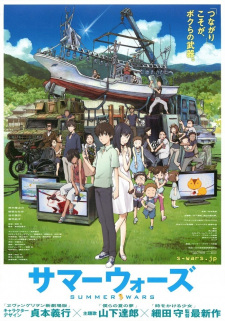
SynopsisWhen timid eleventh-grader and math genius Kenji Koiso is asked by older student and secret crush Natsuki to come with her to her family's Nagano home for a summer job, he agrees without hesitation. Natsuki's family, the Jinnouchi clan, dates back to the Muromachi era (1336 to 1573), and they've all come together to celebrate the 90th birthday of the spunky matriarch of the family, Sakae. That’s when Kenji discovers his "summer job" is to pretend to be Natsuki's fiance and dance with her at the birthday celebration. As Kenji attempts to keep up with Natsuki's act around her family, he receives a strange math problem on his cell phone which, being a math genius, he can't resist solving. As it turns out, the solution to the mysterious equation causes a bizarre parallel world to collide with Earth, and it's up to Kenji and his new fake family to put reality back in order.
(Source: twitchfilm.net) |
Related AnimeAdaptation: Summer Wars
Characters & Voice Actors
Staff
Reviews
|
|
Archaeon
63 of 85 people found this review helpful
|
1 of 1 episodes seen
|
| Overall |
8 |
| Story |
7 |
| Animation |
8 |
| Sound |
8 |
| Character |
8 |
| Enjoyment |
8 |
As far as visual family entertainment goes, anime is rarely high on the agenda, especially given the numerous offerings from Disney, Dreamworks, and other such movie studios. Generally these movies appeal to children and adults alike, and in order to compete with them the anime studios have had to shake off their habitual approach, and have had to focus on making films that are more accessable to Western markets. The undisputed king of this is Miyazaki Hayao, however there have been several challengers to his throne, the latest being Hosoda Mamoru.
Now, those of you who have watched Toki wo Kakeru Shoujo (The Girl who Leapt Through Time), will be familiar with Hosoda's work as a director, and as good as that movie is, his latest effort, Summer Wars, would have been at least as good except for one thing.
It's been done before.
The story follows the brief summer "holiday" of a high school maths prodigy called Koiso Kenji. He has gone to the countryside with his senpai (and secret crush), Shinohara Natsuki, ostensibly to celebrate her grandmother's 90th birthday. During his stay he receives a strange e-mail containing a sequence of numbers and, thinking it simply another maths problem, he solves it and sends it back. The following day all hell breaks loose (but in a quaint manner, this is rural Japan after all).
Summer Wars has a lot to recommend it in terms of it's plot and story. The pacing and progression is very good, and the numerous events that take place are justifiable to a certain degree. It's just unfortunate that, while watching Summer Wars, I couln't help but think of a certain 1983 movie starring Matthew Broderick, called War Games.
If one disregards the settings in the real and virtual world for a moment, then what's left, ironically enough, is a high school kid who unwittingly begins the end of the world through something nuclear, and all because he broke a code. It's even more ironic that the computer in War Games was developed from a simple game playing AI, and that it believes it is simply playing another "game" (if you can call global thermo-nuclear war a game that is).
However, even with the parallels with War Games, Summer Wars is a good enough movie in it's own right and, like War Games, is very much a movie of it's time. The use of online social networking is something that only a few shows have touched upon, and even though Summer Wars is a little bit unbelievable in it's application (everything from traffic management to emergency services is part of the OZ network), it's a purposeful device to make the story more relevant to this day and age, and it doesn't really impinge on one's enjoyment of the movie.
Summer Wars is distinctive in it's looks regardless of which world is on screen at the time. The settings, backgrounds and characters are very similar to those used in Toki wo Kakeru Shoujo, however there is far more diversity in terms of design in Summer Wars. One example of this is skin tone, with several characters being tanned to various degrees. Alongside this is the actual design of the characters themselves, and it's truly nice to see a show that takes a more realistic approach to this. The characters literally do come in all shapes and sizes, in both the real world and the virtual one, with no two characters (in the real world), sharing anything more than a resemblance that close relatives would have.
The one aspect of the design that did surprise me though, was that of the virtual world, but not in the way that most people would think. The CG used in the movie was extremely well handled, and I loved how each avatar was individual, yet also reflected the person in real life. However, I was ever so slightly bemused by the virtual world itself as the design was adapted from another of Hosoda's directorial works - Superflat Monogram. While the art and animation is very good throughout the movie, I would have liked to see them avoid cutting corners by using things that have been done before, but that's just a personal preference. As far as the virtual world goes though, most people will find it inventive, original, and more than a little amusing at times.
A big plus for the movie is it's cast. While most are relatively unknown, including the two leads, this doesn't preclude them from providing some very good performances. Kamiki Ryonosuke gives a very good performance as the bumbling, introverted and ever so slightly love-struck Kenji, while Sakuraba Nanami provides an excellent balance to this as the spirited and precocious Natsuki. One of the biggest surprises in terms of acting though, was Tanimura Mitsuki, whose protrayal of Kazuma had all the foibles and gripes one would expect from a 13 year old with a game addiction.
In terms of music, the various tracks and scores used throughout serve the movie very well. Matsumoto Akihiko (who also provided the music for Resident Evil Outbreak: Files 1 & 2), really shows his talent as both a writer and composer. The ED though is the only track done by someone else. The track used, called "Bokura no Natsu no Yume" by Yamashita Tatsuro, is actually a rather fitting end theme, a lilting ballad that rounds things of nicely.
So where are the problems with the sound? In truth, the majority of issues stem from the effects as there are several notable occasions where the music, speech and effects clash. The majority of the movie is relatively well executed in terms of effects, however those clashes can, at times, be a trifle hard on the hears.
The one area where Summer Wars really excels is in it's wealth of characters. While most of the focus is on Kenji, a good amount of time is spent observing Natsuki's extended family, and it's this aspect of the movie that makes it such an enjoyable film to watch. Anyone with a slightly dysfunctional family will appreciate the numerous minor clashes, feuds, loyalties, gripes, trials and tribulations that go into making any family gathering a "success", and it was an absolute joy to see Natsuki's family bounce off each other like peas on a drum (especially with Christmas just around the corner). The entire family structure and their relationships with each other are handled in a very intelligent manner, and viewers may be surprised to find theselves relating to certain situations.
As far as actual development goes though, there isn't really any aside from Kenji, and even that takes time to progress, although he does adimttedly "man-up" in the end.
Summer Wars is a very enjoyable romp in the realms of absurdity and, while it may not be to everyone's tastes, it does have the benefit of being relevant to a degree. The exponential growth of social networks is having an increasing impact on society, and it's this phenomenon that Summer Wars satirises the most, hence the inclusion of so many societal controls and services within the confines of OZ. While the story itself may not be new, one could consider this a more up to date re-telling of the theme - kind of a "War Games 2009" so to speak.
Whatever you think of the movie, at heart it's only meant to do one thing - entertain - and it does that very well. read more
|
|
Splitter
11 of 22 people found this review helpful
|
1 of 1 episodes seen
|
| Overall |
9 |
| Story |
8 |
| Animation |
10 |
| Sound |
9 |
| Character |
9 |
| Enjoyment |
10 |
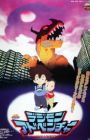
It's been quite a decade for director Mamoru Hosoda. Making a splash in 1999 and 2000 with his directorial debut with the first two Digimon movies, Hosoda honed his skills over the course of the next decade. Now ten years from his debut, Hosoda has returned to his humble beginnings, invoking his second work "Bokura no War Game" to give the world "Summer Wars"; a surreal cyberspace adventure about the power of family and the things that power can accomplish.
"Summer Wars" already gets a notch off because it really is a complete rehashing of "Bokura no War Game". From the growth of the Love Machine to the countdown to Natsuki's 'digivolution' powered by millions of other users, it shows in every facet of the story. Where it breaks off is outside the internet. As exhilirating as the fights with the Love Machine are, Summer Wars shines much more than "War Game" in the addition of a large, sprawling family known as the Jinnouchis; all very full of life and vigor. The main character Kenji's sudden immersion into this family is nicely executed and while relationship ties are generic at best, there is a cohesion to it all that adds a solid layer to the storyline in how this online threat tightly brings together the large family that started with only loose connections to one another.
With a large sprawling family comes a great deal of characters, and this being an original movie, it's hard to remember 25 characters you'll only know for the course of an hour and a half. Naturally, the movie doesn't focus on all of them equally and mostly you only really get to know about 5 of those 25, with the other 20 getting relatively generic personalities and motives. What is notable is not a single one of the 25 characters disappear completely. Because family unity is the message of the movie, they all appear throughout contributing in one way or another until the very end where all their efforts become one.
This relatively simple story is told on two levels; the real world and the online world, and both show off the best of Mamoru Hosada's stylings as well as elevate it to a grander level. In the real world, the animation is very reminiscent of Hosoda's last work, "Toki wo Kakeru Shoujo", with unexaggerated Miyazaki-esque character designs and detailed but muted backdrops. In the online world, Hosoda goes to town with a vast and psychedelic backdrop that ultimately marks how much he has evolved as a director from "Bokura no War Game". Both styles work well together, and though they do clash a few times, both do a fantastic job of absorbing you into the movie.
"Summer Wars" also supports a relatively good score, though I didn't much care for the ending theme. Vocals shine with a wide variety of unique and interesting performances from many seiyuu that don't often work in anime. Their fresh takes on cliche characterization in anime gives the movie a strong ensemble performance on the whole.
Overall, "Summer Wars" is not the game-changer others have made it out to be, especially since its essentially a rehash of one of Hosoda's earlier works, but it is a rehash that has dramatically improved both its good and bad points, becoming a full-fledged film that is exhiliarating, funny, sad, dramatic, and enjoyable; all the things a good movie should be. This is both Hosoda showing the world how far he's come and what he's capable of doing in the future. After seeing this, I'm sure many people will want to come along for whatever future rides he has to take us on. read more
Recommendations
|
|
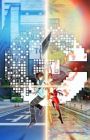
More obvious reasons would be same director, dynamic pace and art while less obvious both mix typical scfi elements with adolescent slice of life.
good drawing/animation, unique story, similar main girl character
|
|
|
Same director, similar settings. The cyber world is compromised and causes great effects on the real world as well. The characters battle the villain that caused the attack to recover control over the network.
They both deal with people trying to save the world after a threat appears on the net. They also share the same director.
|
Opening ThemeNo opening themes found, add themes.
Ending Theme"Bokura no Natsu no Yume" by Tatsuro Yamashita.
Fansubbing Groups
Which fansubbers do you like the best? Click + to approve of their subs for this show. Click - if you don't think they did such a great job.
Related ClubsAnime Recommendation, MadHouse
Recently Watched By|
7 minutes ago |
2 hours ago |
3 hours ago |
3 hours ago |
3 hours ago | |
3 hours ago |
4 hours ago |
5 hours ago |
6 hours ago |
7 hours ago |
|
|