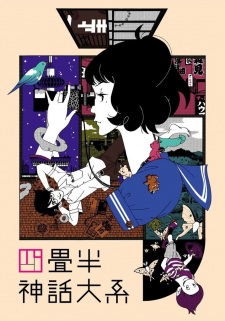
Alternative TitlesEnglish: The Tatami Galaxy Synonyms: Yojo-Han Shinwa Taikei, Yojou-Han Shinwa Taikei, Yojohan Shinwa Taikei Japanese: 四畳半神話大系
Information
Type: TV
Episodes: 11
Status: Finished Airing
Aired: Apr 23, 2010 to Jul 2, 2010
Duration:
23 min. per episode Rating:
PG-13 - Teens 13 or older
L represents licensing company
StatisticsScore: 8.541 (scored by 10865 users)
Ranked: #732
Popularity: #614
Members: 29,116
Favorites: 1,149 1 indicates a weighted score
My Info
Popular Tags
No tags found |
Recommendations Submitted by Users
|
|
Both are chalk full of despair.
Everything is happening very fast in these 2 series, main characters are similar
Both have over-analytic protagonists who often reads FAR too much into what he's doing, perceiving, thinking, and/or deciding. Both take things a little too easy for comfort as the circumstances are HARDLY.... easy. Both of their plots are similar in nature to recognize, yet are QUITE different from, not just each other, but from others in general. Both are a blast and a fun, fun ride.
And both have some strangely interesting art.
Tatami Galaxy doesn't just have humor, it mixes it cleverly, yet still noticeably with it's own masterpiece of a plot. The character cast is SIGNIFICANTLY smaller than Zetsubou's. The main character is naive in nature, in contrast to Zetsubou's. The animation is also a touch higher too. Also(but this is fairly obvious), it's shorter and with no sequels.... as of yet.
Sayonara Zetsubou-Sensei is a black comedy satire that pokes fun at almost anything and everything primarily because the main character in a mercilessly, yet hilarious light! The cast is, surprisingly, huger than many people would think. And while many of them have enough personality, they're often played for gags. And there's no overlying plot.
Both are dark comedies and both of the main characters are losers
same style and similar feel.
Both series presents an unique way of presenting their visuals and story to the viewers; surrealism
Furthermore, the main protagonist from both series often thinks too much and about subjects that are considered absurd and strange. Yet, at the same time it is funny and entertaining with the random gags.
Both series uses word play and has very humorous dialogues that are often exaggerated and over the line.
The two series also often make fun of modern culture and other references through the usage of its dialogues and word plays. It is parody at its finest and definitely something to take an eye on.
|
|
|
Tatami Galaxy is NHK on crack
Welcome to the NHK is far more depressing than Yojouhan Shinwa Taikei while the later adds a smidgen of bizzaro metaphysics to the later episodes. However they both revolve around a group of oddball people loafing around while helping the main character deal with the failures of his life, in their own way. Not always succesfully.
Both are based on a human-failure-type character to make up an interesting story and teach us life lessons (only highly-aware viewers can actually learn, though).
Both shows talk about a despairing life. Youjouhan Shinwa Taikei focuses on a college campus life while Welcome to the NHK focuses on a drop out and a high school girl. Welcome to the NHK differs by extrapolating psychological themes while Taikei focused on humor, but they all talk about the same thing: socializing is beneficial to life.
Both are episodic shows with protagonists who need to take charge of their lives and both get trippy in the process, though NHK is much darker.
The main reason why I believe these two to be similar, is the feeling that you get after completing the show, especially the last few episodes of it. As a college student myself these shows made me stop and think about where I am at this point of my life. It's actually pretty damn inspiring.
|
|
|
Very similar style in which they tell their stories. You see events from different perspectives and how everyone is related by the end of each series. They each may seem solely episodic but by the end you see the big picture and how everything fit together. They're both pretty psychological and delve into its characters minds to confront their delusions and problems.
Crazy art style, weird characters, and both are shows not by Shaft.
All episodes technically fall within the same time frame with newer scenes often approaching older ones from a different perspective.
Both series are more than capable of offering a multitude of bizarre situations complete with their own purpose without ever losing their entertainment or depth value.
Coupled with this, they employ a wonderful, sensational art style that directly contrasts the show.
Few psychological shows, let alone anime, are this entertaining and this good!
Kuuchuu doesn't exactly have an overall narrative like Tatami Galaxy, but it has subtleties that infer that certain events are connected.
Tatami's stories are culminating. As such, it gambles it all on it's final point.
Both series have very unique art-styles, unique stories, and are great.
Trapeze, though has follows the personal struggles of several individuals who share a common psychiatrist.
|
|
|
Both are series that aren't necessarily parodies or strict satire. The Tatami Galaxy takes on an extremely mysterious and reflecting tale of "possibilities". Bakemonogatari mixes some mild to heavy predicaments with supernatural folklore to help enhance/clarify the significance of said issues.
Both have strange, eclectic, abstract art that will undoubtedly impress those with it's usage. Both have and make use of some fine music, but... are paled in comparison to their OPs and ENDs.
Both are quite new, and both set the bar for enjoyment too, as the dialogue and insightful observations will cease to amaze.
The Tatami Galaxy's novelty, manner of storytelling, and overlaying mystery is SOO fresh, so enticing, and SOOOOO rewarding that one cannot label it any other name except "classic".
Of course, one needs to see a few anime "brain tickles" first. But, it should work well either way.
Bakemonogatari's atmosphere is supplemented with standard anime fare, which will sit well with others, but might dampen the blow on some of the content the show has. Still, it's characters' are a bit more colorful than Tatami's, yet the topic's mixture with supernatural isn't so well done on some occasions. The ending also won't please some.
Both have a unique art style and presentation, with emotional tension between the characters. There is an obvious romantic pairing in both series. Both focus on characters and presentation over any other element.
It seems that we don't see series like these two nowadays but these two anime are highly recommended as they have a cleaver usage of characters, art, and witty dialogue.
Both series contains a lot of parody, humor, drama, and among other things. These two series will definitely bring out the enjoyment out of viewers despite its low volume of episodes.
Both series are also intelligent and will present anime in its finest form, one that you'll remember for a very long time.
Yojouhan Shinwa Taikei and Bakemonogatari follow the same basic structure - boy meets girl followed by endless dialogue and surrealistic artstyle. If you enjoyed one, it's safe to say you'll enjoy the other.
Bakemonogatari expands upon the fantasy setting, and adds a bucketload of fanservice. In contrast, Yojouhan Shinwa Taikei ups the slice-of-life and about 1000x the words/minute ratio. However, both hold the same charm - or curse - that makes you either love or hate the anime.
|
|
|
Art style, the general mood, feeling the cover drama.
Another Masaaki Yuasa / MADHOUSE anime, and that promises us the same visual style and mood. If not, at least you would like them both.
Both are insane and great animes done by the same creator.
- Same directorr
- Unique style
- Strong development character
- Great soundtrack
|
|
|
Both share a similar carpe diem message as well as the same comedic style, which is expected coming from the same director. Mind game just does it with a much wilder style of visuals where Tatami Galaxy is a little more elegant in comparison.
Wacky postmodern anime in which the timid guy wants to get the girl. Lots of surrealistic reflections on life and love. Both are directed by Yuasa Masaaki.
Both are unique and crazy shows, done by the same creator.
|
|
|
Both of these shows feature time loops where the same plot is acted out, taking a different turn each time, and frequently overlaps, with things being told slightly differently. Higurashi is a lot more bright colors and slapstick humor, whereas Tatami Galaxy is somewhat darker humor, with less emphasis on little kids killing each other and laughing.
The use of recurrence of time to make characters come to realizations about the world around them and themselves.
|
|
|
Both have surreal and dark atmospheres which give them a similar feel. The one big difference is in Cat Soup there is pretty much no dialogue while in The Tatami Galaxy the main character talks so fast during his monologues that it is occasionally hard to keep up with the subtitles.
they are very similar in the way the story unfolds, lots of mystery
|
|
|
Both feature Yuasa Masaaki's crazy postmodern madness via Madhouse Studios, refreshingly unique style of animation, and stories about love and determination.
Unique shows done by the same creator.
|
|
|
- Non-linier narrative
- Butterfly effect
- Time leap (S;G) Time Loop (YST)
I'm amazed that no-one has yet made any recs for these two. They are really similar in many ways.
-Both handles the concept between present and future (time lines). While S;G has reading steiner Tatami Galaxy has "Tatami room."
-Okabe is crazy dude trying to travel in time while Tatami Galaxy's nameless protagonist is wondering what to do with his life after graduating. It may not sound so similar but when you watch how the story improves you will realize how and how much. Can't really say cause would be spoiler but e.g. the choices and mistakes protagonist do.
-Both have character development which could be said to be on whole new level.
-There is also amazing comedy side on both of these.
The Tatami Galaxy's story develops in the way that you'll realize how brilliant the story actually is after watching more episodes, so if you start to watch it then you shouldn't drop it.
|
|
|
the endless 8 ark in Haruhi goes back in time in each episode and Yojouhan Shinwa Taikei (or Tatami Galaxy) goes back in time in each episode both for a silly reason that the main character forgot to do something
in Haruhi no yuuutsu there aren't many changes but in Yojouhan Shinwa Taikei most of the episode is different
they also both give you that de ja vue feeling
The lead character/narrator enters a time recursion for an extended period (multiple episodes) with some repeating scenes.
|
|
|
Both are dark comedies with with very loose plots and episodes that can often stand alone.
|
|
|
The storyboards are nothing alike but both have the same feeling of less animation and more talking
|
|
|
An interesting story that is fairly chill, that should be interesting for those who liked the mystical aspect of Tatami Galaxy.
|
|
|
Kinetic comedies themed on reality and moving forth with life. Both shows invoke groundhog day plots. Both are funny, emotional, and mature.
|
|
|
While having witty humor, both are artsy, dialogue driven and character focused.
|
|
|
Although there is a huge difference when it comes to the art, both of these shows deal with college-life and growing-up in a way that's easy to relate with.
|
|
|
Both shows give me the same vibe :) The art style is a little similar, and they're both josei.
|
|
|
The protagonists of these entries are similar; both are cynical, double as the narrator for their respective series and their real names are left a mystery. Each finds himself dissatisfied with his life, and only learns to appreciate the imperfections in his life after he lives in a world without them for a time. Both protagonists have an internal conflict that ends with an important decision pertaining which world they prefer. Both entries involve a lot of inner monologue, and not to mention time travel. Tatami Galaxy is more upbeat and fast-paced, while Disappearance is slower and more gloomy.
|
|
|
Small actions result in large results. In Yojouhan Shinwa Taikei, the protagonist explores the different paths he may take while in college, which in each one results in his demise. In C, the protagonist ventures in the world of the 'Financial District.' In that world, those who lost 'money' or go bankrupt would suffer in the real world. Both series share the common idea of earning an opportunity that could either make or break you.
|
|
|
Both have a focus on character connections. In each story there is just a touch of the supernatural, but not a ton. The emphasis on character's relationships over other things is the main commonality.
|
|
|
Both series' have heavy internal narration by cynical, nameless leads as they try to make sense of the chaos billowing around them. Neither move in a linear timeframe.
|
|
|
With all the fast talking, these share the common ground of making me feel like I'm watching Gilmore Girls, but in a good way
|
|
|
Both have lots of imagery/symbolism.
They also both have characters with lots of mental strife and confusion about what's going on in their lives and how to obtain happiness
|
|
|
They both have a kind of a "Groundhog Day" sort of plot
|
|
|
They're both about college students looking for romance and happiness, and they're both sort of... out there (for lack of better words, they're both pretty random at times)
|
|
|
They are both eccentric peculiar anime, which seems to leave you with the same not-exactly-sure-what's-going-on after taste. Both have mysterious elements which coincide with slice of life occurrences with added humour. Not your typical watch, both are great anime with similar atmospheres.
|
|
|
unique art style. Akashi reminds me Nao.
|
|
|
They both have a similar dark undertone in the storytelling, although Yojouhan Shinwa Taikei is a bit more lighthearted in nature. They both have their own way of providing social commentary.
|
|
|
They both are packed with mindfuck and throw everything crazily at you from the word 'go'
|
|
|
time traveling/parallel universe fun
|
|
|
Both Tatami Galaxy and Haruhi Suzumiya deal with time loops and the main character's effects on the world around them.
|
|
|
Well, I think that since Tamaki Suou from Ouran High School Host Club talks and talks and talks, he could possibly out-talk Watashi from Tatami Galaxy in terms of monologues. Both shows as a result of these two characters fill the silence with a whole lot of "Blahblahblah" in a very amusing way--either over-hyper or over-monotone--whatever it may be these two individuals easily make the Japanese language seem so dang art-y and word-y. Watashi and Tamaki, also, have the worst time trying to successfully woo the girls of their dreams (Akashi and Haruhi, respectively) who seem to be single, smart, and generally "normal" if not a little hard to approach. Both shows do not really focus on a successful romantic love story...more like the hi-jinks that come in being young, awkward, and failing; it is a miracle if they have a lucky moment or two that fulfills what they've wished for deep down. The side characters are very important to the main characters; however, the main characters Tamaki and Watashi sometimes dismiss them as not as important as their love interest or whichever narrow or broad interest they are pursuing.
|
|
|
Similar in humor and ease of enjoyment. One does not need to watch much anime to get either. Both use what's commonly known in the world, as well as their own situations/characters/circumstances for humor. Both also mix humor and drama far more successfully than most do now. Both also don't use standard anime fare for supplementary attraction(moe, excessive fanservice, annoying antics, etc)
Each of their core messages are quite mysterious, both in "where they go", and what it means.
And both are a little obscure.
The Tatami Galaxy gets more and more intricate with it's core message. In a practical sense, Tatami's message is FAR more important and critical than Edo Rockets. Despite the gravity of the message, however, it never get's burdensome and it lights up on the enjoyment factor.
Oh! Edo Rocket is mostly mysterious in what it's trying to do, rather than just being strictly mysterious. The character cast is vast in it's usage and it's development. The humor is a bit more EXTREME, yet still witty and resourceful. The drama leans more towards romanticism(fulfilling dreams, putting aside differences, what one should keep in mind).
|
|