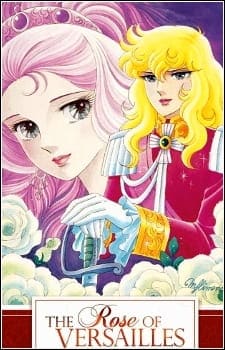
Alternative TitlesEnglish: Rose of Versailles Synonyms: Versailles no Bara, Berusaiyu no Bara Japanese: ベルサイユのばら
Information
Type: TV
Episodes: 40
Status: Finished Airing
Aired: Oct 10, 1979 to Sep 3, 1980
Duration:
23 min. per episode Rating:
PG-13 - Teens 13 or older
L represents licensing company
StatisticsScore: 8.401 (scored by 4837 users)
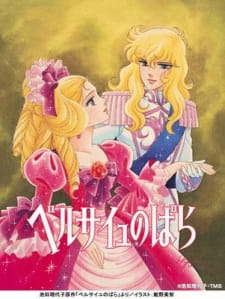
Ranked: #1342
Popularity: #1287
Members: 11,801
Favorites: 472 1 indicates a weighted score
My Info
Popular Tags
drama historical romance shoujo |
SynopsisRaised from birth as a man, the Lady Oscar commands the palace guards at Versailles in the years before the French Revolution. Her beauty and noble spirit make her a shining figure in the eyes of both men and women but she is torn between her chosen life of service and duty to class and country and her own heart and desires. She lives as a noble amidst the opulence of Versailles but her keen senses and compassion are not blinded to the poverty of the French people.
(Source: ANN) |
Related AnimeAdaptation: Rose of Versailles Summary: Rose of Versailles Movie, La Rose de Versailles, The Rose and Women of Versailles
Characters & Voice Actors
Staff
Reviews
|
|
RobdeFR
60 of 73 people found this review helpful
|
40 of 40 episodes seen
|
| Overall |
10 |
| Story |
10 |
| Animation |
10 |
| Sound |
10 |
| Character |
10 |
| Enjoyment |
10 |
[This review is spoiler free]
I finished Versailles No Bara. I am perplexed by this late experience of mine and I’m angry at myself, angry because I could have watched this one sooner, after all, I have it on my “plan to watch list” since the time Live-Evil were still subbing it, that makes it 4 or 5 years, a lot of time. Why haven’t I watched this title sooner? Oh well, better late than never.
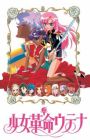
At the beginning I was feeling a little hesitant to start watching Versailles No Bara/Rose Of Versailles because I kept hearing people comparing it to Revolutionary Girl Utena. I didn’t dislike Utena, but I think it is a totally overrated anime with some serious lack of story development added with a very weak lead character. Thankfully, the only similarities with both titles are the styles and visuals that Utena went to get inspiration from, the rest and most important stuff like the characters personalities and the plot, are beyond comparison, so you should rest assured there if you got a similar point of view as mine regarding Utena.
The first thing that naturally you notice when You start watching Rose Of Versailles, is the marvellous character design done by Shingo Araki, the man did a lot of character designs on the seventies for some famous titles but here he was in his best shape and developed his trademark style, which he later also used on Saint Seiya.
Not only the character designs but the style and the peculiar 70s filled directing approach are very appealing and are added with a consistent and clever animation for ’79, and dare I say that some scenes are so well animated with the character movements that they even defy the commodity of modern animation from these days. Some examples being shown on the dances of the characters at some parties and in some crowd scenes where most of the individuals (if not all) of the crowd make independent moves of their own.
Unfortunately Nagahama Tadao died early and with him died some of the “acid” aesthetics of the series, because the acclaimed 70’s director Osamu Dezaki which came as substitute didn’t pick those “acid” scenes but he also fulfilled his duty with excellence. I especially love how the shots of the camera are taken from various angles throughout the series.
The story couldn’t have been better, it picked up historical facts prior the French Revolution and went along history to the beginning of the revolution covering a span of 20 years. It started using the shoujo formula of “newcomer female arrives and gets picked by older already established female at the place”, but it goes beyond its shoujo standards, not only because of the historical facts that the story cleverly went to use but also by the excellent characters that it had and their no lesser excellent character developments.
The author had a good use on the critic of the society of the 17th century, especially the aristocracy problem. Having watched Legend of Galactic Heroes prior to ROV, and ROV being older than LOGH, I get amazed at how the aristocratic situations and characters could have been the same on both anime, of course discarding the sci-fi universe of LOGH on this. Perhaps dare I say, that LOGH, author or director went to get direct inspiration from the clever aristocratic issues of ROV to display on LOGH..
The music is perfect for the anime, it was competent and good. I’m hearing the OST as I write and it does have very powerful songs. I especially loved the 70s tunes that it had which only the 70s could create. Of course the classical ones were also very good, some helped greatly on setting the mood of some special scenes and when that happens it is because the OST is good.
I am still impressed at the quality of this anime, and the only thought around in my head these days is to rewatch it again.
“Classic” is a word only fitted to some works, Rose Of Versailles is perfectly fit for it and I even go ahead and say it isn’t only “classic” but “cult” as well. No wonder it is still big back at Nippon. These type of stories are immortal.
I ended giving it a 10. I don’t give away 10s so easily as you can see by my list, and I wasn’t hoping to find another series so late at these times that I could give a 10. But RoV pushed me to a corner.
10/10 read more
|
|
dublincore
7 of 9 people found this review helpful
|
40 of 40 episodes seen
|
| Overall |
8 |
| Story |
9 |
| Animation |
7 |
| Sound |
6 |
| Character |
9 |
| Enjoyment |
9 |
Age hasn't necessarily treated it well, but Rose of Versailles remains a compelling and gripping viewing experience for even modern, jaded audiences, as long as they enter into it equipped with a bit of patience, a fondness or tolerance for heavy-handed sentimentality, and open-mindedness with regards to their entertainment.
Rose of Versailles tells the story (with a few deviations) of four people, living in the years leading up to the French Revolution. Two of them, Marie Antoinette and Hans Axel von Fersen, are fictionalized but nonetheless fairly 'real' portrayals of their historical counterparts. The other two, Oscar Francois de Jarjeyes and Andre Grandier, are (almost) wholly fictional characters who serve as sort of the emotional anchor for the series. Much of what happens, whether it is straight from history or an invention of the writers, is processed through these two characters before reaching the audience.
I'm assuming that everyone who is reading this review already knows enough history to be aware of the fates of Antoinette and Fersen--just in case though, I'll avoid talking about them, other than to say that the writers do a fine job of making both characters sympathetic and very human. Antoinette is not the self-absorbed pleasure seeker here that she is so often portrayed as, and Fersen in particular benefits from thorough character development and a well-rounded depiction. Of all the characters though, it is Oscar who steals the show. The series begins with her (yes, her) birth into a prestigious military family. Her father, depressed by his lack of sons who he can pass on his family's military heritage to, decides at the moment of her birth to raise her as a boy and as his successor. Flash forward a few years and we see the results: Oscar has grown into a beautiful and somewhat haughty woman who is tremendously skilled in the ways of combat, and whose mannerisms and bearing straddle an interesting middle ground between femininity and masculinity. If you're familiar with Revolutionary Girl Utena, Oscar is very much a prototype for the titular heroine of that particular series--not only somewhat in disposition, but even, to some degree, in character design.
Oscar quickly lands herself a commanding position in the royal guards, becoming a loyal friend and servant to Antoinette, and shortly thereafter finding herself ensnared in the high-society power-games that dominate life in the Court of Versailles. For roughly the first half of the series most of the plot arcs revolve around the emotionally-heightened 'combat' between the French nobles. And it is, to say the least, a bit silly. Shojo tropes are in full bloom here: expect lots of dramatic musical cues, name-calling, wide-eyed close-ups, sparkles, and pastel freeze frames. None of it is any worse than that which still happens regularly in modern girls' anime, but it is significantly clunkier, and is further stilted by the fact that it's all supposed to be happening in 1700s France. It's certainly not going to be to everyone's tastes: you either will just have to deal with it or learn to love it for its cheesiness and narmy charm.
Things improve markedly as the half-way point of the series approaches. Oscar, with the help of her friend (and stable boy) Andre begins to take note of the plight of the commoner and is introduced to the would-be revolutionaries who will rise up against the rule of the nobles in the not-so-distant future. Oscar's loyalties are severely tested, and as the eve of revolution draws near, she has to make impossible decisions about who requires her sword arm the most: the common people of France or Antoinette and her court. This second half of the series borders on the masterful, marred only by some mistimed displays of melodrama and over-the-top sentimentality. These small flaws aside, one couldn't ask for more from any anime series: incredibly well-developed characters (it's remarkable how well the writers do with showing these characters grow over a couple decades' worth of time), brisk pacing, a lovely (and sad) romantic subplot, and a final arc of episodes from which few of the characters, if any, will remain unscathed; it's a complete package. It makes for serious edge-of-your seat viewing, and is topped off with a shockingly cold epilogue that is easily the most brutal and tragic concluding chapter of any 'girly' series I've ever watched. The last ten or so episodes are practically an emotional holocaust--even if you could care less about the interpersonal relationships between the primary characters at this point (you monster!), the large scale and clever interweaving of historical events into the plot should pretty much guarantee that you marathon Rose of Versailles's last fourth.
Technically speaking, Rose of Versailles has aged pretty poorly in some aspects of its presentation. The score ranges from the laughably bad to the fairly decent, and the animation quality is all over the place. (Though it is surprisingly fluid and well-choreographed during the action sequences.) Nonetheless, I think the art design and attention paid to period detail will impress most viewers, as will the character designs, once you embrace their old-school charm and get past how many times the same face design is used on a huge chunk of the cast. Oscar, in particular, is something of a marvel, with the animators masterfully hitting exactly the right notes that the character requires.
The team behind the series also puts her gender-bending to fantastic use, using it to satisfyingly explore gender politics and even (maybe?) same-sex relationships. They get a lot of comedic mileage out of Oscar too, particularly with regards to how the ladies of the court react to her. Less successful is the drama that they try to squeeze out of her gender-identity issues. Still, through it all, Oscar never suffers from being a plot-device; she remains a strong, believable character throughout, and it's easy to see how she's become such an icon. She really leaves a huge impression, and has very quickly become one of my favorite anime heroines, keeping company with Utena, Hawkeye, Holo, and Kino.(Modern anime needs less Tohrus and more Oscars, that much is for certain.)
Another thing that has aged very well, in my opinion, is the Japanese voice acting. While required by the script to overact occasionally, most of the principal cast leave strong impressions, as do a lot of the minor characters. As if things couldn't get any better, each member of the cast even significantly steps up their performance as the series moves towards its finale, bringing a lot of earned pathos to their roles. If only a more subtle editing touch had been used during a few key scenes, I would say that the ending to this series would be pretty much absolutely flawless--which is something that one cannot say frequently about the ending chapters of too many series, period.
Not only is its influence on modern shojo totally massive, but Rose of Versailles tells a fantastic historical tale in its own right, and does us all the great favor of populating it with characters who are a joy to spend time with. There are some significant missteps along the way (an almost complete lack of anything resembling subtlety is the biggest blow against it, in my opinion), but it nonetheless possesses remarkable power, and will really resonate with the right audience. It's not just a good series considering the time in animation history that it comes from; it's a good series period, and is perfectly capable of being compared favorably to many excellent modern series. Hugely recommended. read more
Recommendations
|
|
Both feature young women blurring the gender line with sword fights.
Rose of Versailles seems an obvious inspiration for Revolutionary Girl Utena. Set in Revolutionary France the main character is a woman raised as a man fulfilling a man's role. Much of the setting from Versailles seems to be the inspiration for the style of Utena.
Rose of Versailles and Revolutionary Girl Utena bring to the front the issues of gender identity. The titular heroines in these series choose to take on traditionally male roles which create a tension in these characters as they struggle to conciliate feelings with duty. In both series there is a recurring theme of roses and sword fighting; they both deal with Revolutions albeit of a very different nature and are concerned with moral nobility. Rose of Versailles has a more social and linear approach while Utena spins into a heavy psychological study that renders narrative almost obsolete. Breaking through illusions, be them class based or emotional hang-ups, is at the heart of these two anime.
Both have strong female leads. Both of which meet their fragility and strive to over come it, while dealing with battles, schemes and traces of love.
Chiho Saito was probably inspired from Ryoko Ikeda's works, as these authors' styles are very alike.
Utena & Versailles No Bara are quite similar, as they both involve crossdressing, sword fights, roses, drama, romance, and a gorgeous, rich, aristocratic mood.
If you liked Utena this is another anime/manga I believe you should enjoy. Utena drew inspiration from this both in setting and characters. While Rose of Versailles takes place in the country of France and isn't confined to a school setting, the focus on fighting with swords plays a big part in both anime. The decadent European lifestyle that is acted out in Utena is very much the same as is acted out in Oscar's France (balls, food, elaborate dressing, even many high culture interests).
The main character in Rose of Versailles is Oscar, a woman who got a mans name because her father was stricken with grief that his wife bore a girl,and who was then raised as a male. You can see that Utena's 'Prince' complex (her desire to become a prince) is very much comparable, such as dressing like a boy acting like one but maintaining a certain unbreakable feminine beauty and fragility in both looks and personality (as Oscar is unable to overcome her feminine qualities even dressing more like a guy plus cutting her hair). Both characters are also tested by male characters who try to get them to lose this strength they have by treating them as women but not equals. The main difference between the two characters is Utena has chosen to become what she likes to call a 'prince' while Oscar was raised like a boy.
Both are classic shoujo series featuring strong female protagonists who blur the gender line.
It's been long debated that Rose of Versailles heavily influenced many elements present in Shoujo Kakumei Utena. Utena and Oscar are almost mirror images of each other.
|
|
|
Versailles and crossdressing, anyone?
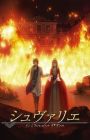
Both BeruBara and Chevalier feature crossdressing and genderbending main characters in a revolution-era French setting that's as accurate as possible, sans the liberties that, of course, had to be taken to create the story.
So lets see. The only reason why I finde this 2 series verry similar is the main charachter and the historic theme of bouth animes.In Le Chevalier D'eon as well as in Rose of Versailles we have the main charachter who is stucked betwen 2 faces. The face of a woman or the face of a man. In Rose of versailles Oscar was raised as a man, but she is going to love as a woman. Determinated, courageous and proude as a man, but fragile like a woman. In Le Chevalier D'eon our main charachter, a male is possesed by his twin sisters soul who want's revenge. Traped between the 2 personalites he is confused and at a point doesn't even know who is the real him.In bouth series the confusion because of the 2 faces life apear at some point and finishes when the charachter is finaly accepting the person that he is. In Le chevalier D'on this crisis is a bit more stronger because he is actualy controled by his sisters spirit.If you watched one of this movie for his historical tipe you will surely like the other for the same reason. In bouth the action is situated in France.Corruption, kings failing and the thirst for power. You can finde them all in this animes.Conclusio: if you liked one of them you'll surely like the other.
Historical anime about France, Versailles, aristocracy, with plenty of sword duels.
Both series play with the gender of the main character (crossdressing in Versailles No Bara, gender bender in Le Chevalier D'Eon).
While one has more drama and romance, the other is more into the horror/supernatural side.
Both stories take places in history at the same time and both contains same historical characters, but Le Chevalier D'Eon is much darker and includes supernatural accidents.
|
Opening Theme"Bara wa Utsukushiku Chiru" by Hiroko Suzuki
Ending Theme"Ai no Hikari to Kage" by Hiroko Suzuki
Fansubbing Groups
Which fansubbers do you like the best? Click + to approve of their subs for this show. Click - if you don't think they did such a great job.
Related ClubsBeautiful Romance, Tomboy/ Feminist Anime Girls Club, Yuri Türkiye, CNCFixins, Pittsburgh Japanese Animation Club, Heterophobia, My Fairy Tale Addiction, Fans of Gender Bending/Gender Swapping, Oscar Francois de Jarjayes FC, MAL: The Later Years, Moe and loli haters , Old School Anime - Brasil , Historical Anime , Osamu Dezaki Appreciation Club, Overrated or Underrated Animes and Mangas, TEH MEWNZ FANCLUB OF HAWTNEZZ!, Les Champs Animes, Year 24 Group, Playing Piano Characters FC, GL Addicts!Romance+, Richismo, Anime Association of Northern Illinois University MyAnimeList club, The Noble Heroines, Realistic Anime, ♔ The Old, Elegant Story , Gender Bender Forever, The Rose of Versailles (Lady Oscar,Berusaiyu no Bara), Missile Punch, Anime and Manga Romance Club, Anime Girls + Roses , Anime History Association, The Emotional/Sad/tragic Anime Collection worth watching club!, .:: ☆ ::. Romantic ♥ Historical .:: ☆ ::. , The True Heroines Club, Overrated Shit, Marketplace Germany, Yuri is the Ultimate <3, Shoujo Wonderland-少女アニメと漫画大好き, Actores y actrices de doblaje de Latinoamérica / Latin spanish seiyuu, Shoujo Anonymous, Old School Anime Club, Asutoraea no Oka(yuri rp), Anime Blue, Ryoko Ikeda Fans, Shojo Romance see all
Recently Watched By|
2 hours ago |
2 hours ago |
3 hours ago |
3 hours ago |
6 hours ago | |
7 hours ago |
8 hours ago |
9 hours ago |
9 hours ago |
9 hours ago |
|
|