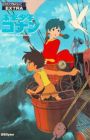
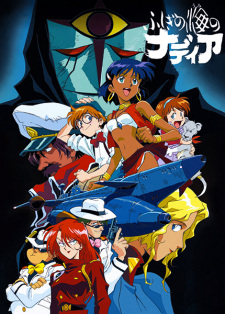
Alternative TitlesEnglish: Nadia: Secret of Blue Water Japanese: ふしぎの海のナディア
Information
Type: TV
Episodes: 39
Status: Finished Airing
Aired: Apr 13, 1990 to Apr 12, 1991
Duration:
25 min. per episode Rating:
PG-13 - Teens 13 or older
L represents licensing company
StatisticsScore: 7.691 (scored by 5229 users)
Ranked: #9312
Popularity: #1316
Members: 11,486
Favorites: 140 1 indicates a weighted score
My Info
Popular Tags
adventure comedy sci-fi |
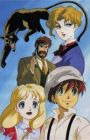
SynopsisIn 1889, the world is on the pinnacle of great discoveries in technology. In mankind's grasp for the future, a sinister foe known only as Gargoyle, obsessed with restoring the former Atlantean empire to the glory it once held, begins his plans to take over the world. Nadia, with the help of a young inventor, Jean Ratlique, and Captain Nemo of the submarine Nautilus, must fight to save the world from Gargoyle and Neo-Atlantis. Based on the Novel '20,000 Leagues Under the Sea' by Jules Verne.
(Source: ANN) |
Related AnimeSequel: Fushigi no Umi no Nadia: Original Movie Side story: Fushigi no Umi no Nadia Specials
Characters & Voice Actors
Staff
Reviews
|
|
BornIn1142
64 of 75 people found this review helpful
|
39 of 39 episodes seen
|
| Overall |
8 |
| Story |
8 |
| Animation |
7 |
| Sound |
7 |
| Character |
9 |
| Enjoyment |
9 |
Story: Nadia, the Secret of Blue Water is supposedly based on the novel 20,000 Leagues Under the Sea. The truth of the matter is, the plot elements shared by the two can pretty much be counted on one hand. The two stories are practically unconnected. But that's alright. The plot crafted for Nadia "based on" Jules Verne's is actually quite good by its own right. It offers both awesomely epic action and touching emotionality and handles both wonderfully. There are a few nicely executed twists thrown in as well.
Of course, no review of Nadia can get around a certain arc in the middle. Episodes 23-34 are directed by a replacement director. The twelve "filler" episodes, in my opinion, aren't horrible, but they ARE horribly mediocre in comparison to the rest. For those twelve episodes (episodes 30 and 31 excepted), the plot comes to a stand still. Life on a deserted island simply doesn't compare to the excitement of the main plot. However, that's not actually the worst part of it. I wouldn't have minded so much if it hadn't also distorted the characterization to a nigh-insulting level. More on that later.
So would you be better off skipping the island and Africa arcs? While they have their moments, in my opinion, the answer is yes. The experience would probably be enhanced if you left them out. The director felt only episodes worth keeping from those twelve were 30 and 31 and I'm inclined to agree. Those two are good and should be watched. You won't lose anything by watching the rest unless you're remarkably touchy, but you won't really gain anything either.
Art: Yoshiyuki Sadamoto's character designs are as nice as ever, and the animation is generally good. Emotions are portrayed nicely and the complicated technological wonders and battles are quite nuanced and pretty. However, the series IS 20 years old and looking its age.
As for the supposed iffishness in part of the animation during the filler arc, I can't say I noticed it. It did, however, suddenly become somewhat more cartoonish than previously (like a character running off a cliff and only falling when he noticed it...) It wasn't very fitting, in my opinion.
Sound: The sound of Nadia is good but not notable. I watched the subbed version and the voices were fine. They suited their characters and the performances were good, as far as I can tell. Nothing much to say on this. In any case, the soundtrack was composed by Shirou Sagisu, so you know its good. The action-comedy parts and the epic struggle for the fate of the world are both handled nicely, but Sagisu's tracks for the bittersweet scenes really shine. I can safely say the score greatly enhances the emotions of the last episodes, especially the ending.
Character: Nadia's characters are, in a word, great. The leads and supporting cast are all very well developed, but even the minor bit parts aren't left as two-dimensional ciphers. The relationships between them are very carefully crafted and actually change believably over time and with new revelations. I personally rooted for Nadia and Jean's romance.
Especially noteworthy is Gargoyle, who is, in truth, a world-class villain and one of the best I've seen in anime. He appears in only about a third of the episodes, but comes off as a true menace who you really learn to hate by the end.
The worst offense of the filler arc is probably the messing with characterization. Nadia herself is by far the worst victim of this. While she has a canonically difficult personality, the the filler arc upgrades this to "annoying bitch". Every flash of likability is negated by another act of irritating stupidity. Especially retarded is her falling in love with some random African kid - a huge slap in the face of the love story that forms the core of the whole series. Thankfully, this and most everything else that happens in the island and Africa arcs is pretty much ignored later on.
Enjoyment: While one can certainly like Nadia solely for its artistic competence, it's also damn good fun. It's been a while since I watched a series as engrossing as Nadia. It's humorous moments are amusing and its sad moments are ridiculously touching. I've rarely come as close to crying while watching an anime as during the ending of Nadia. The characters are likable and easy to get into. The series doesn't take itself seriously all the time, but when it does, so do you.
Overall: Nadia, the Secret of Blue Water isn't nearly as well-regarded as it should be. I saw a bit of it as a child on television, and expected to at least nostalgically like it when I rewatched it. Instead, the series forced its way into my Top 10 list. It's an undervalued classic that most people have not heard of and possibly never will because of its age. Do yourself a favor and watch it. And you wouldn't be doing yourself a disservice if you only watched episodes 1-22, 30, 31, 35-39. read more
|
|
JTurner
50 of 62 people found this review helpful
|
39 of 39 episodes seen
|
| Overall |
7 |
| Story |
7 |
| Animation |
6 |
| Sound |
8 |
| Character |
9 |
| Enjoyment |
9 |
In the mid 1970's, prior to obtaining his well-deserved status as Japan's greatest animator ever, a young Hayao Miyazaki was hired by Japanese movie giant Toho to develop ideas for TV series. One of these concepts was "Around the World Under the Sea", based on Jules Verne's "20,000 Leagues Under the Sea," in which two orphan children pursued by villains team up with Captain Nemo and his mighty submarine, the Nautilus. Although it was never produced, Toho nonetheless kept the rights to the story outline. Miyazaki would reuse elements from his original concept in later projects of his, most notably the terrific action-adventure Castle in the Sky. Ten years later, in the mid-1980's, animation studio Gainax was commissioned to produce an original Anime series to be broadcast on television network NHK. Under the direction of a brilliant but angst-ridden artist known as Hideaki Anno, the studio selected Miyazaki's concept, and crafted an engaging story set in a steampunk 1889 France, with interesting characters, amazing animation (for its time), and a mixture of comedy, romance, mystery, and drama. The result was Nadia: The Secret of Blue Water, which has since become a worldwide fan favorite.
The story begins at a Paris World Exposition Fair where Jean, a nerdy but charming and instantly lovable inventor boy of fourteen, becomes smitten with a pretty, dark-skinned girl his own age. The girl, known as Nadia, is an unhappy circus acrobat with no clue about her past other than a jeweled necklace she wears. After rescuing her from a trio of comic bandits (the Grandis Gang) Jean earns Nadia's trust. The two set off on an even bigger adventure to find Nadia's birthplace, which supposedly lies in Africa. Along the way, they have run-ins with a supercharged submarine commanded by the mysterious Captain Nemo and his pretty but overprotective first officer Electra as well as a shadowy cult of Nazi-like masked soldiers known as Neo-Atlanteans led by the misanthropic, sinister Gargoyle, who wants Nadia's pendant at any cost. In the course of their around-the-world adventure, Jean and Nadia adopt an orphaned little girl, Marie, who senses that her new guardians will become more than just close friends. Although Nadia's explosive temper poses problems, Jean's patience and loyalty keeps their relationship afloat, and her growing love for the boy gradually transforms her as a person.
Nadia has all the makings of a classic series: a well-rounded cast of characters, unforgettable sequences, and a long, involving action adventure. There is a distinctive "Miyazaki-esque" style to the visual designs of the leads, yet only Jean seems to emerge as a Miyazaki creation. Which is arguably what makes him the most lovable character in the whole show. It's easy to see why Nadia finds herself falling for him--who wouldn't want to be with a boy as intelligent, genuinely compassionate, and impossibly generous as Jean? While he does display clumsiness in terms of social graces around the opposite sex, it only makes him all the more appealing as a character. Nadia herself, by contrast, is not always lovable. In addition to having serious anger management issues, she also has unbending and irrational principles about killing, eating meat, or trusting grown-ups. She does, however, display courage and, as mentioned, finds herself growing to care for Jean. Actually, Anno has said that he created Jean and Nadia based on his "light" and "dark" sides. Shiro Sagisu's music is sometimes bland, although some of the later tracks, notably the Neo-Atlantis themes, are memorable. The opening and ending theme songs as sung by Miho Morikawa are also enjoyable.
For all its assets, however, Nadia suffers from one fatal flaw that prevents it from being the classic it aims to be--it doesn't always stay afloat throughout its 39-episode count. The first twenty-two episodes are old-fashioned adventure at its best, with humor, young love, traumatic situations which involve death, and compelling, engrossing mysteries as we learn about Nadia, the Nautilus, and the Atlanteans. The production values in these episodes show their age at times, but frankly, they still exude detail and clarity for an early '90s series. In episodes 23-34, however, it devolves into a painfully dull, unengaging, haphazard, incoherent Saturday morning cartoon, with warped characterizations, and even worse scenarios totally devoid of imagination or credibility. Simultaneously, the animation takes a hit in these dozen episodes, with some episodes looking downright sloppy or dreadfully cartoonish. (In all fairness, these dreadful half-hours weren't supposed to have existed; distributor NHK requested that they be made after the show became a smash hit in Japan.) In the final five episodes Nadia does recover in terms of artistry and storytelling, delivering a satisfying finale, but it's hard to compensate for the damage that has been done. Simply put, the show would have been far better if it were eleven episodes shorter.
For their part, however, ADV Films deserves a shout-out for their work on bringing this series to American audiences. The visual and aural transfers are competently done, but it's their translation that really shines. The English dub, a wonderful achievement for the now defunct Austin-based Monster Island studios, is notable for casting three actual children in the roles of Jean, Nadia, and Marie--Nathan Parsons (12), Meg Bauman (14), and Margaret Cassidy (11), respectively. For inexperienced youngsters, all three do exceptional jobs, and are amply supported by an excellent cast of adults, particularly Sarah Richardson, Corey Gagne, Martin Blacker (as the Grandis Gang) as well as Jennifer Stuart (Electra), and Ev Lunning Jr. (Nemo). All show liveliness and enthusiasm for the characters and give the performances of their careers. Ditto for the use of genuinely believable accents--it adds a national flavor to the characters (although Jean's sometimes shaky French dialect takes some getting used to).
Is Nadia a complete waste of time? Not at all; as mentioned, the characters are fully-realized, and for twenty-two episodes and the final five, the show does indeed deliver an entertaining, consistently engaging adventure story with just the right amount of heart, humor, and drama. It's just too bad that it goes downhill in the second half (despite delivering a phenomenal conclusion). Otherwise, this series would truly be worthy of the praise it receives as one of the greats. The best way to appreciate Nadia is to view episodes 1-22, then 31 (the only "filler" episode to have any genuine plot development), and finally 35-39. It will provide for a much more pleasing experience. read more
Recommendations
|
|
because they got the same Sadamoto-Anno team and there is a lot of Eva ideas inside
Many concepts that were used in "Nadia" would be recycled in "Evangelion", a darker and bleaker series, produced by the same team.
The same team worked with Hideaki Anno, so NGE and Nadia really have the same feel to it. Plus the bottom line is pretty much the same, a mix of fathomless lore, technology and how they interact with the human condition.
|
|
|
Anno of Evangelion fame hit the big time in animation by quite literally knocking on Miyazaki's door and showing him his animation skills when Nausicaa's production ran out of animators. Afterwards, Anno was inspired by Miyazaki's concept for Laputa and ended up directing his own version of the story with his own studio. This is how Nadia came to be.
If Miyazaki has one weakness visible throughout his films, it's characterisation. More often than not, his imagination for story-telling leaves little room for the nitty-gritty of making his characters into relatable humans, as opposed to plot devices. Anno, on the other hand, is most famous for the creation of Evangelion; arguably THE psychological anime. Evangelion was a series that focused almost exclusively on the exploration of its cast; story details being viewed as less important and, ultimately, making the conclusion near enough incomprehensible. And it's this plot/characterisation divide that defines two anime that begin with the same premise.
In Laputa, the hero and heroine might as well have been nameless. They had their roles and there had to be a hint of romance. There was NOTHING else. Their dull designs went along with how hollow they came across. Part of the blame for this failing lies with a restrictive film time limit and the film targeting younger viewers, but it's still hard to imagine if, say, Anno had directed Laputa that the end result would've been the same, for better or worse.
Nadia's different, of course. Rather than a happy-happy Ghibli heroine, Nadia's titular heroine is best described as bitchy--a tsundere before Asuka made tsunderes so popular in - OF COURSE - Evangelion. She gives her eccentric and nerdy romantic counterpart a hard time throughout the series as their relationship gradually evolved; even chastising him for killing for food and refusing to eat meat, among other things. Others may see Nadia's personality and find such a heroine distasteful when a Mary Sue type could've took her place. I, however, see human imperfections in a character and see a person, rather than a drawing. I see two people overcoming their differences through disagreements and see growth.
In summary: Laputa's the title for those looking for an adventure filled with magic. Nadia is also a lot of fun but contains more of the genuine human qualities that I love to see.
Many fans often compare Hayao Miyazaki's high-flying adventure tale "Castle in the Sky" to "Nadia" because it shares many similarities: girl with pendant, boy who loves to build planes, a not-so-evil group of bungling bandits, and a truly ruthless villain. The outline of the plot in both works are similar in many ways as well.
the characters are very similar plus the story as well as the plot is very alike too.
|
Opening Theme"Blue Water" by Miho Morikawa.
Ending Theme"Yes! I Will" by Miho Morikawa.
| No posts for this board were found |
Fansubbing Groups
Which fansubbers do you like the best? Click + to approve of their subs for this show. Click - if you don't think they did such a great job.
Heijin [Heijin] (Brazilian Portuguese)
Related ClubsEnglish Dub Fanclub, Marketplace Germany, Shiro Sagisu FC, That Black Club, Old School Anime - Brasil , Youkai's Mansion, .:: ☆ ::. Romantic ♥ Historical .:: ☆ ::. , Hideaki Anno Fan Club, Studio GAINAX Club, Les Champs Animes, The Blue Club, Nerds FTW!, Nadia / Magic User's Club, AAAC (African-American-Anime-Club), WATER FANCLUB, Old School Anime Club, The Classics Club, [ S T E A M P U N K .], Inoue Kikuko Fanclub, Hideaki Anno Fan CollectiveUnderrated Anime, MAL Adopt a Pet! [CLOSED] see all
Recently Watched By|
3 hours ago |
4 hours ago |
4 hours ago |
5 hours ago |
5 hours ago | |
7 hours ago |
9 hours ago |
11 hours ago |
12 hours ago |
Today, 7:42 AM |
|
|