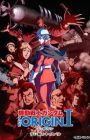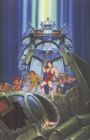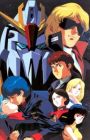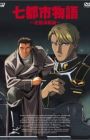
Alternative TitlesEnglish: Legend of the Galactic Heroes Synonyms: Ginga Eiyuu Densetsu, LoGH, LotGH, Heldensagen Vom Kosmosinsel Japanese: 銀河英雄伝説
Information
Type: OVA
Episodes: 110
Status: Finished Airing
Aired: Dec 1988 to Oct 1997
Duration:
27 min. per episode Rating:
R - 17+ (violence & profanity)
L represents licensing company
StatisticsScore: 8.971 (scored by 2017 users)
Ranked: #22
Popularity: #681
Members: 6,282
Favorites: 584 1 indicates a weighted score
My Info
Popular Tags
drama sci-fi space opera |
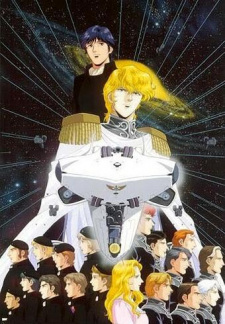
SynopsisFor decades, the Galactic Empire has been locked in an interstellar war with the Free Planets Alliance, a conflict that involves thousands of spaceships and millions of soldiers on both sides. Two new commanders enter the conflict with great hopes: Imperial Admiral Reinhard von Lohengramm and the FPA's Yang Wen-Li. As they deal with superiors and subordinates, maneuver through complicated political arrangements, plot strategies, and win battles, each will be tested, and ultimately, changed, by the reality of war.
from ann
|
Related AnimeAdaptation: Legend of Galactic Heroes Prequel: Legend of the Galactic Heroes: My Conquest is the Sea of Stars, Legend of the Galactic Heroes: Golden Wings, Legend of the Galactic Heroes: Overture to a New War, Legend of the Galactic Heroes: A Hundred Billion Stars; A Hundred Billion Lights, Legend of the Galactic Heroes: Spiral Labyrinth
Characters & Voice Actors
Staff
Reviews
|
|
santetjan
274 of 344 people found this review helpful
|
110 of 110 episodes seen
|
| Overall |
10 |
| Story |
10 |
| Animation |
8 |
| Sound |
10 |
| Character |
9 |
| Enjoyment |
10 |
This series is overrated on this site. That is to say, with 110 episodes, your vote only counts after you've seen 22 episodes, almost a full season, and those who don't like this show probably won't wait for 22 episodes to decide.
Which is a shame, as it's only after about 20 episodes that this series progresses from something that is slow, somewhat overly bombastic, and hinting at more to come to show itself to be one of the most intelligent pieces of anime that's been made to date.
When I say 'intelligent', I don't mean it to be cunning, surprising the viewer with unsuspected plot lines or new angles to view something. Nor does it delve deeply into some obscure theory of science or arts, bombarding the viewer with ideas he couldn't have come up with himself. In fact, there's absolutely nothing in this series that is wholly unexpected or very deep. What it has, though, is a sense of scale that's unsurpassed in any anime - or, for that matter, any television show - I've seen.
Legend of the Galactic Heroes centers around - you guessed it - a bunch of people who, according to populace at large that inhabits the fictional future this series plays in, are of heroic proportions. That is to say, heroic in a very classical sense, being possibly a negative thing as well as a positive.
The series is set in a future wherein the universe known to man is divided into two camps, the aristocratic and absolutist Galactic Empire, and the democratic Free Planets' Alliance, who have been embroiled in a war for some time, seemingly
being evenly matched. This balance is shattered when a military genius with a far-reaching ambition rises on the Imperial side, prompting the Alliance to, somewhat grudgingly, give ever greater backing to the most capable officer on their own side. Both men surround themselves with able staff, who become legends in their own right.
It sounds like your average hero of freedom-versus-tyrant story, but it turns out to be anything but. First of all, the heroes do have a sense of their own importance, but also the sense to question whether they are all that special, or whether the circumstances of their times have just brought them to a spotlight which people equal to them could never have aimed at. More importantly, the main question on which the whole series hinges remains an open one. This question is the age-old one of which is better, autocracy or democracy, the problem being that a good autocracy is usually better than a good democracy, but a bad autocracy being worse than a bad democracy. Within the happenings of the show, it becomes apparent that, militarily speaking, at least, a good autocracy has an edge over democracy in terms of speed and decisiveness, and this shows in how the series progresses.
A large part of the series is devoted to showing the war and its subsequent smaller-scale rumblings. The war is fully shown from the side of the commanding officers - one of only a very few shows to do so - and does show an appropriate sense of scale. With battles involving thousands of battleships and millions of men, simple depictions of large-scale tactics take the place of views of the battlefield itself, and a considerable part of the show is, laudable, devoted to discussions on logistics and military intelligence.
A larger part still, though, is devoted to discussions on politics, all within the greater autocracy versus democracy question. Again, these thoughts never go very deep, but what strikes one is that so very many possible variables are brought up. Almost any motive of rulers or the general populace that might affect a political decision is included at some point in the show, making me at least think to myself: 'They even thought of thát one.' The show does tend, here and there, to lean toward the old 'good soldier, bad politician' cliché, but, overall, it really lacks a clear villain, instead showing each possible side (apart, perhaps, from religious fanatics) from every possible angle. Moreover, all this is shown within a future universe that is highly consistent over the full 110 episodes, even if differences between the warring sides tend to be somewhat exaggerated: in many cases whole societies seem to act a bit too much according to a somewhat radical ideology, only to make their following actions be true to form.
This being true to form applies also to most of the actions that, at first glance, seem to be overly dramatical, in the first place many of the actions of the dozen or so main protagonists. However, when thinking about the how and why of their actions, it usually becomes clear that they cannot have but acted as they did, according to cultural mores and individual character. A case in point would be the reliance of many Imperial officers on the character of some military commander to predict his battlefield tactics. This would seem lunacy, until it is remembered that the Imperial commanders are a tight-knit group, mostly of noble birth, and known to each other: each commander would know the peculiarities of all others, which become all the more predictable as the importance of gaining personal glory and honour in battle are taken into the equation.
This reliance on known characteristics of all personalities is also possible because the characters don't evolve all that much. Now, I've never understood why 'character progression' in general seems to mean having characters make a full volte-face, and I am, in fact, happy with a series that shows all characters as being fully grown, and fixed in their ways. Each has a specific role to play, and a mind-set that might be predictable, but is, again, true to form. This doesn't make the character shallow. Far from it: their characteristics mean that each takes a single position to a fitting extreme, making for interesting differences between the characters, and accompanying differences in outlook.
That said, it is indeed true that the characters may be somewhat flat, and quite a few seem to be included only to show a different point of view toward a specific situation or theory, but it is exactly this relative flatness that makes it possible for them to discuss so many situations.
As for the art, it is old and outdated, but that can't be held against the show. It is a shame that, mainly in the first season, the series is at times simply bad: persons walk in an awkward way, scenes are recycled, and even relative positions of facial structures change from frame to frame. There's no excuse for that. Technically, though, the art definitely gets better during the course of the show.
In fact, the show being old might be a boon. The creators have opted to make the drawing style relatively realistic, which fits the series splendidly. One has only to look at the manga to see how different it could have been: the style of the manga doesn't fit the show at all.
Real points have to go to the design. Again, nothing is really innovative, from the spaceships to the almost 19th century looking setting to the uniforms of the soldiers. It is, however, solid, and consistent, and really brings the world to life.
The music is outstanding. It mainly consists of generally well-known classical compositions, which, granted, have been often used before, but never have they been used to such splendid effect: especially the use of pieces during battle sequences, fitting the individual scenes to the music, is a joy to watch.
As a whole, Legend of the Galactic Heroes never tries to be overly deep, and, though it tends to be somewhat bombastic, never loses itself to any glorification. It is slow and quite meticulous, focusing on a lot of details, and consists for the largest part of dialogue, not action. The story progresses slowly, and only after about a season's worth of episodes the real story starts to evolve.
And this show never, ever tries to evoke an emotional response. The whole series is based on having the viewer have an intellectual understanding of what happens, not an emotional one. There are, thus, no cheap tricks to elicit emotional response, nothing overly dramatic (barring a few strokes of bombast), and no characteristics that make a main protagonist or villain.
I can only applaud this, considering it a feat to produce such a good series without relying on drama. Legend of the Galactic Heroes is, in this sense, the absolute antithesis of my other personal favourite, Le Portrait de Petit Cossette, appealing to the rational side of the viewer, even when the protagonists act with all their vaunted 'foppery and whim'. read more
|
|
noteDhero
89 of 126 people found this review helpful
|
110 of 110 episodes seen
|
| Overall |
10 |
| Story |
9 |
| Animation |
9 |
| Sound |
10 |
| Character |
10 |
| Enjoyment |
10 |
Legend of the Galactic Heroes is an epic tale of the rise to power of two men born at the right time on opposite sides, leading to a clash of brilliant spectacle that could only be executed with care in as an animated original.
Animation- 9/10
Though Legend of Galactic Heroes is 20 years old the visual quality and care is quite priceless. As a viewer who is reluctant to watch series over 40 episodes or over 10 years old, I was taken aback by the engaging art ranging from Ancient Rome, to Victorian England, to Blade Runner-esque futuristic set-pieces and costuming. Both factions, The Free Planets' Alliance and the Galactic Empire, had its own distinctive look, engaging the eye in nearly every direction. Add to these looks, the numerous space battles waging between the two factions and you have a piece of art that is timeless.
Sound - 10/10
Legend of Galactic Heroes boasts over 100 individual voice actors with, I believe only one person, doubling up. This show is a veritable "who's who" of the time's voice talent, and many of these talents are still working today. The quality of performance from this cast is overwhelmingly great. The actors take to both comedy and drama with a meticulous sense of intelligence, and there are few, if any times I found an actor to have either over or under-played a scene. Musically, this anime uses very well-placed classical music as the aural backdrop for the series, and perhaps the only flaw musically are the opening themes, rife with pitchy, technically abominable singing, but because it is so little of the sound content, then I can personally overlook it.
Characters - 10/10
In this show you would be hard-pressed to find a character that does not serve a definite purpose. There is a large cast of characters ranging from princes and generals to whores and religious fanatics. Each character plays his part in the machine of this show, all believably true to their actions. The only flaw with the characters I suppose is names. While the show is good on giving viewers subtitles to serve as a reminder, because these are German names and those of nobility (which also includes titles) there is a double edged sword that both breeds authenticity and becomes mnemonically troublesome.
Story - 9/10
LoGH is a magnificent space opera that delves into philosophy and politics with an unmatched ease. It is clear where shows like Death Note, Code Geass and creators such as Clamp get their influence from when watching this show. While the writing suffers a bit in the final 15-20 episodes, the slack is picked up by the extraordinary momentum the writers and voice cast from the previous 90 episodes created. Even with those flaws, there are no instances of stagnation in the narrative. The show is always distinctively going somewhere, elegantly leading the viewer with excellently written narration to help with suspense. LoGH also manages to integrate fictional technology into the story with out it overwhelming the viewer, or being an excuse for trite deus ex machina.
Enjoyment - 10/10
For someone who is very picky about show length and characters, I was truly stunned by the way this show was tightly managed as a narrative. The pace is a very consistent and mild to help go back and forth between raising questions and finding resolution. LoGH was a highly satisfying experience, and its a shame it was never brought to English so that it could find a bigger audience. I think it's the type of show that Adult Swim, or G4 (when it was TechTV with Anime Unleashed) would have eagerly consumed at the beginning of their respective launches.
Overall- 10/10 read more
Recommendations
|
|
Legend of the Galactic Heroes and Tytania both have the same director and original creator, they both are space operas about great galactic coflict, and much, much more in common. Similarities go so far, that Tytania have been already named by fans "Legend of the Galactic Heroes 2008"
It is made by the same author and some of the same people worked on both.
Both are space operas with empires fighting against rebel fleets and both have the same atmosphere as of the first episode. Its kind of early in the series to say they are the same but I can safely say that both Tytania and LOGH have the same feel. Battles in both emphasize tactics and fleet movements in three-dimensional space.
Tytania is a bit more modernized including communications networks obviously descended from the Internet and other such ideas.
really similair characters - Fan and Wenli. also, both are space opera with many space battles and tactics
similar writers and very good story line
Both have the same director and original creator. The story is also pretty similar to LOGH.
Original stories of both series(manga/light novels) come from the same author. Both series are of mainly space opera genre; the sorta story which focuses on military/politics/strategy. Although a bit sci-fi and post-apocalyptic , they don't focus on high-tech weapons and robot action. They are also similar in the fact that main protagonists are excellent military strategists.
|
|
|
The setting is very different, but the way the show works out is similar. Instead of an intellectual battle between a detective and a god child, Legend of the Galactic Heroes has an intellectual battle between two fleet commanders, each fighting for their own version of justice. It's up to the viewer to decide who's really correct, in the end.
"I know that you know that I know you know." Both deal with an intricate battle of the wits. LoGH has a much more multi-layered plot and character development however. Death Note is like LoGH for kids.
Both are about strategic, intellectual battles between the two main characters, although the battles fought in Legend of the Galactic Heroes are on a larger scale. Both deal with not only the struggle between the two but their respective sides as well.
|
Opening Theme#1: "Skies of Love" by Michiru Akiyoshi #2: "I am waiting for you" by Michiru Akiyoshi #3: "Sea of the Stars" by LISA #4: "Must be something" by Hitomi Konno
Ending Theme#1: "Hikari no Hashi wo koete" by Kei Ogura #2: "Tabidachi no Jyokyoku" by Kei Ogura #3: "Kansou no Uta" by Kei Ogura #4: "Uchuu no Kakehashi" by Kei Ogura
| No posts for this board were found |
Fansubbing Groups
Which fansubbers do you like the best? Click + to approve of their subs for this show. Click - if you don't think they did such a great job.
Related ClubsLegend of Galactic Heroes fanclub, OVA/ONA Group, Legend of the Galactic Heroes FC, The Real Man Club, Odd-Eyes Club, The Legend Ends, and History Begins, N.A.M.A.L, Baman's Barracks, Moe and loli haters , Anyone who trolls Anime ratings is a faggot, Yang Wenli Fanclub, Stargate Fan Club, seinen & josei, Legend of Galactic Heroes, MadHouse, Overrated Animé Club, Long Live the 80's, Oberstein Appreciation Society, Battle Arena, Mari's Club XDDebate, The Norio Wakamoto Club, Intense Anime Characters Fanclub , ~* OKIAYU RYOTARO FANS *~, Anime Blue, My Favorite Anime Club, Anime History Association, hardcore violence and gore, Critics and Connoisseurs, OMG, It`s So BIG!!!, Cogito Ergo Sum - Philosophy In Anime and Manga see all
Recently Watched By|
1 minute ago |
38 minutes ago |
42 minutes ago |
45 minutes ago |
59 minutes ago | |
59 minutes ago |
30 seconds ago |
2 hours ago |
2 hours ago |
2 hours ago |
|
|