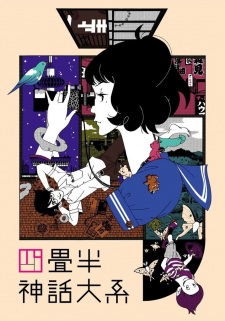



Alternative TitlesEnglish: The Tatami Galaxy Synonyms: Yojo-Han Shinwa Taikei, Yojou-Han Shinwa Taikei, Yojohan Shinwa Taikei Japanese: 四畳半神話大系
Information
Type: TV
Episodes: 11
Status: Finished Airing
Aired: Apr 23, 2010 to Jul 2, 2010
Duration:
23 min. per episode Rating:
PG-13 - Teens 13 or older
L represents licensing company
StatisticsScore: 8.541 (scored by 10947 users)
Ranked: #732
Popularity: #614
Members: 29,323
Favorites: 1,163 1 indicates a weighted score
My Info
Popular Tags
No tags found |
|
|
Detective
260 of 389 people found this review helpful
|
11 of 11 episodes seen
|
| Overall |
10 |
| Story |
9 |
| Animation |
10 |
| Sound |
9 |
| Character |
10 |
| Enjoyment |
10 |
I don't mean to get deep, and definitely not right off the bat, but it's pretty true that small events can change the course of your life, whether you're aware or not, and technically, that's what Yojou-han Shinwa Taikei (or the 4.5 Tatami Mat Galaxy) is all about. Sure it's also about pleasing your Johnny, hijacking blimps, engaging in prank wars, being ripped off by fortune tellers, joining the local power ranger squad, and eating cats and castella, but that's all trivial. Brought to you by the same guy who brought you Mind Game, Cat Soup, and Kaiba, Masaaki Yuasa, brings you what I would like to refer to as his best work yet.
Story: 9/10
A nameless protagonist, referred to as Watashi ('I') by himself, has just entered college, and the story more or less follows his many lives and many misfortunes. Each episode starts with Watashi pursuing something inane or stupid - like a "rose-colored campus life" or "raven-haired maidens" and in each episode his friend Ozu, manages to somehow screw everything up. I say friend in the lightest sense of the term, because Ozu isn't really anyone's friend. He's a backstabbing punk who just loves to terrorize people, and he always manages to infect Watashi in one way or another, usually ending up driving him away from his goal. Along Watashi's trip across the Tatami Galaxy you're introduced to many different people, and in each life, a different story unfolds. Each story is unrelated other than by starting the same way at first glance, but you'll start noticing some patterns, and eventually it brings you to one of the most impressive endings I have ever seen. If I were to tag a genre to this anime I'd first have to say it's a slice-of-life comedy, then mystery, but it's also a really great psychological anime. It's incredibly dialogue heavy, and the first three minutes of episode one has the most text I've ever seen in an anime. That being said it can be very easy to lose track of what is going on, but if you're on your feet then you shouldn't get lost too easily.
Art: 10/10
Yojou-han is brought to you by MadHouse, which is known for it's diverse art style and in this anime's case it is either defined as pretentious or glorious. I would like to call it the latter. It's non-traditional and is unlike any other anime in existence, seriously. It's like Mononoke when Mononoke was new, it can amaze people, or turn people the heck away. It's a very vibrant anime, and everything is so fluid - movement looks just splendid. For those faint of eyes, be wary, Yojou-han Shinwa Taikei may not be the anime for you.
Sound: 9/10
Well, there's a song about shapes in an early episode. That was like, totally freaking awesome. How many anime have songs about shapes? Unless Fullmetal Alchemist the Musical is coming out anytime soon, I think that's about a zero other than Yojou-han. The opening is amazing, and Asian Kung-Fu Generation does a great job (It's called "Maigo Inu to Ame no Beat"). I believe it's their first opening for a non-shonen show. The ending is amazingly well positioned (you'll see what I mean) and the first time you hear it I promise you'll get a small shiver. The singer is the same who sang the Arakawa Under the Bridge opening, Etsuko Yakushimaru. The voice acting for every character is of course, awesome as well. Watashi does most of the talking and I was considering favoriting his voice actor (Shintaro Asanuma) just because I liked to hear him talk. The background music is the only flaw sound-wise. There really isn't much to listen to, and even if their is, I probably didn't notice, because between following the dialogue and looking at the art, it's pretty hard to manage a third element.
Character: 10/10
I've already explained who Watashi is, but let me tell you a little more. Watashi likes shortcuts and doesn't like working, and almost can be seen as a lazy Ozu. Ozu is our antagonist most of the time. He's the downright rotten scoundrel who always leads our poor Watashi astray, and usually ends up profiting off of it. I called Watashi a "lazy Ozu" a moment ago because Watashi isn't an innocent little bird, he's just too lazy to put his efforts into anything other than his hobbies. Akashi, the somewhat romantic interest, is a girl who loathes moths and is bluntly cold to everyone around her. Kind of like Senjogahara (from Bakemonogatari), but easier to cope with. She's pretty funny herself, but all the characters are. We have the doll-fanatic Jougasaki, the drunk and elder Hanuki who likes to speak broken engrish, the Master Higuchi, who is an 8th year graduate who plans to travel the world, and multitudes of others (like Watashi's Johnny (see Eden of the East)). The character development is insanely good too. This anime is about Watashi's little foray of self realization, thusly he gets the most character development, but never have I seen it done so well.
Enjoyment: 10/10
An anime that can create a macrocosm within itself is an anime to be trifled with. It sets the stage with brilliant characters and visuals, brings hilarious moments throughout, and manages to deliver numerous meaningful messages. Is there a perfect world? Will I be happier with more money and women? Will I be happier doing what people say I should? Yeah. It's pretty damn complex. It's as thought provoking as Kaiba while bringing the comedy of Gintama. I think it's safe to leave it at that.
Overall: 10/10
No fanservice, no lolis, no moe, no ultra-violence, no regrets. It's intelligent without being snobby, it's stupid without being idiotic, and it's appealing without being inappropriate.
To sum it up, I think you should just try it out. It's only 11 episodes, and I think for the one season range of anime, this is one of the best out there.
Destiny is always dangling right in front of you, so why not reach out and grab this anime? read more
|
|
Lindle
165 of 266 people found this review helpful
|
11 of 11 episodes seen
|
| Overall |
10 |
| Story |
10 |
| Animation |
9 |
| Sound |
8 |
| Character |
9 |
| Enjoyment |
10 |
Yojouhan Shinwa Taikei (or The Tatami Galaxy) is an anime about a university student stuck in a Groundhog Day-esque time loop. In the span of each episode, our nameless main character (he is referred to as Watashi, basically meaning "myself") goes over the same two years of university, unaware of the loop, each time joining a different club, in search of a "rose-coloured campus life".
Yojouhan is a rare example of a series with time loops where the loops themselves are actually played with. Throughout the 11 episodes, there are several different stories, but many of the episodes focus on the same stories as others. What makes these episodes work is that we see the stories from different angles. In some episodes, we see segments of the story that aren't entirely clear, though at the time are not distracting. In later episodes, these plot points are often explained when Watashi's perspective changes and we see what actually happened. The best part of this, though, is that every episode lends pieces to a larger story. While the series is episodic, what we see effectively falls into place like a jigsaw puzzle, all coming to fruition in the final episode making for one of the most satisfying conclusions I've ever seen.
As a result of this, the first few episodes of the series don't make complete sense. They come off as being more abstract than part of an actual plot, but as the series goes on the beginning is referred to in a way that makes this start a vital piece of the puzzle. However, the start is hardly a throwaway. While not as strong as the rest of the series upon viewing, the bizarre and abstract style make the beginning an enjoyable watch anyway.
On that note, the way the series is presented is part of the genius. Upon starting the show, the first thing that will strike you is undoubtedly the art. The characters are drawn in an oddly cartoony way, using only one-tone colours for the art and having a rubbery kind of movement to them. This seems like an odd choice, but it does help to draw you into the unique world of Yojouhan, and later in the story it even gets used for plot purposes. This is also combined with a lot of black and white live-action shots, wherein the characters are sometimes drawn over the actors.
The strange presentation doesn't stop there, though. One strange feature of Yojouhan is that Watashi is very fond of monologuing, in a way very reminiscent of Kyon (from the Haruhi Suzumiya series, in case you've been living under a rock). He does so, however, at a very high speed. If the show has a fault, it is this, but it's more of a double-edged sword than a flaw outright. For people who aren't great at reading, the high speed of the subtitles can often make the things Watashi says hard to keep up with, but it's rarely overwhelming. On the plus side of it, it helps to keep the pacing of Yojouhan fast, which keeps the series interesting, an important factor in a series that is driven with an abundance of dialogue (excellent though the dialogue may be).
For a show that could have easily been dull or just weird if it had been handled wrongly, it only makes sense that even more precautions are made to make sure that there isn't a dull second in Yojouhan, as evidenced by the motormouthed narration. What helps with this is that rather than being thrown into an entirely new plot every time, there are a few elements that remain the same throughout every story. The beginning and end of each episode are usually the same, as well as Watashi's meeting with a fortune teller. This helps the viewer to keep a pace with the series, which may have been otherwise hard to do.
The characters of Yojouhan aren't really the focus point, but they aren't an afterthought by any means. While each member of the cast is a vibrant and distinctive individual in of themselves, the actual characterisation isn't really the strong point of the characters, but rather how they are used. Just like the story, each character and their actions throughout the two years are explained slightly more with each new perspective. This ends with more or less every character coming out good, but one character in particular sticks out as being an excellent example of defied expectations, showing their nature as a 3-dimensional character as we see their story from each side fall into place. I won't spoil who it is, but anybody who has seen the series should know who I mean. Watashi himself, while an unremarkable person, is hard not to like for his enjoyable musings and relatable situations, and as the series goes on he does develop well, if not remarkably so.
Of course, the time loops persist for as long as Watashi continues to miss the proper way to live the two years, with conclusions that have been dangling in front of his eyes the whole time. Some of the conclusions become expected after a mere few episodes, but other, more important ones (as well as the entire point of the time loops) are less obvious and yet no less excellent.
Yojouhan Shinwa Taikei is an exercise in series structure unlike anything before it. The way the entire series is built comes off as nothing short of genius. I have yet to see any of acclaimed director Yuasa Masaki's previous works, but Yojouhan makes it blatantly clear that he lives up to the reputation that precedes him. I can only hope Kaiba, Kemonozume and Mind Game are nearly as good as this, because now Masaki has set an excellent example of how to make a truly great, original anime.
Story/Plot: 10/10
Animation/Graphics: 9/10
Music/Background: 8/10
Characters: 9/10
Overall: 10/10
For Fans Of: Bakemonogatari, Welcome to the N.H.K! read more
|
|
NonOtaku
24 of 40 people found this review helpful
|
11 of 11 episodes seen
|
| Overall |
10 |
| Story |
10 |
| Animation |
9 |
| Sound |
8 |
| Character |
10 |
| Enjoyment |
10 |
If there was ever a time to slow clap it out, this would be the precise time to.
This series really is why I love episodic series. The bad ones obviously suck beyond belief, but when shows like this one make optimal use of them they can really turn into something unique, and the short stories can allow for ideas that would normally not fit within a linear storyline. A lot of things have to be done right in order to get a good episodic series, though, but to me the key seems to be creativity, along with somehow finding a way to build-up: connecting the different episodes together. I believe that if these aren’t present, you’re just better off with a linear storyline in order to get the best out of your characters. But Yojouhan Shinwa Taikei has both of them.
A man is miserable. Despite all his dreams of a “Rose-Coloured Campus Life” filled with raven-haired maidens who dote on him, his social life is going nowhere. He has no girlfriend, his only good friend keeps getting him into trouble, and the circle he joined brings him no joy. So he tries again, and again, reliving his first two years of college life ad nauseum, making different decisions each time, having no recollection that he’s already done this all before. Will the man ever be satisfied with how his life turns out?
The character designs have a stylish comic book economy that give the impression the animators completed each frame in just a few strokes. The exception is Ozu, Watashi's friend who has a frightfully amphibious face: a head like a fish's, teeth like a shark's, and unnervingly dark lips set against a pale visage. Occasionally, in his wiliest moments, they give him a wagging fox tail. Other than that, most of the artistry occurs in the background details (fractal patterns in the trees and the scenery made of eerie black-and-white live-action photography), the framing of the shots, and the precision editing, which cement Yojouhan Shinwa Taikei's patchwork aesthetic beautifully.
They tend to merge real life shots and video in with the episodes when appropriate and it doesn't seem too out of place which is kinda hard to do so that's a plus. There were no crazy battles, no artsy flips or anything out of the ordinary. However what they did need to do was done well.
The music is borderline strong - the OP is a modern classic by AKFG - I rarely sit through the OP on anime, but I did throughout this series.
The ED was pretty fitting especially for the mood at the end of each episode and oddly seemed to also fit the animation sequence.
Overall the OST is just a decent compliment to the whole story but never takes on a life past background music, arguably what it's intended for and in which case would be perfect but sometimes you can't beat a crazy score overlaying a scene.
Wonderfully planned out, believable, and deep.
Watashi- The nameless protagonist of the story, he wants a rose coloured college life. Well, he must struggle and avoid Ozu's madness in order to attain this fleeting dream of his, all while trying not to waste his life in these pursuits of happiness.
Ozu- A mischievous little two-faced, backstabbing, prankster that always seems to torment and bring down our protagonist.
Akashi- The fated lover to our protagonist, however always at risk of falling to Ozu supposedly. Akashi's a cold and introspective character but at times shows subtle hints of appreciation or affection towards the protagonist.
Oh, and did I mention she has Mottephobia?
These are the central characters, we also get to see a ton of different sides of the characters, and the most important part is that we see Watashi develop in many different ways throughout each episode. The different side-characters all have their own parts to play in Watashi’s world and everything comes together wonderfully in the final episodes.
Overall, this series is one of the most underrated, under appreciated and unknown anime. It is a hidden gem unknown to people. You will rarely see an anime that is very funny but has a very deep meaning. If you are looking for a unique, non-mainstream, non-complex and very interesting story.
This really is an amazing work. It'll make you rethink life which is rare these days. Sure an Anime might awe you with an amazing character to the point you try to emulate their traits. But very few make you reconsider life from a new point of view. I highly suggest you watch it, because it really has it all!
So let us all gather around a 4.5 Tatami Room slurping on our delicious Neko Ramen. read more
|
|
AnnoKano
28 of 58 people found this review helpful
|
11 of 11 episodes seen
|
| Overall |
10 |
| Story |
10 |
| Animation |
10 |
| Sound |
8 |
| Character |
9 |
| Enjoyment |
10 |
When you look back on your life up until now, do you find yourself feeling somewhat dissatisfied with how things have turned out? Do you find yourself regretting choices you’ve made, the people you’ve met and end up wishing you could just give it another shot, knowing that this time around, everything would work out so much better for you?
If you are just such a person, then watching Yojouhan Shinwa Taikei -or The Tatami Galaxy as it has come to be known in English- is one opportunity that you simply can't afford to pass up.
The story of a nameless (referred to as 'Watashi') young man in his third year at Kyoto University, looking back on the numerous adventures, expeditions and escapades he has experienced during his time on campus. However, rather than fond memories, he finds himself feeling rather dissatisfied with the way things have turned out, and proceeds to ask himself where things started to go wrong.
Perhaps it was the club he joined. Maybe he made a few bad decisions along the way. But in all likelihood, it was all Ozu's doing. But it doesn't really matter who is at fault. With his opportunity missed, Watashi has no choice but to harbour his bitterness and day dream about how things could have been so very different...
And then something miraculous happens, and Watashi is given something that you and I will never have; a second chance. The perfect opportunity to go back to the beginning. The opportunity to do it all again, to avoid his previous mistakes and ensure himself a life of happiness. But one simple question still remains; which path should he take? Which of the various roads, streets and avenues is the one that leads to that most glorious of gardens, the rose-coloured campus life?
Unsurprisingly for a character who's name essentially translates as 'I', Watashi is a character that is easy to identify with; after all, 'disappointment' does not discriminate based on sex, race or class, and at the end of the day we are all looking for the same thing Watashi is-- our own happiness.
But he is just one of the many interesting characters in the Yojouhan universe- there's Watashi's quote-unquote friend Ozu, who seems to be set on preventing Watashi from enjoying a care-free existence. There's Master Higuchi, a local god engaged in a bitter "war" with the leader of the film circle. Last but not least there is Watashi's underclassman Akashi, who's charmingly cute appearance, sets the hearts of men flying, shortly before her distant and fiery attitude brings them crashing back down to earth like Icarus.
But Yojouhan's most impressive achievement is its beautiful, understated visuals. Despite integrating features like stylised photography and simplified character designs, Yojouhan never feels like a Director's visual experiment, but a seamless, straightforward production; proving that looking good doesn't always mean you need to show off. Of course, the animation and directing is still top notch, as you would expect from a show that takes this much pride in its art.
The soundtrack, while certainly not below average, is the only thing about Yojouhan that can adequately be referred to as a weakness. The background music -quiet pianos and melancholic violins- certainly do their job, but fail to be impressive. This is a little disappointing when compared with other aspects of the show.
The opening and ending themes do offer some condolences though, with a particularly catchy opener 'Maigoinu to Ame no Beat' by Asian Kung-Fu Generation features grungy guitars and lyrics about the banality of everyday life yet has a subtle optimism about it which feels perfect for Yojouhan. Meanwhile, the ending sequence combines an atmospheric trance song with some mesmerising visuals.
Then there's the dialogue, set to the kind of pace one would normally expect in an auction-house. Long and complicated sentences that begin and end within the confines of a single breath. While it makes reading the subtitles a little bit of challenge at first, the extra effort is worth it, as it makes the dialogue far more interesting, and is just one of the many things that demonstrate the level of attention to detail in Yojouhan.
Offering an interesting storyline and considerably more depth than the typical 'Slice-of-Life' anime and each episode offers something new and original, without ever having to rely on tired clichés like hot spring or beach episodes. It gives the whole show a remarkable freshness, and every episode is a pleasure to watch. And best of all it, it manages to be so much more than just straight up entertainment- it actually has a point behind it all. It leaves you with something to think about, and without resorting to emotional blackmail.
Whether you're an expert or a beginner, a casual or critic, watching Tatami Galaxy is the perfect choice for a few hours of quality entertainment. Anime this good only come around once every few years, so don't hesitate. Isn't it about time you seized the opportunity that is dangling in front of your eyes?
read more
|
|
i_c___c_i
44 of 92 people found this review helpful
|
11 of 11 episodes seen
|
| Overall |
9 |
| Story |
9 |
| Animation |
10 |
| Sound |
8 |
| Character |
9 |
| Enjoyment |
9 |
What stands out the most, the part of it that will leave a lasting impression is how "Mythological Chronicles from the Four and a Half Tatami Room" excellently makes use of the episodic format, and even more than that how it shows itself as aware of the medium through which its eleven episodes flow, using the particularities of a TV series to its advantage, crafting a story that isn't only shown as a sequence of chunks of animation and sound, but also absorbes this contour into itself. And it doesn't do that like how you'd think a series that plays with its format would do it, by being an anime series about an anime series, or a show about a show. But I'll refrain from doing anything more than hinting to what makes it special, and i'll stop myself at this negative definition of the series, describing it as what it's not rather than what it is. If you want to spoil it for yourself, I won't help you with that.
There are plenty of series that develop in an explicitly episodic manner, aided by the scaffolding of certain repetitions. There are plenty of series that follow that "classic" formula of the monster of the week. And that's because the format lends itself well to such a thing. TV series are fragmented experiences by their nature so taking an insular approach when showing the viewers their world, when revealing their story, in a way comes naturally as a consequence of the medium. Often, it's just a convention that nobody talks about, creators follow it and we watch their product. It's something too familiar to be noticed, so most of the time everyone is content with a Doylist explanation - it's shown twenty minutes at a time, they had to work around that somehow. When this observation is made in-universe it's usually played for comedy with the characters wondering for example, why they're doing the same thing every week or other such moments that break the fourth wall. Occasionally though, there are series that incorporate this aspect about themselves, into themselves; series for which highlighting this repetition is more than a rare interruption, comedic or not. "Yojouhan Shinwa Taikei" is such an anime series. It also has moments when it cracks a hole through the wall that separate it from those watching but there is more to it than that. There is a reason behind its repetition, an explanation... more importantly, an in-universe explanation. It goes beyond time or commercial restrictions and works in synergy with the series' storyline. It's always right under the viewers' noses but as obvious as it is throughout the show, it unveils itself bit by bit, and when you finally get to see all its layers it's still pretty interesting. No, it's very interesting, it's all the more interesting for that. This anime uses literally every segment that is characteristic of TV series to create this experience, even the opening and ending songs which at one point will switch places to great effect.
Perhaps this is also one of its weak points though, just as much as it is one of its strong points. The series uses this episodic format due and through but it still has an overarching plot and bridges between its islands that need to be explored, so you can't get the entirety of what makes "The Tatami Galaxy" what it is without watching it until the very end. It doesn't have the advantage a show like "Doraemon" has for example, where you can jump in and watch whatever episode you want and still get what the series is about because its episodes are almost always perfectly self-contained. The show plays with this idea of showing one story per week in an interesting manner, and unlike in "Doraemon" where every episode can stand on its own, here there is always something in the shadows, a thread linking everything together. A thread you'll find the head of only in the last two episodes, and while everything that happened before makes this discovery a lot more meaningful and give it a greater impact, some might not fully enjoy the wait up till that point. I too don't like episodic, repetitive series. But I enjoyed this series in spite of that... or more accurately, I enjoyed it in no small part because generally I don't enjoy watching repetitive series. And that's not only because like I said, when you watch it as a whole it twists certain conventions of the format and turns some of its flaws into an advantage, but also because it manages to avoid many of the trappings that eventually make watching an episodic anime a boring experience. There is enough change and variation from episode to episode for it to remain relatively fresh.
Contributing to that is the great animation and unique visual style. Although I can't say I always like the results (like in "Mind Game" where there are certain things about the animation that aren't to my liking) I do appreciate Yuasa Masaaki's persistence at doing something different than the rest, at making his works stand out at least in one way: visually. And you can definitely see the results of this impetus in "Yojouhan Shinwa Taikei". The anime's overal aesthetics are mainly dictated by Nakamura Yuusuke's character designs. He also did the illustrations for Asian Kung Fu Generation's CD covers, who sing the opening song, so if you're familiar with those you already know his style - extremely flat with little or no shadows, preferring vibrant and colourful shapes to creating an illusion of 3-dimensional depth. The series' visual style flows from that, with an emphasis on a simplistic flat look, nice colour schemes and stylistic deformations over visual realism. And of course since detail takes a backseat to these in a scene, the animation is consistently fluid. That doesn't mean that the smaller details in a frame have been completely ignored though. The anime is still often pretty detailed visually. It doesn't cut any corners in that department and uses a great combination of 2D and 3D animation, even live action footage (especially, but not only, in the opening sequence).
Their design is not the only thing that makes the characters stand out of course. The series is filled with quite the interesting bunch, and by the end of the anime you'll get to know some of their qualities but also some of these characters' flaws, making the cast fairly rounded. There's also a surprising amount of character development. You might guess where some of the characters will end up, but a lot of what will happen will turn out to be a surprise... a pleasant surprise. By the end of the series, the main characters are very different from what they were when it all began, some will even switch roles. My favourite character is definitely Ozu, not only because he is the trigger to a lot of interesting events but also because he has very good chemistry with the unnamed protagonist, his best friend - whenever they interact, the result is great. Contributing a great deal to that are their voice actors who do a great job at bringing these characters to life, like veteran seiyuu Fujiwara Keiji who voices Great Master Higuchi or personal favourite Sakamoto Maaya who voices Akashi, an engineering student and important character in the overal plot of the anime.
If I had to force myself to complain about something in this anime, it would probably be the soundtrack. Of course, the music in the series is still good but compared to the other aspects of the show, there was room for more and better - it doesn't have the same impact say, the animation has. But I won't complain about that. Well... let's pretend I didn't, because
"Mythological Chronicles from the Four and a Half Tatami Room" is a great romantic comedy. It's a clever anime with a lot to offer and if it does have its flaws, it goes above and beyond to compensate for them with everything else that's going on. For each of the things in it that are lacking there are a pleiades of others to make up for it. If you decided to start watching it, you should definitely stick with it until the end... read more
|
|
Silent_Scream
33 of 70 people found this review helpful
|
11 of 11 episodes seen
|
| Overall |
10 |
| Story |
10 |
| Animation |
10 |
| Sound |
10 |
| Character |
8 |
| Enjoyment |
10 |
2010 wasn’t really a great year for animes. If you’ve noticed, most of the genres in this year would be the: very clichéd moe-gags; the once you’ve seen it, you’ve seen them all harem; the amazingly ridiculous PLOT (if you know what I mean) and fanservice; and the de-braining existence of mindless comedies. Amongst all these genres, the hailed “best” and probably most overlooked anime of this year would be a mind-twisting dark comedy which was The Tatami Galaxy.
The Tatami Galaxy runs with different arcs for each episode with a total of 10 arcs. These arcs keep on repeating but with different twists and circumstances. By this type of story-telling, it could often be compared to the “Endless Eight” of The Melancholy of Haruhi Suzumiya (2009) and the total mind-blowing Higurashi no Naku Koro ni. Though it might be used as a comparison, the three titles are entirely different. In The Tatami Galaxy, the same situation arises but with the existence of tons of different options in which it could provide a different ending for each arc; in Haruhi, all scenarios were the same but Kyon just need to realize something to break through the endless cycle which in turn could get very annoying; and the difference from Higurashi is, instead of preventing something from happening with the efforts of everyone around, The Tatami Galaxy is trying to make things happen by yourself… and it doesn’t involve killing lolis.
The Tatami Galaxy is being told in how the main protagonist perceives his world. He is the focus of the story and is also the narrator himself. Having the main protagonist as the narrator, depending on the circumstances and situation, he could be extremely biased and most of the time uses exaggeration in describing things. By running through parallel worlds, the anime looks on the different angle of events, like what could have happened if he chose this over that and the other numerous possibilities. All the 10 arcs will always start the same but with immediate options that were presented these greatly affects the outcome. Sometimes, some events that are entirely irrelevant to the current arc are seen but then it will be shed light upon on some other arcs as to why such a phenomenon occurred. These events are also used to fill out the missing links in each and every arc leading to a grand conclusion.
The main character of The Tatami Galaxy didn’t state his real name all throughout the span of 11 episodes thus he calls himself “Watashi.” Being the main character, he is also the narrator himself in which kind of reminds us of Kyon (Haruhi) but a lot better and is absolutely not a total killjoy. Unlike your usual high school life setting, The Tatami Galaxy is set on a college stage. Watashi is a college student that goes with the flow of his surroundings; in which other people are a great factor. One of these great factors or if not the main reason why this happens is the guy who was described by Watashi having a youkai-like face, Ozu. Ozu is a mischievous student who is your typical trouble-maker. He bullies the weak, sucks up to the strong, a backstabber, doesn’t care as long it’s fun, has low grades, hates vegetables and etc. He is the most hated guy of Watashi but also his best friend. Being a college student, Watashi also has his campus crush who is Akashi. Akashi is the strict and no-nonsense type of girl but also has a cute side to her as she is easily scared by the presence of moths. Some more important characters are the Fortune Teller who always runs away with Watashi’s money, the campus heartthrob but who has a creepy fetish Jougasaki, the “Master” man-user Higuchi, and the drunkard dentist Hanuki. Through the different arcs, the characters reveal their different facet except for Ozu which is pretty much linear as he remained to be the usual boisterous youkai that Watashi believes him to be. Though near the end, a revelation will be known as to why he acts that way. These people greatly affect what is happening and unless Watashi doesn’t find content with his 2 years in college, the time loops will always occur thus leading to another arc and story.
The humor of The Tatami Galaxy mainly runs on the narration and the conversation that Watashi does with the other characters. By any chance that you’re wondering what is with the “weird” art, it is actually used to describe how Watashi sees things. The art is done as simple and twisted as it could be so that in other arcs were Watashi’s views are different, it could be easily changed and adapted. The theme songs of this anime are done by Asian Kung-Fu Generation and by the one who sang the Arakawa Under the Bridge’s opening, Etsuko Yakushimaru. Surprisingly, Koinu to Ame no Bīto by AKFG is not as J-Rock as their other anime songs which fits as an opening song of this anime perfectly while Kami-sama no Iu Toori by Etsuko Yakushimaru is simply awesome. It is so haunting yet so catchy that will leave you craving out for more.
There were no dull moments in The Tatami Galaxy as you might often find yourself focused on to know what’s going on because of the rapid narrating of Watashi. Being monotonous and very fast, it helps in getting more attention and kills any boredom that makes it always interesting. But by this, you really need to focus and some people might stop and pause a lot of times if you’re not a fast reader and could not understand Japanese.
Overall, The Tatami Galaxy is one great anime but sadly is overlooked by some. Honestly, there could possibly be no wrong in this anime just the fact that not all would appreciate it as it mostly appeals to those who like to think while watching which mostly consists of the older age group. But if you’re a fan of dark comedy with a brain-twisting plot, you should just go and watch this now.
read more
|
|
roriconfan
60 of 129 people found this review helpful
|
11 of 11 episodes seen
|
| Overall |
9 |
| Story |
10 |
| Animation |
9 |
| Sound |
9 |
| Character |
10 |
| Enjoyment |
9 |
When I first watched the first episode, a lot of other titles started popping up in my head. I kept making references to other older works, which usually translates to bad final impressions. But eventually, this series is not a complete rehash of other titles; nor it was made with disjoined elements that seem like random scenes thrown in the pot. Despite all the shortcomings of a story that feels episodic, random-gaged, and repetitive, I must say that by the end of the day it was none of the above. But I need to explain myself by implementing the notorious “comparative criticism” I am so fond of.
STORY SECTION: 10/10
This series is to the most part a comedy. If you happen to have watched several anime comedies you will probably have realized that the story is (ironically) a joke too. The first episodes set up a premise, they promise a plot, they give hints of mystery, progress, evolution… and do Jack. Really, it doesn’t take more than 2 episodes to turn to random gags, episodic structure and open ended to keep trolling the viewers for a sequel with the hopes of a conclusion to come along… only to dreadfully create a far less exiting second season with usually far less context and far more fan service. Recent examples to the series’ airing dates include Arakawa Under the Bridge, Working, B Gata H Kei . Go further back and, WOOP, 99% of comedies are like that. This is quite the usual bait and fandom bites it all the time, unwilling to admit the harsh reality. It is also quite ironic how the first anime I ever watched was in fact a comedy… with a concrete story! I am referring to Kabamaru Igano which is surprisingly good even by today’s standards.
Anyways, after all that came Tatami Galaxy which happens to belong in this very rare category of concluded scenarios. That alone is enough to give Story a wooping score… but there is more! Yes, there is! The structure of the story eventually becomes a web of events that interact with one another, making the final episode to actually feel like everything happened for a reason as such. It didn’t feel like there were wasted episodes, dead time, random gags and such. Remember that Haruhi / Haibane Renmei / Matrix rip-off that was Angel Beats? Well forget it; this series is actually NOT shitting around just to end up being rushed and half-baked.
Even more, the story is actually deep, far more than a run of the mill plotless school comedy. In fact, to the most part it was planned along to unfold this way BEFORE starting making the first episode. The scriptwriter didn’t begin with the usual “Well, duh, let’s start at random and make up stuff along the way.” Thus the story does not only avoid random progress but also offers a lot of other delightful extras, such as multi-layered lines of events, science fiction, psychological immersion and even witty life lessons around one’s being. Now that is what I call a wonderful story!
Was it an original story? Nope. Usually that means I am loosing interest in it very fast but this time it was actually far better that all the other similar stories I could think of.
Mind Game has similar thematics in terms of the protagonist’s inability to interact properly with others. In fact, the visuals and the plot reminded me a lot of that movie. In fact… it is made by the same guys! WOOP! And guess what, being a series that takes place in far more areas and has more duration allowed the same theme to unfold far better and smoother that in that movie. Thus it is overall SUPERIOR to Mind Game, a movie which many have in their tops.
Sayonara Zetsubo Sensei and Kuuchuu Buranko are comedies with a high amount of artistic animation, social criticism, and psychological immersion. The problem is those where episodic and had no overall plot or story. Thus, once again, Tatami feels SUPERIOR in this regard.
Bakemonogatari had in similar fashion to the above witty dialogues but the story was far too simple and could easily split to stand-alone arcs.
The main story being about time loops has also been done before with the most recent example being Endless Eight . WAIT, TAKE OUT THE GUN FROM YOUR MOUTH! GET DOWN FROM THE ROOF! MOVE AWAY THE KNIFE FROM YOUR WRIST! Although this series has a similar form of pacing, it is NOT REPEATING TO THE POINT OF SUICIDE. It made sure to be using the same events with a far different take or just skip them when they loop and leave you alone to understand the rest.
Again with time loops was the great Girl Who Leapt Through Time. Although I am very fond of that work, it still feels less captivating for being a movie with less artistic approach.
Thus I find no reason to give the story anything less than a perfect 10. The ending may feel weird and far-fetched or as some called it “pretentious” aka the scriptwriter offers the ideal ending on a subject that bothers him. That is not a reason to detract point from the story, since as I said for such a type of series offers a hell of a lot instead of just going for the easy way.
CHARACTER SECTION: 10/10
Then comes the cast, which feels good as well. Usually a series focuses too much on one or two characters, leaving all the rest as comedy generators, irrelevant and useless to the actual plot. Remember TK in Angel Beats? Yeah, he was dancing and speaking in dreadful engrish. Did he actually do anything in the story? Nope! Here, every character is part of the plot, affects future events and is looked upon from different viewpoints. By the end of the series they have all evolved far beyond the archetypes they were formed from and are not by any chance cardboards. Plus, the way the series uses internal monologues all the time offers a deep insight to each one’s mentality that flesh him/her out with simple comedic speech. So cheers to the scriptwriter for a job well done!
Some may feel dried up and not imposing in any way. I find no reason to detract points for that as they are still maturing and evolved by the end of the day. Also, the most interesting character ends up being Ozu, the “main villain” of sorts. Unlike most series where the villain overshadows the hero for being damn evil and politically incorrect, here he is great for having a secret agenda that is revealed late in the story. Yippee!
ART SECTION: 9/10
True art is timeless. It has nothing to do with KEWL visuals and 2354 different points from which the sound emanates. This series uses a style that is both minimalistic and enough for all that it tries to depict. Abstract, almost cartoonish, with almost no shading on characters and with a lot of live action film segments used in for quick depiction of areas with lots of background detail. Although that can be seen as cheap by most, you can see that it actually fits with the thematics of the story and doesn’t actually hinder it in any way. It really has to do with tatami apartments and university groups in Japan, plus it takes a somewhat realistic approach on the problems many college students face. So it’s not alienating to see actual filming of such areas. And if you add to that all the psychological symbolisms, such as Johnny the Cowboy, then you get a very interesting result that hardly disappoints. And believe it or not, it actually has more animation and detail that Shaft’s works, which although similar in aesthetics use still panels most of the time. I prefer the Miyazaki fully animated level of detail a bit more than this but I still like it very much.
SOUND SECTION: 9/10
Hm, the protagonist speaks faster than a speeding bullet and you’ll end up freezing the episode every 30 seconds to find the time to read the subs. Other than that, I’ve seen even faster speech in Puni Puni Poemi. But no worries, it is still very funny and smart most of the time, as most of the context is an allusion to ones’ mentality. Voice acting is fine too; I found no out of place pinching in voices. Sound effects contribute to the series’ thematics and the music score is good both in intro and outro.
VALUE SECTION: 9/10
Replay value is actually very high, as you will be interested in watching again all those minor details that were cleverly intergraded in each episode and seemingly played no purpose up until the final episode, where everything comes together. Beyond that, it is an ingeniously made series, far more mature and well thought of that most comedies out there which are no more than “Well, duh, there is this cute girl and, duh, a dork living with her, and, I don’t know, duh, stuff happen”.
ENJOYMENT SECTION: 9/10
Aside from a few scenes that appear really weak in humor and the ending that may or not feel meh for some, I must say that I fully enjoyed every minute of it; a thing as rare for me as finding a virgin in a red lights district.
VERDICT: 9.5/10
A very good and funny take on a subject that is somewhat overused in a bad way.
SUGGESTION LIST
Mind Game (anime movie)
Sayonara Zetsubo Sensei (anime series)
Bakemonogatari (anime series)
Kuuchuu Buranko (anime series)
Endless Eight (Haruhi trollfest)
The Girl Who Leapt Through Time (anime movie)
Cube 2: Hypercube (live action Western movie)
Groundhog Day (live action Western movie) read more
|
|
Fuzzen
37 of 78 people found this review helpful
|
9 of 11 episodes seen
|
| Overall |
10 |
| Story |
10 |
| Animation |
10 |
| Sound |
10 |
| Character |
10 |
| Enjoyment |
10 |
From the critically acclaimed director Masaaki Yuasa comes an anime that defies the definition of conventional: The Tatami Galaxy provides a ride full of twists and turns, rewinds and jumps through time. Beautifully crafted and imbued with a comedic touch, The Tatami Galaxy explodes with energy, ultimately forming a dense and complex narrative that serves as the embodiment of good directing. Indeed, The Tatami Galaxy proves that animation is a viable medium in terms of both storytelling and visual appeal.
Upon first glance, what do you notice? Chances are it’s the art style. Similar to Yuasa’s previous works, The Tatami Galaxy features a unique, anomalous, but yet simple art style that never fails to evoke a sort of anger towards Yuasa among some anime fans, for many claim that they watch anime to get away from this very style; however, The Tatami Galaxy’s art style reasserts the classic saying that less is indeed more. The style itself is brimming with simplicity; characters are bestowed with one shading at all times, only the most dominant features are depicted, while chins, ears, adam’s apples, collarbones and other aspects of the body are forgotten, leaving the characters themselves appearing very flimsy, curvy and far from dynamic.
How, you may ask, does this advocate the fact that less is more? For those of you unaware of the mechanics behind the animation process, animators must draw a character numerous times, bearing the same proportions and details as the previous sketch. As a result of this, many animators spend their time copying over details from the preceding drawing rather than creating a sense of flow between them. On the contrary, The Tatami Galaxy’s simple style allows the animators to portray actions more fluidly and regularly than other shows. The condensed style is much faster to draw, and so the animators are given a chance to work without restraint, and that is absolutely what they do. Characters ricochet across the screen, a plethora of objects move at once, still frames are very limited, and unlike many other anime, budget does not act as a confinement for imagination.
I would also like to point out that, from a cinematic standpoint, this anime is incredibly well put together. Transitions between scenes flow brilliantly and scene composition is done with great expertise. I wouldn’t be exaggerating if I said that The Tatami Galaxy is easily one of the most visually appealing works of animation that have ever graced this earth.
Does the theme of less being greater than more desist after moving away from the topic of art and animation? Well, not entirely. As the story progresses, or rather regresses, the characters are shown in varying situations that range from sad, hilarious to downright over the top. Rather than taking the time to elaborate as to what the character’s roots are, the show uses its recursive nature to build the character’s personalities and give them a good portion of depth. The characters themselves are all very likable and are drawn very smoothly. I especially enjoyed Ozu’s antithetical antics and Akashi’s icy yet affectionate attitude.
The stunning visuals are not the only thing The Tatami Galaxy has going for it; the voice actors pack great amounts of effort, emotion, and in some cases, speed, into their roles. The background music is also similar to the previously analysed categories in the sense that it follows the ‘less is more’ rule of the show. The Tatami Galaxy is at times silent, while at others calmingly quiet, but the rare fast-paced ensembles never fail to produce a sense of excitement and urgency in the viewer. The composer and sound directors working on this show deserve a great amount of kudos for their excellent work.
Lastly, I will assess the plot of The Tatami Galaxy. Ordinarily, I would deconstruct the plot of an anime first and foremost, but coincidentally, this is far from an ordinary anime.
The story follows its nameless protagonist as he searches for love. In an attempt to find his raven-haired goddess and attain the rose-colored campus life he had been dreaming of, he joins a multitude of extra-curricular activities, but the majority of his efforts are for naught. He denies the reality that has been set out before him, and time rewinds back to the day he first joined college, only giving him yet another opportunity to follow one of the endless contingencies awaiting him.
The plot gives the viewer room to guess what’s going on – it allows them to speculate why time resets, how each individual episode correlate with one another, and the nature of the protagonist’s recursive campus life, or to even ponder the possibility of no recursion at all. Rather than taking the viewer for a ride, The Tatami Galaxy lets the viewer create their own ride, then continues to enhance said ride into a rollercoaster.
Overall, The Tatami Galaxy is a brilliantly put together anime brimming with creativity and originality. Like its predecessors, The Tatami Galaxy is filled with Yuasa’s postmodern madness and humor, giving the viewer food for thought and a good laugh at the same time. I’m usually very hesitant to give an anime, or anything in particular, the title of a masterpiece, but I believe that this show deserves no less than that. It is for that reason that I give The Tatami Galaxy all 10s across the board.
read more
|
|
Zergneedsfood
26 of 57 people found this review helpful
|
11 of 11 episodes seen
|
| Overall |
9 |
| Story |
9 |
| Animation |
10 |
| Sound |
9 |
| Character |
9 |
| Enjoyment |
9 |
The problem with calling a piece of work "deep" or "intellectual" is that a lot of people on the internet have very specific notions about their own intelligence, and it's quite often that people will go into a show with preconceived notions of negativity and elitism, hoping that a single mistake in the show's presentation will be enough reason for an unrealistically lowered score in order to convey their superiority and highly developed understanding of visual art to the rest of the world.
That's why, to not insult the people who are fed up with labeling The Tatami Galaxy as an intelligent introspective narrative that incorporates deep themes about what it means to have a "rose colored campus life", I'll just say that if anything else, The Tatami Galaxy is a refreshing story that's bold in its premise and succeeds in its execution. While not necessarily a story that left me in awe over its intellectual depth as deep as The Japan Trench, it definitely has some important things to offer, and past all the volumes of texts, I think there's a lot of really well done things to consider about this show. And while some may complain that the show tries to come off as elitist, and at times bombastic and overly complicated, I think people are missing the point if that's what the show seemed to convey to them.
The story of Yojouhan Shinwa Taikei is very simple. We're introduced to a nameless main character who seeks the perfect college campus life. The episodes follows him on a two year journey of his exploits, where he chooses different clubs and societies in an attempt to gain higher social standing, a beautiful girlfriend, or just recognition of his talents. These escapades usually end in failure, no thanks to a mischievous friend named Ozu, whose very existence seems to be to keep the main character from achieving his dreams. At the end of each episode, as the main character is reminiscing on how things might have been so much better had he not taken the steps that he did, an unexplained plot device spins him back to the beginning of his college years, and the cycle continues with him choosing yet another club to find his perfect two years.
The style of the show is what makes the show visually appealing and inviting. It's a very vibrant world, and the main character's rather mundane and normal appearance creates a very stark contrast between him and an otherwise colorful world, which I thought fit in quite nicely with everything the show was trying to express. The very smooth animations and unique character designs, coupled with scenes that sometimes just look like a series of different geometric shapes flying in a million different directions makes this show a very art heavy piece, and I think that works to its benefit. Without saying anything about its content, characters, or even sound, the Tatami Galaxy is a very pretty show, and it's a breath of fresh air from some of the more solid and recycled art forms and generalized character designs that are so common today in anime.
As far as the characters, I think that's a strong part of the show as well. It's a very dynamic cast, filled with people that go beyond the initial archetypes that were cast on them. The deviant friend, Ozu, is more than just the troublemaker bent on destroying the life of the main character, and might have a few secrets of his own. Akashi, the cold and abrasive female lead, has a few quirks that makes her interactions with the main character enjoyable, and while she receives probably the least amount of attention, her presence usually gives the audience a moment of clarity and logic that the rest of the show sometimes neglects. Even supporting characters like the handsome charmer Jougasaki and the self proclaimed deity Higuchi all go beyond their initial stereotypical roles and become people with dreams, aspirations, and personal flares that make them more human and lively in the story. In other words, the characters in this story feel more like humans, rather than labels you can attach to characters and identify as a specific trope or another. That allows people to connect with the story more.
At the end of the day though, the meanings that are derived from this work are not really that "deep" or "thought provoking", and I can see why people get frustrated when they receive hype that's poorly directed. I mean, sure, if you look past the amusing speedy text, the simple story line, and the humor, the Tatami Galaxy does have something more to tell. It's a story about appreciating the things you have, not the things you don't. It opens our eyes to the endless possibilities and futures each and every one of us has in front of us, but it also expresses how sometimes certain things are just meant to be, and we as human beings in a cosmos of unpredictable circumstances can only do what's, in our minds, the best decisions given the hand we're dealt. However, while these themes are probably deeper than the average harem or slice of life show that's airing these days, they're certainly not ideas that are uncommon in literature.
But if one goes into the Tatami Galaxy expecting some radically deep and intellectual material, I think that's the wrong way to approach the show, much as it is a mistake to approach almost any anime with the sole intent of gaining some kind of intellectual value from it. The real focus of the Tatami Galaxy is to highlight a specific portion of our lives and to illuminate all the different possibilities that can arise from such an important period. All its supposedly "smart" insights and musings come secondary to what some might consider a nostalgic experience, and to others an ongoing process. And to that extent, I think the Tatami Galaxy succeeds in its efforts to display a time that may be difficult for a lot of people. It's not hard to sit in the main character's shoes and think that while other people are off having successful adventures in college, you're the only that seems to be left behind the crowd, nor is it hard to imagine back to one's college years and think what could have done better to maybe change one's life around.
These are the questions that the Tatami Galaxy asks. It doesn't necessarily try to probe at some greater questions of life or delve deep into better understanding a specific human condition, nor do I think there's an intent to appear smarter than it is. I'd say that's more or less a product of the main character's personality shining through the narrative, which I think adds stylistic appeal that's probably more or less rare in animes that just open up stories with a happy girl saying her name and what school she's in. Instead, the Tatami Galaxy asks "what kind of possibilities do we have in life" and by extension "how many of those possibilities have a negligible impact on where we end up?" The show doesn't answer this question completely. It tries, in some areas, especially with the main character who gives extensive explanations and attempts to rationalize an answer with his narrations, but ultimately it leaves such an ending to be answered by the audience, who forms a conclusion based on the main character's experiences. That's the Tatami Galaxy, a cosmos of different paths and opportunities to be explored and a moderately insightful look at a time where one may feel disillusioned by what many consider to be one of life's greatest experiences.
I thoroughly enjoyed the Tatami Galaxy, and I didn't enjoy it because it was a deep and thought provoking work. It was fun to watch, visually appealing, had characters that were interesting and beyond my initial expectations, and ended up nicely with a few important messages about life that I took to heart. If that's the kind of story you're looking for, I'd like to highly recommend The Tatami Galaxy to you.
read more
|
|
shine_heaven
25 of 54 people found this review helpful
|
11 of 11 episodes seen
|
| Overall |
8 |
| Story |
|
| Animation |
|
| Character |
|
| Enjoyment |
  |
No matter how twisted the life of a human being is, no matter how cruelly providence tosses him around, in the end it all comes down to a simple desire: everyone wants to be accepted, loved. “Yojôhan Shinwa Taikei” (“The 4.5 Tatami Galaxy”) tells a story of one young man who tries to find a place for himself in a vibrant but chaotic world, meets numerous charismatic companions on the way and finally obtains what he had been searching for since the start.
STORY (9)
Enter Watashi (“I”), a young and hopeful freshman at a university who is faced with the choice that will determine his further life at the said campus: he has to choose a club to belong to. So he decides, inspired by the colorful dreams of pleasant and carefree existence as a student, yet the reality is nowhere near as bright as his imagination. When all starts going downhill and Watashi cannot cope with the demands of the world around him, the clock spins backwards, stop, reset, he goes back. …wait. He actually goes back in time.
Although the story is based on the same scheme as the overly hyped “Higurashi” series, it is done in a slightly different manner. The catch is that every counterpart of a person he meets retains their personality, but is actually met in different circumstances. The people around him do change their places, yet he feels he does not – at least not until a certain point in his life, but that is something that has to be seen for oneself. From the good introduction and right until the perfectly developed ending, the story is a strong – if not the strongest - focus of this series.
ART (7)
Although very impressionistic and fluid, the art doesn’t shock. Remembering the very promising promo artworks that came out ages ago and thinking to myself “hey, this is going to be one interesting series, better watch it”, I feel slight bitterness when I feel it is rushed at times, but what pains me the most is that it’s nothing that hasn’t been seen before. Sure, simplicity at its best – sophisticated graphic design does not necessary make a good series, but improving it wouldn’t hurt at all, would it? Fortunately, it is not anything that would subtract from the brilliance of “Yojôhan Shinwa Taikei”.
SOUND (8)
What strikes in this case, are the perfect opening and ending sequences. A little gift to fellow Asian Kung-Fu Generation fans, the show features a song that goes perfectly with the general mood prevalent throughout, making the opening animation truly an integral part of it. The ending, on the other hand, ties perfectly into the finishing scenes of each episode.
The voice-acting here, ah. It’s professional, suits the show and shows the many sides of the characters effectively. Shintaro Asanuma who played the part of Watashi reigns here. Indeed, his lines are something that needs some accustoming to (“man, slow down, this is killing me” was what I thought at the very beginning), but later on they become a masterpiece, giving this show a certain feeling that can’t be found in its equivalents. It is just as if the main character had too much to say and too little time. I got the feeling it was natural.
CHARACTER (8)
Another strong issue. There is no single unlikable character in this colourful show. Whether it’s one of the leads, or the big cast of supporting figures, they all feel as if they belong there, no matter what their role would be. Out of the trio Watashi-Akashi-Ozu, the protagonist may seem the dullest, but the journey he goes is far from boring. Akashi, his ideal raven-haired maiden, is an outspoken young lady with a particularly nasty fear of moths; it is, however, Ozu that drives the craziness, accelerating it by his mischievous doings, successfully making Watashi’s life even more difficult than it already is.
“Yojôhan Shinwa Taikei” has also a well-developed cast of supporting characters, as mentioned before, whose stories intertwine with Watashi’s existence, often in troublesome ways. The most interesting part is always finding out what happens to whom in each part – situations change, but personalities remain strong.
ENJOYMENT (8)
Watashi’s monologues killed me at first. I started watching and was reluctant to continue; it wasn’t long, though, until I resumed the show and was taken by surprise. And it was a very positive surprise. Seeing a show like this is rare nowadays, one that may not be most innovative in its category, but it certainly is captivating and inspirational. Before I noticed, the series was over and I could only sigh. Spring 2010 was a good time for anime and “Yojôhan Shinwa Taikei” contributed to it remarkably.
OVERALL (8)
Watch it. Be prepared, but watch it nevertheless. The show is like a breath of fresh air – it’s a revitalising, pleasant experience. Follow Watashi’s road to finding himself, follow the journey of a human who dreamt of a satisfying life. A solid reality in an abstract wrapping. But that is just how life goes, isn’t it?
read more
|
|
ShibuyaRiver
25 of 55 people found this review helpful
|
11 of 11 episodes seen
|
| Overall |
10 |
| Story |
10 |
| Animation |
8 |
| Sound |
8 |
| Character |
8 |
| Enjoyment |
10 |
The Tatami Galaxy is a new anime released by Madhouse animation studios, and a adaptation of a Morimi Tomihiko novel.
There's two things of very noteable worth in this series. One; is the story. Two; is the animation.
The story in The Tatami Galaxy is constructed over a episodic nature. As each episode recollectes the main character's last two years of college, but within different social circles or clubs. So every episode plays around the main character going through almost the same events, and meeting the same characters, in each episode. This sounds like it'll become very tedious.. BUT! Unlike Haruhi's Endless Eight, which forces you to watch the same episode 8 times, The Tatami Galaxy plays afew key scenes the same, but the actual journey through each episode is always different. Because of this, each episode feels fresh, and the novelty doesn't slowly wear off and become dull.
Also, the amount of detail that went into this series is staggering. I can almost akkin it to the Watchmen graphic novel, in the sense that the series is scattered with all these little small details and foreshadowing. It's impressive when a episode later in the series will make a callback to a very small scene that happened in the second episode.
Though, something I became seriously impressed with is the ending. Considering the story works in a episodic nature, I had a hard time believing that everything would lead to a beliveable conclusion... I don't want to spoil anything, but it's very satisfying.
The animation in this series is very simplistic, yet beautiful to look at. It provides a sense of charm and atmosphere for the series. Though, the animation has two things working for it, it uses a intergration of real life stills or videos, and placing animation on in, and, it has a sense of 'exaggeration' that is common placed in most animes, but instead of playing it up for laughs like other animes do, it provides this sense of fantasy or imagination within this universe. The animation is very 'arthouse', if I had to define it to a single term. Which is no surprise, considering Madhouse has always been known for pumping out series with excellent animation behind it.
As of far, The Tatami Galaxy is one of the most intellectually satisfying pieces of media that I've seen in quite sometime. Even though it's half-way into the new year, I'm going to go ahead and say that this is quite possibly, the best anime I've seen this year. I can't suggest this highly enough. read more
|
|
jgsa
15 of 34 people found this review helpful
|
11 of 11 episodes seen
|
| Overall |
8 |
| Story |
10 |
| Animation |
4 |
| Sound |
8 |
| Character |
10 |
| Enjoyment |
8 |
The Tatami Galaxy is one of those rare shows that everyone going into and leaving both high school and college needs to watch, anime fan or not. The premise of the anime is that the unnamed protagonist, unsatisfied with wasting two years in university on a club, wishes to relive his previous two years, always sure that choosing another path will solve his woes. Somehow, his wish is always granted. However, always in his way is the mischievous Ozu, who seems to drag him into trouble, and through the protagonist's misadventures we are introduced to an eclectic batch of eccentric characters.
If there's anything for which The Tatami Galaxy should be commended the most, it should be the brilliant writing. Characters start off as one-dimensional parodies in the eyes of the unreliable narrator, but through each of the stories, they are given more depth. Likewise, the plot seems to be a random amalgamation of hypothetical would-be's, and thus seems to meander at no real direction. However, like 4.5 tatami can piece together into a square, the brilliant final two episodes piece everything together to give a surprisingly complete picture of a true plot and of the true characters. Without spoiling anything, it's hard to elaborate, but these two episodes are truly spectacular in combining nine seemingly disparate episodes into one complete narrative arc. Regarding style, The Tatami Galaxy is unique. The art is really simple, and for many, it can be a real turn off. However, the simplistic designs put the emphasis on dialogue and development; moreover, it is used as a plot device in one of the episodes. The soundtrack is likewise good, though it is generally overshadowed by the lightning-quick dialogue. Being able to read subtitles quickly is an important skill; otherwise, one may find himself pausing far too often. Ultimately, though a more traditional art style would be aesthetically rewarding, the quirky nature of The Tatami Galaxy's production complements its clever storytelling.
All in all, The Tatami Galaxy is a fantastic anime. The rating may not be too high, but this is due more to the issue of personal enjoyment; I didn't bond to any of the characters, I wasn't fond of the art, and I found the first episodes to be a bit slow. Nevertheless, the anime epitomizes smart, clever writing. The prominent rich themes perfectly cater to the audience. More so than other mediums of art, anime provides an escapist alternate reality for those looking for a break from life, perhaps due to a dissatisfaction with some aspect of our lives. Even though I had a fantastic four years in high school, I sometimes wish I could relive it just to be even more active. Maybe I should have joined ASB. Maybe I should have asked that girl out. Maybe I should have gone to that dance. We can always find things we should have done. I suspect this may be more true of those who are entertained by such a free art form. What The Tatami Galaxy teaches us is that while it's important to try to make the most of your high school and college experience, don't forget to look back and appreciate all the great bonds and experiences. Though they may seem mundane, we wouldn't trade them for the world. read more
|
|
MadShadow42
20 of 48 people found this review helpful
|
11 of 11 episodes seen
|
| Overall |
8 |
| Story |
|
| Animation |
|
| Character |
|
| Enjoyment |
  |
Normally when discussing animation the first name that comes to mind is that of the studio, but in this particular case the director's signature is far more prominent. Masaaki Yuasa is known for forsaking many of the elements traditionally associated with quality animation--detail, consistency, realism--in favor of more minimalistic, free-form style you'd normally only see in an independent film or web animation. The designs are minimalist but still expressive and distinctive. The color choices are bright and diverse but ignore the conventions of shading or lighting, mixed with several unmoving cloth and wallpaper patterns reminiscent of Gankutsuou and a few instances of monochromatic live action scenery. Now I get to talk about the studio: it may come as a surprise to some that this was animated by Madhouse. This certainly isn't their best work by normal technical standards--frame rates and fluidity are pretty modest--but the studio truly lives up to its name with this creation, managing to make these simple designs pop off the screen with passion and finesse. There are some occasional animation loops and the like here and there, but overall this can stand on par with SHAFT's best artistic efforts. Of course, when an anime's visual style is so prominent, it becomes absolutely crucial that its artistry fit the story it's telling. I'll address that question in a bit.
Musically, the show's track is primarily comprised of light orchestral pieces that manage to support its comedic and dramatic moments equally well. The music itself is nothing you haven't heard before, probably even in other anime, but it generally fits. The show has a habit of reusing some of its tonal motifs regularly whenever a certain situation pops up, but considering the story is built around a Groundhog Day loop I can write that off as part of the joke. It's never abused to the point of becoming a distraction, so overall I can say that this show is perfectly competent in its use of sound.
Voice acting is always important, but here especially it's absolutely crucial. Though there's no dub, I must tip my hat to the Japanese voice actors for carrying the difficult script so well. Of particular note are Shintaro Asanuma as our protagonist and Keiji Fujiwari as Higuchi, both of whom have lines that require them to speak a mile a minute and manage to deliver them without a hitch. I'm not sure if they had some sound editing to help them along, but good editing only does so much for lackluster performances and even when speaking at a normal pace they still sound quite good. The voice acting as a whole leans a bit toward the cartoonish side but it's never flat or dull. I think this show would benefit from a dub simply because of the amount of subtitles you'll have to read to get through it if you don't know Japanese, even though you'd probably much rather be taking in the show's quirky visuals. In my personal experience, I had to pause the video a few times just to keep up with all the subtitles. Still, that's not to disparage an excellent Japanese voice track. I just hope that if someone (Funimation?) does eventually dub it they'll do the series justice.
So for all the college students out there in both Japan and abroad who watch and enjoy anime, it's kind of sad and a little surprising how few anime there are that make the effort to address life at this juncture. In recent memory, the only other such series that spring to mind are Moyashimon (which is also unlicensed) and Honey and Clover. As a college student myself, I'll take representation where I can find it. I should probably clarify that The Tatami Galaxy is more about college as a life experience than as an educational institution. That the show chooses this angle, particularly in Japan where the culture leans so heavily on academic achievement (I'm basing this on hearsay, don't quote me on it), is actually quite refreshing, and it certainly becomes more of a boon than a burden, to say otherwise would be missing the point. It could be argued that this show is an achievement simply for its choice of subject matter and for the fresh ground it chooses to tread. But the show also stands out for its style of storytelling. What really holds The Tatami Galaxy together more than anything is the consistency with which it delivers its central metaphor.
First of all, unlike the infamous Endless Eight, the Groundhog Day loop here actually varies its timeline. Most of the recursions, particularly early on, feature similar chains of events aside from the club our protagonist chooses to join, and on the surface it might seem like pointless repetition, but there is an underlying arc that creeps up on the audience over the course of these loops. Each episode gives a different angle on the same events, and small, seemingly pointless details from one cycle can become pivotal plot points in another. To say that every detail in this story has a purpose isn't entirely accurate, at least not from a plot standpoint. Thematically, though, it gets its message across loud and clear as we're shown all the different opportunities that can be found just by slightly shifting our perspective. However, the way to happiness isn't through the missed opportunities of another lifetime; as an old fortuneteller reminds our protagonist every episode, the opportunity to find happiness is always dangling right in front of him. It's a simple message, but the execution is unforgettable, bordering on downright groundbreaking. In many ways, this show seems to deserve a full 10/10, but for all there is to praise here, The Tatami Galaxy has some fairly serious problems.
Getting back to the setting I mentioned earlier, one of the main draws of The Tatami Galaxy is the fact that it addresses college life. Naturally, it's going to ring particularly true to people who have gone to college or are going to college. As an audience, we're expected to sympathize with the characters for the juncture they're at in life, and it works for some people. Still, even though their backdrop makes this easier to overlook, it has to be said: these characters do not act like real people.That's not to say that they're flat, static or archetypal, they are none of these things... and now I need to clarify. Many of the key characters of The Tatami Galaxy have traits common among ordinary college students you may have met, but they tend to come across more as the sum of their traits than as actual, believable people. Hanuki and maybe Higuchi are the most human characters of the cast, but aside from them the motivations we're shown are either simplistic or alien, if not both. Some of them still get their share of development, but when the characters feel like they sprung into existence as college students with no prior life experience you know you're in trouble.
I could have forgiven all that. After all, we're seeing the world through our protagonist's warped perspective, of course he'd fixate on the superficial, but now I get to address the elephant in the room. The astute readers among you may have noticed that I have yet to refer to the protagonist by name. Well, that's because he doesn't have one. Throughout the series he's never once referred to by name (not even a nickname a la Kyon) and he's simply credited as Watashi (Japanese for "I" or "me"). The intent behind this is obvious: he's supposed to be the everyman we can all relate to. Unfortunately, the writing only half-succeeds at getting this across, and the end result is basically an assemblage of human desires and flaws, and feels more like a symbol of college students in general than any actual college student I've ever met. I'm not saying Watashi isn't likable; he can still be fun to watch, and from time to time you'll probably feel something for him, but sympathizing with a character based on his situation only goes so far.
I mentioned earlier that Watashi's perspective is warped, and boy did I mean it. The Tatami Galaxy is at its very best when it utilizes this trait to its full potential, i.e. when there's a discrepancy between what's said and what's shown, or when Watashi shuts up and gives the audience a chance to take in the situation with their own eyes and ears. But this series is based on a novel, specifically a first-person stream-of-consciousness novel. This works well enough early on in the series, when Watashi is stumbling through timelines, misinterpreting his own mistakes and shortcomings, etc. Nor does the use of repetition bother me especially; it's part of the theme, and the meanings of some of the lines he repeats will actually change depending on the context. Still, when a character says in twenty words what could have been communicated in five, it gets frustrating. Worse yet, it's not uncommon for Watashi to explain in intricate detail the conclusion we're expected to draw from the scenario presented. How someone so messed up in the head still manages to be so eloquent is beyond me. We know you're trapped in the "what-ifs" of your life, so shut up and do something about it.
This problem reaches its absolute worst in the last two episodes, specifically the first episode-and-a-half of the last two episodes, where Watashi is forced to confront the manifestation of all the college years he's wasted in all the different lives he's lived. This could have worked if he was more of a character and less of a symbol, but instead we get a mouthpiece spouting explanations for things we should already be able to piece together on our own. If that was all, the conclusion would just be heavy-handed, which wouldn't be so bad, but then Watashi goes on to explain the understanding he comes to about all the other characters and their motivations. Looking back at the nine episodes that preceded, I can understand how the setup is present for many of these character arcs, but having Watashi telegraph his conclusions at us does not wrap them up in a way that feels natural. This is lazy, manipulative storytelling that ignores one of the most basic narrative principles: show don't tell. To be fair, the latter half of the final episode is actually quite fitting, and it successfully ties up the story's central metaphor, but the story's humanity is lost in the process.
For those of you who argue that the story doesn't need a human side precisely because it's symbolic: saying it's okay to forsake that element because it's "a necessary sacrifice" is not only a pitiful excuse, but also completely untrue. It's not easy or common, but it is perfectly possible to merge metaphor and humanity. Revolutionary Girl Utena did it. FLCL did it. The presentation may be "avant-garde", the subject matter may be fresh ground, and to a certain extent I respect it for that, certainly enough to warrant a recommendation, but the lack of a human heart holds this series back from being the masterpiece it could have been. On a more subjective note, I have to wonder if Yuasa's artsy direction was really the best thing for this show. Don't get me wrong, it's not bad, but at a time when more and more people are going to college and it's becoming a more universal part of growing up, mightn't an earthier, more realistic art style have made the show more accessible to a wider audience? Just food for thought.
Despite all my gripes and frustrations, the series' merits as an allegory are still perfectly valid, and I commend it for that. The reason I emphasized the series' flaws so much in this review isn't that the show is bad, not by any stretch. The Tatami Galaxy is a thoroughly admirable creation that delivers spectacularly on the intellectual front, but never quite reaches for your heart the way it really should, and much like its protagonist it can get pretty far up its own ass. Still, the unique artistry and storytelling set this series apart, and it does have something to offer for anyone who's been to college. read more
|
|
rific
36 of 86 people found this review helpful
|
4 of 11 episodes seen
|
| Overall |
9 |
| Story |
8 |
| Animation |
10 |
| Sound |
9 |
| Character |
9 |
| Enjoyment |
9 |
Quite the unique anime this is. The art is very odd yet amazing at the same time, as is the story. Takes a few episodes to get a grasp on what the series is about, and I am still confused, but severely entertained.
From what I can gather, each episode is a different potential time line that (so far) resets after each episode, sort of like the arcs in Higurashi. However each timeline is completely different so, unlike the evil endless eight, there is some progression along with different hilarious storylines. You'll need to watch a few episodes before you get a hang of what's going on, otherwise I can see a lot of people dropping after the first episode.
The characters are very interesting. The main character is just how I like them, kind of cynical but hilarious at the same time. The only problem I have with him is that when he narrates, he talks EXTREMELY fast. Sometimes I need to pause to read it. The way he interacts with the supporting cast and situations are pretty hilarious. All of the side characters are unique as well (especially Ozu, ugly bastard. But I still love him).
Even though there isn't a whole lot of plot developement so far, the series has been very enjoyable. I will definitely continue to watch this until the end and I wouldn't be suprised if it makes it onto my favorites. It has that charming, goofy uniqeueness to it but still a touch of something much deeper.
Definitely recommended, especially since it isn't doing so well with rating and views. read more
|
|
hboson
4 of 10 people found this review helpful
|
11 of 11 episodes seen
|
| Overall |
10 |
| Story |
10 |
| Animation |
10 |
| Sound |
10 |
| Character |
10 |
| Enjoyment |
10 |
We have all wondered about the possibility of a different outcome in our lives if another path had been chosen in the past. Our main character, Watashi feels the same way as he longs for the ‘rose colored campus life’ or a ‘raven-haired maiden’ none of which he possesses and so we embark on a journey of the many lives of Watashi as he struggles for the vague idea of what he thinks is happiness.
My attention had been gripped very tightly from the beginning due to the fast paced dialogue although at first it was a nuisance I was slowly able to appreciate the element and texture it added to the anime. Getting into this anime I was very skeptical of it as I feared that the repetition of it would be its doom. However I couldn’t be more wrong. Although this might seem like the case in the beginning, every episode is brilliantly layered and what appears to be the main character using a reset button to come to the same conclusion every time is actually utilized in a magnificent way.
In the second half the the pieces of the puzzle slowly start to come together and all the episodes begin to intertwine and we begin to see more sides of a character in each episode or slowly being to realize the symbolism or significance things might have held, ones we might have looked past before but it is nearly impossible to escape the realization of what they represent. The castella, the mochigum, the book Higuchi took forever to return, the ramen, the 4.5 tatami room.
I could go on and on and even though reading this you probably think I have given away everything and spoiled it for you, I have not. That is how incredible this anime is. Just when you think you have everyone’s motives or where this story is headed figured out, it throws something at you that completely changes what you had in mind. That is one of the greatest things about it, it never lets the viewer rest, it forces you to think harder and harder about what everything could mean, what conclusion it could come to. It experiments with Watashi’s psychological state in such depth that sometimes it feels like simple problems of a college kid and his life but at others it’s an unsolvable maze which has you perplexed trying to figure it out. My never ending praise for this anime might seem exaggerated but I am overwhelmed with emotions after watching it.
Upon entering this show you will also notice that the animation and art is uniquely strange to ones usually seen in anime and they were a huge contribution to making this show stand out. The music too was glorious. The opening is partly why I kept coming back to this anime with incomprehensible amounts of excitement. The quirkiness of the characters and the unfortunate failures of Watashi would flash through my head and I wouldn’t be able to help but smile when listening to it. The ending song was nice too.
It was a glorious ride and I command you to watch this anime or you shall be banished to a dungeon where all you get to eat is castella and fish burgers for an eternity. read more
|
|
Akito_Kinomoto
12 of 35 people found this review helpful
|
11 of 11 episodes seen
|
| Overall |
5 |
| Story |
4 |
| Animation |
7 |
| Sound |
6 |
| Character |
4 |
| Enjoyment |
4 |
The Tatami Galaxy is an example of an anime that’s far-sighted in what it wants to accomplish versus everything it needs to accomplish and everything it doesn’t accomplish. Beneath the originality of its plot and stylistic art design is a dragged-on story with barely any substance to show for it.
To its credit, a story about an unnamed protagonist who continuously relives his college years in hopes of finding his perfect campus life isn’t something you see every day. For that matter, neither are the deliberately one-dimensional, “incomplete” character designs and background art. But originality doesn’t get you far, even if you have a goal, if you don’t know how to get to your goal.
To explain what I mean about The Tatami Galaxy having a goal but not knowing how to get there, I mean one of the show’s messages is heavily implied by the time the viewer reaches the third episode: stop aiming for perfect circumstances and be content with your current situation. But the message can’t carry the show because every time Watashi (meaning “I” or “Me”), our protagonist, relives his college years only the club he’s in changes; everything else about his experiences remain the same and the differences that should be brought out depending on what club he’s in are superficial: He joins the Tennis Club with the hopes of finding someone special but it doesn’t work out, he joins the Film Club for the promise of friends but it doesn’t work out, he joins the Cycling Club with the hopes of finding a girlfriend but it doesn’t work out, you get the point. Worse still is that Watashi relives his college years several times throughout the show; a few repeats of an identical situation to convey a message is fine but any more than that without enough variation on each scenario becomes an exercise in viewer patience. The Tatami Galaxy either needs less episodes, more variation on every timeline, or both.
The show is further brought down by its characters. Nearly everyone is defined by a single quirk or personality trait with little in the way of development; Ozu is nothing but the mischievous best friend, Akashi doesn’t go beyond being the sarcastic love interest that’s afraid of moths, and Jougasaki is a consistently overbearing jerk. It also doesn’t help the one-dimensionality of the characters when nearly every interaction is identical and happens with the same person. Ozu screws up Watashi’s endeavors, Watashi starts eyeing Akashi, and Jougasaki is thrown in somewhere to deliver the coup de grace to Watashi’s campus life. How about Ozu being in a love triangle against Watashi for Akashi’s feelings? How about Jougasaki being a bro to Watashi once in a while? Characters can also be defined by being compared to one another but unfortunately there’s hardly any change in who’s talking to whom. The Tatami Galaxy has repetitive character dynamics in the truest sense of the word (repetitive) on top of the cast itself being underdeveloped.
Of course, it could be argued that the characters don’t need to be developed because they exist to characterize Watashi. Since he usually shows a contrast with Ozu, Akashi, and Jougasaki, Watashi is defined by who he isn’t; he’s not a mischievous friend who screws up another’s life, he’s not a jovial moth hater, and he’s not an overbearing jerk. But since most of the characters are figured out by the third episode, by extension it means Watashi remains as undeveloped as everyone else. Furthermore, characterizing Watashi via showing what he isn’t doesn’t tell you who he is; not being mischievous doesn’t necessarily mean you’re honest, not hating moths doesn’t mean you love them, and not being a jerk doesn’t automatically make you nice. The Tatami Galaxy tries to characterize Watashi by saying who he isn’t but ends up being more descriptive of everyone else.
The one-dimensionality of the characters can also be supported by saying this is how Watashi views the people around him. He’s so focused on himself that everyone else seems one-dimensional to him and the way he sees them can reflect how someone doesn’t pay enough attention to anyone in real life. However, it’s difficult to believe Watashi’s perspective on everyone wouldn’t change because not only is he reliving his college years multiple times but he’s actually conscious of the timeline resetting. Nothing changing regarding Watashi’s relationships to everyone could be interpreted as the show’s other message: the end result will be the same no matter which path in life you take. But this makes no sense considering how The Tatami Galaxy ends; Watashi decides to stop pursuing “perfection” and be content with what he has and suddenly the end result changes for the better. Honestly, what was the point of hammering the theme of an unchanging destiny throughout the show when a change in expectations was all it took for Watashi’s college life to turn around? Because everything will suddenly work out if you don’t set your standards too high?
But as well-meaning as the message of “everything will work out if you don’t set your standards too high” is, it’s, quite frankly, hopelessly naïve. The struggles people face to reach their goals will not go away just because the goals are unambitious; in fact, it’s everything a lot of people can do to accomplish an everyday task but I digress. People might say there’s nothing wrong with a simple message but unfortunately The Tatami Galaxy is a show that’s clearly trying to be smart. The simplicity of the anime’s themes might have been easier to accept if the narrative wasn’t as straightforward repetitive as it is and the characters were properly developed and dynamic in terms of whom they interact with. Director Masaaki Yuasa makes the mistake of using thematic focus as The Tatami Galaxy’s means instead of its end because everything that’s more important to a story is neglected.
This is what I mean by The Tatami Galaxy being far-sighted. It knows what it wants to say but it takes more than a message to carry a show. It needs a narrative with enough variation on its timelines to stop it from being repetitive. It needs to develop its characters enough to stop them from being predictable in the truest sense of the word. But The Tatami Galaxy fails miserably in both of those aspects and ends up with themes that switch presence at the plot’s convenience. At the end of the day, it’s like this anime joined the noitominA Club with the promise of being profound but it didn’t work out; if meta-irony baloney was what Masaaki Yuasa was going for, he succeeded. Otherwise, The Tatami Galaxy is all style, no substance, and crushingly disappointing. read more
|
|
BoaCC
10 of 31 people found this review helpful
|
11 of 11 episodes seen
|
| Overall |
6 |
| Story |
7 |
| Animation |
5 |
| Sound |
6 |
| Character |
7 |
| Enjoyment |
6 |
An insight into University life the parents knew to be true but is afraid to admit it is how their children might end up. The Tatami Galaxy introduces these horrors directly to their well-groomed kids in the form of an educational, animated series. It is informative, illuminative and it is to be laughed at.
Released two years after Kaiba, directed by the same man; no anime had my eyes roll faster in reading subtitles. Even Shaft productions required assistance in the form of wall scribbles.
The Tatami Galaxy is an unusual storytelling of an unnamed, 20 year-old student, participating in club activities to find true love. We saw the most important and life defining moments over his two years at University from different propositions. Each time, I laughed at his miserable attempts to see rainbows and roses only to ultimately steer into the same hole, drenched, forever alone. We know him only as “Watashi”, a pessimist, with the power to turn back time and re-run his life. Throughout the 11 episodes, the MC continues to do so until he reaches a point of satisfaction. For a series based around a student and campus life, the protagonist was hardly seen attending lectures and there were little University specific relations. Like watching the life of a true college dropout, which to be fair, he was. A stereotypical good-for-nothing, unexpectedly, meets up for the “very first time”, but on multiple occasions, with Ozu, his compatriot, who is very sly and is a great talker. He is also an ogre. Instead of being the MC’s right-hand man to help him hit on girls he so desperately desires, Ozu only brings “Watashi” bad luck and misery. Each time our protagonist presses the reset button, Ozu always, somehow, tracks him down as if they were connected by a “black thread of fate”.
The life of “Watashi” is so depressing it makes most viewers feel lucky. Betrayed by friends and had his brand new bike stolen in front of his eyes, he wasn’t able to enjoy the simple things many of us take for granted. The only roads for a character such as him to head to are pretty obvious, even for a 13-year old. While this might explain why the series is rated PG-13, “Watashi’s” and Ozu’s characters should not be mistaken as plain or transparent. For these two characters reveal different sides of their personalities more towards the ends of the series and might surprise some. The supporting characters pop up whenever necessary for repeated performances or otherwise, but were mainly there to provide us with humour and create new playgrounds for the director to plant foreshadow and clever linkages. Their relationships with the main character were never allowed to build upon because the restart button was applied episodically. Having said that, the director had to allow some elements from the previous dealings to seep through in order for him to produce a complete conclusion; the result is our characters act as if they have some sort of partial amnesia.
Akashi might not be a tsundere but she certainly is one of the coldest girls out there. She is not the best looking but then again, the art style is not the right instrument to make her so. The only other living creature with her face shown was Ryouko Hanuki, who has really long eye lashes and a decent fashion sense. She is older than Akashi and is more mature. Her face matches proudly to her figure and is without a doubt, the hottest character in the series. As a PG-13, The Tatami Galaxy has some arousing scenes and mature scripting that are probably not appropriate.
Simple and jagged drawings standing in front of real-life imageries could be considered abstract art to some, keeping in tune with Yuasa Masaaki's other works, it is an acquired taste. If it was committing to the same art style as the original creator, then fair enough. But The Tatami Galaxy is based on a novel so the art gets no sympathy from me. It was nowhere near as fluid as Kaiba. Many scenes are in black & white; especially when the protagonist is alone. Other scenes are sepia or unusually coloured like different roses as if everything on screen is dyed into the same colour. Sound-wise is very average, the sound director didn't need to work very hard as all he needed to do was play the lone voice of “Watashi” half the time.
The opening and ending theme songs are played behind tatami multiplying like bacteria and Yakushimaru's cute voice for the ending theme song was always looked forward to.
The Tatami Galaxy has some great scripting, often genius and amusing. But such long winded conversations and monologues require obligatory scenes to fit the screen time. The fast monologue in a different language is annoying. I like Japanese rap songs but this, without some beats, is mere noise. By around seven's episode it started to hurt my ears. If it was fast dialogue between two or more people, it might have been acceptable.
There should be an Art/Cultural genre defining series such as these which often teaches its viewers meanings of life and remind us of what is out there in life. There are two ways of looking at this series; call it intelligently written for episodes are connected with reused scenes and situations, or label it as making-up new acts to reach the same rundown. The second one looks more reasonable for many episodes have too many plot holes in their attempts to link and filling gaps are never smooth. But realistically, it's a combination of both.
The final episode has many questions answered but the Time Lord element was there for viewers to accept without challenge. A surprise end to the series which changed my preferences of certain characters and my attachments to some, felt like a run-and-hit and even a little done by. But thinking back, I realised it was a sagacious piece of work that deserved some praise.
A very monologue and dialogue heavy series that doesn’t have enough action to play out, protagonist talks to its viewers on-air and asks questions we ask ourselves. What felt like a taunting task to watch was quite rewarding at curtain call. Not a bad anime for a small cast with cheap production, but it made me work hard with few immediate rewards in between.
If you liked this, Sayonara Zetsubou Sensei is a good bet.
(Thanks to Vis4Vanity for recommending this series) read more
|
|
Inkwave
3 of 11 people found this review helpful
|
11 of 11 episodes seen
|
| Overall |
9 |
| Story |
10 |
| Animation |
10 |
| Sound |
10 |
| Character |
8 |
| Enjoyment |
9 |
I once went through a pretty severe existential crisis (who doesn't?). I recall searching "the meaning of life" on Wikipedia, out of sheer desperation for some answers. To my surprise, there was an extensive page cataloging various thoughts on the matter of existence, from Platonic to Utilitarian perspectives and everything in between. It was then that I learned that the right answer to some questions is not a clear, black-and-white response, but the very fact that others are also asking the same questions. Watching this anime reminded me of that fact of life.
STORY - 10
There are two types of narratives. There is the kind that throws the viewer right into the heat of progression from the start and always accelerate. Death Note and Code Geass come to mind as anime that are excellent examples of such storytelling. Then there is the style of storytelling that, while not necessarily boring, won't utter enthrall the viewer until the very end. Tatami Galaxy is like that. This kind of plot progression is useful if the ideas and themes being elucidated is more important than the plot itself, and, indeed, Tatami Galaxy is about much more than what actually happens to the protagonist. The episodic storytelling is a brilliant framing device for exploring the protagonist from various angles. If you've seen Picasso's cubist paintings, you'll know that the objects in his works often do not make visual sense at a glance, but if you look at the frame from multiple perspectives, you can discern features and relationships that are hidden in any single viewpoint. The person's eyes are facing forward because they are meant to be seen from the front, and his nose is stuck grotesquely sideways because that is his nose when viewed from the side. Tatami Galaxy's episodic storyline takes snapshots of the protagonist's life from various angles, subjecting him to different situational experiments, and, by the end of the show, gives the viewer a gestalt collage of his world, and, through that, our world. It is the type of plot progression that will never bore you, tantalize you, and, by the time of the finale, blow your mind and flood it with understanding.
ART - 10
Tatami Galaxy is definitely art-house. Metaphysical realism is achieved through the depth of character interactions, instead of visual realism. The world of Tatami Galaxy is barely sane when the protagonist is (very seldomly) in a state of relative stability. However, whenever drama engulfs him, the entire screen becomes submerged in a deluge of stylization, symbolism, surrealism, and utter psychedely. This was actually a big dilemma for me because there is a great deal of rapid-fire dialogue that result in fast-shuffling walls of subtities for a non-Japanese speaker like me. I found that I had to often hit the pause in order to read and comprehend all of the subtitles, so that I could fully appreciate the visuals without scrambling to speed-read the subtitles. So worth it, since there is never a shortage of eyegasm on the screen, especially in lieu of the rich symbolism and integration with the dialogue. If you enjoy the art-house style of anime such as Bakemonogatari and/or the rich symbolism of Neon Genesis Evangelion, you should be all over the art style of Tatami Galaxy.
SOUND - 10
The ED is fantastic. It always (with an exception, but no spoilers) integrates fully with the ending moment of the episode itself, and is an addictive blast to listen to. The voice acting and the sound design dance on the line between reality and psychedelic delusions, at times delivering crisp and believable sound effects that keep one's mind firmly anchored to the reality being portrayed on screen and, when appropriate, diving headlong into the waters of gratification, hubris, delusion, comic despair, and agitation that the protagonist is feeling at the time. Since the character design is very stylized over all, it is their excellent voice acting that allows them to remain identifiable.
CHARACTER - 8
The main character, who is not only the main character, but the being whose thoughts and experiences constitute the very reality of Tatami Galaxy, is one of my favorite anime character of all time. The trials he faces and pores over are something everyone can identify with, and his struggles are portrayed in an extremely candid and believable manner. Perhaps it was helped by the fact that I watched the show from a similar position as the protagonist, a college student, but the moments when the protagonist's inner thoughts seamlessly superimposed upon my most private and subjective thoughts were priceless. Watashi (his name is never given, so the Japanese pronoun for "I" is used on the character page) IS Tatami Galaxy. The main goal of the show is to dive into the mind and existence of Watashi, and what a wonderfully deep and interesting pool he is.
My gripe is that other characters are not fleshed out as much as they could have been. Sure, Watashi is the personification of the entire show, but the tight cast of eccentrics that constitute his entourage were so quirky and likable that I found myself wishing that they received some spotlight as well, instead of just being seen from the protagonist's perspective. The demonic Ozu, with his mysterious background, Jougasaki, with his... Kaori, Higuchi, with his enlightened ways were all very engrossing characters who could each have had a show about himself. So, in conclusion, the characters were so good and enjoyable that it was a pity they were only shown from the protagonist's eyes (though that in itself was brilliant).
ENJOYMENT - 9
A highly-subjective nine. I'd have easily given the show a 10 over all, but I feel that each category, even the ones I had given 10 on, could be polished and trimmed out just a tad further. The story was engrossing, but I wish there could have been a bit more content; I actually wish that they'd milk out this show the way other popular franchises get milked out (but perhaps not as much as Bleach, etc.). The art was wonderfully quirky, but I wish they had gotten even crazier. The sound was awesome, but I wish they could have said more stuff, played more sound effects. In the end, I want more and more of this show. My feelings upon watching the finale was comparable to that I felt upon watching the finale of NGE. Brilliant and mind-blowing, but a tad premature, even just for my subjective thirst for more of this amazing show. This is why I give the show a highly-subjective 9. It was such a refreshing experience, and I felt that the creators could have decided to bring it to an end, even just one more episode later, after having developed it more. You know, sometimes you'd be watching a show, and it suddenly hits you, 'this show has really hit its crux; it's about time it ended.' And that applies not only to crappy shows that drag on from the beginning and make you wish it would end; every show, regardless of its quality has an appropriate ending point, and I just feel that Tatami Galaxy ended when it was at 99%, rather than the perfect 100%, at which point, I would have thought 'what a wonderful ride it was! now I can't wait to see what kind of ending the creators will top it with!'
I do not recommend this show for those who watch anime to blow off steam and get some pure entertainment out of it. That's not in any way a bad thing, as I utterly enjoyed shows like TTGL for that very reason. However, if you feel that you're up to some highly intelligent, fresh, mind-blowing journey into the vicarious psyche of an everydude, by all means, pick up Tatami Galaxy. After you've seen that psychedelic clock rewind (you'll know if you watch) for a couple of times, you won't be able to wait to find out what delusion Watashi gets himself into in the next "reset" (again, it makes sense if you watch) and forget even to expect a linear storyline. read more
|
|
abstrxct
4 of 17 people found this review helpful
|
11 of 11 episodes seen
|
| Overall |
8 |
| Story |
7 |
| Animation |
10 |
| Sound |
9 |
| Character |
9 |
| Enjoyment |
8 |
I just got through with this series and I can honestly say just by reading website descriptions and watching the first episode, I had no idea what was going to happen. A problem with most anime is that the storyline tends to follow a same set popular pattern more or less and ends up making the majority of anime similar or almost the same in my opinion. Because this is defined as a 'love' story, I was expecting you know, the typical shy/unknown boy beats the bad guys and ends up wooing the girl.
Well, I was really wrong.
Stemming from this, let's first start with first impressions.
The art is AMAZING. I absolutely adore the style, and I love the use of a really flat, linear art style with strong color/pattern and even integration of real pictures/video as background or filler. It really helps the story define its self defined role of being more 'indie' or 'unique'? Nevertheless, it's amazing. Definitely reminds me of styles used in vintage manga/anime. But it's certainly a fresh take on it.
Secondly, the music. I think the opening traditions with the rest of the episodes very well. Again, integration of drawings as well as real pictures/video. The music is also upbeat and not the typical music you would hear for this sort of thing. The ending is also very good. I love how the tatami's are transformed into cells and I feel this went amazingly with the last few episodes. (You'll understand once you finish it.) The music is refreshing and the transition from anime to ending is very good.
The storyline. It, to me is definitely a fresh take on a typical plot. While watching the anime I realized that the main character is on a quest for love, but also on a quest to fulfill himself wholly and make purpose in his life. This, I feel, is extremely relatable to a large majority of people than the 'boy beats up bully and girl confesses to him' scenario. This to me is much stronger than a love story. With the constantly changing storyline and perspective, I definitely was on my toes.
The characters and the main characters interaction with them are very 'interesting' to say the least. I do often find myself confused by these interactions and scenarios but the ending clears a lot of that up for me. These are definitely 'strange' and memorable characters which has me questioning-where is he and how the heck do you meet these people?!
Lastly, overall I would definitely suggest this if you are like me: you love 'indie' or interesting art in an anime (or just good art in general) , but you hate the typical plot line. It's also fairly short at 11 episodes and it's definitely a nice, short fun story to get into.
read more
|
|
Dullvice
2 of 10 people found this review helpful
|
11 of 11 episodes seen
|
| Overall |
9 |
| Story |
9 |
| Animation |
8 |
| Sound |
8 |
| Character |
9 |
| Enjoyment |
9 |
9/10
Ah, comedies can be great for pointing out things, or teaching good lessons. They can even criticize the general public. This show brings to life what some might relate to. Living life as perfect as you want is something that is perfectly normal to want. We all want that rose colored life we dream of wherever we go. For some, we want this to start at college. However, that is a grim illusion that can’t be perfect. Nothing is ever perfect.
Story:
This is an interesting story. It involves the different lives the main character gets to live via time travel. Each one is vastly different from the other. As episodic as the show is, it all coveys the message pretty clearly. Some people might not get the message (such as the main character) that perfection cannot be achieved. All the different lives, all the different goals, and of course all the hard work Watashi put in did not fit his idea of a rose colored campus life. All of his multiple lives flesh out this message well. We get to see his struggle and his hard work put aside in favor of some unrealistic goal. The other interesting parts is, all the episodes connect, or show more the overall shenanigans of what Ozu is doing throughout the whole show. It cleverly does this by using Watashi’s different lives shed light on different aspects of his plan. You’ll most likely notice that they all do have connection, and the conclusion solidifies it. It’s a neat way of showing an overall plan with different scenarios. The plot also follows the shenanigans time travel can cause. Each universe causes a different life to be lead, caused by the few choices Watashi chooses. Finally the conclusion is magnificent. It’s the climax of the overall message and it presents this is such a great fashion. It also teaches Watashi a few things in being a delinquent. Overall the plot was very excellent. This show does have one ‘flaw.’ You will be finding yourself pausing every time the main character talks. He talks very fast, and you probably won’t be able to keep up in the first watch.
Characters:
Watashi instantly become relatable through his personal monologue of all the actions, environments, and people he encounters. Almost none of his dialogue is wasted. It all has the purpose of explaining the two years he spends in each episode. It makes you feel like a lot went on in just one episode. It’s clear enough to understand what shenanigans him and Ozu did throughout the two years as well. It does this effortlessly. Watashi’s character is also deepened by this. He’s witty, and observant to no end with each situation and the people that come along with it. He isn’t particularly shallow either. Each episode shows he works hard, in an attempt to reach that perfect campus life he oh so desires.
Ozu is the other protagonist. He appears at every instant to mock and ruin all the hard work of Watashi. He goes well beyond being mischievous. The twisted friend is a more fitting image for him. In the end he is the only one that interacts with Watashi the most. All mystery about him is then shown in light towards the end of the series.
As for the rest of the cast, they weren’t ignored at all. They were all given their spotlight in a majority of the episodes. Their somewhat one dimensional personalities are all flesh out well when they do appear. This show could have easily ignored the minor characters, but they used them to make Watashi’s life more exciting without treating them like cardboard cutouts.
Art/Animation:
Ah, this is very refreshing. The art is very unique and stylish. The simple design of the characters and the environments gives the show an easy going feel. There is a good amount of contrasting colors to bring the environment out. The art in this show is almost timeless. It’s one of the aspects that one won’t forget in the show. I also liked how they featured live footage of areas I the show. It fit the theme well since it makes relations to college life and how surreal it can be. The animation isn’t anything amazing however. It’s fairly the run of the mill type. It flows fine, but nothing too amazing. It has a bad habit of making use of still frames in certain scenes in each episode. It was not bad by any means, just average with frequent still frames.
Sound:
The voice acting was fine for the most part. Everything was in its place. The music gave a nice touch to every scene, no matter how repetitive it was. The opening and ending songs will definitely be remembered read more
|