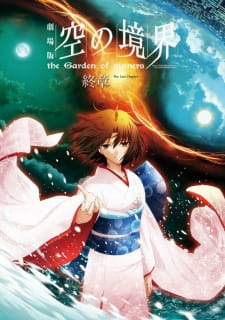
Alternative TitlesJapanese: 空の境界
Information
Type: Special
Episodes: 1
Status: Finished Airing
Aired: Feb 2, 2011
Duration:
33 min. per episode Rating:
PG-13 - Teens 13 or older
L represents licensing company
StatisticsScore: 7.341 (scored by 8797 users)
Ranked: #18232
Popularity: #967
Members: 17,792
Favorites: 34 1 indicates a weighted score
My Info
Popular Tags
No tags found |
SynopsisAccording to the Kara no Kyoukai official website, a blu-ray box set of Kara no Kyoukai (the seven chapters + Remix) was announced to be released on February 2nd 2011. 30min long OVA of Kara no Kyoukai: Epilogue will be bundled with the box set.
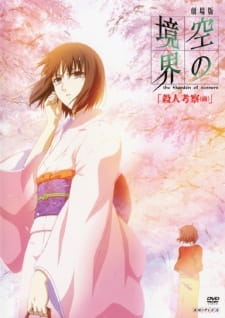
The epilogue titled "Kara no Kyoukai" is about a conversation between Mikiya and "Ryougi Shiki". |
Related AnimeAdaptation: Kara no Kyoukai ~the Garden of sinners~ Prequel: Kara no Kyoukai 7: Satsujin Kousatsu (Part 2) Sequel: Kara no Kyoukai: Mirai Fukuin
Characters & Voice Actors
Staff
Reviews
|
|
Archaeon
199 of 264 people found this review helpful
|
1 of 1 episodes seen
|
| Overall |
8 |
| Story |
7 |
| Animation |
8 |
| Sound |
8 |
| Character |
7 |
| Enjoyment |
8 |
Kara no Kyoukai review Part 8
Finding a way to end a story can be a little tricky if the tale in question has no "natural" conclusion, and in cases like those there is a tendency towards overemphasizing key events in the plot or particular moments of character development through the use of flashbacks or the ubiquitous clip show before the big finale. There is a problem with this method though, as while it can be effective in the right sort of setting, it also has the potential to ruin a perfectly good narrative. That said, the last hurrah of the Kara no Kyoukai franchise is an interesting variation on this idea that may see more use in the future.
Set after the events of Satsujin Kousatsu Part 2, the Epilogue takes place on a deserted road overlooking the town, and is nothing more than a conversation between Mikiya Kokutou and Ryougi Shiki after the two meet on a snowy night.
The main thing to realise about this installment is that its sole purpose is to close off the series, but the approach it takes may not sit well with certain people as it adopts a far more introspective and thoughtful stance than any of the previous outings. The plot has one goal, and that is to explain Kokutou and Shiki (who they are, why they are, their relationship, etc), and as part of this it also resolves some of the questions that were left unanswered at the end of the final movie.
What's interesting about Epilogue is the manner in which it delivers the information to the audience. Gone are the dark storylines with their action based resolutions, and replacing them is a much quieter, dialogue heavy look at Kokuto and Shiki as individuals. The method used to reinforce specific points about one or both characters is also intriguing as it utilises the recounting of previous installments, but rather than use the traditional flashback sequences (which would really ruin the mood), Epilogue weaves them into the conversations in a manner that is more referential and comparative than anything else.
The overall atmosphere of quiet contemplation is heavily influenced by the look of the show, and the orange-yellow glow that permeates the town and its outskirts gives this episode the feeling of warmth and tenderness. One highlight of the visuals is actually the gently falling snow, which may not be obvious at first as quite often people make judgments based solely on the strength of the foreground and characters. Weather effects are common in anime, but studios rarely distinguish themselves in this department so it's nice that Ufotable have decided to redress that imbalance in a small way, and one look at the panoramic views across the town will highlight just how much effort they have gone to. The overall effect of both the illumination and the snowfall gives the show an ethereal quality that is rare in anime, as rather than relying on special effects and tricks to fool the viewer, it instead uses reality as the benchmark. The only flaw with the snow is that it doesn't stick to clothing or settle on the umbrella, but this is a relatively minor gripe that doesn't really affect the episode as a whole.
There's not much of a change in the overall look of the characters except for the fact that they appear older and more in tune with themselves than before. The difference is actually in the details, in particular in the facial expressions of Kokutou and Shiki. Both have undergone a metamorphosis over the course of Kara no Kyoukai, and this is reflected in the way they look at each other in this episode.
One thing that stands out in this franchise is the quality of the acting, yet while there have been some great performances throughout the series, Epilogue's quiet nature is a very different proposition from the bouts of frenetic activity and angst in the movies. To their credit both Suzumura Kenichi and Sakamoto Maaya offer very good performances, but along with this is the sense that the pair are more comfortable with their roles than at any time before, and this has the effect of "relaxing" the flow of the story.
Another key area for the franchise is the music, and Epilogue is no slouch in this department. The show begins with a haunting classical piece dominated by flute and piano, which leads into purposely subdued background music that at times is barely audible, especially during conversations. The subtlety and slightly off kilter nature of the music, together with the occasional "enhancing" of the speaking roles, add to the dream-like atmosphere of this episode, and all of this is rounded off by a choral, hymn-like ending theme.
The strangest aspect of Epilogue is that it doesn't focus on characterisation or development in any tangible manner. Instead the viewer bears witness to what appears to be character affirmation, which is surprising as the series has studiously avoided this in a number of ways. The interesting part about this though, is that the script has been written in a way that conveys a sense of inevitability, and the focus on introspection and explanation is a major shift away from the more dynamic dialogue of previous outings.

At first glance Epilogue may appear to be a strange and far too wordy addition to the Kara no Kyoukai franchise, but don't be fooled. There is a depth here that may surprise a few people, and while there are no knives, guns, action and the rest, it more than makes up for this by allowing the viewer to empathise with the characters in a way that the movies have ignored up to now. That said, while I enjoyed this addition to the series there will undoubtedly be others who find it far too slow to be entertaining.
Taken as a stand alone episode this may seems more like an art house anime than anything else, especially with the introspective dialogue laced with psychology. As part of the whole though, Epilogue offers closure on one of the major themes of the franchise (the relationship between Kokutou and Shiki), and also provides the series with something that has been missing from day one - a proper ending.
read more
|
|
Lucena
9 of 23 people found this review helpful
|
1 of 1 episodes seen
|
| Overall |
7 |
| Story |
6 |
| Animation |
8 |
| Sound |
7 |
| Character |
6 |
| Enjoyment |
7 |
The Kara no Kyoukai anime film series may have ended nearly two years ago, but for some, the story was not quite over yet. People who were lucky enough to get their hands on the Blu-Ray box set of the series were not only treated to the seven films in crisp HD, but also received a new, never-before-seen "epilogue chapter" as an added bonus. The chapter is one that many fans of the original novels had hoped to see animated, and once they heard that their wish came true, they rejoiced with great anticipation. Not long ago, I've decided to revisit this mysterious world for the first time since 2009. As to be expected, I was not embraced warmly by the film's presence, but was given a distant and melancholy greeting like the one Shiki Ryougi gives her close friend, Mikiya Kokutou, in the film.
I shouldn't be too harsh on judging the film's story, since this is an addendum to the series' story and doesn't necessarily have to be seen in order to understand the series' main plot. In fact, there really isn't a plot to speak of, since it is simply a conversation between Shiki and Mikiya, What is interesting about it, however, is that it acts as a sort of bookend for the entire series as a whole. The series begins with a meeting between these two characters, and if you include the epilogue in the series' main plotline, then that is where it ends. Normally, I would give the character and the plot two separate ratings, but in this case, they both share the same rating because this film is nothing but character interaction. I use the term "character interaction" loosely because Shiki's lines mainly consist of one monologue after another while Mikiya simply responds with a few sentences. The film might as well be renamed "Shiki Ryougi Waxes Philosophical for 30 Minutes" due to how much she speaks here. Luckily, what she has to say may prove to be very interesting to those who like the psychological aspect of the series. Keep in mind that if you decide to watch this, you should have a fresh idea of how some of the key elements of the series play out, because she refers to them quite a bit. Otherwise, you'll sort of feel detached from what she is saying, almost like you have never seen the series before. Her monologues also do stretch out longer than they should be and take them from a level of meaningful character analysis to melodramatic ramblings. Seeing how this is, once again, an added bonus to the entire series, do not watch this unless you have seen all of the movies, because you will be spoiled and confused. What the "story" and characters are able to do, they do well, but other than that, it's nothing special.
The animation is also nothing to marvel at in this film, which is a surprise, given studio ufotable's technical expertise shown in all of the films in the series. Seeing how the film only takes place in one location, I can understand that they were limited in their expression because of that, but they could have done more than place the camera on Shiki for a lot of the time. There were several opportunities in which the animators could show Mikiya's reactions to Shiki's monologues outside of the moments before it was his turn to speak. It could have been worse, though. ufotable could have been lazy and edited stock footage from the previous films in, but being true to their craft, they decided to animate as much as the could for the sequence. In contrast to the nearly-stagnant animation, the artistry held up very well. The characters looked as beautifully-designed as ever and you could see the lights on every individual building in the far-off city. Even for a half-hour sequence, ufotable did not give anything less than their best. Had it not been for the artistry of the film, the animation would have bothered me even more.
Rarely, I would describe the audio aspect of any form of visual media as hypnotic, but in this film, i can't help but feel drawn in by the hushed tones of the soundtrack and the voice acting. Keeping to the intimacy of the characters' conversation, Maaya Sakamoto give Shiki an almost motherly sound to her voice, sounding different than the two previous "Shiki" that she played throughout the series. She gives this "new" Shiki a wise, poised, and almost otherworldly personality. The sincerity in Kenichi Suzumura's Mikiya reciprocates that nicely, making him seem well-grounded and mature in front of this graceful, almost intimidating woman. Accompanying the film is several new pieces by series composer Yuki Kajiura, who does not approach the film with her usual theatricality, but with music as delicate as the snow falling around the characters. The ending theme is another Kajiura composition, "snow falling", performed by the songstress trio Kalafina. It is a version of the last instrumental piece to play before the credits, but features the group singing in the composer's signature "Kajiuran" vocalization style. Although the music seems tacked on to such a short film, the pieces that play are beautiful enough to be remembered.
The film treats its audience in a way that "Final Fantasy VII: Advent Children" treats its audience. It expects the viewer to know every important aspect about the film in order to understand it. Watching this without having any recollection of the series' events will have you scratching your heads over "SHIKI and Shiki" and "what Touko Aozaki said". It's probably the main reason why people would want to give it such a low rating, but judging it as its own entity rather than as part of a whole spectrum would make it unfavorable to some. This film isn't reserved for those who watched the series in its entirety, but for those who watched it and relished every minute of it. Even if you qualify as one of those people, this is the kind of film to watch to say that you did, in fact, watch it, and that you have fully completed the Kara no Kyoukai viewing experience. You can say that, for you, the story has truly ended. read more
Recommendations
Opening ThemeNo opening themes found, add themes.
Ending Theme"snow falling" by Kalafina
Fansubbing Groups
Which fansubbers do you like the best? Click + to approve of their subs for this show. Click - if you don't think they did such a great job.
Related ClubsDraconisMarch: video rants, reviews, and reactions, Asagami Fujino Fan Club, MAL Theme Club, One-eyed characters, The French Poet - Mikiya Kokutou, !~~tsubasalover's Friendships~~!, Fantasy Club, ~The Yuki Kajiura Fanclub~, Kalafina Fan Club, Type-Rn/Mobius of Echelon: A Type-Moon Roleplay , Ryougi Shiki Fan Club, Kokutou Azaka Fan Club, Aozaki Aoko ( a.k.a Miss. Blue ) And Aozaki Touko ~FC~, KEIKO Fans!!, Type-Moon BR, Knife Club, Type-Moon, ufotable, Enjou Tomoe Fan Club, Brother Complex ClubKara no Kyoukai see all
Recently Watched By|
1 hour ago |
1 hour ago |
1 hour ago |
3 hours ago |
5 hours ago | |
5 hours ago |
5 hours ago |
7 hours ago |
8 hours ago |
Today, 8:44 AM |
|
|