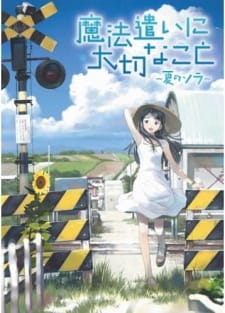
Alternative TitlesSynonyms: Someday's Dreamers Summer Skies Japanese: 魔法遣いに大切なこと ~夏のソラ~
Information
Type: TV
Episodes: 12
Status: Finished Airing
Aired: Jul 2, 2008 to Sep 24, 2008
Duration:
23 min. per episode Rating:
PG - Children
L represents licensing company
StatisticsScore: 7.501 (scored by 2954 users)
Ranked: #13142
Popularity: #1259
Members: 8,420
Favorites: 27 1 indicates a weighted score
My Info
Popular Tags
magic slice of life |
SynopsisSuzuki Sora is a cheerful country girl from the small town of Bie. She made a promise to her father, and following this promise applies and is accepted for a magic intership in Tokyo, where she will face the life in a big city. While training to get better with her magic, she meets a mysterious boy also practicing to become a mage. While he can not use magic that well and he seems distant and cold at first, Sora's fate intertwines with his and the two are thrown together, learning a lot of new things about life and each other.
(Source: ANN) |
Related AnimeAdaptation: Someday's Dreamers ~Summer Skies~ Spin-off: Mahou Tsukai ni Taisetsu na Koto
Characters & Voice Actors
Staff
|
Kobayashi, Osamu
Director, Episode Director, Storyboard, Key Animation |
|
THYME
Theme Song Performance |
|
micc
Theme Song Performance, Inserted Song Performance |
|
Yoshigaki, Yusuke
Key Animation, Character Design, Animation Director |
Reviews
|
|
sayami
28 of 37 people found this review helpful
|
12 of 12 episodes seen
|
| Overall |
9 |
| Story |
9 |
| Animation |
10 |
| Sound |
10 |
| Character |
10 |
| Enjoyment |
9 |
The second season of Mahou Tsukai ni Taisetsu na Koto, Natsu no sora is reached my expectations... I was afraid that they would create another boring slice of life drama, like the first one(I didn't really like the first series). But fortunatelly it didn't disappoint me and this was a great work to begin with.
Story 9: Like other slice of life animes, Natsu no sora is a very relaxing peice, there isn't any place for fighting or blood. With the supernatural parts, they made it more impressing and ejoyable.
The main character, Suzuki Sora is a little bit shy but straightforward girl from Biei, Hokkaido. Like her father, she can use magic, and in Tokyo, she got the opportunity to become a legal magician, but she has to do training before. So Sora, from the country side, travels to Tokyo, and experience a lot about frendship, love and of course magic as well. But something isn't going on the right way...
Art 10: I loved the art. I loved the unique style they showed us, especially the real backgrounds. The contrast between the characters and the background made the anime so enjoyable. It was a good opportunity to know Hokkaido or Tokyo from another point of view. There might be someone wo doesn't agree with me, but if you dropped this because of the art style, then you missed a chance to watch a great anime, and a great storyline.
Characters 10: The characters were realistic in their personalities or actions too. How to deal with the costumers problems or just to use magic on the right way. They had to solve their own problems about love, the faluire in magic or how to bear the death of an important friend... There are things that can't be solve by magic and they have to realize how cruel life is, but if you experienced sadness then you can treasure those little happy things that happens with you... That's what I felt while watching the anime.
Sound 10: I liked the sound very much, especially the opening and the ending. I also liked the idea of putting a steet musician in some parts, because of the great songs she perform. Of course you can sense that this is a production from 2008, the sound is well made, and it's suit the series.
Enjoyment 9: I don't have to say I really enjoyed the series, especially because I could know Tokyo a little bit more and it was a refreshing slice of life drama. But I don't want to emphasize the fact that it made me cry in the end, and it's a plus point to me. Because if it can make me cry then it really can express feelings and I think in a series the most important thing is to express the feelings that the artist wants to: happiness, sadness, jealousy, kindness, joy, anger, fear... And if the viewer can feel these emotions then it's worthy. And Natsu no sora can...
Overall 9: Well I quite glad that I watched this series, but to be honest it was almost one year ago. It didn't disappoint me like the first series it was much better. But if you don't really like slice of life drama, then you shouldn't watch this peice, because reviews full of disappointment are usually from these people.
It's really suits summer afternoons, because you can feel the hot like in the series... it's really strange feeling... So just watch it, I recommend it!!!
read more
|
|
santetjan
77 of 102 people found this review helpful
|
12 of 12 episodes seen
|
| Overall |
7 |
| Story |
5 |
| Animation |
7 |
| Sound |
8 |
| Character |
6 |
| Enjoyment |
7 |
Every now and then, anime shows us a world wherein people smile more often than they do in actuality. From the very opening sequence of Mahou Tsukai ni Taisetsu na Koto - Natsu no Sora it becomes apparent that it is one of those precious shows.
Though it seems a sequel to the 2003 Mahou Tsukai ni Taisetsu na Koto, they only share the same fictional rendering of Japan and it is not necessary to have watched the earlier show to appreciate Mahou Tsukai ni Taisetsu na Koto - Natsu no Sora (hereinafter, Natsu no Sora), as all characters and most of the setting have changed.
Within the fictional universe of Natsu no Sora, magic is real. So much so, in fact, that it is considered a commodity and performing magic is a service industry. While the ability to perform magic is still a rare gift, the presence of mages is part of society, meaning that the populace at large will not be stupefied when witnessing it. The interaction of magic and society as a whole is touched upon: the show makes it known that there are laws and regulation for performing magic and that all mages must be registered, and mention is made of magic being used in national defence. Yet what the viewer is presented with is smaller-scale magic used in the practice of everyday life. The magic we see is of a constructive kind, sweet and helpful: broken chinaware is mended, lost items are retrieved, dolphins stranded on the beach are helped back into the ocean.
The magic itself being rather small in scale and quite homely, it becomes clear that it's an extra, something that enhances the plot instead of shaping it. What the show mainly presents us is a glimpse in the life of a small number of mages in training who receive their education during the Tokyo summer. Protagonist Suzuki Sora, a kind, smiling and innocent 15 year-old, fresh from a country town in Hokkaido, and a few of her classmates that have converged in Tokyo for a few weeks are mostly seen wandering parts of the city and taking in the sights of summer.
For most of the show, the actual happenings consist of the achievements and failures of the mages as they try their hand on professional magic and of the interactions they have with each other and the inhabitants of the city. All is calm and gentle, devoid of the outrages of joy and tragedy so prevalent in most shows, and the story happily takes a backseat and shows us the characters' discoveries of small-scale wonders such as a street corner singer who sings for a daily growing audience, the diverse sights of a shopping mall and the sunset over the sea at Enoshima. There are a few cheap jokes added, but since, for once, these manage not to be to someone’s expense they actually enhance the general cheerfulness.
And, slowly, it shows us how the characters get to know each other better, their feelings evolving into friendship and a sweet and innocent puppy love. Of course, not all goes well all the time, and the characters have to struggle with failure in their training and the small fights and arguments that will certainly erupt between people, but most of the time things can be talked over without having to resort to emotional outbursts, as the show takes for granted that everyone will, in the end, try their best to help out in any way they can.
One would suppose that having a romantic relationship enter would steal the focus away from the cheery setting, infusing it with sudden passion and emotion that comes too late for a show of this length. Sadly, it does, even managing to have one of the protagonists have one of the very standard and clichéd secrets that almost promised to destroy any developed story. Natsu no Sora, however, has the good graces not to have this come to the forefront for too long and without too much fuss once more embraces the highly satisfying happiness of summer.
Given how much time is spent showing parts of Tokyo in summer, it should be no surprise that the art is gorgeous. Consisting mostly of photographs with a thin animated overlay, the background show us diverse sights of a city bathed in sunlight and occasional shadow. Superimposed on these stills is the hustle and bustle of people going their business, cats yawning and stretching and traffic moving purposefully. All these latter elements are drawn in a rather minimalist animation style which contrasts sharply with the realism of the background and makes it quite clear what the focus of the eye should be upon. In very many cases, this focus should be on the smiling faces of the people inhabiting this fictional world.
The main characters as well are devoid of many details. Their facial features consist of rather simple lines, angles and curves, giving all of them a distinct facial shape accompanying their personalities. This lack of detail gives them very clear expressions, a wide range of which are visited. Lips and lip sync are done very well, yet ever better are the many shots in which the camera's focus is on a character not speaking but replying only by means of her visible expressions. Moreover, what the characters lack in detail they gain in a very well developed sense of poise, the way they're standing, walking and sitting oozing personality, be it shuffling in a slump or happily moving with a spring in the step.
As varied and contrasting as the major art styles are is the music. Natsu no Sora has one of the more diverse soundtracks of the series coming out lately, with music ranging from a cheery flute and fiddle, via the rock/pop of the street corner singer, who we hear singing a different song every few episodes, to what the show itself describes as 'British new wave electro'. Despite the variety, most songs are happy or uplifting, with only a very few sadder pieces added to the mix. To this diversity is added a distinct way of using it: music is considered a part of the background and often switches with the elements of setting show. An example of this switching, which is by and large done exceptionally well, is the aforementioned shopping mall, where the music changes with each shop visited, culminating in silence on a floor that is empty.
The best element of the sound in Natsu no Sora, however, would be the use of voices. Unlike most shows, the camera doesn't always focus on the person speaking, showing equally often the listener, resulting in the voices coming from outside of the screen. This enhances both the feeling of being in the conversation and the effect of noting the expressions visible on the faces of the listeners. Moreover, many sounds coming from elements outside of the screen altogether add to the idea that the show is set within a living, breathing world.
As said above, characters are easily distinguished graphically and are able to express a wide range of emotions. Most characters of importance are fairly young and innocent kids who spend their days in pleasant companionship, though, of course, they all have quite distinct personalities that blend well together even if these are somewhat clichéd: from the sweet and innocent Suzuki Sora and the initially brooding yet kind-hearted Midorikawa Gouta to the domineering but insightful Asagi Honomi. Most of the characters are also given a personal quirk, which is something of a cheap shot yet works remarkably well to give them personality. A good example would be Asagi’s tendency to always call people by both their family and given names. Most importantly, because all of the characters are, by and large, kind and content folk, talking in pleasant tones and properly polite, the few times that their rawer emotions come out are special and memorable and, hence, have far more of an impact than even the most dramatic scenes from most other series.
Natsu no Sora is a show that moves slowly through summer days, both of the city and of the characters, and that shows the best both have to offer. We are invited to simply take a look around and see the simple beauty in many small things, leaving for a while those issues of importance that elicit stronger feelings. Calm and cheerful conversations, subdued and down-to-earth negative emotions and an innocent love are bound to make you smile for a bit and help you recuperate from the generally completely irrational outbursts of emotion most other shows bombard you with.
Sweet, simple and charming it makes you look upon a potato harvest, city highlights and a sweet girl's smile with the same feeling of contentedness. read more
Recommendations
|
|
Same genre, same studio, same seiyuu for the main heroines, and great opening themes in both of them. The atmosphere is not very similar (Sketchbook is more calm and Natsu no Sora is more dramatic), but if you liked one series, it would be worth trying another.
|
|
|
Both Slice of life, Romance.
Soundtrack is great!
And the feeling from this series is somehow the same.
|
Opening Theme"fly away" by THYME
Ending Theme#1: "Kawaita Hana (乾いた花)" by micc (eps 1-11) #2: "Fly Away" by THYME (eps 12)
| No posts for this board were found |
Fansubbing Groups
Which fansubbers do you like the best? Click + to approve of their subs for this show. Click - if you don't think they did such a great job.
Related ClubsHAL Film Maker Fanclub, Cogito Ergo Sum - Philosophy In Anime and Manga, Бессюжетные девочки, Slice of Anime Life, The Lighthearted Anime Club, Magical Girl Fans Unite!!, Hanazawa Kana's Fans!, Daisuke Namikawa Fan Club!, Otaku no Namida * Otaku's Tears
Recently Watched By|
3 hours ago |
6 hours ago |
10 hours ago |
Today, 7:54 AM |
Today, 7:37 AM | |
Today, 4:33 AM |
Today, 12:21 AM |
Yesterday, 10:12 PM |
Yesterday, 6:34 AM |
Yesterday, 12:46 AM |
|
|