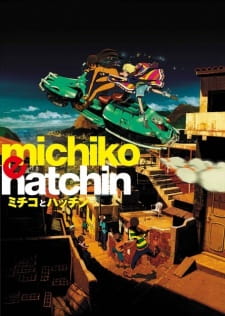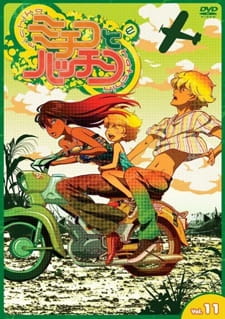
Alternative TitlesEnglish: Michiko & Hatchin Synonyms: Michiko e Hatchin Japanese: ミチコとハッチン
Information
Type: TV
Episodes: 22
Status: Finished Airing
Aired: Oct 16, 2008 to Mar 19, 2009
Duration:
22 min. per episode Rating:
R - 17+ (violence & profanity)
L represents licensing company
StatisticsScore: 7.901 (scored by 12824 users)
Ranked: #5902
Popularity: #546
Members: 32,409
Favorites: 405 1 indicates a weighted score
My Info
Popular Tags
No tags found |
SynopsisAfter escaping from prison, the sexy criminal Michiko rescues an abused girl known as Hatchin. The two are about as opposite as they come, but their fates become intertwined through the connection of a man from both their pasts. On the run from the police and Hatchin's abusive foster parents, the unlikely duo set out to find this man and ultimately discover their freedom.
(Source: FUNimation) |
Characters & Voice Actors
Staff
Reviews
|
|
Archaeon
313 of 404 people found this review helpful
|
22 of 22 episodes seen
|
| Overall |
9 |
| Story |
8 |
| Animation |
9 |
| Sound |
9 |
| Character |
10 |
| Enjoyment |
9 |
What would you get if you crossed Thelma & Louise with City of God? You may get complete drivel, or you may, if you're very lucky, get something like Michiko to Hatchin.
Manglobe, the production company (and the brains behind), Michiko to Hatchin, have really pushed the boat out with this anime. But then again, they're no strangers to success or quality, especially as they are the company responsible for Ergo Proxy and Samurai Champloo. The series was directed by Yamamoto Sayo and is effectively her first full time at the helm of a production, and whilst this may have been a gamble on the part of Manglobe, it's one that certainly paid off as Michiko to Hatchin has a certain "fresh" quality that I haven't seen in anime in a long time (not since Cowboy Bebop in fact).
The tale is about an escaped convict named Michiko Malandro and her quest to find her lost, and supposedly dead, lover Hiroshi Morenos. In order to achieve this, she "kidnaps" a girl who is supposedly Hiroshi's daughter, initially thinking that she would know where Hiroshi is. However the world has changed during her years in prison, becoming at times more brutal and less forgiving.
The decision to set this tale in a quasi-South American (Brazilian), country was a stroke of genius as the creators and director could do things that would never have been included had the show been given a more staid setting. In addition to this, the characters themselves are able to have that little bit more "flair" about them because of the setting, something that initially detracts from some of them until one realises that the gaudiness is all simply part of that character's persona - more on that later though.
Now fans of Ergo Proxy and Samurai Champloo will know that Manglobe are able to produce some stunning visuals, and Michiko to Hatchin is no slouch in this department. From barren deserts to lush jungles, from slum shanties to sleek factories, the level of detail is excellent, and well above that of many recent titles. In addition to this, the various settings in which the story takes place have a certain realistic quality about them that belies the fact that this is an anime.
In addition to the great scenery, the characters are extremely unique and well designed, again, adding to the sense of realism about the show. The leads and immediate supporting cast are individuals to a tee, with each character possessing a certain lifelike quality that many anime would find difficult to match.
One area where the show really excels is with the animation. It's rare to see such lifelike movement in anime, and in many ways the fluidity and natural motion in Michiko to Hatchin represents a step up from that of Samurai Champloo.
Sound is another area where this show works very well. The effects are extremely well chosen and choreographed, and while some may be overwhelming, this is actually purposeful because of the situations the characters may find themselves in. The music used throughout the series is atmospheric and refreshing, and is reflective of the Latin-American feel of the show. The OP, a track called "Paraiso" by the Japanese jazz band Soil & "Pimp" Sessions, is an excellent piece that harks back to the classic "Tank!" of Cowboy Bebop fame. Unfortunately the same cannot be said of the ED, "Best Friend" by Karutetto, as it is a bit too "boy-band" for my tastes.
One of the truly great things about Michiko to Hatchin is actually the cast. Manglobe and Yamamoto took the somewhat surprising, move when they chose the actors, opting not for established traditional seiyuu but for established screen actors. However, this seemingly risky choice has paid off in spades for the series. Maki Yoko (Battle Royale II: Requiem, The Grudge), is extremely versatile as the sexy, pouting, hotheaded, and somewhat childish Michiko, whilst Ohgo Suzuka (Year One in the North, Memoirs of a Geisha), is truly excellent in the role of Hatchin as she provides a depth of character that is rare to find.
Which neatly brings us to the characters themselves. Michiko is willful, headstrong, selfish in the extreme, and very childish. Hatchin is somewhat shy and nervous, but also responsible, tidy, and hates laziness. Both leads are extremely well defined from the outset, something which is reinforced as the relationship between the two is extremely combative (the pair are effectively polar opposites). Others like the terrifying Satoshi Batista or the terrier-like (i.e. always chasing Michiko), Atsuko Jackson are also well defined from the start, and through the first few episodes it may be difficult to see how any of the characters are actually developing because of the strength of the characterizations.
One reason for this is because both Manglobe and Yamamoto decided against using normal anime practices for developing characters, and instead chose a far more realistic and subtle approach. One needs only to compare the relationship between Michiko and Hatchin (or even Michiko and Atsuko), at the beginning of the series, with their behaviour towards the end to see exactly how much they have developed as characters. An example of this is the fact that Michiko is initially very much an annoying, sexy, pouting, selfish jerk, however at the end of the series she reminds me of Balsa from Seirei no Moribito. Hatchin, Atsuko and Satoshi also undergo this extremely subtle development (you'll see how much by episode 20).
I thoroughly enjoyed this series for many reasons, the main one being the fact that this is a show that is not afraid to show the casual brutality of its setting. There will be some out there who didn't like the way the series ended, however I found the conclusion to be very much in keeping with the essence of the series, whilst at the same time being far more realistic than the endings of most other anime.
Michiko to Hatchin is a rarity in the medium, and should not be prejudged on the basis of one or two episodes. The complexity of each character, the harsh, unforgiving setting, the sometimes brutally real actions of individuals, and the extremely subtle development all serve to make this one of the best shows of 2008, and one of the best anime to appear in the last decade. At times Thelma & Louise, at times City of God, at times Laurel and Hardy, this anime possesses a style and flair that surpasses that of Samurai Champloo - a feat by any measure.
Given the quality of this series, and its previous titles, I'm rapidly becoming a fan of Manglobe. read more
|
|
WishMeLuck
53 of 75 people found this review helpful
|
22 of 22 episodes seen
|
| Overall |
10 |
| Story |
8 |
| Animation |
9 |
| Sound |
10 |
| Character |
10 |
| Enjoyment |
10 |
In a world plunged into an immoral wasteland, it is often difficult to find friends and comrades that you can believe in. The cold brutality of the situation may be that you simply can’t. But sometimes a slight glimmer of hope remains amid the tumult and chaos, that maybe perhaps you really do have a partner out there, a comrade that will stick with you and care for you to the very end.
The world depicted in “Michiko to Hatchin” is this wasteland, a setting fraught with greed and death amid the indigent and the impoverished. This is South America (Brazil), or rather a variation of it. From the gritty alleys, to the squalid shanties and the lush and viridescent landscapes, Manglobe doesn’t disappoint. The setting is not only a beauty to look at but is also something unique and rare that allows the show to take wing and travel regions that are distinctive yet still within the realms of what was initially established. Through this director Yamamoto is able to channel the genius of Watanabe and the result is something unlike any other that challenges and perhaps even surpasses works such as Cowboy Bebop and Samurai Champloo.
The story chronicles the lives of mainly Michiko Malandro, an escaped convict on a desperate hunt to find a supposedly dead man that was once her everything and Hana Morenas nicknamed Hatchin, the apparent daughter of this man and who Michiko initially thinks is the ultimate clue to helping her achieve her goal. The premise is set, but the main plot is less prominent than what many would expect. In this show it is merely used as a device to tie in many self-contained stories together and give the show a satisfactory conclusion because ultimately this show isn’t about the goal, it never was. The show is about the journey and the bonds that are broken and healed along the way. And the stubborn, immature Michiko along with the self-righteous, mature Hatchin are characters real and charming enough to carry you through this journey and not let you go.
The show also has an astounding soundtrack that lives and breathes nearly as much as the characters do. The energetic soundtrack fits every beat and every pulse of this high-powered train ride, yet also smoothly transitions towards a more melancholy nature when the situation calls for it. Through this the music is able to create remarkable scenes of raw emotion and immeasurable charisma that echo and persist long after you have finished the show. The animation is no slouch in its department either. One of the reasons why Michiko and Hatchin feel so startlingly real is that they look and move like real people as well and while there are times where the animation quality may drop, it still stays very consistent throughout and lends to an experience that is both aesthetically pleasing and emotionally stimulating.
Ultimately this is a series that as well as examining the lengths in which people would go to accomplish their goals, more importantly looks at the bonds that are formed during that time. Michiko and Hatchin go on a dangerous adventure together as a tornado of a tag team, and through this are able to form a relationship that overcomes the trials and tribulations that come their way and even the long and arduous chasm created by time. It is a bond both honest and deep that lies in juxtaposition with the superficial and vapid bonds congesting the streets of Brazil, a strong bond of indomitable love and unending trust. And though there are many instances throughout the series where the two characters pull each other down with their flawed personas to the extent that you would think they are better off without each other, it becomes evident later on how much they need one another, how much more they are able to accomplish with each other as their platforms. The show does well to depict two sides of a relationship, one of anger and disarray during quarrels and also one of a serene and resonant beauty during the rare moments of an embrace and while the show is far from deep or a riddled literary piece of work, it does well to show the power of friendship and love in a realistic manner and the way in which it is able to travel the void of time and always be there right when you need it, proving that love is far from a burden, but rather a privilege. The privilege of being responsible for another.
Sayo Yamamoto’s first work is by no means perfect, but through its unique setting, remarkable soundtrack and captivating characters, she is able to construct a show filled with raw emotions and a flaring style constituting to a heartening, disturbing and riveting journey that in my book is nothing less than a masterpiece.
read more
Recommendations
|
|
they both have the same coool feeling and both have a jazzy starting. Only one is a criminal escaped from prison and the other a Bounty hunter.
Same feeling, also tons of gunfights.
Both are pretty funky shows that take place in a slightly askew futuristic world. Similar music and art. Similarly wild characters and improbable situations and scenes. Nice gun fights. The babe in Michiko is similar to Fay from Cowboy Bebop--gutsy, scantily clad, nonchalantly violent.
There are adventures, good music, chases and shootouts and a little bit of drama. But is not the case, the main rhythm, rhythm was definitely one and the same.
Both shows give off the same vibe, as episodic but character driven entertainment, with high speed action, situational comedy and a tinge of melacholy. Thoroughly recommend both.
jazz, action, drama, the 5-0, and smoking hot girlies
Even though the premise is different, Michiko to Hatchin has a very similar vibe to cowboy Bebop. Both stories are wild west stories build around a futuristic 70's style universe. Where Bebop had the bounty hunter's gallivanting all over the place looking for their big payday theme; Michiko has a classic wild west bandits on the run premise. The similar feel might be because Shinichiro Watanabe was the music director for Michiko to Hatchin. But even if you don't think they're similar, I'm sure you'll enjoy Michiko if you liked Bebop.
Both are about searching for a loved one, with ties to the criminal underworld. They both have strong character designs, fluid animation and the same humour. They both also with hold information from the viewer, slowly revealing the story through flashbacks and conversation.
Both are silly without loosing the ability to deliver a dramatic message. Both use a linear narrative to tell a coherent story. Both have a strong ensemble cast. Both use quirky characters within a group dynamic to drive the story forward. Both are top notch entertainment where every episode is worth watching.
Bebop's episodic nature makes it a better standalone series and allows it to play more freely with genres and styles.
Michiiko's more continuous narrative allows for better character growth which builds deeper attachments to the various characters.
Both have a very interesting soundtrack featuring Jazz. Both have good action and plot. While the Bebop crew are bounty hunters, Michiko is looking to reunite with Hatchin's father.
|
|
|
I would recommend Black Lagoon the 1st and 2nd season as a similar anime to Michiko to Hatchin. Both seem to happen in some spanish territory. We can see lots of action, guns, mafia, pursuits. Michiko is quite similar to Revy. Both main characters are strong, independent women with a unique personality and complex past.
I would say Black Lagoon TV series are the best equivalent to Michiko to Harchin.
'Michiko to Hatchin' also stars a brazen and petulant young woman who's forced to team up with a timid and more down-to-earth character and end up meeting all kinds of colorful characters and experiencing the wildest adventures, most of them connected to the criminal underworld in some form.
Black Lagoon more violent, when Michiko to Hatchin is more bright and colourful, but if you are tired of the slow development of the plot, these two certainly fit your mood. Cool chick with gun is common of course.
Michiko to Hatchin and Black Lagoon can be compared on many levels. Strong female leads, non stop action, character development, and setting (among other things). Both are set in crime riddled areas of the world; Michiko to Hatchin in a South American surrounding, and Black Lagoon in South Eastern Thailand, or more specifically, "Roanapur". These settings not only allow for some of the insanity that takes place in Michiko to Hatchin and Black Lagoon to happen, but are crafted in such a way as to make the viewer believe that they are in fact real places.
However, it is within the character development, as well as the ever present theme that it is not the destination that is important, but the journey and people we meet along the way, that make these two anime great. While the pacing and premise are quite different, both will leave you asking for one thing: more.
Looking for an anime with charismatic characters? Both series have many similarities, but I will talk only Michiko (Michiko to Hatchin) and Levy (Black Lagoon). Both of these characters are women who have strong character. They are among the best female characters in anime. Strong, beautiful and sexy, they know what they want. We take pleasure to follow them in their adventures, enjoying their mood swings, anger and moments with ease. If you think about that kind of character, these animes are made for you, skip the one you have not seen if you know one of them. (Sorry for my english)
These two series here have quite a lot of similarities. Let's see..
First of all, they are both set in a criminal world where an innocent character gets involved with a main female character who has many skills including the usage of firearms, the operation of various vehicles, and is seen as a violent individual. However throughout the series, they both form a special bond.
Both series also features a lot of face paced action, drama, some comedy, as well as some emotions.
Both series also has character development that is strengthened through the bonds between the two main characters.
Both stories have a gritty and dirty atmosphere and the setting for both contain a lot of broken/desperate towns, filled with dark and depraved people. There is a hefty amount of action throughout both series too. Even in all this down and out type atmosphere both shows manage to bring some meaningful or sentimental feel to the characters situations.
Obviously, Michiko and Revy are verrry similar, and the setting is too.
Also, i feel as if the relationship between Revy and Rock is kinda similar to Michiko and Hatchin. Kinda. In a weird way.
|
Opening Theme"Paraiso" by SOIL & "PIMP" SESSIONS (eps 1- 21)
Ending Theme#01 "Best Friend" by Karutetto (eps 1- 21) #02 "Nada pode me parar agora" by Aurea Martins (Gabriel Muzak as backing vocal) (ep 22)
Fansubbing Groups
Which fansubbers do you like the best? Click + to approve of their subs for this show. Click - if you don't think they did such a great job.
loli-ai [loli-ai] (Brazilian Portuguese)
Related ClubsFemale Badass!, Marketplace Germany, Brasil, Music Addicts, Brasilia, Black People in Anime, Minas Gerais / Brazil, Watch Anime Together Club Headquarters, That Black Club, Tattoo Anime People, Original Anime, Underrated Anime, feminist anime collection club, Girls With Guns FC, Anime in Blu-ray, !~~tsubasalover's Friendships~~!, Anime Weekend Marathons, Masaaki Yuasa Fans, Cloudy-Wolf Encodes , Anime BlueAnimeklubi Miyako, Anime Latino, Deviant Hearts, Scooter Girls, Michiko e Hatchin see all
Recently Watched By|
1 hour ago |
2 hours ago |
4 hours ago |
4 hours ago |
4 hours ago | |
5 hours ago |
6 hours ago |
6 hours ago |
6 hours ago |
6 hours ago |
|
|