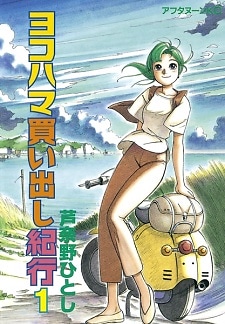
Alternative TitlesSynonyms: Yokohama Shopping Log, Yokohama Shopping Trip, Touge Japanese: ヨコハマ買い出し紀
Information
Type: Manga
Volumes: 14
Chapters: 142
Status: Finished
Published: Apr 26, 1994 to Feb 26, 2006
StatisticsScore: 8.851 (scored by 3518 users)
Ranked: #162
Popularity: #180
Members: 9,902
Favorites: 1,085 1 indicates a weighted score
My Info
Popular Tags
sci-fi seinen slice of life |
|
|
TheCriticsClub
248 of 316 people found this review helpful
|
140 of 142 chapters read
|
| Overall |
10 |
| Story |
10 |
| Art |
10 |
| Character |
10 |
| Enjoyment |
10 |
Yokohama Kaidashi Kikou (abbreviated to YKK outside Japan) is an example of the proverbial “diamond in the coal mine”. Written and drawn by Ashinano Hitoshi, the manga was serialized in Kodansha's Afternoon magazine for almost 12 years, and has gathered a number of devoted fans around the world despite the lack of licensed English translations. This comes as no surprise since it is one of the few series which deserves to be treated as a works of literature rather than of pop culture. YKK is a testament to the true potential of manga and the series is recognized as such, having been deemed worthy of Afternoon magazine's Four Seasons Award for debut works as well as the 2007 Seiun Award for Best Science Fiction Manga.
Story (9.7) & Characters (10)
YKK is a science fiction story as it is set in a future after an unspecified large-scale disaster and the main character, Alpha Hatsuseno, is a robot who looks human. However, this is where any similarity to "regular" sci-fi ends. There are no spaceships, lasers, or mecha of any sort. Instead, older technology such as scooters, radios, propeller-driven aircrafts and the like, are very much still in use. This is reflective of the rural lifestyle that humanity has adopted in the story and adds to the easygoing pace of the manga. This tranquil, almost bittersweet feeling is reflected in the art style, the characters, and even the manner in which the story is delivered.
The story is told mainly from the perspective of Alpha Hatsuseno as she meets old friends, makes new ones, and casually explores the world around her. The most unusual fact about Alpha is that she isn't human, but a type A7M2 robot who looks human and is capable of feeling emotions. The story begins with Alpha taking a trip to Yokohama to buy coffee beans. She has been alone for some time as she waits for her "owner" to return from wherever he has disappeared to and, being immortal, she has decided that she can wait as long as it takes. In the meantime, she runs Café Alpha, a small coffee shop in the middle of nowhere which her owner left in her care.
Besides Alpha, several other characters also appear throughout the series. Some are shown regularly like Oji-san and his grandson Takahiro who run the gas station near the café. Others turn up less frequently such as the anonymous café customer and the mysterious Misago, an ageless wild woman who only appears before children. Next to Alpha, the other most prominently featured character is Kokone Takatsu, a type A7M3 robot. Kokone is effectively Alpha’s younger sister (production-wise that is), and as their friendship grows, she begins to develop romantic feelings for Alpha which later stir her curiosity about the history and nature of the A7 series.
Although the other characters do not enjoy as much exposure as Alpha does, several are given sufficient development to be memorable in their own right and their experiences serve as important reference points that highlight the passage of time. Through them, the reader is shown the great expanse of the story spanning the landscape and the era.
One of the most notable achievements of YKK is the manner in which the characters enhance each other throughout the series, and how Alpha gains a new perspective on life through her encounters with them. The interactions between the characters are often laconic and unhurried. Because of this, each encounter gains a languid, almost dreamlike quality that is far more memorable than what can be found in many other slice of life manga.
Art (9.7)
The art in YKK contributes greatly to the relaxed atmosphere of the manga. Ashinano’s style is evocative of the simple yet fantastic nature of the world. In several parts of the manga, commonplace scenes are given an ethereal quality. This, together with the character designs and Ashinano’s unusual use of blank space, gives the art style a surreal characteristic that at times appears almost paradoxical. As with any long running series, the art style has evolved and improved over time.
Ashinano Hitoshi's character designs are perplexingly both spare and meticulous. Each character’s face is basic yet highly expressive; a stark contrast to their elegantly elaborate clothing and accoutrements. This unusual style is further enhanced by the picturesque backdrops and settings which the characters find themselves in. In addition to this, Ashinano has made wonderful use of blank space to emphasize the amount of detail in the characters and settings, something which is more prominently highlighted in the beautiful colored illustrations and panels that appear in the manga. This style of artwork focuses not only on the locations, but on the characters themselves and serves to enhance the reader's empathy towards each character.
From the most beautiful parts of nature to fantastic creations of Ashinano’s imagination (giant sunflowers, underwater streetlights, water gods, kamas, and many other wonders that Alpha discovers), each object and location in YKK helps to transport the reader more deeply into Alpha’s world. Not only is it easy to understand what she is feeling about her surroundings from the art alone, but the simple beauty serves as a way of deeply understanding not only the intricacies of her world, but of ours as well.
Enjoyment (10)
Many readers have hailed YKK as the epitome of the slice of life genre and, given the premise, this may be no exaggeration. The series makes exceptional use of “mono no aware” (a Japanese term used to express the awareness of the transient nature of things, and the bittersweet sadness at their passing), and the time period in which the story is set makes the use of this especially poignant. In Alpha's words "It looks like the twilight of this age has quietly arrived. I think I'll be around 'til these twilight years end."
Reading YKK is without doubt one of the most unique and wonderful experiences in manga. Each chapter is filled with a calm, inviting feeling that pulls the reader into the story like a lucid dream. Alpha is without doubt one of the most engaging characters ever created, combining childlike innocence with reflective maturity. The story is remarkable in both its simplicity and its complexity as the reader is taken on a journey of discovery about themselves, the world around them, and the transient nature of things, whilst the art perfectly resonates with both of these elements to produce an atmosphere like no other.
Melancholy yet hopeful, exciting yet wistful, joyful yet sad, YKK is a singular achievement in manga that is deserving of the title "Masterpiece", and should be afforded a place amongst the great works of modern literature.
OVERALL - 10
This review is the final result of a review team composed of members from the "Critics and Connoisseurs" club. The team members were:
Anomalous - writer and editor
Archaeon - writer and editor
Yuunagi - writer and editor
Here are their individual scorings for the Manga:
Category - Anomalous, Archaeon, Yuunagi
Story - 9, 10, 10
Art - 10, 10, 9
Character - 10, 10, 10
Enjoyment - 10, 10, 10
Overall - 10, 10, 10
In the club wide poll held for Yokohama Kaidashi Kikou it received an average overall rating of 8.83
read more
|
|
Yuunagi
147 of 198 people found this review helpful
|
143 of 142 chapters read
|
| Overall |
10 |
| Story |
10 |
| Art |
9 |
| Character |
10 |
| Enjoyment |
10 |
"This gentle calm and quiet is the twilight of an era.
I will probably watch the passing of this twilight age."
Content:
The stories featured in YKK are mostly light and melancholy. Readers who are used to action, sex, fanservice, violence, and/or intense drama would either be A) disappointed, or B) surprised that stories without the said elements could possibly exist and still be enjoyable.
YKK is characterized by mono no aware, a Japanese concept that describes beauty as an awareness of the transience of all things, and a gentle sadness at their passing. Entertaining old customers in a coffee shop, riding through desolate roads on a scooter, reminiscing while watching the sun set; none of these are close to being earth-shattering and yet the author somehow presents ordinary scenes in such a way that they evoke overwhelming feelings of nostalgia. Being reminded that today will be tomorrow’s yesterday, one cannot help but appreciate the present for its fleeting existence.
Literary Style:
Ashinano’s style of writing is radically different from that of other mangaka. Rather than using the typical cliches and standards of comics and animation, the author’s style is more similar to those used by writers of literary novels and short stories. Using motifs and details to imply themes, skillfully combining images of everyday life with colloquial monologues and dialogues to produce visual and verbal poetry, it is obvious that, while YKK is appropriate for readers of all ages, it requires a mature and understanding reader to fully appreciate this work of art.
In fact, his method of implying themes through details might remind some of J. D. Salinger’s The Catcher in the Rye. The characters, the plot, and the details don’t just represent themselves as components of a work of fiction, they reflect the reality of everyday living. The characters act naturally and events unfold as they would in real life: without fanfare. This makes it easier for the readers to relate with the characters and believe in them. As the characters develop, the reader may also find their revelations relevant to his/her own life. In a sense, Yokohama Kaidashi Kikou may in fact be one of the few titles which are actually worthy of being called “graphic novels”.
Visuals:
Ashinano’s character designs are simple yet charming. The faces of the characters are very expressive, effectively bringing out the characters’ moods and personalities. As one goes through the volumes, it’s also quite interesting to see how Ashinano’s style had improved through the years (the series ran for 12 years, after all).
What really makes his art stand out, however, is his awesome ability illustrate the setting in fine detail. Gusts of wind sweep across vast fields of grass, the lights of a submerged city continue to glow beneath the ocean waves, roads and towns once bustling with life now stand derelict and abandoned; the scenes often invoke feelings of nostalgia as if the writer and the readers had been there themselves. Later on in the series, Ashinano starts using more and more of these images to enforce or sometimes even replace the dialogue to deliver his message to the audience.
Overall:
Well, it looks like it’s all downhill from this point on for anime/manga because I don’t think I’ll ever find anything close to being as good as this series. Sure, I’ll probably stumble over a few other well-written stories out there, but I really doubt it if they would be as emotional and as thought provoking as Yokohama Kaidashi Kikou. read more
|
|
TrenchKamen
11 of 16 people found this review helpful
|
140 of 142 chapters read
|
| Overall |
9 |
| Story |
9 |
| Art |
8 |
| Character |
10 |
| Enjoyment |
10 |
It is a brilliant stroke to tell a story about transience through immortal cyborgs. Maybe many Westerners would even find that counterintuitive, because transience--more specifically, mono no aware, the nuances of which I will not belabor here, but if you are not familiar, look it up, it's a treat--is a particularly Japanese literary theme, and most Western works focus only on the rapid change the future brings. But there is a constant in that, change and transience, and though we have the saying "the only constant in life is change", I don't think Americans have come to understand that paradox fully. It's given token observance in some speculative fiction, usually in passing dialogue, but nowhere in Western media have I seen the constant side of transience explored with a fraction of the depth given in YokoKai.
This is a world where few things are explained. In that way, it reminds me of Haibane Renmei. Mysteries are left open, and the characters come to open-ended conclusions about everything. There is no closure, and no loose ends are tied together. In this sense, YokoKai defies a cardinal rule of Western storytelling. And yet, it works beautifully. The mystery lends to the gorgeous atmosphere, and the gentle sense of wonder. The artwork is stunning, simple yet powerful pen-hatching.
This is a story about humanity, though sparse and pervaded by nature. An unelaborated ecological disaster has cleaved the human population, sea levels rise and carve out new landscapes. Life is simpler in this story, slow. This is, as Alpha says, the twilight of human existence. Humans will pass from this world, and the world will continue on without it. Yet, the world has been changed by the presence of humans, aside from the disaster--plants resemble human technology, and humans have left behind robots, sentient beings who will survive beyond the twilight. There is a gentle optimism in this, a strange constant in a story pervaded by mono no aware, an awareness of transience. But this is transience backed by the constant of nature, and of evolution. It is sentience that is sacred. Robots are treated no differently from humans, for they are human in that most important way. And sentience, the ability to reflect, has marked the world, leaving psychic residue that manifests as shadows, such as the plants.
The multi-task, multimedia-saturated generation must find it hard to imagine such a simple and slow life. The only technology seen in the manga is moderately old or unobtrusive--motor scooters, cameras, coffee makers. The characters communicate by snail mail. Nary a cell phone or mention of the internet, or even television, is seen. Alpha spends entire days doing nothing but painting the shop, riding about on her moped to take photographs, or fixing up an old well. Such a slow pace, unencumbered by entertainment, must seem like the setting for a profoundly boring life. I admit, though I can sit and daydream far longer than most of my peers, I usually want to be doing something cerebral, like reading, or playing a video game. I don't know if this is mostly because of my desire for 'efficiency' (like sitting around leisurely is a waste of precious time) or my scattershot Gen-Y attention span. I admit I have that urge to sit in front of my laptop far more than I should, as do all of my friends--you should see some gatherings, where everybody is in front of a screen--even though I know reading blogs is just as unproductive as sitting around daydreaming. But there is that illusion of productivity, when we sit in front of technology. Then again, plant me in a library, and I'll be entertained from opening to closing. Is reading a physical book any more inherently good, though?
This is also a world of work-life balance. The overworked Japan of today is gone. People work as much as they need to, with ample leisure time. Alpha frequently leaves her cafe for days at a time, and often receives only one guest per few days. And they can sustain this lifestyle because there is zero commercialism--they work for money to purchase what they need. No keeping up with the neighbors. No consumerist lifestyle. Sure, they live in simplicity, but they're happy. They have the basic creature comforts--nay, luxuries, like air conditioning and running water--but that is all they need. We could all take a lesson from this, given our hyper-commercialized and overworked lives. These people shy not from good, hard work, but they work to achieve a goal, not to spin their wheels, or produce more beyond what is needed for the sake of an edge. There is no blind cycle of consumption. And I have found hard work with a purpose is far more cleaning, and fulfilling, than work half as hard with no purpose.
Inherent in seeing the beauty in YokoKai will be the fact that some people will accuse of thinking too hard about all this crap. On its face, this is a manga about nothing, just mundane details of daily life, making coffee, re-building a cafe, riding into town on a motor scooter. That is a deeply Japanese aspect of the work, showing beauty through the mundane without further elaboration. It's left for the reader to decipher. I can't think of any American works even remotely in the mainstream (or sub-mainstream) that have such slow pacing. In pacing, it's decidedly un-American, un-Western. Quite literally nothing happens for long stretches of story arc. Finding meaning in it must seem to many as though one is trying too hard, or is being pretentious. And being accused of being pretentious is almost worse than being accused of being a hipster. I really think only a Westerner with zero exposure to Eastern works could think that.
Let us look at the concrete details. It is a story about cyborgs, the dying human race, and a world after an ecological disaster we caused. How many stories encompass these themes? And yet, YokoKai is utterly fresh, new, and brilliant. I do not say this lightly. Perhaps because I've had such extensive exposure to brilliant interpretations of the ways technology and life will intersect in the future, I've become vastly harder to impress. A lot of mainstream American science fiction has nothing of interest to offer me. See, for example, Avatar, which explores nothing new in science fiction, and explores it far less deftly than many earlier works.
I think some people interpret my cynical criticism of such movies as just that--the hallmark of a critical, cynical, and jaded person. I've been accused of 'looking for things' to gripe about. But I fancy that it is a sign of a life more deeply contemplated and exposed to superior, stunning art. I don't think this makes me inherently better than anybody else, but I do resent being accused of faux-jadedness, jadedness for the sake of being cool. I can be quite the enthusiastic appreciator of beauty.
I think the accusation of 'looking for things' to gripe about, be offended by, etc (itself a classic derailing tactic) occurs when somebody with a deep, extensive understanding of a subject (either through exposure, like art or ally activism, or through living it, as in the case of a member of an underprivileged group itself) is quick to see things others either miss entirely or see as entirely novel. There is a level of expertise common in the accused. Not that there aren't cynical, unhappy people who do find fault with everything, but activists and scholars deeply resent being lumped into that juvenile camp. And because it's an accusation hinting at juvenile nihilism or blind rebellion, the derailing tactic doubles as a discrediting tactic. That nihilism is the flip-side of hipster irony, liking kitschy things because of their perceived lack of value, but in appreciating irony you have to acknowledge there is something inherently inferior or unlikable about the subject in the first place.
Anyway.
Overall, Yokohama Kaidashi Kikou is a real treat. It's grand, sweet, and breathtakingly beautiful in its simplicity, yet brilliantly imagined. It features a world that unfolds organically for us to discover, and leaves us with a sense of open wonder. It makes me want to drive a moped down an open country road, just for the thrill of being. read more
|
|
Sjiveru
12 of 19 people found this review helpful
|
140 of 142 chapters read
|
| Overall |
10 |
| Story |
10 |
| Art |
10 |
| Character |
9 |
| Enjoyment |
10 |
Reading YKK always puts me in a strange mood. Often reading seems to be the only way to trigger this mood in modern American society. Reading YKK makes me want to sit back and appreciate things, rather than just going through life doing what I've always been doing. Whenever I'm forced to take a break, I always have an impulse to go for a long walk - even though I know that as soon as I get back in I will die from allergies (I live in Austin, TX, in all seriousness a contender for "Allergy Capital of the US"). The only reason I don't read YKK on a near-continuous basis is that I'm afraid I'd get sick of it after too many repetitions.
It's not a story for everyone - if you're looking for action, drama, off-the-wall comedy, fanservice, or pretty much whatever most mainstream manga is built around, you won't find that here. (The only reason it counts as seinen is because kids would find it boring.) In a way, that's the best part - rather than just going for constant, almost driving levels of entertainment; it takes the time to slow down and force you to look at life from a perspective of someone who can enjoy things because they're there. YKK is the epitome of the slow, quiet manga - it pulls you into its slow, quiet world, and makes you very depressed when you have to go back to reality since you won't be able to spend your whole day just sitting and looking at scenery (and as boring as that may sound, YKK makes you seriously want to).
YKK gets an overall score of 10 for me.
The story is 10 - very well-done, even though it's in effect a slice-of-life manga with no true overarching plotline between chapters. In fact, most of the plot beyond each individual chapter goes on in the background, rarely if ever interacting with the characters themselves. The beauty of it is that no one has to even mention the background plot for you to understand everything going on in it. For example, the fact that over the course of the manga humanity is slowly disappearing is only mentioned once, and I was a bit surprised when I discovered this line on my second read-through - apparently I missed it the first time, but I had understood that this was happening anyway. It's subtle enough that I'm not sure I can even explain why.
Art is 10 also. It's rather different from the standard manga artstyle nowadays, and transitioning to YKK after reading other things can be a bit jarring sometimes, but that's for no inherent flaw in the art itself. Of course, the scenery is beautiful - most, if not all, chapters have sections with no text and nothing but panoramic scenes of whatever landscape Alpha happens to admiring. The prevalence of these really adds to the manga - rather than slowing it down and making it boring, the images provide a strong sense of the world in which the story is happening, and almost as much is said by the art as by the text (especially when it comes to the background plot).
Character gets a 9 - the Romantic Two Girl Friendship between Alpha and Kotone seems unnecessary and a bit distracting, though that's more my personal taste. It's subtle enough that you don't really have to notice it, though. Beyond that, the characters are done very well, with all but the most minor characters having very well-defined and interesting personalities. There's no one who seems like "all they ever do is X". In the case of Takahiro and Makki, watching them grow up is one of the most heartwarming aspects of the manga.
Enjoyment is turned up to 11. YKK has actually raised my standards for manga - I read a bit less now, since every time I read I hope for an experience like this and am almost always disappointed. (Not to say that whatever I read isn't worth reading, it's just not on the level of YKK.) I mentioned the mood that it puts me in, and I truly wish I could find another story like YKK that would induce the same feeling. There are a few that come close (the Sketchbook anime is pretty good at this), but nothing I have yet found has matched YKK in excellence.
If you're someone who is trying to want simplicity and quiet in their life, but just can't get away from the distractions of modern society, read this. It'll do all the work for you. The hard part is keeping the feeling going once you've finished it.
YKK is a wonderful manga - it's interesting and beautifully-drawn, and it imparts a sense of "the world is worth looking at" and makes you want to go out and do exactly that. read more
|
|
Acinonyx
29 of 46 people found this review helpful
|
140 of 142 chapters read
|
| Overall |
10 |
| Story |
10 |
| Art |
10 |
| Character |
10 |
| Enjoyment |
10 |
SLICE. OF. LIFE. This might as well be the end-all be-all of the genre. The lazy countryside setting in a low-tech, post-apocalyptic future is something unique and is accentuated very well by the beautiful artwork and endearing characters.
The slice of life aspect of this series is sometimes taken to the extreme. Many chapters focus on simple conversations or mundane aspects of life out on the countryside, but manage to never be boring with the endearing characters and whimsical direction of the story. One such chapter focused solely around Alpha trying to decide where in her yard to re-set her weather vane. Many themes found in the manga revolve around flight, the importance of living your life to the fullest, how both people and the planet change over time, and even human nature is explored a bit.
One of the more endearing aspects of Yokohama is the tentative relationship between Alpha and Kokone. The friendship-and-maybe-something-more between them is very sweet and even a little fresh being that they're both very human-like androids.
There's a few supernatural and sci-fi elements mixed in to the bunch that really add a depth to the story. Featured every now and again is the character Misago, a legendary creature that only appears in front of children and never says a word, and a flying fish-like creature called Kamas that people of the day keep as pets. One of the more interesting aspects of the manga was the occasional refference to the various ways that the earth was remembering humans (I won't give the details away), hinting at some profound relationship between the two. Most of the technology side of Yokohama revolves around the androids and the various technology associated with them. One such device is a camera whos pictures can be more deeply experienced by inserting a tube into ones mouth and somehow lets the viewer relive the scenery. Some technology still exists from the past, like scooters, trucks, gas stations, cameras, and radios.
Some unexplained threads remain throughout Yokohama that rather than detract from it, manage to add to the mystery and depth of the series. Alpha's missing owner, and her strange relationship with machines are ongoing plotpoints throughout the story that never see closure.
I'd passed on series like Aria before reading this because I wasn't sure I'd ever be able to get into a pure slice-of-life story, but suprised myself by reading the entire 140 chapters in one sitting. It was literally something I couldn't tear my eyes away from. The story has a somewhat sad undertone due to various problems between the life expectancy of humans versus those of androids, which only adds a bittersweet undertone to the wonderful flavor of Yokohama. Something strange about this manga is that their is absolutely no violence, profanity, 'bad guys', or the like which was a very refreshing and innocent change of pace compared to everything else out on the market.. I recommend this to anyone that likes a more innocent storyor those that enjoy stories for the characters and how they interact. read more
|
|
wingless
8 of 13 people found this review helpful
|
140 of 142 chapters read
|
| Overall |
10 |
| Story |
10 |
| Art |
10 |
| Character |
10 |
| Enjoyment |
10 |
This manga has more artistic merit than any other anime or manga I’ve seen (though some come close), and I’ll try my best to do justice to this amazing work of literature.
What does the passage of time feel like to something that never ages? This is just one question that Yokohama Kaidashi Kikou explores. YKK is an observation of days passing by through the eyes of a character that is at once both innocent and wise. In this story, the world is ending, and yet this is perhaps the most peaceful manga in existence. This surprising contrast lends much beauty to the story. You won’t find another post-apocalyptic story like this one. While most of them are about chaos and despair, YKK is about calm acceptance of the world’s fate, and learning to enjoy the small beauties that remain in a disappearing world. You still have time left, so why make yourself suffer? Another question this manga asks. It emphasizes the importance of enjoying the small things in life, because there won’t always be big things to take advantage of. It is truly amazing how each chapter of this manga is simply an observation of everyday life, and yet there is so much substance lying behind the simplicity. No, that may not be the right wording, since it implies substance and simplicity are mutually exclusive. The simplicity is what makes YKK so amazing; I can not think of a single piece of fiction that says so much with so little. Nothing is shoved in your face or hammered into your head, it requires you to think a bit. This manga handles philosophy better than most books, let alone other manga. Each chapter has something to say, something that will only register if you sit back and take in what you just read. Since the dialogue is very sparse you may think this is just a quick read that you can skim through, but if you do that then you will not experience it as you should. It is a meditation in the literary sense, and should be read as a meditation in the mental sense; slow and contemplatively.
The art in Yokohama Kaidashi Kikou is just as amazing as the story, and in fact plays a big part in the delivery of the story. The characters’ designs cute but not cutesy, and are full of, well, character. But the real beauty lies in the scenery. There are many, many pages of beautiful sketches of lush fields, forests, etc, and the quality never once lets up. Another reviewer said she was moved to tears by some of the drawings in this manga, and I am not ashamed to admit the same. To see such beauty in a world that coming to an end is deeply moving, and is just one layer of depth YKK possesses. Speaking of which, I should mention that the world is still recognizably apocalyptic, albeit in a very mild way. Bustling cities and highways are no more, all that remains are some few and far between towns and miles and miles of dirt roads and fields in between. Again, the sparsity is what makes the art stand out.
The story is told through the eyes of a robot named Hatsuseno Alpha, whom I referred to in the first paragraph. She is, as mentioned, innocent, but not in the way a typical moeblob is. She is childlike, not childish, in that she is amazed by the simplest things and can find beauty in anything. And yet it is this same trait that makes her wise, for is that not an admirable attitude to have in the face of a crumbling world? Alpha is a robot, so she does not age, and will probably be with the world for a much longer time than a human would, and she accepts this peacefully. Due to her disposition she is not distressed by the idea of near immortality, and how lucky we are for that, for it allows her to narrate the story in a completely unique way. Her observations on her encounters and experiences are what makes YKK so wonderful, as they make you sit back and think about many things, including your own life and how you live it.
As for the rest of the characters, they possess the same laid back acceptance of the world’s fate as Alpha, though it’s a bit different for them since they are (with a few exceptions, such as Kokone) human. They are all written extremely well, in that they feel like very real people, like they were your own acquaintances. They all teach Alpha something along the way, but still stand as individuals. They possess pure hearts and good natures, but in a believable way; man will die out soon on it’s own, so why bother with cruelty? But the manga still encourages kindness even in the midst of a flourishing world. I think, if some of the more ill-natured people of the world read this manga, or maybe the depressed, or the spoiled, I think they would all learn something from the way these characters go about their lives.
YKK is wholly slice of life, so naturally there will be some who will find it boring. But it is different from many slice of lifes, so much so that people who aren’t normally fans of the genre will enjoy it. You simply have to be able to tolerate the languid pace and the lack of any huge events, and you will find that this manga says so, so much more than most slife of lifes, and most fiction period. It is a poignant reflection on how humans live, told in a beautifully simple way. I think this goes without saying at this point, but Yokohama Kaidashi Kikou is an unparalleled masterpiece on the world of manga and anime. A must read if you want to witness the true potential of the medium. read more
|
|
Maltovski
16 of 30 people found this review helpful
|
141 of 142 chapters read
|
| Overall |
10 |
| Story |
10 |
| Art |
10 |
| Character |
10 |
| Enjoyment |
10 |
First of all, I’m going to start off by saying that I think YKK is amazing. Not just amazing. Absolute genius. It possibly the most thoughtful, beautiful, and well crafted story of any manga. It takes real skill to create an interesting manga, essentially, about several people living their 'run-of-the-mill' everyday lives. From something as simple as a friend visiting, or going to the beach, its creator, Ashinano, crafts a wonderful, detailed story with equally as beautiful art to match.
I'm not going to bother going through a detailed synopsis, but basically, YKK follows Alpha, a robot looking after a coffee shop for her owner who is away on an indefinitely long trip. It's set in the future after an ecological disaster. Sea levels have risen and a lot of towns have been submerged. The dwindling humans have reverted to a simpler life; living alongside these exceeding human-like robots. Alpha's coffee shop on the far coast of Japan is out of the way of most people, and her weekly number of customers rarely enter double figures. Alpha interacts with the few local people, other robots and her surroundings and each chapter show a new adventure normally from her perspective.
Where to begin now? The characters. Alpha is a lovely character, and instantly likeable. She’s kind, friendly and most of all interesting. The small number of humans and robots that make up the primary characters are all excellent too. Oji-san, Takahiro, Makki, Kokone, Ayase, Sensei and others leave you wanting to know more about their history as pieces of their past are shown to the reader asthe story follows their lives in these slower, more reflective, years.
The story is slow. Very slow. There is no action. No rapid character development. And none of the usual plot points that make up a generic shounen manga. But, of course, that is in no way a bad thing. It’s perfect for the audience it's try to reach and the mood it's trying to create. The peacefulness is shown in the characters, surroundings and story. Reading it is a calming experience and even though the subtle melancholy that is left after each chapter is sad, there are plenty of happy moments, bound to make you smile.
In fact, the overhanging story is very subtle itself. Its better described by the genre, 'Slice of Life'. Because that’s the obvious thing there is to it; watching a period of the lives of the characters. You see how the times of changed and how the remaining humans, and robots, are living in this time.
The art also suits the story perfectly. The landscapes are beautifully drawn and the characters appearance and expressions tell you more about their personality. Its some of the nicest art I’ve seen in a manga. Simple, but it's perfect for the mood of the story. It flows excellentlyl and isn’t full of ruled boxes and panels; adding to the relaxing appearance. Also, the art tells a lot of the story. It requires your full attention to take note of the hints that it gives. The story doesn’t explain everything. But links and answers can be found in the artwork.
All in all, YKK has won me over. It really is a classic and although I can see why a lot of people would not like it (the lack of action, drama, etc, will put people off it), it's something everyone should give a chance. It's cemented itself as my favourite manga, if not favourite story ever. Mainly because I was sad when it ended. More so than any other book or series. Knowing that I wouldn’t be able to follow the life of Alpha and her friends anymore is quite upsetting; yet the ending provides suitable closure for the series and draws together a few of the loose ends to provide a nice ending to the mysterious world of Yokohama Kaidashi Kikou. And I think it’s kind of sad that I got attached to the characters so much. But that’s what the series does to me. And I hope if you give it a chance, it'll do the same to you, because, if it does, you'll find a real gem with Yokohama Kaidashi Kikou.
~Maltos read more
|
|
kirsion
6 of 13 people found this review helpful
|
140 of 142 chapters read
|
| Overall |
9 |
| Story |
7 |
| Art |
10 |
| Character |
9 |
| Enjoyment |
9 |
YKK is a manga revolves around a female robot named Alpha who lives in a far-fetched, but peaceful japan. To start off, YKK was a 90s manga, so a lot of the clothes style and technology are 90s and surprisingly haven't changed much over it's 12 years run. The plot is simple, Alpha a robot who runs cafe and gets occasional customers, and seems to live life in the moment. Some people dropped YKK because they didn't find the story engaging enough or it was too boring. Personally I think that YKK is a soothing, very laid-back and has a nostalgic feel with mysterious undertones. I don't think the manga is necessarily boring but rather slow-paced. Each story, or chapter is very short at about 15 to 20 pages, with little to no dialogue at times, which makes reading very easy. But what really makes YKK special is a the calming art style and the dialogue feel like a mix of a novelistic and poetic words. The art is very detailed from the interior of the cafe to the waves of the sea, plus every volume has a colored chapter to read. The characters are lively and 'slice of life' like, for example, as you read you in the perspective of Alpha, she watches over Takahiro and Makki like a guardian. Through the years that YKK was serialized characters actually age, and because Alpha is a robot she doesn't age, instead she watches as Takahiro and Makki become teenagers, and adults right before her eyes. In YKK there are a lot of questions left when manga ends like why did are they few male robots, what is the purpose of robots, and how the world became peaceful and such. Overall YKK is one of a kind, a beloved manga by many and is one of my favorites of all time. read more
|
|
StarfleetCpt
9 of 21 people found this review helpful
|
140 of 142 chapters read
|
| Overall |
10 |
| Story |
10 |
| Art |
10 |
| Character |
10 |
| Enjoyment |
10 |
Yokohama Kaidashi Kikou is one of those works that just comes along and doesn't manage to gather a huge fanbase, but the cult following it does gather will remember this story for a lifetime. It's simply outstanding, and manages to carry a story larger than its obstensibly slice-of-life tone with just enough subtle hints to carry it into the realm of mystery and science fiction.
Story: 10 (Outstanding)
The story is about Alpha Hatsusueno, an unusual young woman living in the outskirts of Yokohama, Japan. After a brief conversation with Ojisan, her closest neighbor, we quickly discover that this sometime-in-the-future Yokohama has been wiped out by rising water levels, and we also discover just what makes Alpha so unusual - she's actually an A7M1 android (or rather gynoid, to be gender-correct), a practically perfect mechanical representation of a young woman constructed for purposes not even she is aware of, other than to serve as a prototype for mass-produced others like her during some forgotten time. She spends her days looking over a cafe waiting for her never-seen owner, until one day a package arrives delivered by another young woman named Kokone, who just happens to be a robot herself. Their mutual loneliness gravitates them towards each other, and Alpha learns to venture further away from Yokohama on a voyager of self-discovery while learning more about the few people left in her life.
A fantastic story indeed, heavy on character and storytelling visuals, we get a true sense of what this world is like and what these characters are experiencing.
Art: 10 (Outstanding)
Yokohama Kaidashi Kikou is masterfully illustrated in both its character designs and landscapes, something most closely matched by the grand works of Myazaki. Alpha and her fellow female robots are downright gorgeous (admittedly a major part of the appeal of this work for the author :) and the scenery is breathtaking. What really elevates this work to a masterpiece is the magic integrated into the art - the surreal imagery of streetlights glowing underwater and having an out-of-body experience in midair is something that has to be seen, especially when it's done so well on the static page.
Character: 10 (Outstanding)
Alpha Hatsusueno is a very well-done character who has everything to offer to the reader - a gorgeous young woman who learns to have a love of life through the friends that surround for her and love her. I realize what I just wrote may make her sound out to be the ultimate Mary Sue but this characterization is carried off very well. Her character is an interesting mix of various things, ranging from childish naivety to piercing wisdom and insight, serving to illustrate the contradictions of living as a young woman who is in fact older than most people left alive. The other characters around her are just as richly told, with Kokone displaying many of the same degrees of naivety-to-wisdom but in a different manner, reflecting her different interests, motivations and aspirations; the humans serve to reflect off the robots, and to reminds us that these robots are reflections of ourselves.
Enjoyment: 10 (Outstanding)
All of these factors come together to make Yokohama Kaidashi Kikou an absolute triumph of storytelling. Truly, it is a deep experience that one is not likely to forget and reminding the reader as to why it may just about be perfect.
Giving Yokohama Kaidashi Kikou a final score of:
10: Outstanding read more
|
|
sweeny
3 of 8 people found this review helpful
|
140 of 142 chapters read
|
| Overall |
8 |
| Story |
|
| Art |
|
| Character |
|
| Enjoyment |
  |
This is the epitome of slow paced and slice of life. The story centers around Alpha, a very human robot, and her life at the Alpha Café, the people she meets, the friends she makes, and her mysterious owner.
Across the 14 volumes there are less than 10 named/important characters. This is quite impressive, given that the story spans something in the realms of 20-30 years. The author has created a tale which is happy – Alpha and her friends! Alpha’s adventures! But at the same time, without looking too deeply, there is a pervasive melancholy. Perhaps it is the references to the past, the fact that we don’t know how far ago the past really was? The fact that there are substantial environmental changes seen within the human characters life as well. The constant refererences to the encroachment of the sea over the land.
The passage of time, and change, are coupled with the sense of things staying the same. The art work is lovely. Clean lines which convey a sense of wonder and change. The characters have surprising depth – as you would expect. Slice of Life manga, by their very nature, are character driven. There is no real “bad guy” in this, and I found a lot of questions left unanswered. For instance – I wasn’t really sure how the supernatural/gods theme fitted, but I found it fascinating the way that robots (technology) and the occult (religion/gods) simply co-existed. And what and who was Alpha's owner???
This didn’t seem to matter though. If you are after a gentle read this is not a manga heavy on the dialogue. If you are after a gentle read, where nothing *really* happens, but you still can’t look away, this is the manga for you. (As a side note, I watched the anime “quiet country café” before I read the manga, and I found it really hard to get into. I think though, that I would have more enjoyment now that I have read the manga.)
read more
|