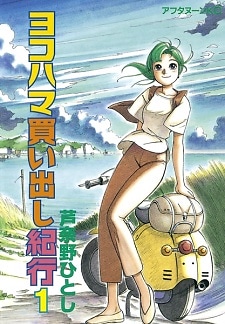
Alternative TitlesSynonyms: Yokohama Shopping Log, Yokohama Shopping Trip, Touge Japanese: ヨコハマ買い出し紀
Information
Type: Manga
Volumes: 14
Chapters: 142
Status: Finished
Published: Apr 26, 1994 to Feb 26, 2006
StatisticsScore: 8.851 (scored by 3520 users)
Ranked: #162
Popularity: #180
Members: 9,915
Favorites: 1,082 1 indicates a weighted score
My Info
Popular Tags
sci-fi seinen slice of life |
SynopsisSet in a post-apocalyptic Japan of the near future where the sea level has risen and flooded much of the coastal areas and Mt. Fuji has erupted within living memory. The population has been considerably reduced and political and technological institutions have broken-down. Local communities have become nations and telephone and television no longer exist (although coffee vending machines and streetlights stubbornly continue to work). There are strange new animals and plants (like flying fish and glowing streetlight trees). The remaining people have adopted a slower-paced, simpler way of life and rely more on each other. Along with the human population are some intelligent, humanoid robots. One of the robots, a female named Alpha, runs a cafe by the same name in the country outside of what remains of Yokohama. With her trusty motorscooter and her camera she travels around the area making friends with the humans and robots, having new experiences and observing the passage of time.
Note: Includes the epilogue, Touge, published with the 10 volume re-issue. Chapter count also includes 'Chapter 0' from volume 1. |
Related MangaAdaptation: Yokohama Kaidashi Kikou, Yokohama Kaidashi Kikou: Quiet Country Cafe
Reviews
|
|
TheCriticsClub
248 of 316 people found this review helpful
|
140 of 142 chapters read
|
| Overall |
10 |
| Story |
10 |
| Art |
10 |
| Character |
10 |
| Enjoyment |
10 |
Yokohama Kaidashi Kikou (abbreviated to YKK outside Japan) is an example of the proverbial “diamond in the coal mine”. Written and drawn by Ashinano Hitoshi, the manga was serialized in Kodansha's Afternoon magazine for almost 12 years, and has gathered a number of devoted fans around the world despite the lack of licensed English translations. This comes as no surprise since it is one of the few series which deserves to be treated as a works of literature rather than of pop culture. YKK is a testament to the true potential of manga and the series is recognized as such, having been deemed worthy of Afternoon magazine's Four Seasons Award for debut works as well as the 2007 Seiun Award for Best Science Fiction Manga.
Story (9.7) & Characters (10)
YKK is a science fiction story as it is set in a future after an unspecified large-scale disaster and the main character, Alpha Hatsuseno, is a robot who looks human. However, this is where any similarity to "regular" sci-fi ends. There are no spaceships, lasers, or mecha of any sort. Instead, older technology such as scooters, radios, propeller-driven aircrafts and the like, are very much still in use. This is reflective of the rural lifestyle that humanity has adopted in the story and adds to the easygoing pace of the manga. This tranquil, almost bittersweet feeling is reflected in the art style, the characters, and even the manner in which the story is delivered.
The story is told mainly from the perspective of Alpha Hatsuseno as she meets old friends, makes new ones, and casually explores the world around her. The most unusual fact about Alpha is that she isn't human, but a type A7M2 robot who looks human and is capable of feeling emotions. The story begins with Alpha taking a trip to Yokohama to buy coffee beans. She has been alone for some time as she waits for her "owner" to return from wherever he has disappeared to and, being immortal, she has decided that she can wait as long as it takes. In the meantime, she runs Café Alpha, a small coffee shop in the middle of nowhere which her owner left in her care.
Besides Alpha, several other characters also appear throughout the series. Some are shown regularly like Oji-san and his grandson Takahiro who run the gas station near the café. Others turn up less frequently such as the anonymous café customer and the mysterious Misago, an ageless wild woman who only appears before children. Next to Alpha, the other most prominently featured character is Kokone Takatsu, a type A7M3 robot. Kokone is effectively Alpha’s younger sister (production-wise that is), and as their friendship grows, she begins to develop romantic feelings for Alpha which later stir her curiosity about the history and nature of the A7 series.
Although the other characters do not enjoy as much exposure as Alpha does, several are given sufficient development to be memorable in their own right and their experiences serve as important reference points that highlight the passage of time. Through them, the reader is shown the great expanse of the story spanning the landscape and the era.
One of the most notable achievements of YKK is the manner in which the characters enhance each other throughout the series, and how Alpha gains a new perspective on life through her encounters with them. The interactions between the characters are often laconic and unhurried. Because of this, each encounter gains a languid, almost dreamlike quality that is far more memorable than what can be found in many other slice of life manga.
Art (9.7)
The art in YKK contributes greatly to the relaxed atmosphere of the manga. Ashinano’s style is evocative of the simple yet fantastic nature of the world. In several parts of the manga, commonplace scenes are given an ethereal quality. This, together with the character designs and Ashinano’s unusual use of blank space, gives the art style a surreal characteristic that at times appears almost paradoxical. As with any long running series, the art style has evolved and improved over time.
Ashinano Hitoshi's character designs are perplexingly both spare and meticulous. Each character’s face is basic yet highly expressive; a stark contrast to their elegantly elaborate clothing and accoutrements. This unusual style is further enhanced by the picturesque backdrops and settings which the characters find themselves in. In addition to this, Ashinano has made wonderful use of blank space to emphasize the amount of detail in the characters and settings, something which is more prominently highlighted in the beautiful colored illustrations and panels that appear in the manga. This style of artwork focuses not only on the locations, but on the characters themselves and serves to enhance the reader's empathy towards each character.
From the most beautiful parts of nature to fantastic creations of Ashinano’s imagination (giant sunflowers, underwater streetlights, water gods, kamas, and many other wonders that Alpha discovers), each object and location in YKK helps to transport the reader more deeply into Alpha’s world. Not only is it easy to understand what she is feeling about her surroundings from the art alone, but the simple beauty serves as a way of deeply understanding not only the intricacies of her world, but of ours as well.
Enjoyment (10)
Many readers have hailed YKK as the epitome of the slice of life genre and, given the premise, this may be no exaggeration. The series makes exceptional use of “mono no aware” (a Japanese term used to express the awareness of the transient nature of things, and the bittersweet sadness at their passing), and the time period in which the story is set makes the use of this especially poignant. In Alpha's words "It looks like the twilight of this age has quietly arrived. I think I'll be around 'til these twilight years end."
Reading YKK is without doubt one of the most unique and wonderful experiences in manga. Each chapter is filled with a calm, inviting feeling that pulls the reader into the story like a lucid dream. Alpha is without doubt one of the most engaging characters ever created, combining childlike innocence with reflective maturity. The story is remarkable in both its simplicity and its complexity as the reader is taken on a journey of discovery about themselves, the world around them, and the transient nature of things, whilst the art perfectly resonates with both of these elements to produce an atmosphere like no other.
Melancholy yet hopeful, exciting yet wistful, joyful yet sad, YKK is a singular achievement in manga that is deserving of the title "Masterpiece", and should be afforded a place amongst the great works of modern literature.
OVERALL - 10
This review is the final result of a review team composed of members from the "Critics and Connoisseurs" club. The team members were:
Anomalous - writer and editor
Archaeon - writer and editor
Yuunagi - writer and editor
Here are their individual scorings for the Manga:
Category - Anomalous, Archaeon, Yuunagi
Story - 9, 10, 10
Art - 10, 10, 9
Character - 10, 10, 10
Enjoyment - 10, 10, 10
Overall - 10, 10, 10
In the club wide poll held for Yokohama Kaidashi Kikou it received an average overall rating of 8.83
read more
|
|
Yuunagi
147 of 198 people found this review helpful
|
143 of 142 chapters read
|
| Overall |
10 |
| Story |
10 |
| Art |
9 |
| Character |
10 |
| Enjoyment |
10 |
"This gentle calm and quiet is the twilight of an era.
I will probably watch the passing of this twilight age."
Content:
The stories featured in YKK are mostly light and melancholy. Readers who are used to action, sex, fanservice, violence, and/or intense drama would either be A) disappointed, or B) surprised that stories without the said elements could possibly exist and still be enjoyable.
YKK is characterized by mono no aware, a Japanese concept that describes beauty as an awareness of the transience of all things, and a gentle sadness at their passing. Entertaining old customers in a coffee shop, riding through desolate roads on a scooter, reminiscing while watching the sun set; none of these are close to being earth-shattering and yet the author somehow presents ordinary scenes in such a way that they evoke overwhelming feelings of nostalgia. Being reminded that today will be tomorrow’s yesterday, one cannot help but appreciate the present for its fleeting existence.
Literary Style:
Ashinano’s style of writing is radically different from that of other mangaka. Rather than using the typical cliches and standards of comics and animation, the author’s style is more similar to those used by writers of literary novels and short stories. Using motifs and details to imply themes, skillfully combining images of everyday life with colloquial monologues and dialogues to produce visual and verbal poetry, it is obvious that, while YKK is appropriate for readers of all ages, it requires a mature and understanding reader to fully appreciate this work of art.
In fact, his method of implying themes through details might remind some of J. D. Salinger’s The Catcher in the Rye. The characters, the plot, and the details don’t just represent themselves as components of a work of fiction, they reflect the reality of everyday living. The characters act naturally and events unfold as they would in real life: without fanfare. This makes it easier for the readers to relate with the characters and believe in them. As the characters develop, the reader may also find their revelations relevant to his/her own life. In a sense, Yokohama Kaidashi Kikou may in fact be one of the few titles which are actually worthy of being called “graphic novels”.
Visuals:
Ashinano’s character designs are simple yet charming. The faces of the characters are very expressive, effectively bringing out the characters’ moods and personalities. As one goes through the volumes, it’s also quite interesting to see how Ashinano’s style had improved through the years (the series ran for 12 years, after all).
What really makes his art stand out, however, is his awesome ability illustrate the setting in fine detail. Gusts of wind sweep across vast fields of grass, the lights of a submerged city continue to glow beneath the ocean waves, roads and towns once bustling with life now stand derelict and abandoned; the scenes often invoke feelings of nostalgia as if the writer and the readers had been there themselves. Later on in the series, Ashinano starts using more and more of these images to enforce or sometimes even replace the dialogue to deliver his message to the audience.
Overall:
Well, it looks like it’s all downhill from this point on for anime/manga because I don’t think I’ll ever find anything close to being as good as this series. Sure, I’ll probably stumble over a few other well-written stories out there, but I really doubt it if they would be as emotional and as thought provoking as Yokohama Kaidashi Kikou. read more
|
|
Both are the most superb slice-of-life that i have ever read.
each manga has its own unique atmosphere and tells you wonderful storys that when they end you fell all fuzzy and warm inside.
Both are slowly paced slice of life series.
Due to its brighter atmosphere and the moé appeal of the characters, ARIA is a good choice for helping people get used to the genre before introducing them to YKK with its more mature and melancholy insights.
In truth, if one was to really think about it, ARIA and YKK are not actually similar from how it is presented or the feeling you get from it. However, the story's theme(?) is quite same - a slow, peaceful glimpse of a group of people who seem to find happiness from many small things. I think that alone is enough to try the other and experience both.
Storyline wise, they aren't at all similar, but YKK gives a similar vibe as that of Aria, both occuring in a futuristic world, yet giving a laidback, fantasy feel to it. Though Aria is much much better IMO, YKK is worth a second look.
Honestly there is no plot, you could say they're about nothing and turn away from them. That would be a mistake. These titles are relaxing and soothing reading matter that gives you sensesation that life isn't all about money, work even education. In both landscapes are feast for eyes. Main difference is in pace , both slow but YKK is more adult and based on inner thoughts of heroes while Aria is shonen slice of life with lot of moe. Same charm , different ways of achieving it.
both are relaxing slice of life with no action, but great characters and warm atmosphere.
These two are both very relaxing to read, nothing much happens, but together with the characters you can come to appreciate the beauty of the world. Definitely worth reading.
|
|
|
Another light-hearted slice of life title. Stress-free yet not saccharine, it's perfect for the jaded manga reader or anybody who wishes to see the world in a new light.
Both calming and peaceful manga that i really enjoyed. Though the setting may be different they still manage to have the same feeling of calm and ejoyment of life.
Both top quality Slice of Life!
Both are about green haired girls that go through the adventures of day to day life.
Yotsubato is more light hearted then YKK but both are excellent and are worth giving a try!
How does a view of the world of a 5-year old match the world of Alpha and Kokone?
Discovery.
You couldn't expect the discovery of the world by a 5-year old to be as peaceful and calm as YKK, but there are moments (like the astronomy) where things just work out right.
There's more humor in Yotsuba, the artwork is of a very good quality, and the characters around her are well crafted. Well worth checking it out.
If you don't read Japanese, then the French translations by Kurowawa.fr are released much quicker than the English translations, and can be bought from online french booksellers.
Unbelievably cute slice of life mangas. Although for different reasons, since Yotsubato is more comedy and YKK is just life story-telling.
|
| No posts for this board were found |
Related Clubs♥ Coffee Lovers Unite! ♥, After the Apocalypse, Anime Break, Anime Girls Fan Club [A.G.F.C.], ★Pictorial Culture Miscellany★, Café Alpha, CNCFixins, Cogito Ergo Sum - Philosophy In Anime and Manga, Critics and Connoisseurs, Eiko's SQUAD., Iyashikei, Iyashikei Oyajitachi, Legendary - Anime & Manga !, Licensing Unlicensed Manga, Machines and Cyborgs, Manga > Anime, Manga Experience, Manga Masterpieces Club, Manga vs. Anime, Overrated or Underrated Animes and Mangas, Overrated Shit, Read Everything And Discuss: Manga, Recommendation Club, Scooter Girls, seinen & josei, Slice of Anime Life, The Lighthearted Anime Club, The Super Superior Secret Society of Secret Secrecy and Supreme Superbness in Superstellar Saturation, Veronin is the greatest user on MAL with the best taste and everybody who disagrees with him is a horrible person who deserves a painful death. , ~ Flagship Conspiracy ~, Бессюжетные девочки
|
40 minutes ago |
2 hours ago |
7 hours ago |
7 hours ago |
8 hours ago | |
Yesterday, 8:16 PM |
Yesterday, 4:16 PM |
Yesterday, 8:09 AM |
Yesterday, 6:51 AM |
05-23-13, 9:00 PM |
|
External LinksOfficial Site, MangaUpdates, Wikipedia
|
|