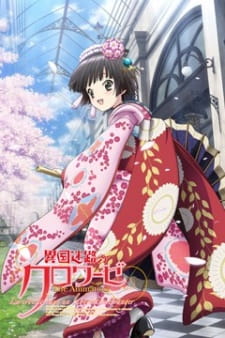
Alternative TitlesEnglish: Croisée in a Foreign Labyrinth ~ The Animation Synonyms: Ikoku Meiro no Croisée The Animation, Ikoku Meiro No Croisee The Animation, La croisée dans un labyrinthe étranger Special Japanese: 異国迷路のクロワーゼ
Information
Type: TV
Episodes: 12
Status: Finished Airing
Aired: Jul 4, 2011 to Sep 19, 2011
Duration:
23 min. per episode Rating:
G - All Ages
L represents licensing company
StatisticsScore: 7.521 (scored by 10955 users)
Ranked: #13252
Popularity: #805
Members: 22,783
Favorites: 55 1 indicates a weighted score
My Info
Popular Tags
No tags found |
SynopsisThe story takes place in the second half of the 19th century, as Japanese culture gains popularity in the West. A young Japanese girl, Yune, accompanies a French traveller, Oscar, on his journey back to France, and offers to help at the family's ironwork shop in Paris. Oscar's nephew and shop-owner Claude reluctantly accepts to take care of Yune, and we learn how those two, who have so little in common, get to understand each other and live together in the Paris of the 1800s. |
Related AnimeAdaptation: Ikoku Meiro no Croisée Side story: Ikoku Meiro no Croisée Special Other: Ikoku Meiro no Croisée: Yune & Alice, Ikoku Meiro no Croisée Picture Drama
Characters & Voice Actors
Staff
Reviews
|
|
Archaeon
122 of 248 people found this review helpful
|
12 of 12 episodes seen
|
| Overall |
6 |
| Story |
6 |
| Animation |
7 |
| Sound |
7 |
| Character |
6 |
| Enjoyment |
6 |
There has long been a mutual fascination between Eastern and Western cultures, and although modern technology and tourism have made it easier to explore the mysteries of other lands, things were very different during the latter part of the 19th century. At that time, travel was still relatively dangerous, and the cost of the undertaking meant that it was generally reserved for royalty, the upper and middle classes, and well-to-do merchants or craftsmen. Journeying to a foreign land (and returning to spin tall tales of exotic things), was considered a mark of one's status, and aside from choosing life as a sailor or joining the military, the working classes had very few options when it came to visiting other countries. The generally accepted method was emigration, but even though port cities across the world became hotbeds of ethnic diversity and multiculturalism, newcomers also ran the risk of racially motivated assaults, propaganda, and worse.
Another method was for a person to be "sponsored" by a citizen of another nation, and while this allowed them to live and work in that country, they also had to abide by certain strict "rules". Like any system it was open to abuse, but many people were also granted a better start in life than they would have had in their homeland. The biggest difference between this method and emigration though, was the perception of the native populace. Many of those who were sponsored didn't live as part of an existing ethnic community, and because of this they were often tolerated as novelties rather than a threat.
Okay, that's a bit of a heavy beginning for a light-hearted slice of life anime, but a bit of context may help with certain aspects of Ikoku Meiro no Croisée.
Based on the manga by Takeda Hinata, the story follows the lives of Claude Claudel - an ironmonger living and working in Paris, and Yune - a young Japanese girl who has been sponsored by Claude's grandfather, Oscar, to come and live with them for a time. Unfortunately they have very little understanding of each other's cultures or histories, so every day is an opportunity to learn something new ...
Now many people will immediately pass this series off as nothing more than inane, lighthearted fluff with no real story, and in all honesty that's a pretty fair assessment. The episodic plot is rather straightforward and progresses in the relaxed manner that is so common in slice-of-life shows. In addition to this, there's an element of whimsy to the narrative that can make it difficult to take certain events seriously, and the whole show can often seem like it's trying very hard decide what it should be.
That said, there is a charm to proceedings that comes from a cast of surprisingly earnest characters, and there are flashes of a much deeper story hidden within the sugar-coated exterior. Unfortunately these undertones are rarely allowed to surface, but when they do, the series gains an intensity that can sometimes be at odds with the relaxed atmosphere, and it can often seem as though there is a purposeful avoidance of certain topics.
As far as appearances go, there's a nice uniformity to the predominantly European design, and everything from the buildings to the clothing are reflective of the period. Unfortunately there's also one glaring irregularity that may have been purposeful, but seems rather unnecessary, and that is Yune. The major problem is that she has been designed to be petite and tooth-achingly cute, and it's because of her looks that people automatically assume that the series is nothing more than a big ball of moe fluff. It's probable that this was an attempt to highlight just how different she looks to everyone around her, but there's an element of tastelessness to it - even though it does fit the 19th Century European vision of a typical girl/woman from the Far East.
That said, the characters are surprisingly expressive, both facially and in their behaviour, and the show makes good use of this factor. In addition to this the animation is pretty decent throughout, but it's also rather placid, which is why the art style sometimes changes for events that are meant to be charmingly amusing. In a very real sense it's a visual form of the much hated "canned laughter", and while it's supposed to "encourage" viewers to chuckle, thankfully it's not used enough for it to become anything more than a diversion.
Ikoku Meiro no Croisée has a rather interesting set of characters that can sometimes play very well off each other, but because this is a slice-of-life tale the focus is less on developing them as individuals, and more on nurturing their bonds with the people around them. Now it may seem like splitting hairs, but it's actually a rather important distinction as this type of growth rarely occurs in other genres. Although the series isn't on the same level as Aria in this department, it does manage to hold its own for the majority of the show, and Yune's earnest habits and mannerisms may cause some viewers to make comparisons between her and Mizunashi Akari or Binchou-tan.
Now while there's a lack of obvious development, there are attempts to add definition to the characters and explain why they think and behave the way they do. Although the reasons are often retrospective, they're also logical and fit into the class system of the period, but viewers may sometimes find themselves frustrated by the fact that they ultimately don't lead anywhere.
Because this is a "Stranger in a Strange Land" type of story, the script takes a simpler, more explanatory approach than normal. Surprisingly, this seems to have allowed the voice actors more freedom rather than restricting them, and much of the dialogue is delivered with the kind of warmth and sensitivity one would expect from a slice-of-life show. Touyama Nao manages to capture Yune's shy earnestness rather well, and her performance is balanced by Kondo Takashi's seriousness as Claude, and Yuuki Aoi's rather madcap portrayal of the show's resident Japanophile - Alice Blanche.
The opening theme, "Sekai wa Odoru yo, Kimi to" by Youmou to Ohana, is a rather cheerful song with a continental flavour that fits very well with the accompanying animation showing Yune, Claude and Oscar on a day out in Paris. Strangely, the ending sequence features Yune waking up on a bed in the middle of a forested park (how this fits into the show is anybody's guess), while Touyama Nao sings "Koko Kara Hajimaru Monogatari", a slightly melancholy ballad that doesn't quite fit her breathy, high-pitched voice. There are also two additional closing songs, "Tooku Kimi e" by Nakajima Megumi and Touyama Nao, and "Tomorrow's Smile" by A.m.u.. Both are very similar to the main ending theme in terms of emotion, but neither has a dedicated animated sequence, instead using the episode itself to give context to the track.
The background music ranges from sombre to the more common lighthearted pieces, but there's a surprising subtlety to it that may not be obvious at first. As the series progresses, it gradually becomes apparent that different primary instruments (violins, pianos, harps, clarinets, etc), have been used throughout in order to add dimension to particular scenes, and enhance the overall tone of the anime.
Although the series does have its problems, Ikoku Meiro no Croisée also retains a fair amount of entertainment value. Much of this comes from the relationship between Yune, Claude and Oscar, but one can't deny that some of Alice's ideas about Japanese clothes and objects can be worth a chuckle. The series maintains a lighthearted atmosphere for the majority of the story, and although there is a banality about particular events, it's not really enough to discourage those who enjoy this type of anime. On the other hand, while the undercurrent of tension between certain characters can sometimes shed new light on the relationship dynamics, it can also place an unnecessary burden on the narrative as the issues beg to be explored, but very few are actually resolved.
Ikoku Meiro no Croisée tries very hard to avoid being categorised as nothing more than 19th Century moe fluff, and in several small ways it manages to achieve its goal. Unfortunately the rest of the show is a bit too sugary-sweet, and while it can be charming, it studiously avoids addressing any of the real issues that someone in Yune's position would have faced.
It's idealistic escapism, which is okay up to a point, but it's also far too nice for its own good. read more
|
|
Detective
55 of 113 people found this review helpful
|
12 of 12 episodes seen
|
| Overall |
8 |
| Story |
7 |
| Animation |
9 |
| Sound |
9 |
| Character |
8 |
| Enjoyment |
9 |
Croisée in a Foreign Labyrinth was mostly overlooked last season due to it's overlapping qualities with the third season of Natsume and the Book of Friends. If you were watching Natsume, then you already know that they are two very different anime despite them sharing similar pacing and atmosphere. Natsume on one hand received tons of praise, but Croisée mostly ended up getting flack. I was quite upset when I was reading through reviews that quickly disregard Croisée as "moe-trash" and simple pandering. Yes, the show does have a little girl in it, and yes she is adorable. That does not mean the show is moe, and more importantly it does not mean the show is trash. I hope this review clarifies some points on the show, and in turn convinces you to pick up this anime. It is well worth your time for many reasons.
The setting is late nineteenth century, France. If you're interested in European art, then I strongly recommend this anime, as the backgrounds and clothing are all very realistic. Many times, I was captured by the scenery and it is a very strong suit Croisée has that many anime simply leave out.
Immediately, the characters are what will jump out at you. There's an old man, a boy in his late teens, and a young girl. Now this set up could have gone horribly wrong and turned into something perverse and offensive, but it did not. The old man, Oscar, was one of my favorite characters in the show. He's an important father figure to both Claude and Yune, and he brings interesting wisdom, making the show worthwhile to think on even after finishing. Claude Claudel is the protagonist of the series alongside the small Japonaise, Yune. The show is about how Yune adapts to her new environment and how Claude adapts to a foreigner living with him in his deceased father's failing sign shop. The characters work off of each other very interestingly, and I felt it was very easy to sympathize with both of them as their problems were more mundane than extreme. This may lead some to think that the show is very melodramatic, but it is in fact the opposite. The execution here is done very well , and all problems are solved in a way that develops the characters in a believable manner.
There are two other characters that are very much the opposite of our protagonists though, Alice and Camille. They are part of one of the richest families in Paris at this time, and they both have unique relationships with Yune and Claude respectively. Alice is very obsessive with the Japanese culture, which at the time, was highly intriguing to the people of Paris. Her relationship with Yune is somewhat one-sided but very interesting and even complex as the show completely unfolds. Camille's relationship with Claude was very interesting as well, but I do not wish to spoil it for those who haven't seen it yet.
I digress but I must include this. Alice supplies an anachronism - the only one in the show - and whilst it was unnecessary, I don't think it should soil the reputation of the show. Alice says "moe" despite the show being set more than one-hundred years before the word came into history. This joke is used more as a 4th wall joke in my opinion, so it shouldn't be too heavily stressed upon.
The sound contributes greatly to the setting and I found it adding to an already wonderful experience. Even the opening is an instrumental piece. The show could have abused the setting and sound to create a very pop soundtrack to sell to the masses, but it didn't and I have great respect for that. The one thing I regret this anime did not do, was include more French words into the script. Though that is understandable, as there is a large challenge in overcoming linguistic barriers. Luckily, as a side-effect, choking strange words down the audiences throat is not what happens either.
Croisée in a Foreign Labyrinth is a piece resistant to much of the failings that can be found in both historical and slice-of-life anime. There's not an over-abundance of fanservice yet it is still incredibly enjoyable to watch. Yune is not sold as sexual, and unlike many shows focusing around little girls, she has great characterization, as does the rest of the cast.
The show is slow, but if you're willing to try out a new experience then this may be a good place to start. If you're hesitant to pick this anime up, then I hope this review has encouraged you to do so. I was too, hesitant to continue this show beyond it's first episode, but I am glad that I did, as it became a very memorable anime. It is certainly worth watching, especially since it is very short.
If you enjoyed any of these anime, then you might also enjoy Croisée in a Foreign Labyrinth: Victorian Romance Emma, Usagi Drop, and Aria the Animation. read more
Recommendations
|
|
Both deal with a plucky young girl finding her way in world that is new to her -- a new country in Ikoku Meiro no Croisée, and a new family in Usagi Drop. Though contextually quite different, their shared slice-of-life approach and fondness for warm and fuzzy feelings (for the characters and viewers both!) ensure they have a similar pleasant and charming feel throughout.
Both are wonderful slice of life stories about a younger girl being taken care of an older guy. Both leave you with a warm fuzzy relaxing feeling~~~
Both series feature a young girl who feels foreign to the world around her, whether literally (Yune from Ikoku Meiro) or metaphorically (Rin from Usagi Drop). This young girl must adapt to a new lifestyle, live under the roof of a new guardian, and make new friends. However, while this sounds like the tale of something angsty, both of these series are instead rather positive and light-hearted, though still managing to hold genuine dramatic weight to the people and situations that the girl comes across in each show~
Though different art styles and different time era's, both consist of a male looking after a little girl and you get to witness the events that happen when the two lives collide.
Both animes are based on young girls in a different "place".Both atmospheres are also very calm, soothing, easy-going, and childish. However both anime take place completely different worlds .
You'll feel the same feeling from both of this show...
Both of it tell a amusing daily life story about an adult and a kid..
They both give you a warm feeling at the end of each episode and deal with being part of a new family.
|
|
|
A person comes from Japan to Europe and they end up dealing with the cultural differences between their country and the one they are visiting. On top of this the people around them learn about the cultural differences too.
Both series deal with a Japanese person adapting to life in turn-of-the-century Europe. Gosick is a fair bit heavier with its mystery plots and intrigue whereas Ikoku Meiro no Croisée is typically lighthearted and slice-of-life-y, but the fish-out-of-water character aspects and moments of unanticipated cultural clashes are consistant between both and provide ample similarities throughout.
although both animes have some differences, the artwork and characters are really similar. Both have a very cute main protagonist, also, a both anime's have the two main characters from different backgrounds, however, instead of the lead male going to the lead females country, its the other way round. Also, Ikoku Meiro no Croisee is more refreshing so if one enjoyed gosick, its more likely they'll enjoy this anime too.
Both of the main characters seem almost doll like, and both stories take place in Europe but involve an element of Japanese. Also both take place in an older time setting.
Art and style in both animes are heavy influenced by France during the 19th-20th century. However, Gosick is a detective type plot and much more serious and mature in contrast to Ikoku meiro which is more childish and laid-back.
While seemingly similar at first glance, these two series actually have a bit in common:
1) Both series has a young girl (although different personalities) that is cute/doll-like who has a friend who cares for her
2) Both the male protagonist in the series have similar personalities
3) Both series has a similar setting as in the French/Victorian like style
4) Both series has similar artwork
5) Both series are lighthearted that contains comedy, drama, and some emotions
|
Opening Theme"Sekai wa Odoru yo, Kimi to. (世界は踊るよ、君と。)" by Youmou to Ohana (羊毛とおはな)
Ending Theme#1: "Koko kara Hajimaru Monogatari (ここからはじまる物語)" by Nao Touyama #2: "Tomorrow's Smile" by A.m.u. (ep 8)
Fansubbing Groups
Which fansubbers do you like the best? Click + to approve of their subs for this show. Click - if you don't think they did such a great job.
Related ClubsAnime Power Rankings, Genre of the Arts Fanclub!, Ikoku Meiro no Croisée Fan Club, Slice of Life Club , LOLI DEFENSE ARMY, Stranger in a Strange Land, Touyama Nao Fanclub, .:: ☆ ::. Romantic ♥ Historical .:: ☆ ::. , !~~tsubasalover's Friendships~~!, Missile Punch, ♔ The Old, Elegant Story , Yune Fanclub, SeitoCast Anime Podcast
Recently Watched By|
17 minutes ago |
1 hour ago |
4 hours ago |
4 hours ago |
7 hours ago | |
8 hours ago |
9 hours ago |
10 hours ago |
Today, 12:38 AM |
Yesterday, 10:56 PM |
|
|