Alternative TitlesSynonyms: Hotaru No Haka, Tombstone for Fireflies Japanese: 火垂るの墓
Information
Type: Movie
Episodes: 1
Status: Finished Airing
Aired: Apr 15, 1988
Duration:
1 hr. 28 min. Rating:
PG-13 - Teens 13 or older
L represents licensing company
StatisticsScore: 8.621 (scored by 14286 users)
Ranked: #312
Popularity: #138
Members: 20,873
Favorites: 327 1 indicates a weighted score
My Info
Popular Tags
drama ghibli historical |
SynopsisOn the final days of World War II, 14-year-old Seita and his four-year-old sister Setsuko are orphaned after their mother is killed during an air-raid by American forces in Kobe, Japan. After having a falling-out with their aunt, they move into an abandoned bomb shelter. With no surviving relatives and their emergency funds and rations depleted, Seita and Setsuko must struggle to survive their hardships as well as those of their country, which is on the losing end of the war.
(Source: ANN) |
Characters & Voice Actors
Staff
Reviews
|
|
tehnominator
88 of 119 people found this review helpful
|
1 of 1 episodes seen
|
| Overall |
10 |
| Story |
10 |
| Animation |
10 |
| Sound |
9 |
| Character |
9 |
| Enjoyment |
10 |
I once heard a singer define what he thought of love. He said, 'Love is watching someone die.' For Seita, a young Japanese boy living during one of history's darker moments, he witnesses several events that can only be called true tests on the heart.
Set in the backdrop of World War II, Seita and his much younger sister try to survive while their country is wracked with the devastation of war. The Americans bomb their town, and they are forced to live with an aunt after becoming orphaned. A country torn by war leaves its people with homes ripped with dissent: their aunt starts to feel the pressure of having two young children in her house, and Seita decides, in a moment of pride, to take off with Setsuko and try to live by themselves in an abandoned bunker outside of the village.
Grave of the Fireflies is not a fairy tale despite Seita's attempts to make Setsuko think that they are living in one. The movie sadly follows their lives in this bunker where they don't battle soldiers and warmongers, but try to battle scabs, starvation and sorrow. In an interesting light, despite the very graphic and violent scenes that the movie opens with, the rest of the movie does not deal with fighting and war, but more of the war's impact on these two children. Calling it a history lesson would be wrong. It isn't. The film has often been criticised as anti-American in sentiment as it details the Japanese suffering. This notion could not be more incorrect. It doesn't matter who dropped the bombs--the bombs have fallen anyway, and people have been affected. This is not about who was right, who was wrong, who started it--this is about a young boy, his sister, and watching as life slowly trickles away just as the light of a firefly eventually diminishes.
This film encompasses what a tragedy is really. Terrible things happening to two children is tragic, yes, but there are different facets it also looks at. A true tragedy is not only watching the downfall of a person--it's watching that very person causing their own downfall. Yes, Seita should have swallowed his pride and stayed with his aunt. He would have been guaranteed food, shelter and safety. This movie is exceptional because it knows bad decisions are made all the time, and it shows that. Isn't war one of them? A terrible choice? It is, which makes wars tragic events. Isn't Seita's decision to try to be independent when he really couldn't bear the responsibility a terrible choice? It is, and this is why everything that happens afterward is a tragedy.
Art and animation for this movie are truly magnificent. Made decades ago, and yet it still looks amazing. The movie is gruesomely detailed, showing the exact look of a body burned beyond recognition, the little nits and lice that thrive from destitute and unhygienic living conditions, the bones pressing against skin that has been denied nourishment. There's something darkly, hauntingly beautiful about the artwork for this anime. The character design is realistic, and watching Seita and Setsuko, well, it could be any two Japanese children. Which I think means a lot more in the grander picture: how many boys and girls just like them have been victims of the second World War? Possibly more than we truly want to know.
Grave of the Fireflies has an excellent score. The technical aspects of this film are near perfection. The score utilises melancholy sounds, but it understands the quality of silence just as well. Take the first scene of this movie. There is dead silence. And breaking this silence is the voice of a boy, telling you that something has happened to him. Breaking this silence are his weak, laboured, quiet and quick breaths he takes as you watch him sitting on the floor of a train station, waiting for death to take him. There are few silent scenes in anime that have managed to bombard a listeners' very emotions. But where there is no vitality, where there is no life, then there is no sound. And when it's all over, the bustle and noise of life continuing swells and crashes. Grave of the Fireflies captures that perfectly.
Setting a World War II epic around young children who cannot understand the weight of the situation at large around them is possibly the most unorthodox, but most brilliant way to look at it. World War II was not only about the the Jews being executed or countless soldiers dying to defend their cause. There were other people who were affected. Grave of the Fireflies looks at two Japanese children.
Seita is a good brother. He tries, with all his might, to take care of his little sister. He plays with her, tries to take her mind off of their situation, and does things that would shame him to try to feed her. His character is defined by his pride as a Japanese male (whose father, in the Navy, must have taught his son about Japanese dignity). He refuses to be dependent, but his independence causes most of the problems for himself and Setsuko. He tries to be strong and tries to be a man. This movie looks at what happens after responsibility is dumped on a young boy and places him in situations where he has to become the adult. His mother dies, he knows he can't cry. He has to be strong. But how does he relate this to a little girl? He can't, because he doesn't know how and he does what he can to make her smile again, even if it does mean playing blindly after a devastating experience.
Setsuko is adorable and it's hard not to love her. Her childish innocence and her outlook on life is refreshing, when there's not much else but death and decay surrounding her. And it will break your heart to watch her, as she tries to entertain herself, as she tries to stop the rumbling in her stomach, and as she has to live in an environment of suspended unhappy playtime. The interactions between Seita and Setsuko are a marvel to watch. Anyone with siblings can relate to what they share. Their bond is deep. It's something else to watch them turn into each other's worlds when the world outside has turned ugly.
It is debatable on whether you can call Grave of the Fireflies 'enjoyable'. Can watching the spiralling descent of two innocent children be entertainment? I highly doubt. This movie is utterly depressing, and if your heart isn't made of stone, you will probably bawl your eyes out. I've seen unemotional, grown men break down during this movie. There is something darkly fascinating about watching Seita and Setsuko. There won't be a minute to stop after you've started this movie. It is slow, depicting the side of war we rarely ever see in movies, which is living. No battles, no enemies, no guns. Just a boy, his sister, and them trying to get by and see another day.
Grave of the Fireflies is tragic. From seeing Setsuko dig a grave for the delicate fireflies after they die to seeing Seita figuratively dig their own graves with his choices and the lifestyle he gives himself and his sister, this movie is an experience that will move you greatly. read more
|
|
ace52387
15 of 21 people found this review helpful
|
1 of 1 episodes seen
|
| Overall |
8 |
| Story |
9 |
| Animation |
9 |
| Sound |
8 |
| Character |
8 |
| Enjoyment |
7 |
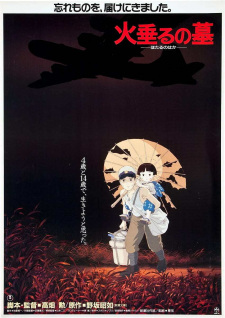
Looking at the poster of this film, a boy with an officer`s hat caring for his sister in the midst of an American bombing, I feared this would be a piece of Japanese conservatism meant to incite nationalistic indignation towards America, or perhaps the rest of the world, for committing such atrocities. I imagined the boy-scout equivalent kid symbolizing the innocence of Japan or some such nonsense. Thankfully, it doesn`t wave a finger of blame around. American bombs certainly sparked the series of events in this film, but it is just as much the aunt`s fault for speaking insensitively to the children. Equally at fault is Seita, the brother himself, for not being able to swallow his pride and underestimating the harshness of reality. Seita`s fervent faith in the Japanese empire is an ironic shot at the government of the time; they too had a part in these events for bringing the American military to their own doorstep and putting off the unconditional surrender. The film never picks out one party to villainize. It doesn`t give us the respite of anger or hatred, or any other respite at all, from the depression that this film positively bleeds. Because the viewer knows the inevitable outcome early on, every bit of childish sweetness, every instance of love between the siblings is all the more heartbreaking. There is no escaping the sadness, and for this it is unique as a film that is engrossing, but also tremendously difficult to sit through.
Grave of the Fireflies is neither a history lesson, nor is it entertainment. It is a chronicle of events that never comes to a climactic point. There is no definitive explosion of melodrama that marks the film`s peak. It feels pointless, much the way such events would feel in real life.
The passivity with which the children express their emotions takes our pity for them to another level. When they lament their misfortune, they weep, or stare blankly, as if they no longer have the strength to give themselves release through bawling loudly, or screaming bitterly at the sky. That battered demeanor communicates a stifling sense of resignation and depression that is more powerful than any melodramatic outcry.
The animation is a little stiff and unspectacular for a Ghibli feature, but the film rarely relies on motion to convey anything so this is not a big hinderance, easily made up for by the spectacular detail and variety in way the characters` facial expressions illustrate the different nuances of pain in different situations. The most striking element by far is the gruesome and uninhibited way it shows how war can destroy humanity. People insensitively handle the very graphically drawn dead bodies. There is an instance when the poverty stricken Setsuko visits a doctor. As she lifts up her shirt, the lines of her ribs are clearly visible, and with the depression in her abdomen and festering infections all over, it`s clear that she is in imminent danger, yet the doctor barely bats an eyelash. As striking as the depictions of death and disease are to us, it is even more alarming that the characters in this film look at it so nonchalantly. The music is largely slow and tragic, but a couple of pieces have a gentler, melancholic feel that fit well with Setsuko`s oblivious innocence. The discordant sounding strings can be a bit heavy handed, and there are times when some of the sweeter scenes are obtusely paired with heartbreaking pieces, but for the most part the music is elegantly used.
Fictional tragedies are usually bittersweet. In Romeo and Juliet, an unfortunate circumstance created a misunderstanding, but the final acts themselves were in the name of the most beautiful emotion in the world. The audience can then take comfort in the fact that the misfortune was in the end, an expression of love. You`ll find none of that in Grave of the Fireflies. I groped around desperately for some reprieve, a character to hate, a moral to the story, a silver lining, something that could make sense of the senseless tragedy. I found no such thing, and perhaps this is more in tune with reality, but I`d prefer fiction to indulge in a poetic flourish of some sort, just for the sake of balance; a bit of sweet to all the bitterness. Grave of the Fireflies is commendable for not selling out the unforgiving nature of reality, but as a result, it is the one of the most suffocating animated films ever created. read more
Recommendations
|
|
Not only are both films a must watch - they also share a lot in common. Both lead characters are forced to 'be a man' at times of tragedy (despite their age) and both must come to terms with the losses that occur - as such they are both extremely powerful anti-war movies based on real events the authors went through. They are both very upsetting, but don't let that put you off watching these great films!
They both give depictions of what it was like after WWII in Japan. Grave of the Fireflies gives the opinion more after the war was nearing it's end while Barefoot Gen gives perspective of both during and after the war.
It's hard to imagine you'd like one of these titles and not the other --- they are each a unique and interesting story yet both composed of very similar content and themes. Watch both back-to-back for guaranteed sadness.
They are both about the same thing - war. These two stories are very depressing, sad and cruel...
It will also make you cry... A lot. The tears will not stop flowing if you watch either of these. They both portray tear jerking tragedies caused during World War 2.
Both set during war time in Japan. Barefoot Gen is a really heart-wrenching story about one boys struggle after the bombing in Hiroshima. Not for the faint-hearted.
|
|
|
Both deal the gruesome truth about war; and the negative effects war has on society; especially children.
War, destruction, emotions, tears... both are masterpieces.
Both masterful examples of watching people suffering the life out of themselves for entertainment.
|
Opening Theme"Setsuko and Seita" by Michio Mamiya
Ending Theme"Futari" by Michio Mamiya
| No posts for this board were found |
Fansubbing Groups
Which fansubbers do you like the best? Click + to approve of their subs for this show. Click - if you don't think they did such a great job.
Related ClubsClaim an anime siblings, Central Park Media Fanclub, Animetr, Long Live the 80's, The Anime Adaptation Club, Anime Drama Club, Watch Anime Together Club Headquarters, Hideaki Anno Fan Club, Anime History Association, Anti-Studio ghibli, Guns & Gore club, Group of Anime Addicts (GAA), !~~tsubasalover's Friendships~~!, EVERYONE WELCOME!, ~AnimeFans~, ***Legend of Anime***, The Classics Club, Anime Experience, Anime Movie Club, Get Your Quota! For MAL Claims ClubsBoston Anime Club, ~.:ghibli 24/7:.~, ♥ Studio Ghibli ♥, The Second World War club, History Club, Club Dubbed, Crispin Freeman Fan Club, Historical Anime , ~ONII-SAN... Big Brothers club~, Hotaru no Haka, Add Live Action, ._:AnImE/MaNgA tO LiVe ACtiOn:KuRaBu:_., Anime is Life and Love, MAL: The Later Years, Studio Ghibli Fanclub see all
Recently Watched By|
5 minutes ago |
3 hours ago |
3 hours ago |
4 hours ago |
5 hours ago | |
5 hours ago |
6 hours ago |
6 hours ago |
7 hours ago |
7 hours ago |
|
|