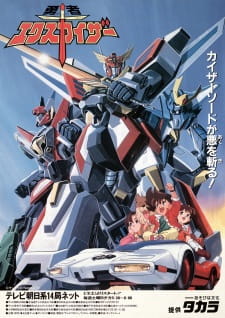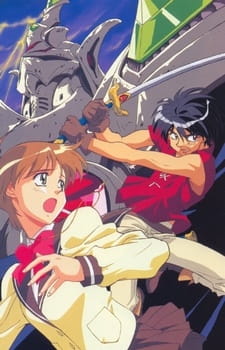
Alternative TitlesEnglish: Vision of Escaflowne Synonyms: 天空のエスカフローネ, Vision of Escaflowne,Tenkuu no Escaflowne Japanese: 天空のエスカフローネ
Information
Type: TV
Episodes: 26
Status: Finished Airing
Aired: Apr 2, 1996 to Sep 24, 1996
Duration:
25 min. per episode Rating:
PG-13 - Teens 13 or older
L represents licensing company
StatisticsScore: 7.951 (scored by 13002 users)
Ranked: #3702
Popularity: #133
Members: 21,067
Favorites: 629 1 indicates a weighted score
My Info
Popular Tags
action adventure fantasy mecha romance |
SynopsisHigh school student Hitomi is transported from Earth to the magical world of Gaea, where she meets boy prince Van Fanel, and is caught up in his quest to unite the countries of Gaea against the ominous Zaibach empire. On the way, she discovers an hidden ability and strives to unravel layers of mystery surrounding Van, his past, and the giant machine known as Escaflowne. (Source: ANN) |
Related AnimeAdaptation: Vision of Escaflowne, Escaflowne - Ishi no Kioku Alternative version: Escaflowne: A Girl in Gaea
Characters & Voice Actors
Staff
Reviews
|
|
ace52387
14 of 17 people found this review helpful
|
26 of 26 episodes seen
|
| Overall |
9 |
| Story |
10 |
| Animation |
8 |
| Sound |
10 |
| Character |
8 |
| Enjoyment |
9 |
Escaflowne is in the same generation as other venerated anime titles often fondly reminisced upon by fans, kenshin, trigun, cowboy bebop, and fushigi yugi. Where those titles all had specific target audiences, Escaflowne goes broader, not by distinguishing itself from any set Anime genre, but mixing the staples, or cliché’s of several genres together. Nothing about Escaflowne is very impressive at first. The juxtaposition of a Shoujo cast of main characters and mecha/fantasy war at its bloodiest is novel, but neither individual elements are even close to out of the ordinary. Hitomi, the main character is an understandably reluctant heroin who also has, as high school kids often do, a romantic interest that is easily piqued. The 2 male protagonists are opposites. 1 is a smooth player, the other a brash but innocent young man. There is a rather typical demented and obsessive villain, who is kept in check by another level headed villain. The characters are certainly not unique, but to be fair in this regard, how many anime characters are? Evengelion aside, I can’t think of another vaguely popular anime of a similar genre that could boast of a cast that is much fresher.
Story/Characters:
The strength of Escaflowne, and the greatest reason why this is one of my all time favorite anime’s despite how I may have more praises for other titles on paper, is the story. Escaflowne’s story is masterfully paced, rivaled (but definitely not surpassed) only by full metal alchemist in this regard in 13+ episode series’. The number of fillers are often a measure of the tightness in a story, but in Escaflowne’s case, it’d be hard enough to find a filler scene, let alone a filler episode. The story keeps you engrossed in the central plot at all times, never taking a break from it in favor of developing a character’s past with flash backs or developing a relationship with a side plot. There are flashbacks, and there is plenty of relationship development, but it’s always directly related to the events of the story. The plot cleverly weaves the situations of all the characters, heroes and villains together in a way that when we learn of the past of one character, it always ties into at least one other character, and the bigger picture. The imposing empire has a weapon that doesn’t quite control, but can affect fate, which results basically in altered luck. Because our heroin has the unique ability to predict the future, which fixes fate, her mental state is directly related to the effectiveness of the empire’s military. Psychological warfare of all sorts, including romance, is employed against her so that she can’t, or won’t use her ability. Her relationships are therefore always in the center of the story, thus the 2 contradictory elements of its concept, a shoujo cast dealing with love triangles and teenage angst, combines seamlessly with the war setting. Escaflowne plays like a very long movie, and you can easily lose track of how many episodes you have watched in one sitting, but individual episodes retain endings, save for 1 or 2 exceptions, that break at logical points in the story, where there is some resolution along with the cliffhangers. How the story could be so perfectly structured, fluid yet broken into 26 pieces, is beyond me.
The relationships in this series develop so many nuances that the characters transcend how emotionally effective their archetypes may be in any other series’. While the main characters have personalities that are indistinguishable from their mirrors in the same genre, the genuine way they express certain emotions make them uniquely effective despite their clichés. The jealousy expressed is as it is in reality, bitter and painful, where the love and the hate for one person creates utter confusion in the characters’ minds. Love and romance is also distinguished finely, where one is affection pure and sweet, the other is a mélange of one liners, swooning, and loads of baggage. While the central theme of the nature of fate, and mankind’s destiny of bloodshed is vaguely interesting, what truly inspires reflection is how real the relationships between some of these characters feel.
Hitomi is also my favorite shoujo/josei oriented protagonist. They are so often resolved simpletons with near unbreakable wills, but where’s the drama in that? Hitomi is the exact opposite, she is a little moody, indecisive, and usually feint of heart. It’s obvious which mirrors a real high school girl more closely, but that aside, her character gives rise to all kinds of conflicts and makes those instances where she manages to collect herself more inspiring as the accomplishment and the courage is truly highlighted next to her usual, very human cowardice and reluctance. For a main character in a story that centers around villains trying to break her will, a weak, flawed character is perfect.
Sound:
The orchestral score is with good reason one of the most admired sound tracks in Anime. It is absolutely riveting, feature film level in its quality and variety. Instead of many plays on a couple of melodies that most soundtracks use, all the tracks in Escaflowne are unique, ranging from warm unaccompanied strings to a chorus belting menacing tunes that bring to mind apocalyptic images. Soundtracks as comprehensive and expansive as Escaflowne’s no longer exist in TV series’. The opening and endings don’t get nearly as much love, but they are excellent fits for the series. Each reflects the essence of a character and highlights the themes of the series so fittingly that by the end, listening to it will conjure up the emotionally impacting scenes of its climax once again. What more can you ask for in an opening or ending?
Animation:
The character designs take a few episodes to get used to, but a more objective look at the animation quality in terms of fluidity will show Escaflowne as an above average, bordering on excellent title, and animation quality always ages well. Raw production value that yields more detailed, human looking animations and more frames will result in smoother, prettier animation. Advancements in technology don’t significantly change that fact. Just look at the scene where snow white dances with the dwarves in the classic Disney movie. A newer movie like Mulan can’t come close to its humanness in any scene. The color scheme of escaflowne is not as neon-y bright as many modern titles, but there are no fair standards of evaluation in that department since that is as subjective as color preference.
---
Escaflowne is one of my favorite pieces of entertainment, up there with some of my most beloved movies and books. The telling of this story is truly artistic, and nothing since has measured up, but its overall excellence is also due to the raw emotional value of the complex relationships these characters build and some of their true-to-life expressions of emotions that are rarely seen in Anime. read more
|
|
Venneh
55 of 73 people found this review helpful
|
26 of 26 episodes seen
|
| Overall |
8 |
| Story |
9 |
| Animation |
7 |
| Sound |
9 |
| Character |
8 |
| Enjoyment |
8 |
Title: The Vision of Escaflowne
Manga, Anime: There are three different manga for this anime, and the two that were released around the same time as the anime are worlds apart. In order to understand this, you need to know a little something about the production.
Escaflowne was in development for about five years. Shoji Kawamori (famous for his work on the Macross series and Eureka Seven) came up with the initial idea for the series after a trip to Nepal, and hashed out the basics of the series with Minoru Takanashi at Bandai, with Hitomi originally as a curvy, long-haired, air-headed girl with glasses, and a decidedly more shonen bent to the series. Sunrise (famous for their work on the Gundam series and Cowboy Bebop) was originally selected to do the series, which was then planned at 39 episodes, and Noboteru Yuki worked with Kawamori, with the director at the time being Yasuhiro Imagawa. The director stuck around long enough to coin the phrase Escaflowne, and then left before production actually started, and the project was shelved. Two years later, Sunrise picked it back up and bought on Kazuki Akane (famous for his work on Noein -To Your Other Self- and the Birdy the Mighty 2008 remake), who then gave the series a complete makeover, bringing in shoujo elements to balance out the shonen, notably, making the men a bit more into bishonen and remaking Hitomi as the girl we know in the series.
The first of the manga titles to come out shared the anime's name, and was based on the original production ideas, which gave it far more of a shonen bent. This manga was done by Katsu Aki, and ran in Kadokawa Shoten's Shonen Ace magazine from October 24th, 1994 to November 26th, 1997. It was licensed Stateside by Tokyopop, and the eighth and final volume was released on September 14th, 2004. The second manga title, titled Messaiah Knight - The Vision of Escaflowne, later retitled Hitomi - The Vision of Escaflowne, was released around the same time as the anime, and was a shoujo adaptation based more on the final version of the anime. Yuzuru Yashiro did this adaptation, and it ran in Kadokawa Shoten's Asuka Fantasy DX magazine from April 8th, 1996 to January 18th, 1997, and has yet to be licensed Stateside. The final manga title is called Energist's Memories, which is an anthology of several stories from the Escaflowne universe done by several manga authors. It was released in January of 1997, and also has yet to be licensed Stateside.
Escaflowne is a twenty-six episode series (yes, you'll notice it was cut down from the 39 episodes originally planned) that was produced by Sunrise and Bandai Visual, and directed by Kazuki Akane. It ran on Japanese TV from April 2nd, 1996 till September 24th, 1996. It was licensed Stateside by Bandai Entertainment, and the latest full boxset was released on April 11th, 2006 as part of the Anime Legends collection.
Story: High school track runner Hitomi Kanzaki has a talent for stunningly accurate tarot readings. One day, she has a vision of a young man slaying a dragon, and, later that night, the same young man is transported to her world in a pillar of light, along with the dragon, and he slays it. As soon as the young man, named Van Fanel, has harvested the energist stone that lies in the dragon, the pillar of light returns him back to his world, Gaea, where both the moon and Earth (known as the Mystic Moon) hang in the sky - only Hitomi is taken back with him. As Hitomi tries to find a way home, her latent psychic powers are awakened, which in turn awakens Farnelia's mech (known as Escaflowne), and she becomes caught up in the politics and conflict between Asturia, Farnelia, and the Zaibach Empires.
You can tell that the story was originally meant for a longer series, but the decision to trim it down to twenty-six episodes came through just when the series came in just as production was beginning, and the director didn't want to sacrifice any of the characters or plot lines. So, instead, the already elaborately planned plotlines and character development was made to fit into a twenty-six episode series. And, admittedly, while the story and development is a bit jerky, slow at first but then speeding up in others, it still manages to completely and coherently wrap things up in its length, not to mention give the fairly extensive cast of characters good development.
And speaking of characters, I have so much respect for how they developed them. The characters all start out as fairly common shoujo tropes, but are developed into real people and incredibly engaging ones at that. Hitomi especially; she could've been this horrible Mary-Sue, but instead she is developed and even grows up a little as she makes her way through Gaea and reacts pretty realistically to her situation. Relationships between all of them are slowly developed, and you aren't hit over the head with it as they are; when they are finally bought to light or out and out pointed out, you realize, "Oh, that explains it!"
For those of you who are mech fans, you'll be happy to hear that the mech fights are paid as much attention to as the the story and character development; there's at least one major fight every other episode. And especially appropriate is how they developed the mechs to match the level of technology that's found in Gaea.
Gaea is general is built extremely well as a world; just about every aspect you could think of is given thought and explained in ways that don't make you feel like you're being hit over the head with the exposition hammer all that much.
The downside of all this is that you feel like you're getting bombarded with information, and there are a few minor characters that are mostly running gags and who they seem to forget exist for a few episodes here and there and then are bought back into the story to remind the audience, "Hey! They're still here!"
So, overall, while there is quite an overload on information, and a few gag characters are forgotten here and there, Escaflowne's story is still pretty good, and all elements of it are given equal loving attention.
Art: Compared to other shows that were airing roughly around this time (Ruroni Kenshin, Martian Successor Nadesico, Ghost in the Shell), Escaflowne's art is pretty damn good, if not gorgeous. Character designs are given the perfect amount of detail, not to mention as are all the different races on Gaea, mech designs, backgrounds, just everything is absolutely beautiful in this. There are some very strong lines used in this, like what we saw in Ouran High School Host Club. And overall, the quality of the art has aged quite well.
The style of the art has not aged well, though. Facial features are extremely exaggerated, notably with a few noses that could conceivably be used as swords with how pointy they are. Also, CG use in this is fairly obvious, which is a bit understandable, but it's still a bit painful to watch at times.
Music: The music for this is absolutely spectacular. Yoko Kanno did the work on this, and it's not the typical jazz soundtrack that I've seen from her in Darker than Black and Cowboy Bebop. Instead, here, we get EPIC orchestral scores, with beautiful string work and special emphasis on the cello (used to be a cellist, so it's always great for me to hear the instrument used so well) and excellent choral arrangements.
The OP is sung by Maaya Sakamoto, Hitomi's seiyuu, and is just a lovely ballad (well, waltz, actually, it is in 3/4 time) in general. It's always a good thing when I don't skip through the OP, and it's even better when I sing along to it; I did this every episode. The ED is a more stereotypical upbeat JPop number done by a guy instead of a girl, and was very easily skippable.
Seiyuu: This series is chock full of good seiyuu. Hitomi was Maaya Sakamoto's (famous for her work as Haruhi in Ouran High School Host Club and Aeris Gainsborough in Final Fantasy VII: Advent Children) debut role, and her singing of the OP was her first work singing. Besides Ms. Sakamoto, Jouji Nakata (famous for his roles as the Count in Gankutsuou and Alucard in Hellsing) appears as Folken, and Juurouta Kosugi (famous for his roles as Akio in Revolutionary Girl Utena and Fernand d'Morcerf in Gankutsuou) appears as Dryden.
As for the other seiyuu, the voices fit well, and were acted well, which is all I ask for.
Length: Twenty-six episodes makes the series feel a bit pushed for time. Having the full run of 39 episodes probably would have helped this in the long run, and especially given it some time to breathe. Any shorter, though, and it just wouldn't have worked.
Overall: Escaflowne has an excellent story and characters, a well-built and animated world, excellent seiyuu and beautiful music. It has a few flaws, mainly from the compressed schedule it was given to air in, and the occasional forgetting of characters but, nonetheless, is a very solid series. It's not a ZOMG favorite series for me, but I would definitely recommend it for anyone looking for a good series.
Story: 9/10
Art: 7/10
Music: 9/10
Seiyuu: 9/10
Length: 7/10
Overall: 41/50; 82% (B) read more
Recommendations
|
|
Unlike the travel in time animes, Escaflowne and Juuni Kokuki both have separate worlds apart from Japan. These worlds have their own religions, technology, biology, history, etc. Where most other animes do not have deep thought.
Heroine is a high school student; she gets transported to another world and told she has a power that she never knew about.
Both feature a high school girl who falls into a completely different world.
both deal with a female individual that plays a role in this other world against their own will. Both includes drama and action.
|
|
|
Like ROLW, Escaflowne is a fantasy series with music by Yoko Kanno. However, Escaflowne has more interesting characters (imo), a better thought out setting and intriguing storyline.
Record of Lodoss war - D&D + Mecha(kinda) = Best Anime of all time
|
Opening Theme"Yakusoku wa Iranai (約束はいらない - No Need for Promises)" by Maaya Sakamoto
Ending Theme"Mystic Eyes" by Hiroki Wada
| No posts for this board were found |
Fansubbing Groups
Which fansubbers do you like the best? Click + to approve of their subs for this show. Click - if you don't think they did such a great job.
Related ClubsCat girl lovers, The Abridged Series Fanclub, Pisoga, Choose your personal anime character knight!, 90's Anime Fanclub, Anime Association of Northern Illinois University MyAnimeList club, Fantasy Anime Club!, Fantasy Romance, The Classics Club, #*~The Blue Haired Anime Characters Club ~*#, Anime Recommendations, The Romantic Manga, Anime and Drama Club, Glompers Anonymous, Bandai Entertainment, [ S T E A M P U N K .], Black Hair Fanclub., AMV Makers Society, Escaflowne FanClub, ManuMission, Super Robot Wars FanclubRomance Lovers, Androgynous characters, Into Another World Anime & Manga, Shoujo Wonderland-少女アニメと漫画大好き, Anime Central, Everyone is EMO, SKYclub ~ SKY Animes, Animax Asia, A.S.A (Adiktus sa Anime), Mecha Fans Club!, Neko-Mimi lovers, Mecha Kingdom メカ王国, Random Anime & Manga Club, Machines and Cyborgs, TMIE TRAVELLERS, Japanese Anime's #1 Fans 日本のアニメの# 1ファン, Fang-tan, Guild Against the Killing of Hot Anime Guys, Wings, The Yoko Kanno Fanclub, Kemonomimi Shoujo, Maaya Sakamoto fanclub, Mecha Mayhem, Shinichiro Miki Fanclub, ~ONII-SAN... Big Brothers club~, Claim a Soundtrack Club! see all
Recently Watched By|
39 minutes ago |
42 minutes ago |
45 minutes ago |
52 minutes ago |
1 hour ago | |
1 hour ago |
2 hours ago |
2 hours ago |
2 hours ago |
5 hours ago |
|
|