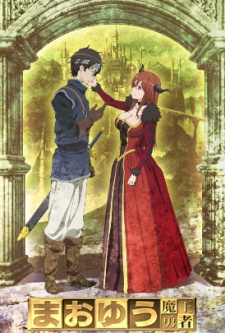
Alternative TitlesEnglish: Maoyu Synonyms: Maoyu Maou Yusha Japanese: まおゆう魔王勇者
Information
Type: TV
Episodes: 12
Status: Finished Airing
Aired: Jan 5, 2013 to Mar 30, 2013
Duration:
23 min. per episode Rating:
PG-13 - Teens 13 or older
L represents licensing company
StatisticsScore: 7.481 (scored by 23622 users)
Ranked: #14482
Popularity: #312
Members: 49,094
Favorites: 164 1 indicates a weighted score
My Info
Popular Tags
No tags found |
SynopsisAfter a long and treacherous journey, our Hero finally arrives at the Dark Lady's castle only to find himself being asked for help. The Hero explains how the war that the demons have brought upon the humans have killed thousands and put more in misery. The queen of demons however argues that this war has made the human society band together as one and showed empirical evidence how it has increased population, increased production, boosted economy and improved society overall. Furthermore, she explains to the Hero that ending this war will result in a civil war that will produce more bloodshed than there ever was. The Hero, convinced that the only way to bring peace, relatively speaking, is to join forces with the Dark Lady, agrees to help with her plans!
(Source: MU) |
Related AnimeAdaptation: Maoyuu Maou Yuusha Summary: Maoyuu Maou Yuusha: Kono Monogatari wa, Daniku Dake Dewanai no ja!
Characters & Voice Actors
Staff
Reviews
|
|
Stellio
52 of 99 people found this review helpful
|
12 of 12 episodes seen
|
| Overall |
7 |
| Story |
6 |
| Animation |
7 |
| Sound |
8 |
| Character |
5 |
| Enjoyment |
6 |
The problem with creating a historical anime is frequently similar to that of adapting a manga or video game: oftentimes, the author has to resort to filler or fan-service materials to clumsily meet the airing requirements for shows. However, an axiom that directors ought to familiarize themselves with is that quality is invariably better than quantity.
Thankfully, this inference only applies to certain aspects of Maoyuu Maou Yuusha, a recent adaptation of the original light novels under the same name.
Set in a time period of gruesome wars to political corruptions, Maoyuu depicts a fantasy world where humans and devils are fighting for the ultimate authority, while exploring the infrastructures involved in wars. Despite it falling under the fantasy genre, Maoyuu brings many historical references into play- from the great innovations of the Discovery age (such as the compass, movable type prints, etc.) to the spread of crops like potato and corn into the agriculture industry. Moreover, it is reminiscent of a certain series that many of us could've never forgotten- Spice and Wolf.
Better known for its formula of enchanting romance, Spice and Wolf consists of a very similar antique structure in the way that it handles its plot, drama, world-building, and specifically, the daily lives of merchants. While this may sound bland, Spice and Wolf manages to make it work with a recipe of individual arcs for concentrated purposes, and thus, the viewer can gain a fine viewing of diverse episodes with several delightful, piquant subjects at hand.
If Spice and Wolf is a mix between curry and rice, then Maoyuu would surely be a mix between potatoes and candy bars; since, it is neither a smart combination nor a completely satisfying experience. Still, it's only in comparison that one is weaker than the other. The steady, episodic approach that Maoyuu employs very much stands out on its own.
A scaffolding plot, after all, is better than none at all. The story of Maoyuu starts out with our protagonist Yuusha, a hero siding with the humans, not expecting the beautiful demon queen Maou, whose only wish was to negotiate with him, in the heart of the demons' castle. After their fated meeting, Yuusha then embarks on a journey at Maou's will, and each episode continues with mini-stories about Yuusha's encounters and findings for a seemingly nonexistent reason.
Whereas, it is fairly obvious from the start that Yuusha has difficulties conveying his true intentions for Maou, and oftentimes these misunderstandings are used for comedic purposes as well as entertainment. Although repetitive, the several quirks that Maou and Yuusha begin to form do add onto the character interaction, and definitely made certain arcs more interesting.
However, side characters do abruptly intervene in the capital of romance arcs, usually with very few good reasons for doing so, and thus, some developments can turn out stagnantly without progression. Most side characters also have very little to offer, ranging from a delusive maid to female knights like Onna Kishi. At times, female characters would surround Yuusha in herds, and it becomes questionable whether or not pandering to the audiences was the purpose. And, although some characters were satisfyingly fleshed out with conclusive stories, other individuals had trouble deciphering their prominent role in the series. Such abstruse matters also bring up the lack of characterization or any predisposition to determine the presence of a solid personality for specific characters, since most of the cast only experience trite developments.
Maou, for example, is best described by her acquaintance as "useless meat". Although Maou herself denies this, and claims at all costs the significant deeds that she has achieved and will, the fact of the matter remains that her role embodies a few inconsistent hiccups. At times, she continuously aims to resolve world peace, while the scenes which repeatedly follow her scholarly deliberations are abruptly placed daydreams of Yuusha. Such applies to the grander scale of Maoyuu as it deconstructs historical figures and side characters to bring concerns about the time period being depicted- the medieval ages. Contrarily, the portrayal of the church's public servants during prehistoric times may have exaggerated some of the exploitations, but Maoyuu does extensively illustrate the corruption which overtook officials of feudal societies. Additionally, a charming aspect of Maoyuu resides with how the characters were named after fantasy classes, which effortlessly resonated a lovely core. However, due its enormous cast, Maoyuu couldn’t engender insightful eccentricities for certain characters as it did for others.
Likewise, the character aesthetics in the series stuck with genuinely dull decorations as exemplified by Yuusha, whose character design emits the appeals of a generic, immutable male lead. Similarly, Maou has her own pairs of inflatable balloon issues, which many will see as being hackneyed and unoriginal.
However, the art directing, layouts for many of the map animations and arrangement of urban images are, in comparison, much better. Correspondingly, majority of the background frameworks and presentations also fulfill their duty in making a location look rural, metropolitan, or even appropriately hideous.
Music is undoubtedly one of Maoyuu's greatest assets. The original soundtrack entrances viewers with its vibrant nature, and likewise, the use of many instrumental pieces evokes an indelible atmosphere. With a spirited opening and ending theme, Maoyuu further enlivens its vigor. Correlation between the animation and music also paints an impressionable feeling for the series overall, and the seiyuus all befit their roles perfectly.
On the contrary, good narration doesn’t necessarily equal quality dialogue.
While the conversations in the series do present interesting observations about macroeconomics, some expositions on the networks of commerce can come off as brusque. Not only so, Maoyuu emphatically focuses on the construction of its own fantasy world, rather than the chronological order of its historical references, so some of the mentioned inventions furnish idealized timelines over what's factually correct. This, in turn, produces temporarily engrossing world-building, but it can also repeatedly bore or confuse the viewer with arbitrary elaborations on ultimately flimsy subjects.
From the tone of my writing, it may sound like the majority of Maoyuu is about monotonous history or economics; however, during the latter parts of the series character relationships take center stage, and action scenes transpire more often. As most climaxes do, the story delivers a closing end towards previously unresolved issues, and desolating sides of things take form in both dialogues as well as battles. This, in some ways, may dismay some audiences since the pacing relatively changes, but as a closure, many aspects of the show become a lot more tasteful and digestible even in spite of the several interrelated topics displayed.
Moderately diverse, Maoyuu is a series that really tries to bring something to the table for everyone, and in its mixture of historical references with fantasy themes, some of its themes are marred by oversimplified explanations. Although the stale, generic personalities some characters exhibit are very definite flaws, the majority of Maoyuu can still offer insights on the economic and strategic aspects of war, which shifts towards a manner infrequently attempted in its medium. It is most unfortunate, then, that this unique concept lacks the excitement its influences (Spice & Wolf) had obtained so gracefully. Perhaps if given a second season, the lackluster aspects of Maoyuu can do itself more justice through more concise yet lively handling of its themes, and its character relationships may become even more captivating. If nothing else, this series provides a fascinating outlook on the protocols and systems of commercial economics, but sadly, is a hero crippled by his towering boldness of attempting too many feats.
Despite its unfortunate flaws, Maoyuu can still compensate for its faults by further constructing its dynamic universe, but only if a sequel will be permitted to fully execute the conceptual values. read more
|
|
Pariah695
15 of 29 people found this review helpful
|
12 of 12 episodes seen
|
| Overall |
8 |
| Story |
8 |
| Animation |
10 |
| Sound |
10 |
| Character |
8 |
| Enjoyment |
8 |
Maoyuu has quite the little story. An anime spawned from 2chan, quite impressive if you ask me. Now I'm sure that I'm in a large group of people who decided to watch this show because it is like Spice & Wolf and made by the same team. If you're after something to fill the hole of season 3 of Spice & Wolf then this will not satisfy. It's far from a bad show, but it's not Spice & Wolf.
It's something different, it is middle age European, there are economics, but not like Spice & Wolf. The economics are extremely simplified, and the feel and progression between the main characters is not as good. There is more focus on all of the characters and politics, not saying it's bad but it's not the same. I still recommend it if you liked Spice & Wolf, but don't expect the same thing.
The story is quite good. The idea of the demons fighting humans for a purpose, and that both sides benefit from the war existing is great. I always love a good story that blurs the line of good vs evil, and it really gets better toward the end where you learn more about the war. Some great stuff with politics and corruption. The economic aspects are simplified but they are still interesting if you like it.
The characters are alright but most aren't great. The Hero is ok but he seems to lack a layer of depth that he should have. The Demon King is a pretty amazing character. She is extremely understandable and likable and she pretty much steals the protagonist role from the Hero, which I have no problem with. One of the biggest problems is that it has one of those secondary romance interests that is way too forward and it always makes those characters annoying. Some of the better characters are the maids that you get to know. At first you'll dislike one and like the other and by the end you'll like both. I also need to commend that this show for the first time in my life I was horrified by a scene of violence. It wasn't even the most violent thing I've ever seen but the context of it made it mortifying. Amazing.
While I was watching the show I kept on thinking of Spice & Wolf and how much better Spice & Wolf is than Maoyuu. It is better, but Maoyuu is still very good. After I finished I looked back at it without that look and just gave it a fair look without comparing it. It's good, very good. Spice & Wolf is so good because it isn't mainstream at all. It's very outlandish. Maoyuu is somewhere between a mainstream anime and an outlandish one. If you like a different sort of anime or enjoyed Spice & Wolf then give it a try. If mainstream is more your style then you might get lost in the politics but you might still like it. read more
Recommendations
|
|
The studio behind Maoyuu have CLEARLY embraced the fact that the source material came to be thanks to S&W making a serialised story of economics and love economically viable. They've also taken advantage of the desperation S&W anime fans feel for a S3 that - probably - won't ever be. Why not employ the same JP voice actors, the same director and other people that worked on S&W? It makes good business sense.
As an enlightened fellow pointed out in passing, Maoyuu started out on 2chan and - more than likely - panders to the wants of its target audience as much as it does because of this. Gone is the witty banter shared between Howo and Lawrence--in their place, you get Demon Queen's tits and 'jokes' about her "useless meat" shoved down your throat 24/7. There's the intelligent dialogue that made S&W a favourite, for sure, but even that is questionable (war = good) and learning about the economical benefits of certain food ain't all its cracked up to be, to tell you the truth.
Maoyuu will probably be one of the better anime going around the block, don't get me wrong. It having S&W staff employed makes me confident of that. But that line of thought is part of the problem: Maoyuu will always - rightly - be in Howo's shadow. Will JRPG cliches/tropes being added to the S&W mix make-up for a lack of the personality/charm that made S&W such a fan favourite?... I doubt it. Very much.
The fact that both shows share a lot of similar anime-related features are clear as day, but the most fascinating part about both shows are how they take on the area that most anime can't: discussing actual knowledge.
Spice and Wolf series are a lot like Trading for Dummy printed in feudal age. They have feudal settings with a dash of fantasy, that's what we knew easily from the cover. But you don't judge the book by its cover, or you might overlook something nice.
Spice and Wolf discuss trading, politics, microeconomic and others relevant knowledge for an average feudal traders. It sure doesn't live up against your professor's Econ101, but for an anime, a mean for entertainment, they did well including knowledge, or at least knowledge-flavored contents in its show.
MaoYuu settings take on a bigger scale. Lead characters are playing politicians, and unlike random trader, they have considerable amount of influence on politics in their world. Thus, MaoYuu feature a simple discussion of war, politic, macroeconomy, and other stuffs relevant to Demon Lord.
Both MaoYuu and Spice and Wolf are anime featuring ACTUAL knowledge which is a rare find for an anime. Gundam does NOT discuss Physics used to build giant space robot, and K-On! never teach a single guitar cord, do they? This is what set MaoYuu and Spice and wolf apart from most anime, they discuss, even if it's just the most fundamental part of the whole field of study.
But remember again, they are not Econ101 or Introduction to Feudal History, they are still anime, the mean for entertainment. Do not compare it to actual books and say they sucked. Be classy, judge them for what they are.
And yes, if you enjoy economy, politics, and history in real life, you will likely enjoy them both. But if you always on the look for action packed Medieval fantasy, you might be disappointed though.
Both series have the same atmosphere and tone with an emphasis on how social and economic systems function in a by gone era. While there is danger for the main characters in each series it's not the major focus of the story line.
While Ookami describes trade and business in a medieval world, Maoyuu follows the story of two characters trying to evolve their war torn world into a place which can move on, two nations living in harmony, as opposed to one being destroyed by the other then trying to recover.
The two shows are very similar. Same lead voice actors, supernatural female protagonist, trades, lots of dialogues, female protagonist wants to go somewhere that ended her and the male lead to travel together. Maoyuu is good so far.
Both have a non-human female traveling with a man in between villages.
has a very similar vibe. same old country setting. although the characters are not much alike, and there is magic in Maoyuu, and not much in spice and wolf
Both deal with economics and feature merchants and are set around the same time frame of the middle ages. Both also have magic elements and have the same style of subtle romantic tensions. Both highly recommended. =)
Similar music, both involves Economics (Micro and Macro), the art is pretty similar with medieval setting, the interaction between two characters is fun to watch, Holo and Maou likes to tease the male main characters, there are many psychological,intelligent and insightful conversations which provide us a different perspective on how to see things.
Directed by the same director, Holo's voice actress is also Maou's voice actress, the same also applies to Yuusha's voice actor. The singer who did the OP of Spices and Wolf 2, also perform the ED for Maoyuu. The most important parts are both anime are unique in its own way and the similarities mentioned above create a really similar feel and atmosphere between the two anime.
Either season, If you like Spice and Wolf you will like Maoyuu Maou Yuusha, same people made it same voice actors. I for one was hoping for a season 3 but Maoyuu Maou Yuusha might actually be better than that, it has the same feel as S&W as soon as I saw the first episode Spice and Wolf popped in my mind. Like Spice and Wolf, Maoyuu Maou Yuusha at its core is about Romance, not that typical Tsundere or too timid to do anything romacne but actual Romance.
Both shows contain romance and a supernatural element. Both are set in a less developed world. And both have themes containing; economics, agriculture, and trade.
It's no surprising that these two series have many similarities to be quite honest.
Both titles features a fantasy setting where a main male protagonist encounters a main female protagonist (strangely voiced by the same VA). From there on and out, they form a strange bond as they encounter various events.
Both series deals with the theme of economics rather than the traditional fantasy sword fighting to save the world.
Both series has a similar feeling that is more lighthearted but also covered with a fun adventure like background.
Both series has comedy, drama, and hints of romance.
A major portion of the staff for one is a part of the other and both focus on lady companion with a quirk and economics.
The fact of how Maoyuu Maou Yuusha can make me enjoy the first 2 episodes even though 2/3 of it its about economics remind me of Spice and Wolf.
Both Series have lovely Heroine and the setting its kinda similar.
- both series were made by this same directors
- the same seiyuu in main roles
- less duels, more economy
- characteristic, good-tempered atmosphere
- main hero is human and main heroine is a fantastical creature
Both have a strong focus on economics while also having bits of action to keep things interesting. They also both have a weird but cute relationship between the two leads.
They both take a strong look at politics and economics of a pre industrial/medieval setting. It has interesting and engaging characters and a unexpected plot pretty much every episode. The main characters romance is often shoveled to the side of the main plot but still apparent and present during the series. Uses fantasy to enhance a story while maintaining intelligent and political facts and information about War,Economics and public perception. Ookamis Related works would also apply to this recommendation.
- Advanture
- Same seiyjuu
- A pretty close relationship between Yuusha and Maou.
- Similar music/ost and the circumstances overall.
- Same atmosphere (medieval)
- Travelling as a couple
- epic romance story
Similar main characters and over all theme.
Get almost exactly the same feeling after watching these two anime.
first of all they have the same voice actors for the two main characters, but the theme of the story is also the same as they are both about money and how it affects the world in different ways.
and they both have romance
It's like its sister anime because it has the same art and flow. A lot of the anime uses economics and merchants.
-Same voice actors
-medieval style
-Main characters go on an adventure
-Both are amazing :)
|
|
|
Definitely get the same flavor from the Maoyu archetypes but now even more comedic because they take the settings and integrate them into the character backgrounds which then get thrown into a new world instead resulting in hilarious moments and situations. Demon king and hero again, with the use of magic but now in the modern world.
Just like others have said the storyline is pretty much the same, but it's set in modern society and that now the main hero is a girl, and the main villain is now a guy. Both have comedy aspects, however Hataraku Maou-sama has more of it.
In both series, there's a similar feeling and the main male character seems to have similar personalities.
There is some sense of supernatural themes but mostly presented in a fun way. With that, there's the comedy and humorous dialogues thrown together.
Although the settings are a bit different, Maoyu and Hataraku Maou-sama! maintains a similar background involving shaping a world (although in different ways).
Just reverse the role of the main character and put them in a different setting. otherwise both show are really similar.
It has the same kind of character development around Hero, Satan, and friends.
These anime's rely heavily on comedy and pulls it off quite well.
The art is appealing and characters are appealing. The subtle plot twists make them worth watching.
Most notable similarities: Demon king, and Hero.
Hataraku instead has a male demon king/lord/whatever and has a female lead hero/tsundere/whatnot. But a notable difference is that there is no romance between the to leads (at the moment). Beginning seems kind of rushed compared to the manga (same with Maoyuu) but can be quite enjoyable nonetheless.
The two have the same demon to human kind of relationship except one was set in some alternate middle ages setting, while the other was set in modern times. Another differences, the head demon from one anime was a woman, while in the other is a teenage boy, though he's actually older than one thinks.
Both have a hero, both have a demon king (although it is reversed in Maoyuu).
In both we see that the hero (Yuusha) goes to the demon/devil king to destroy them, but instead the hero ends up cooperating one way or another because of different circumstances.
Hataraku is like Maoyuu, just set in modern times with less politics and more comedy.
|
Opening Theme"Mukai Kaze (向かい風)" by YOHKO (eps 1-11)
Ending Theme#1: "Unknown Vision" by Akino Arai (eps 1-10) #2: "Mukai Kaze (向かい風)" by YOHKO (ep 12)
Fansubbing Groups
Which fansubbers do you like the best? Click + to approve of their subs for this show. Click - if you don't think they did such a great job.
Animakai [Animakai] (Brazilian Portuguese)
Related ClubsKamiya Hiroshi fanclub, Anime Indonesia, Jiraiya Icha Icha Research Club, Polyamory in manga, Romance+, AnimePM, The Fukuyama Jun Fanclub, Touyama Nao Fanclub, Currently Airing , Saito Chiwa FC, Maoyuu Maou Yuusha, Terashima Takuma FC!, CLOSED, Lyos Anime, Monster Girls <3, Anime Experience, Yuuki Kaji Fans., Anime Revolution ♡, Lyos Anime Gif, Currently Airing AnimeAdvent Anime Club, Serious stories (anime/manga) see all
Recently Watched By|
5 minutes ago |
7 minutes ago |
8 minutes ago |
18 minutes ago |
31 minutes ago | |
50 minutes ago |
1 hour ago |
1 hour ago |
1 hour ago |
1 hour ago |
|
|