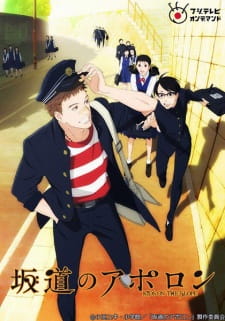
Alternative TitlesEnglish: Kids on the Slope Synonyms: Sakamichi no Aporon, Apollo on the Slope Japanese: 坂道のアポロン
Information
Type: TV
Episodes: 12
Status: Finished Airing
Aired: Apr 13, 2012 to Jun 29, 2012
Duration:
22 min. per episode Rating:
PG-13 - Teens 13 or older
L represents licensing company
StatisticsScore: 8.521 (scored by 25221 users)
Ranked: #802
Popularity: #360
Members: 44,754
Favorites: 1,040 1 indicates a weighted score
My Info
Popular Tags
No tags found |
SynopsisThe beginning of summer, 1966.
Because of his father's job situation, freshman high school student Kaoru Nishimi moves by himself from Yokosuka to Kyushu to live with relatives. Until then, Kaoru was an honor roll student who tended to keep to himself, but meeting notorious bad boy Sentaro Kawabuchi starts to change him. Through his devil-may-care classmate, Kaoru learns the attractions of jazz and finds the first person he can call a "friend". He also discovers how much fun it is to play music with a pal.
Other characters include Sentaro's kind childhood chum, Ritsuko, who is the daughter of a record shop owner; the mysterious upperclassman, Yurika; and Brother Jun, the much-admired leader among their peers. Set against the backdrop of a seaside town with a scent of American culture, this series is a drama about young people coming into their own, crossing each other's paths, and finding friendship, love, and music!
(Source: Official Website) |
Related AnimeAdaptation: Sakamichi no Apollon
Characters & Voice Actors
Staff
Reviews
|
|
paean
81 of 149 people found this review helpful
|
12 of 12 episodes seen
|
| Overall |
9 |
| Story |
|
| Animation |
|
| Character |
|
| Enjoyment |
  |
"That's the thing about jazz: it's free flowing, it comes from your soul." -Billy Chrystal
When it comes to Sakamichi no Apollon, there is one complaint you will hear very often, and it goes like this: for a show that is seemingly about a bunch of kids sharing a love of jazz, it focuses too much on the drama, whereas the music often takes a back seat.
Personally, I think there is a reason why the musical genre important to this show is jazz pointing beyond the time period it takes place: jazz is all about interpreting a tune in your own individual way. One could argue that out of all musical styles, only jazz is truly allowing the performer to express themselves through the music. And that is exactly the function of jazz in this show. Sakamichi no Apollon is not intended as a series about jazz, but as a series where jazz acts as a form of self-expression for characters who are often unable to communicate effectively through words.
When played in a group, jazz is not only about finding an individual voice. It becomes the product of an interaction between different forces of creativity. Consequently, this is also a show about friendship.
Nishimi Kaoru is one of those kids who have been moving from place to place because of a parent's job situation ever since they were little. Never having stayed at one place long enough to make friends, the model student's life starts taking a whole new direction when he meets his very opposite in terms of personality, Kawabuchi Sentarō. Through his first real friend, Kaoru, a classical pianist, not only learns the attractions of jazz, but also gains a new outlook on life.
Obviously, the story this anime tells is nothing groundbreaking. You have probably seen it elsewhere. Sakamichi no Apollon, however, shows that something does not actually need to be original, much less unique, if executed well.
Still, most developments are rather predictable. As one of few people who do not actually mind the focus being on human relationships, this is the one big flaw I can find in this show. I am willing to forgive it, but should you be looking for an anime with brilliant twists, do not watch this, or you will be severely disappointed.
Besides the plot not being overly complex, there are other things noteworthy about Sakamichi no Apollon. One aspect that really stands out is realism. Not only do the characters have believable, yet interesting personalities, but also are details not central to the story researched well. The backstory of one of the side characters, Junichi, who is voiced by namesake Suwabe Junichi, gives you an idea of what the social climate during the student protests of the 1960s was like. And unlike other works of Japanese animation making use of elements of Catholicism, Sakamichi no Apollon does not feature teenage vampire-hunting priests; instead, it portrays Christian religion refreshingly accurately.
It's a slice of life story, granted.
Like I said, I am willing to forgive this show its unoriginality. The reason for this is that from episode one, I was captivated by its atmosphere. Fittingly, I will leave you with a quote by jazz pianist Bill Evans:
"It bugs me when people try to analyze jazz as an intellectual theorem. It's not. It's feeling."
The same is true of this story.
The feeling? Genuinely heartwarming. read more
|
|
Stark700
163 of 311 people found this review helpful
|
12 of 12 episodes seen
|
| Overall |
9 |
| Story |
9 |
| Animation |
6 |
| Sound |
10 |
| Character |
9 |
| Enjoyment |
9 |
Let's do a trivia here! Are you someone who wants to know what it is like back in the 1960's? Ever wanted to build an escapism from the harsh reality of today's world? Want to just sit back and enjoy some old school music after a stressful day? Well, perhaps you've found a series worthy to invest your time into because Kids on the Slope is there and sure to give you something to think about.
Kids on the Slope (also known as Sakamichi no Apollon) is a story taking place in the beginning of summer, 1966. It stars the protagonist Kaoru Nishimi, an honor student who tends to keep to himself. He has a rather reserved personality and hard to open up. That is until he meets the bad boy and future best friend Sentaro Kawabuchi. While mistakenly getting to a bad start, these two soon develop an unforgettable friendship based on respect, forgiveness, and of course, music. Later comes into picture is Ritsuko Mukae, a friendly girl who plays intriguing roles in the story ranging from music, friendship, and later love. The series follows three friends as they create unforgettable memories of the 1960s in the age of jazz music, friendship, and melody.
Now, you're probably asking yourself “why should I watch this series?”
Well, first of all this series contains the unification of icons Watanabe Shinichi (Series Director of Cowboy Bebop) and music composer Yoko Kanno. That alone can be seen as a good reason to start watching. While labeled as a coming-of-age drama, this series also contains a bit of the romance theme and of course, drama. So for those interested into the intertwined story arcs mixed in with misunderstandings, jazz critique, and love trials, then this could be a little added bonus.
[ - Story - ]
Kids on the Slope details friendship and is one of the most important element of the series and should not be just seen as an aspect of the anime but in real life as well. Kaoru, Sentaro, Ritsuko forge friendship through one common passion: the love of music and the bond that they share.
This series does not have a strong impression at first. From the first episode, there's not much to say besides the typical high school drama and music setting. Furthermore, for those carving for action and psychological twists or for some who call it “mindfucks”, then this is the wrong series to look into. Thankfully, there's an old saying that goes “never judge a book by its cover”. Damn right, you shouldn't because this coming-of-age drama is sure to give you a surprising twist.
In the beginning, there is the common theme. Kaoru falls for the friendly girl, Sentaro falls for the graceful girl, and Ritsuko is already in love with the childhood bad boy. Then comes even more characters that makes the already complicated geometric love shape even more complicated later on.
Kids on the Slope moves at a relative pace that can be considered neither slow or fast. Ironically, it starts off slow even though it's kids on the SLOPE. Anything that flows down a slope relatively moves fast but in this case retains a relatively average pace. So I'll say this again, this series is not for the fans who carves the fast paced action and psychological twists. If you want that, try Jormungand or something.
[ - Characters ]
While the characters are animated plainly and simple, their inner character and style is what drives this series as why it's ranked into the #100 of MAL. Beyond the romance polygon are characters that balances out the series.
First we have Kaoru, the middleman who has the reserved personality. He is smart, he is reserved, and he has the talents to become a real star. Thankfully with some fate, he finds someone who also share a similar love for the age of music. That brings us to Sentaro. Like the opposite of ying and yang, Sentaro is seen as the tough guy with the soft spot, the one that picks fights but also the guy who protects and values his friendship with the other characters from the bottom of his heart. His outer image covers up the fact that he is a deep down guy and cares for the people and things he truly loves; his friends, his family, and the children that respects him so much and of course, music. Finally, there's Ritsuko. She is the cheerful girl, the one that builds bridges of friendship with friends and generally well-liked. Yet behind her outer image lies a somewhat insecure girl and sometimes jealous of others' ability to be so outright themselves.
Later on of course, there are other characters that enter the scene that have stark personalities and also not who they appear to be. I'd love to go on and on about these characters but this isn't an summary is, it? This is a review so I'll leave you to find out. But trust me, you'll love to get to know them once you see the realism behind their outer characters.
And speaking of realism, it is noticeable that the characters' personal lives are conveyed in a way that can be seen and defined as quite real. Whether tragic, sad, or cheerful, we see the histories of the main characters that can be related to most of us. They all have background histories that brings the overall realism into the 1960's and even towards today.
[ - Animation/Art -]
If there's one thing to forget, it might be the art. I'll say this in the most honest way as possible:
It is too plain and simple.
The animation is not rich and series airing this Spring Season like Fate/Zero puts it to shame in the art department. The animation however brings out a powerful feeling of nature and refines the 1960s style in its finest form. While plain and simple (Karou's glasses, Sentaro's shirt, etc), we can see that the culture it tries to convey of the 1960s is successful. Culture has indeed changed from the past to present day as we can clearly see the lesser technology and more general and sophisticated themes. It is simple and not detailed just like how high school should be. It doesn't need to be something special that makes us go “wow!” After all, the precise of an entire series is not always judged by art solely. At one point of watching over 100 series, it's just down right common sense.
[ - Sound/Music - ]
Ah yes, this is the main event, if for any reason to watch this series at all, it is this.
Music and life plays a key role in this series and thus, one could expect the melancholy and drama the music lyrics conveys and delivers. With the ultra talented Yoko Kanno in charge, one can expect a blockbuster hit and smash of the season. And she does not disappoint, neither her skills or the characters' that plays both artistically and beautifully in the series.
In fact, the music in the series plays well, even in rhythm with the main characters. If you take careful notice, the way and style they play their instruments systemically match their art and moments. The way the characters play the music is natural and in the ways they are of themselves, not for a popularity contest. To play music and bring pleasure to the ears is something to respect and take notice of. These kids really do have talent.
[ - Enjoyment - ]
This story is of the old school coming-of-age style so the pleasure of enjoying this series can vary. At first glance, one might decide to drop or put on-hold at its relative pace as well as its lack of the typical “shounen action”. But with so many of those airing these days (including this season), why not give something new a try?
It's more than just a high school story of kids falling in painful geometric shapes of love or the “friendship conquers all”. And of course, despite being hard to make it into the mainstream, it's one of those series that takes an unique and cultural approach of the coming-of-age genre mixing in with jazz music, friendship, and love all in a wonderful little package. The characters are unique and real with their backgrounds, contrasting personalities, and style. The story is easy to follow despite its intertwined arcs. The art (despite plain and simple) brings out the naturalism and culture of the 1960s. It's something not as complicated as the real world we face today because it's so damn right simple. Honestly, I miss it. And who can forget the relaxing music? Without it, this series would be dead. But with it, the series comes to life through realism and gives viewers something to talk about.
Again for those who are so into the shounen style battles, the fan-service of ecchi shows, or psychological mindfucks, this series can be something new to look forward to.
After all, there's an old saying that goes, “life is like a box of chocolates. You never know what you're gonna get." And once you open that box, you'll be surprised what you'll find. In this case, it's Kids on the Slope. read more
Recommendations
|
|
Both josei romances that center around a musical theme. Even though Nodame Cantabile is about classical music and Sakamichi no Apollon is about jazz, they both give you a very similar feel (minus Nodame Cantabile being absolutely hilarious).
Both give you a look into a genre of music that is no longer mainstream.
Kids on the Slope focuses on Jazz while Nodame Cantabile focuses on classical.
In both anime it is music that unites people.
Both are Joseis and are about music.
There are romance and student environment in Japan.
However there are some differences between each other:
Sakamichi no Apollon takes place in a secundary school on the sixties years; the kind of music played by main characters is the Jazz.
Nodame Cantabile TV takes place in a music faculty on the present days; the kind of music played by main characters is the Classical Music.
If you like a good music, like Jazz and Classical, you should watch these animes!!!
If you like a good story, with romance, some comedy, drama of daily life; you may like too!!
Both series has a josei genre and thus have a similar feeling and style.
Music plays a major theme in both series that also involves romance as well as drama and comedy
Both series are quite realistic and some of the characters have similar personalities.
Both are slice of life's in which a group of young people are brought together by their love for music.
Its about music altough Sakamichi Apollon is more real in showing relationships and emotions.
|
|
|
The similar part is that both anime are for high school students who play music.
The difference is that Sakamichi no Apollon is more about the love stories of the characters and is full of cliches, while Beck is more about music and characters' development as persons through music.
Similar premise, just replace Jazz music with Rock music as the main music focus. Characters are all in high school as well in both, however Beck takes place in present day.
Musical and school story. Both.
Tbh, I found these two series quite alike in terms of their pace and feeling when watching them.
Both Beck and Sakamichi no Apollon (also known as Kids on the Slope) explores the theme of music and how the main characters of the series embraces them.
Both series' artwork is naturalistic and has realism that reflects the older ages compared to the more modern 2000's style.
Both series has a slice of life theme in it that features comedy, drama, and romance.
Both series are a breath of fresh air so give it a shot.
It's not only about music. BECK - ROCK, Sakamichi - JAZZ.
But also it's slice of life about musicians lifes. About problems of everyone of us, because everyone've got plenty of them. It's about how hard is love, friendship and keeping your existence in society.
Both of these titles are set in the present and feature high school kids as the main characters. There is a great deal of high school drama, but at the end of the day the characters best relate through music. Beck is much more lighthearted and funny; kids on the slope tries to be more thoughtful. Both are excellent animes.
Both series are about MUSIC. It`s not just a good OST: music is the heart of anime.
In my opinion, there are only two kinds of animes. Drama and Action.
Beck and Sakamichi share a feeling through the whole series. The action is slow and you can't expect a bloody gunfight every episode. The characters will always be presented as very simple, but the more you dive into the understanding of the characters meaning in the series, you will obtain that everyone has a light and a dark side. The character you thought were a ugly scumbag, will maybe turn out to be the nicest character in anime history! Judge the book by the content, not the cover.
Also, both animes has a love to music. Beck is for all the rock/pop-lovers, and Sakamichi is for 60's jazz. Both animes will create a big view of both genres, and you will understand why the music-culture is very important. If you don't like this kind of music, you should consider watching either Beck or Sakamichi.
Last but not least, both animes aren't just about music. Actual themes is also friendship, love, hard work and accomplishing goals and following dreams!
|
Opening Theme"Sakamichi no Melody (坂道のメロディ)" by YUKI
Ending Theme"Altair (アルタイル)" by Motohiro Hata meets Sakamichi no Apollon
Fansubbing Groups
Which fansubbers do you like the best? Click + to approve of their subs for this show. Click - if you don't think they did such a great job.
Related ClubsnoitaminA, Beautiful Romance, Slice of Life Club , Mahvilyze, ♛☠♥ We Love Anime ♥☠♛, ***FictionJunction YUUKA (Yuuka Nanri) Fanclub***, Unusual is Better, ♫ The Music Genre ♫, Romance+, Realistic Anime, The Jazz Club, ★Josei Anime★, debates de animes temporada, Cowboy Bebop Blues, ~ Childhood Friends Love Stories ~, Scrumdiddlyumptious Food in Anime, The Sakamichi no Apollon Followers, Sakamichi no Apollon, Okamoto Nobuhiko FC, Recommendation ClubYukiyo Club♥, ღ Paramour Paradise ღ, VOMIC (^o^New Member Badges R UP^o^), Spring 2012 Game: Will it get dropped? see all
Recently Watched By|
13 minutes ago |
16 minutes ago |
30 minutes ago |
1 hour ago |
1 hour ago | |
1 hour ago |
2 hours ago |
2 hours ago |
3 hours ago |
3 hours ago |
|
|