



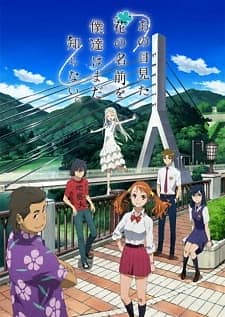
Alternative TitlesEnglish: anohana: The Flower We Saw That Day Synonyms: AnoHana, We Still Don't Know the Name of the Flower We Saw That Day. Japanese: あの日見た花の名前を僕達はまだ知らない。 InformationType: TV
Episodes: 11
Status: Finished Airing
Aired: Apr 15, 2011 to Jun 24, 2011
Producers: Aniplex, Dentsu, A-1 Pictures, Fuji TV, NIS America, Inc.L, Fuji Pacific Music Publishing Duration:
22 min. per episode Rating:
PG-13 - Teens 13 or older
L represents licensing company
StatisticsScore: 8.731 (scored by 77697 users)
Ranked: #342
Popularity: #59
Members: 119,390
Favorites: 5,708 1 indicates a weighted score
2 based on the top anime page.
My Info
Popular TagsNo tags found |
Jun 25, 2011
The keyword is ‘tries’, and for the most part, AnoHana succeeds. It is one of those anime that illustrates perfectly the idea that the relative distance to perfection is inversely proportional to the obviousness of huge, glaring flaws. For everything that AnoHana does just beautifully right, there is usually something little it gets horribly wrong. Before we go on, I would like to state for the record that I absolutely endorse this anime to anyone who asks, reasons which are perfectly illustrated in Archaeon’s neatly succinct review, of which I direct you to. There really is no reason to write another straightforward review reiterating everything he's said when you can just go and see his. Instead, for those who have already finished the anime and are looking for a more critical approach to viewing AnoHana, it may interest you to read further here. There’s no denying AnoHana is fine piece of work. Everything from animation to sound, characterization to story are all quality material and together form both a visually and emotionally satisfying experience. The anime is far past the point of debate about whether watching it would be enjoyable and worth one’s while, because it most certainly is. The proceeding point of scrutiny would be to examine the anime at it’s core fundamental level. This is the point where the ‘really good’ pieces of work are separated from the true masterpieces. This is also the point where AnoHana unfortunately falls flat. Specifically speaking, AnoHana’s screenplay just isn’t very good. In fact, considering how well rounded the anime feels as a whole, the screenplay is actually deceptively and surprisingly bad. Okada Mari, one whom I respect greatly for her work on Tordora and Kuroshitsuji is back again; this time she is chief script writer for AnoHana. Unfortunately Mari’s apparent inexperience in writing shines through clearly in the screenplay. There is no doubt she has talent and a knack for good ideas, which makes it disappointing to see she still stumbles on some basic areas of writing. The narrative for example, is sorely lacking in woven exposition, with the many aspects of the story left feeling one dimensional and underdeveloped (more on that in a moment). The dialogue is also inconsistent; the majority of the time it is written and delivered beautifully, but there are frequent punctuations of awkward, out of place lines that leaves something to be desired. Most of these instances are offset by the talent of the seiyuu who try their best to bring emotion to these parts, but the moments are still unavoidably noticeable. For instance, count how many times this scene happens: Jin-tan glances to his side at Meiko and mutters ‘Menma...’ another character looks at him, confused, and questions ‘Yadomi?’ There are very clear distinctions between the lines that have significance to the plot or the character, and lines which are simply conversational pieces, with almost no blending of the two types. At times it feels like the latter lines have no contextual meaning at all and are simply there to fill in time because the script writer couldn’t think of anything else to write. For an anime like AnoHana where the entirety of the narrative is delivered via dialogue and character interaction, this is a very dangerous habit to fall into. There are many good things that Okada Mari brought from her experience working on the series compositions of titles like Toradora, Fractale and Gosick. Unfortunately one of them also happened to be the abysmal pacing that they all suffered from at one point or another. Naturally, the structure Exposition-Rising Action-Climax-Falling Action-Resolution can’t possibly be adhered to as strictly for anime as it does for say, novels or films, simply due to the episodic nature of anime; there is an underlying need for each episode to be standalone in it’s own right, even if it is meant to contribute to the overall story. However that isn’t to say we shouldn’t at least make an effort. The problem with AnoHana is that it simply tried too hard to be episodic. Each episode’s substory warranted so much attention that there was very little room left to develop the main plot. Although each individual 24-minute segment was neatly tied into a little package with it’s own structure, which seemed fine at the time of watching, suddenly we reach the end of episode 9 and we realize with 2 episodes to go we’re still on the exposition part of the main story. This is again, partly due to the fault of the narrative not having any woven exposition in itself, relying instead on almost purely dialogue and flashbacks to establish the backstory, an alternative which is both more time consuming and less efficient. (To throw an example out there, think how easy it would have been to tell stories of Popo’s adventures around the world by simply including a few souvenirs from his travels in his little hut. A few frames to easily explore an episode’s worth of exposition, which can then be used to add elements to Popo’s character without the need for spoken exposition.) I am strongly hesitant in calling AnoHana a melodrama. The constant hint of realism in both the visuals and characters suggest otherwise, as does the very real themes that it tries to convey. The anime obviously works very hard to provoke an emotional response and I wonder at times if it is trying a little too hard. Not a scene goes by without Yadomi frowning at something, and the prevalence (or rather excess), of falling tears in every episode almost screams at me: “Here is an emotional scene, indicated by the tears. Feel sadness you sheep!” The need for AnoHana to constantly use the act of crying to convey sorrow seems almost shortsighted, and while they are a good tool for reinforcing the emotional instability of the characters, they seem to serve little other purpose. All this cumulatively leads to the biggest flaw of AnoHana: as an anime observing death and how people cope with it, there is shockingly little character development observed. What AnoHana tries to offer instead are single characters at two points in time. On one hand we have the happy-go-lucky childhood of the super-peace-busters, on the other we have the sullen, withdrawn adolescent individuals of those friends, drifting apart and trying to move on with their lives. At first sight it is amazingly easy to mistake this contrast of past and present for ‘character development,’ however true character development demands something a little more in-depth than, ‘friend dies, people become sad.’ Yukiatsu is arguably the only character who experiences true change, *spoiler alert* in his brief contact with Menma *spoiler alert* he experiences denial, confusion, jealousy and anger, and in doing so, realizing his self-loathing attitude and changing himself. Yadomi’s development is also arguable, though I remain skeptic as to whether what seems to me as merely an overdue self realization can be categorized as development if it were there subconsciously all along. In comparison, the other characters, experienced only minimal changes, exchanging confessions and realization which, while heart-moving, can hardly be justified as ‘development,’ begging the question of whether there was any point to the whole thing other than being an emotional roller-coaster of adolescent diversions. If you’ve managed to read this far and haven’t yet ‘unhelpful’d’ this review or thrown your mouse across the room in anger, then props to you, and perhaps you’d like stay a bit longer and allow me to explain where all this nonsense is coming from. The mindset of a critic is slightly different from that of an average viewer. We’ve seen, considered and analyzed far more than what would be considered healthy for a normal human being and as a result, we view things a bit differently. Cliches and archetypes you’ve seen maybe half a dozen times, we’ve seen hundreds of times. We get bored quickly, we’re more easily dismissive, we hone in on small mistakes like vultures, we’re very excited by originality and we’re far more disappointed when a promising series falls short just inches from the finish line. Nine out of ten times, the things we watch are mediocre at best. Stuff that’s so average that it takes all of our willpower just to struggle through a normal review; talk about some story, mutter about some character, drag on about some animation and call it a day. But then something like AnoHana comes along, something new, something exciting, something to sink our teeth into. We may end up enjoying it, we may not, but the fact that it had piqued our interest meant it had already established itself as something special, something good enough to be able to be improved upon in the future, something we WANT to spend time thinking about, something actually WORTH criticizing. Think of this review not as a “everything that was wrong with AnoHana” review, but as a “AnoHana was this close to being a true masterpiece, I found myself taking time out of my busy schedule to watch it twice and write up this critique, if only it had improved on these points, I might have given out my first ever 10/10" review. In fact, consider this review a praise by exception, in that everything I DON'T mention is absolutely friggin' brilliant. That's a LOT of stuff. read more
I found this review Helpful Not Helpful Jun 24, 2011
Now it may seem a bit odd to talk about death, grief, and learning to deal with the loss of someone close, but essentially that's what Ano Hi Mita Hana no Namae wo Bokutachi wa Mada Shiranai (We Still Don't Know the Name of the Flower We Saw That Day), is all about. The story opens with Yadomi Jinta, a seemingly grumpy teenager who is playing a game in his room on a hot summer's day whilst his childhood friend Honma Meiko (Menma), pesters him repeatedly. Having had enough of the game, Jinta decides to make lunch, but only for himself and his father which annoys Menma no end as she also wants to eat the ramen he has made. It all seems like a fairly normal, everyday scene that one might see in anime, but not everything is as it seems ... On the surface AnoHana looks like a fairly straightforward tale of teenagers learning to deal with a past trauma and maturing in the process, and for the most part that's a fairly accurate perception. The plot is well constructed and takes a measured, almost methodical approach to events which is reflected in the often placid tone of the narrative. Unfortunately this leads to a degree of predictability as certain events in the storyline are clearly foreshadowed, and while the series promotes a degree of empathy for the characters and their situation, there may be occasions where viewers want the story to get to the point. One surprising aspect is the manner in which flashbacks are used to punctuate specific occurrences or emotions, whilst adding historical context to the relationship between Jinta, Menma, and the rest of the "Super Peace Busters". These sojourns into memory act as a nice counterpoint to the current state of relations between the characters, and highlight just how much has changed for each of them over the last ten years. This contrast is also reflected in the visuals, and while there is a marked difference in the appearance of almost all of the Super Peace Busters, it's actually the subtle contextual setting that makes the change much more pronounced. The key thing to remember is that people often romanticise personal history and memories, especially if one has undergone some kind of trauma, and AnoHana plays on this by sharpening the focus and darkening the tones on the present day, which contrasts with the soft focus flashbacks that are often filled with "light". The design itself is well handled, but while efforts have been made to really highlight the changes ten years can make to a child's physical growth, it's the character animation that stands out. A-1 Pictures have tried to visualize the movement differences between a child and an adolescent, and while there are a few niggles here and there, the overall effect promotes the sense that the characters are no longer the children they once were. Because AnoHana is a character driven piece there is a heavy emphasis placed on the dialogue, and while the majority of the script is actually pretty intuitive, the manner of speech during the flashback scenes can sometimes seem a bit odd. Thankfully the series has some very talented seiyuu on hand, and it's interesting to note that some of the roles feature two different voice actors - one for the present day and one for the past. Each role is given due care and attention, so it's unfortunate that even with so much talent on hand, there are a few issues from time to time as the seiyuu handling the child roles are all adults. Now while this may be standard practice in the industry, studios like Ghibli have proven time and again that children are much more capable of playing the younger roles than the majority of adults, and while the relatively minor flaws in the dialogue do stand out, one has to wonder how different the series could have been if child actors had been used. AnoHana features a number of slow pieces of background music performed on piano or guitar that reflect the measured plot and add a slightly bittersweet air to the storyline. The opening theme, Aoi Shiori by Galileo Galilei, features a sequence that shows the characters in their past and present forms and hints at the the reason for their emotional difficulties. The ending sequence features a montage of the three girls of the Super Peace Busters, Menma, Anjou Naruko (Anaru), and Tsurumi Chiriko (Tsuruko), and is set to Secret Base ~Kimi ga Kureta Mono~ (10 years after Version), which is a cover of the 2001 single by Zone and is performed by Kayano Ai, Tomatsu Haruka and Hayami Saori, the seiyuu who play the roles of Menma, Anaru and Tsuruko. Now given the nature of the series and the near constant focus on the characters, certain viewers may assume that AnoHana should feature almost continuous development, so it may come as a surprise to some people that the show takes more of a "stop-start" approach. Because of the attempt to apply a degree of realism to the characters and the emphasis on depicting them as plausible, any attempts at continuous development would seem overly contrived. Balancing that though, is some rather strong characterisation. One of the key things to remember about each person in the story is that they have experienced a specific defining moment in their lives, and that allows the characters to be depicted as individuals from the start. The strength of the characterisation is even more palpable if one compares the present versions of the Super Peace Busters with their past selves from the flashbacks. That said, there are occasions where the story has difficulty finding a resolution to a given situation so it can sometimes seem as though events are being dragged on in a effort to develop the characters. AnoHana is a surprisingly simple, yet slightly over sentimental, look at the coping mechanisms of children and adolescents when coming to terms with a past trauma, and in that respect it's one of the more surprising titles of the last few years. The series errs more on the side of soap opera than outright drama from time to time, but like many of the other relatively minor flaws, this can be forgiven in light of the fact that the subject matter is well managed and delivered. In truth, the closest neighbour to AnoHana would probably be Tokyo Magnitude 8.0 as that also highlights the difficulty children have in dealing with the sudden loss of a loved one. It's difficult to say whether I actually enjoyed the series or not. On the one hand it has some genuinely entertaining moments, but on the other the series deals with an issue that has little enjoyment value (unless watching kids coming to terms with emotional scars is your thing), and even though AnoHana isn't a story without flaws, that doesn't mean it's bad. In fact, the reverse is true as while the series does take a slightly romanticised look at the characters and events, the constant element of realism that runs through the narrative sets this anime apart from many others. If nothing else, AnoHana is a great example of how good a completely original anime can be. read more
I found this review Helpful Not Helpful Jun 13, 2013
Dealing with the loss of a loved one isn’t easy at all. We may not realize it at first, but there is this unquestionable beauty in death that in the long run would shape us into a better individual. Whether it is a friend or a family member, the death of the ones whom we hold most dear is just another steppingstone towards a new chapter. Their seeds become the fruit of those who come after them. However, there are some who look at death as an ordeal, a morbid perception. Everyone has his or her own ways of coping with their loss. Eventually, they change – sometimes for the better, but sometimes for the worse. We don’t understand the concept of death until it comes knocking at our door. If there was one anime that shows how powerful the effect of death can have among the youth, it would be “Ano Hi Mita Hana no Namae wo Bokutachi wa Mada Shiranai” or simply “Anohana: The Flower We Saw That Day”. It was written by Tatsuyuki Nagai. The anime is about 5 childhood friends who drifted apart after losing one of their playmates, Meiko Honma or better known as “Menma”. Because of this, they became the kind of people whom they never really imagined to be now that they’re already teenagers. Jintan Yadomi, the de facto leader of the Super Peace Busters (the name of their group), decided to live his teenage life as a recluse. However, the spirit of an older-looking Menma came before him on a summer day, telling him that she wanted a wish granted. Thus, Jintan found the resolve to reunite the group once again. I have to admit; Anohana is probably one of the most emotional animes out there. I was moved by how deep the message was and the bonds each character shares. I enjoyed watching every episode without getting bored. It was very riveting in its own unique way. The character development was consistent throughout the series. The animation is up to snuff, as well. If there was one thing that I really appreciated about this series, it would be the soundtrack. I love how the music was in tune with the emotions and situations in the episodes. It displays a certain vibrancy in which you’ll find yourself at the edge of your seat. It was very powerful that it even brought tears to my eyes. The opening theme, “Aoi Shiori” by Galileo Galilei is a perfect fit to the mood of the series; the same goes for the ending theme, “Secret Base (10 Years Later)”, which was performed by Ai Kayano, Haruka Tomatsu, and Saori Hayami. The way the next episode preview blended into the credits was exceptionally unique. I haven’t seen other anime ending themes work that way. On the other hand, what struck me the most in the series are the characters – the tight bond each of them shares. When we examine them individually, they portray the typical teenagers nowadays. However, there are times when they would have this serious knack for annoying me – the way they express their emotions and feelings and the constant “love polygon” that never ceases to frustrate me until the end. But I was glad that they were able to move on. That’s what this show is about anyway – being able to continue living your life to the fullest despite the obstacles that hinder your way. Being an original anime production, it somehow brought justice to the message. It made me think about the symbolic meaning behind it because, like I said, it has a very deep message. Overall, Anohana was worth the watch. It is an epitome of an original anime with a solid plot line. I recommend it although I suggest you have a tissue paper by your side while watching. read more
I found this review Helpful Not Helpful May 15, 2013
If you want the full effect of this show then don't read anything about it. I just recommend to watch it as blind as you can, as long as you aware of its genres. It's not just because every review contains somewhat spoilers but I speak out of experience. I wish I wouldn't have known anything about this before I watched it, then it would have been even better. So this is my final warning, just go ahead and watch it, ignore all other information. Now that that is out of the way, I will start by making a bold claim. There are only 2 kind of anime. Type 1 - This type is about telling you a compelling story, with cliffhangers, plot twists and and interesting setting or theme. This is all about to make you think. Type 2 - This type on the other hand is all about making you feel a certain way. It's not that Type1 cannot make you feel, it's just that Type 2 disregards the plot more than type1 and focuses more on manipulating your emotions. This is all about to make you feel. Of course you could argue there are Type 3s that are a mixture of both, or then there are weird ones that are all about art. But those could usually be categorized in one of the 2 more than the other. So what is AnoHana? Type2 it's that simple. AnoHana isn't about telling you this interesting story that keeps you hooked and craving for more. It's about making you feel. It is entertainment for the heart not for the brain. So the right mindset to watch it would be: Turn off your brain as much as you can, and embrace the feelings that will overcome you. If you focus to much on details you will find yourself in a spot where you cannot appreciate what this show is about. !!! Warning - Some Spoilers contained !!! AnoHana was directed by Tatsuyuki Nagai, who is also responsible for Toradora! and Railgun. But also directed Ano Natsu de Matteru and Honey and Clover 2. You can see a pattern here. He likes SoL. And drama. And he is really good in this. Besides Nagai, Mari Okada was responsible for the Script of AnoHana. She also worked on Toradora!, and wrote the script on Black Rock Shooter, Gosick, Sakurasou and True Tears. (as well as many more). You can see a pattern here as well, she loves drama and romance. With this background information we can take a look at the Story: AnoHana takes place at the end of Summer in an idyllic small town in midst of Mountains and surrounds a group of Teenagers who used to be best friends in their childhood. Though a tragic event happened, in which one of their friends died, which led to the disband of the group. The Story revolves around how Meiko Honma returns as a ghost to bring these friends together and get her wish granted. The premise sounds already heartwarming and is maybe not something you never have seen before in some way or the other but still gripping enough to make you interested. Through out the course of only 11 episodes we see the maincharacter Jinta Yadomi, who is the only one who can see "Menma" ghost try to come in contact with his old childhood friend again and get back on track with his life, as well as seek redemption for the burden he imposed on himself regarding Menmas death. 11 Episodes though is far enough, and 10 would have been enough as well. The story does not drag on and is fast enough/things happen on a steady pace, that you never get bored. The story is not particularly complex, which is good, since it can focus completely on the plot and the characters. The viewer doesn't need to know much in advance, nor is it 100% necessary to pay attention at all times. Though AnoHana is farm from being plausible. There are so many things that are never answered or looked into with great detail it fills the plot with so many holes, if it was a ship it would sink the moment it enters the water. But as I said, this show is not about a great, well thought out plot. But about emotions. If you disregard all the supernatural things that never get any explanation then you will have much more fun watching it than nagging on every occasion something doesn't make sense. At least the ending is solid and we get a satisfying, sad but yet still happy ending. Overall the Story is just cute, nothing too heavy. It's about themes like, friendship, love, redemption and dealing with the death of a loved one. Characters: It boils down to 6 characters that matter in the show, and a handful of sidecharacters that are at least mentionable. Yadomi, Jinta (Jin-tan), is the male maincharacter, he skips school for quite some time and lives alone with his father. He is the only one who can see Menma and first thinks of her as a mere hallucination. He is stressed, not only did he lose his childhood friend he could never tell his true feelings, but also his mother due to an illness. Since he is the maincharacter, we'll find out the most about him compared to other characters in the show. Not only do we have the biggest insight on his past and the way he lives, but also on his thoughts and emotions. Obviously he grows the most as a character comes from accepting Menma as real, to confessing to her and finally in a struggle to let her go, lets her go. He is by far one of the most likable characters in the show, though not the most likable character I've ever seen in such a show. At least he feels somewhat new and original and I have trouble fitting him into a stereotypical archtype without thinking about it too much. If I had to, he would be the antisocial "emo" teenager. Honma, Meiko (Menma), is the second most important character. Even though the story revolved around her, Jin is still the protagonist and we get the most insight on him. Menma is still like a child even though she (supposedly) has grown (but still looks like a loli). Her attitude is that of a curious happy go lucky girl with very playful character traits. She is pushy and somewhat clumsy. Compared to Jin she is much easier to identify as stereotypical character as him, but that's mostly because you are supposed to feel sorry for her. I personally enjoy characters like her, and wish I'd have a ghost like her being around me, she is just too cute, both in her appearance and in her attitude. It's hard to tell if she grows as a character since her mindset is so simple at times. Unlike Jin who turns from an antisocial emo to a strong, independent male. Her change comes more from what happens to her, rather what she becomes. Anjou, Naruko (Anaru), is almost as important in the show as Menma, though the story doesn't revolve around her. Besides Jin she gets the most attention and undergoes the most changes. She starts of as being your typical tsundere, but is a bit more than that. She is in love with Jin and always thought as Menma, not only has her friend, but also as a rival. She grows in terms of confessing to Jin, forgiving herself and accepting Menma as the "winner". She learns to stay true to herself and becomes less easily influenced by those around her. Similar to Jin she learns to become less dependent. She was more likable than I first thought she'd be and I found it kinda tragic that she didn't "win". But it wasn't so much a romance as it was a drama. Tetsudo Hisakawa (Poppo), is the comic relief of the show show, but turns later to become a bit more than that, though I kinda found his motives too attached and not well fleshed out. They were tagged on way to late in the series and thus never truly making him a really serious character like the others were. But that said he was good comic relief and a very likable character. You kinda feel sorry for him being the "forever alone" guy of the group, but they handled it well and so did he. He doesn't go through a lot of transformation but was a very important character in bringing everyone together again, also he was a true friend to Jin. Atsumu Matsuyuki (Yukiatsu), I personally couldn't stand him. Right from the start he is introduced as Jins childhood rival/friend who has turned to a real dick. It is revealed later on, that he didn't really overcome Menmas death either and also was jealous of the bond between Jin and Menma. Though not the most likable character, he is important and is the direct counterweight to Jin, which was very important for the story. Unlike Poppos resolution, his wasn't as cheap but also not really founded in the end. They gave him enough screentime though, yet I had the feeling they didn't really know what to do with him in the end. I found it hard to see him as anything but a counterweight. Chiriko Tsurumi (Tsuruko), the forgotten character. No really she has not only the least amount of screentime, also her backstory is explained the least. I can't really say if I liked her or not, but I feel sorry for her being so underrepresented in the show. Mentionable sidecharacters: Irene Honma, the crazy mother of Menma, who also got her salvation in the end. Not much to say here. Atsushi Yadomi, Jins father who is like the coolest dude ever. He is calm and lets his son work out his own way without leaving him behind. He wins the award for best dad 2011. Everyone else isn't really that mentionable. Overall AnoHana has a good, l likable cast with fleshed out characters and interesting interactions. The entire cross romance thing felt like attached drama though. Especially since some of it wasn't really mentioned before ep10. Animation: AnoHana uses a mixture of warm but soft colors, emphasis realism over stylizing things and is in tradition with similar shows like ToraDora or Sakuraso no Pet na Kanojou. It didn't use any crazy techniques or ugly 3DCG that was out of place. It was overall very clean looking and had simple but somewhat realist animation. Despite being "just" a Slice of Life, Drama, AnoHana actually had some really well animated scenes. But sometimes you also got some "quality". I can only remember one occasion where it actually was unintentionally funny, when Poppos eyes looked cross-eyed and everything around him was super serious. Despite that, it is neither amazingly animated nor bad. Above average. Backgrounds were good looking but not stunning. I cannot remember any amazingly beautiful drawn backgrounds but it was always fitting and looked well made. I mean, it's "just" a SoL, don't expect some crazy action scenes with stunning backgrounds and beautiful light effects. Well done is all you'll get here. Talking about character designs is more interesting, because those were done by Masayoshi Tanaka, who also did the character designs for Ano Natsu de Matteru, Highschool of the Dead, Toradora! and others. I personally don't really like his style. His characters Hair always looks like one piece of cotton, rather than hair. It's way more puffy that it could be, and also he likes to use all sorts of colors for his hair, instead of sticking to more realistic ones. That aside his style is at least rememberable and you'll see the similarities in his other works (especially Ano Natsu). I do give credit for Menma though. She was darn cute. Again. AnoHana is not about winning awards for amazing animation, it's a cute story with cute visuals which are somewhat realistic. So don't go in and expect to be blow away. Sound: When it comes to voiceactors AnoHana had some famous names like Haruka Tomatsu (Asuna/SAO, Shizuku/Tonari), Ai Kayano (Inori/GuiltyCrown, Shiina/Sakurasou), Takahiro Sakurai (Suzaku/Code Geass, Makishima/PsychoPass), Miyu Irino(Makoto/DenpaOnna, Kiritsugu/FateZero). So needless to say the voice acting is great as for most modern shows done but big studios such as A1 pictures. The opening was pretty cute, but I personally skipped it (mostly out of time issues) since I wanted to see the show. I watched it 3/11 times and maybe a 4th time considering the song was in the last ep at the end. The ending was also good but inferior to the opening in my opinion. Both were fitting to the show though. Not the best but good ones at least. The ost is a mixture of Piano pieces, acoustic songs, sometimes mixed with hip-hop beats (don't misunderstand that, with hip hop beats I mean 4/4 with the snare on the 3). It wasn't special or anything but fitting for a SoL and was well used in dramatic scenes. Overall it was calm and melancholic, like the show itself. I think it's hard to fuck up soundtracks in well made anime nowadays. Value/Enjoyment: On MAL AnoHana is one of the top anime, and also THE top anime under A1 pictures. Not my personal favorite of A1 pictures (that would be Shinsekai Yori) but I can understand why. The show itself wasn't anything new or special. But it was really well executed and deserves to be one of the best anime of A1 pictures. Yet I think it is overrated. It gets compared to Angel Beats a lot, and I know Angel Beats has a lot of Problems as well and they are both tearjerkers. But if I had to pick one, I'd go with Angel Beats offering more than AnoHana. So AnoHana stands among all the sad, romance/drama/SoL of the history of anime, but where? It is one of the best, yes. Tatsuyuki knows how to make a good SoL, and so AnoHana was one of his successions. It will be remembered and watched by many to come and will make many people cry, it's just that good. But not the best... I enjoyed it greatly and will treasure it, but it is not as good as people say it is, at least for me. I know the problems and I am not afraid of pointing them out if I need. I just ignored them because I can enjoy both, a great story and a great emotions. Now to the Scores: Story 7/10 (good) Premise 2 (intriguing) Pacing 2 (through out interesting) Complexity 1 (Simple but sufficient) Plausibility 0 (none) Conclusion 2 (manly tears) Characters 7/10 (good) Personality 2 (multidimensional) Behavior 1 (sometimes illogical) Development 1 (mostly good) Motivation 1 (at placed tagged on) Likability 2 (great cast) Animation 6/10 (fair) Artstyle 2 (Fitting) Quality 1 (mostly good) Background 1 (well done) Character D. 2 (good but nothing great) Sound 7/10 (good) Voiceacting 3 (top notch) OP/ED 2 (good op, fitting) OST 2 (nothing outstanding but fitting) Value/Enjoy 14/20 (7/10) (good) Value 6 Rewatch/2.S 1 (maybe some day) Sentimental 3 (very attaching) Historical 2 (A1 pictures "best" work) Enjoyment 8 Art and Animation 1 Music & Sound 1 Story & World 2 Characters 2 Value & Attachment 2 read more
I found this review Helpful Not Helpful Mar 16, 2013
For all time, for all eternity, even if there’s no reality. Being a tale revolving around a tragedy suffered by one of its main characters, Ano Hana does a very good job of showing how the decisive incident had affected the other characters, and how the fact that each of them were unable to let go of the tragedy in their shared past drove them to deal with it in their own ways. This makes for a cast of sympathetic characters, each with unique quirks and underlying motivations, which interact with each other quite seamlessly… apart from the one character which the whole story revolves around in the first place. Indeed, in a cast of more or less well-developed personalities, it is Menma which comes across as something of an anomaly, being simultaneously a childish and an idealized figure which everyone else somehow loved unconditionally, despite being rather flat as a character. After the accident which took the life of Honma “Menma” Meiko, the surviving childhood friends which made up the “Super Peace Busters” broke up, and gradually drifted apart. Several years later, her ghost appears before Yadomi “Jintan” Jinta, who was the leader of the band, but had withdrawn from society and become a hikkikomori. However, since she cannot be seen by anyone else, Jintan’s insistence of her reappearance only reopens the old wounds that the rest of the former childhood friends have been harbouring since that day. AnoHana generally achieves an animation standard on par with many of its peers, although it manages to add one or two interesting distinguishing touches. We notice an effort to capture the tone of the story in the visuals - scenes prefer the dusk, dawn, and evening, meaning melancholy shadows creep in many a nook. Though I've got to add I'm a big fan of the animation in this one. It’s really smooth and nice looking. The characters are simple looking, but it's what makes them look more "down to earth". Since this story is light and focuses on feelings, the animation is bright and soothing. The overall sound quality in this animation is excellent. The voice acting is great bringing out the emotions of the characters. However, the soundtrack and songs are another matter. The OP/ED really spice up the story! They both are calmer than average, but still make you want to listen to them over and over. During the anime, sad sounding songs are used to add more to the emotions displayed all to make the anime greater. This is a wise soundtrack that knows its presence is required to accentuate and not dominate. Melodic, mellow, and utterly fitting, it works with the mood of the show when it is needed and stays completely out of the way when it is not. AnoHana never allows its leads to wallow and instead sends them bumping along a dynamic grieving process marked by poignant rediscovery. The result is a piecemeal deconstruction of their final moments with Menma and how uniquely it affected them. Considering the brief running time, AnoHana manages a heroic amount of characterisation and whenever two characters interact, the resulting drama sparkles. Such as when geek Anaru’s relationship with her new vapid friends, for instance, becomes a fascinating glimpse into her pushover personality and brings an added gratification when she rediscovers the joys of gaming with Jintan. Yukiatsu, an arrogant overachiever brimming with undisguised resentment, proves a peculiar success as the hidden contrasts of his personality come to light. All in all, it's a must see anime. It's very heart-warming and touches at that right spot. It's very dramatic, so you won't like this if you don't like drama. The story really draws you in, has cute characters and the atmosphere is soothing. If you've lost someone close to you, this is an anime that you can really feel close to you. I'm a person who really doesn't really display my emotions but DAYUUM this one has made me cry for a good 10 minutes. AnoHana- Making rivers and dehydrated people since 2011. read more
I found this review Helpful Not Helpful Dec 31, 2011
Story: I really liked this story. Well, the story wasn't exactly out there but it was still very interesting and I was able to watch episode after episode eagerly. The cliff hanger endings were great and I've already rewatched the whole series. The story was great! Art: The art was indeed outstanding! The characters were all different and easy to tell apart and they each had an appropriate set of outfits (except Menma of course). I had no problems with the art. In fact I was extremely impressed. The animation was great too. Sound: All the voice actors did a great job and I really love the sound track. A cry manly tears when I listen to 'Last Train Home'. The voice actor who played Anaru did superb! So much emotion! I was really impressed! Character: Very interesting... I found it kind of odd, coz well, Menma died when she was a kid. She has grown like everyone else but... she still thinks like a kid. Isn't that a little awkward, I mean there seems to be something going on between her and Jintan but how is that okay, when she's still emotionally a kid? Menma's character was okay. She really was a bother to me though. All the other mains were very interesting and unique. Enjoyment: I enjoyed this anime a lot! I felt like crying in every episode (welll almost every). It's definitely one of my favourites! Unforgettable anime! I definitely recommend this anime to shoujo fans and people who like a good tear jerker. I want to rewatch this anime.. read more
I found this review Helpful Not Helpful Oct 22, 2011
That last part is where things go wrong, but more on that later. As the show begins, we see a boy sitting at home while his female friend is pestering him. The boy's father is remarkably unfazed by what is going on. Soon enough, we learn why. The girl, Meiko, died 10 years ago and is a ghost visible only to our protagonist, Jinta. She's come to him with a request: he has to help fulfill her last wish so she can part for the afterlife. Problem is that Jinta has grown up to be a recluse. Nonetheless, he gathers all his courage and ventures outside. Earlier episodes show Jinta in his attempts to reconnect with his group of old friends to find out what Meiko's final wish could be. The Super Peace Busters (the name of the group) are a colorful bunch, and the series is at its best when it shows them getting back in touch. AnoHana nails that mix of awkwardness and nostalgia felt between people who haven't seen each other for a long time. In particular when they're connected by tragedy. In this regard, the character interactions feel incredibly authentic. And then Meiko comes into play. Meiko, as portrayed by the series, is the most wonderful girl ever. She's incredibly sweet, loving, selfless, wonderful and innocent. Jinta is in love with her, even after all these years; as are the other boys from the Super Peace Busters. And the girls? Their emotional crises are all about how they could never match up to Meiko, even now that she's dead. Keep this in mind: we're referring to a girl who died over 10 years ago, when all of them were around 5. I repeat: this happened 10 years ago. A lot can happen in so much time, especially for children growing up. The death of a friend, tragic as it is, will usually stop hurting quite as much. Life goes on, and day-to-day concerns have a way of catching up. AnoHana doesn't seem to grasp this. Every single person who knew Meiko even the slightest bit is still devastated over her death because she was simply the most wonderful girl ever. Or so we're told. The Meiko we can see, however, is an annoying caricature. Her personality is that of ditzy, clingy, ''moe'' characters such as Yui Hirasawa (K-ON!). Her reactions mostly consist of either crying or being incredibly cheerful, and things she does on her own usually boil down to misguided attempts at cheering up Jinta with antics that we're supposed to consider cute. The makers even shoehorn in some fanservice of her. Raising the question of how seriously they really want us to take her. Very seriously, it turns out. The whole plot ends up revolving around Meiko and her wish. By the end it's difficult to remember any aspect about the other characters that doesn't trace back to Meiko in some way. Worse yet, the series spends a lot of its running time having characters doubt Jinta's claims that he can communicate with Meiko's ghost. This in spite of the fact that Meiko is a ghost who can interact with physical objects. That's right. Proving her existence would be incredibly easy and yet the series keeps contriving ways to wring melodrama out of other characters' disbelief. One could defend this by claiming that people in real life don't always go for the best solution and make stupid mistakes. Which is true. But the characters in question are portrayed as decently smart in spite of their issues so it feels strange that such an easy to solve problem is dragged out for so long. Worse yet, the actual narrative ends up pointing this out. Indeed, the series itself pokes fun at how long it took to solve its nonexistent problem. It would be cute if it wasn't so infuriating. Sadly, the frustration only gets worse from there. As the series culminates in an ending that's composed and executed with such bombastic melodramatic sincerity I almost felt bad about laughing at it. The climax basically abandons any pretense of subtlety in favor of having characters shout their feelings at each other, only to neatly wrap up their issues with an instant-cure group therapy session. If only it were that easy in real life. Real grief, of course, is a totally different beast. It's not something you get over after a miraculous event. Rather, it's a constant uphill battle as you struggle to pick up the pieces and try to fill the void that's appeared in your life. The way AnoHana presents a one-size-fits-all solution is hopelessly naïve, however well-meaning. That last bit is a great way to sum up the series in a nutshell. Its superb presentation and handful of interesting parts are ultimately wasted on a series that decides to focus on all the wrong things. Pandering, sentimental and ultimately frustrating. ''Ano Hi Mita Hana no Namae o Bokutachi wa Mada Shiranai'' is a crushing disappointment. PS: The ideas I have formed about the themes explored in this series are based on my own imagination and second-hand accounts of people less fortunate than I. Should you disagree things I have written in this review then please do not hesitate to write me a message. I apologize for any offense I may have caused and wish to explicitly state that it is in no way intentional. read more
I found this review Helpful Not Helpful Aug 8, 2011
[Hello, Having just read your review on Anohana, I'm truly saddened to see you didn't enjoy it, at the very least you didn't buy into any of the hype. But more on that later, the main issue I would like to point out is that I don't agree with you on a couple fine points. First off, the series sets no lofty goals, it's flawed with execution errors and plot holes undoubtedly, but its base method in itself is its simplicity. Like you stated, it's a story of loss in a form of a "ghost story". I don't see it as a profound series at all, in fact, it often lacks in presenting a serious tone. However, for someone who can step into the characters' mindset, the technicality and surface value of the anime is rendered forgivable, reason falls apart in the face of emotions. And I believe it's not fair to only judge it from your eyes. Especially when you claim most people in real life eventually forget about such a "loss" as day-to-day routines and just life in general forces us to forget. Which normally I would more then agree with you on, we see it happen all the time e.g the death of a relative/loved one or the shock of a sudden undue revelation. However, keep in mind these are indeed kids you're talking about. And no matter how you argue, children are at their most vulnerable age, they soak in every detail and every event influences their personality. From my personal experiences and working with many mentally challenged individuals, I can tell you it's no small thing to have someone/ something you love taken away, especially with all the implications of painful realism, forcing decisions upon unanswered questions. Without a doubt all individuals react differently and I can't say such a generalization of yours can be made. And additionally, I don't believe that all the characters' inability/ or at least difficulty of moving on is hinged on the fact of how "perfect/wonderful" Menma really was. Think of it in a child's perspective instead of an adults'. And add that to the fact of how her death marked the end of innocence for all those involved and the beginning of regret, so many words left unspoken, the true manifestation of loss/grief with no way to set things right. Then tell me if it's simply normal to walk away, that might be the case in today's modernized western world but it's not within the culture of the Japanese. They don't blot out the deaths of cherished family/friends, but instead pay their respects to something that clearly defines what they are to that day. That being said, I clearly understand your position on this anime but am having difficulty just accepting it, I loved this anime not for what it is but what it provided me as a medium, the joys of adolescent friendship preserved, the remembrance of certain things I thought had left me, rediscovering elements I've clearly needed to think more upon.] My Review: If you're reading this, it means you have no life. Read on if you dare... All jokes aside, if it takes you this many positive reviews and what-not just to convince you to pick this series up, then I have no words to say. *But, however, if you're like me and like to read over some of the reviews of your favorite anime then proceed. (Warning: I'll be including as little plot summary as possible.) After the completion of this work of art (Yes, in my opinion it's that great) there's only one phrase I could write. "This anime defines the reason why I watch anime." So much so that I didn't even bother writing a cliched philosophical statement regarding this work's main theme and/or problem. For those who ignored my first statement and still wish to continue -It's best to go in with no expectations and no prior knowledge of the plot... It'll make it even more amazing. If that's possible.- That being said, after deciding to place this among the top of my "planned-to-watch" list I had very high expectations and was ready to judge harshly if necessary. I can be a cruel sadistic bastard when it comes to something that I find dry and overly lacking in innovation. However... even I'm surprised at how badly I contracted brain damage. I went in with my many preconceived notions (Is this just another tragedy?) and cognitive biases (If it's repetitive material then I'm going to hate) (My friends are probably up to their usual "Freak of the moment" rants). The end result? I was still absolutely floored. Now time to analyze: Is it original? Perhaps, but it still had many of the elements found in other less-than-original-anime. And what are those? The setting for one. Childhood friends centering around a memory-ridden landmark. Slight plot-holes due to the rapid transformation of adolescence characters into adulthood. Transition was done quite well and even the middle episodes were quite interesting to watch. Is it life-changing? Few works are. But this one could perhaps edge out one or two of the masterpieces. Although there's only 11 episodes there's more than one pivot point in the anime where raw tendrils of earth-shattering thought are summoned from even the dullest of minds. (No offense, I don't mean dull. Just dense in the metaphysical criteria) You feel this sort of fire and restlessness from a simple scene. There is definitely power in Anohana to be witnessed. Is it emotionally provoking? Sometimes, but there is also a smooth liquid quality to most of the story. The beginning started strong. I was immediately hooked. You sort of get used to the quality of the scenes. It becomes mentally harder and harder to draw yourself away from each and every little detail. Is it informative? Critical issues are addressed but this is not one of those slice-of-life portraits. But if you mean informative in terms of sheer joy and gratification you'll be hard pressed to find another that is both serious and light. Why exactly is this anime so damned good? I guess it all goes back to the holistic representation + the sum of all its parts. The message is almost starkly dismally hopeful, pardon the oxymoron. You dream of life for the characters but at the same time you are sad because of the result. The story-line is balanced and well construed. There are almost no fillers of any kind and almost each little conversation and flashback plays a paramount position in the overall work. The music made starting each episode easier, as well as giving one of those joy-rides upon the completion of each sequence. The characters are quite realistic and not your typical stereotypes; They are also designed well with actual capacities for growth. However... For me at least, those were just the key points of a good anime. Not a great anime. So why did I just give it a score of 10 overall? Along with many other titles I enjoy there is a goal the main characters hope to achieve. And just like those titles there should be a pleasing story that usually runs smooth while finishing the conclusion with a bang. But what sets Ano Hi Mita Hana no Namae wo Bokuachi wa Mada Shiranai apart, asides from it's slightly long name, is a thoroughly different approach to a traditional method. It's this style that makes Anohana so enjoyable. But how is this possible? What possible ploys and techniques from the usual suspect directors have we not seen? A profound sense of loss? Death and an unavoidable universal subject matter? A basis on a belief of afterlife and reincarnation? Psychological dilemmas and love triangles? Of course not. The truth is by the time most of us get to watching Anohana, we would have witnessed some of these more than just a couple of times. By now you are probably a little tired of the reviewer for avoiding the point. Here's where you skeptics ask "Yes, I reckon it's a good anime but why should I drop what I'm doing and give it a try?" More than one person has already suspected this review is another one of those multi-section circular breakdowns which is a practice in the art of saying nothing. But it's missing a few things. 1.) Where's the statement of undying loyalty? or 2.) Where's the "It was damn good but I'm too cool to admit it because I'm the reviewer so I'll just pretend I didn't love this anime so much that I apparently wasted my time writing a review". And if you didn't understand what I just wrote up there then look down. Questions have arisen. Such as: I understand Anohana is probably amazing but how come you haven't explain it properly yet in your own terms? What are you exactly saying and where's that ground-breaking theory of yours at? Why should I waste my time reading this kind of wishy-washy overly florid review? (aka when I could just STARE AT THE NEXT REVIEW DOWN and read me a complete plot-based thriller or a fan's praise-fest) The answer? I don't know. At this time of writing this review I still have no idea. Ha, you think If I knew I wouldn't tell you? Probably. But once I know I'll most likely share. Until then, I'll try to abstain from writing at 3 in the morning, even if it's about my favorite anime. It would also be good if I didn't fret so much if I was being too sarcastic. Rest assured I loved this anime and you should too unless you didn't get past my first statement in which case... read more
I found this review Helpful Not Helpful May 15, 2011
So, why do we care about AnoHana? Simply, because of death's inevitability. AnoHana portrays different ways in which people cope with a death, whether through blaming oneself, becoming a shut-in, or obsessively buying anything in relation with the deceased one. These examples presented by AnoHana helps us delve deep into characters. "Jintan" has the core of a leader, but Menma's death has made him a shut-in, as it is his way of coping. However, he shows leadership in several parts throughout the 5 episodes, but he's just unsure of his ability to lead after Menma's death. He acts as a leader that had just been defeated. On the outside, he looks like a messed up person. However, he is dependable because he is true to himself. "Anaru" is a dependent person, struggling to fit in with society and reaching conformity. Little does she realize that the path she is going down does not lead to happiness, because she is preventing herself from expression and self-freedom. She actually like games and being at home, but she decided to stop doing that because it doesn't help her reach "normality". According through direct dialogue, it is said she is easily influenced by others. I agree, because the concept of "normality" is created by others. "Yukiatsu" is the most messed up dude in this show. On the outside, he is a charming honors student that seems to have a great future. However, his unstable core depends on either a person and/or a dream. For example, his dream of being with Menma is ruined by her death. Now he couldn't depend on anything in regards to that situation. He fell apart. But he creates a facade of a responsible and dependent guy so he won't be looked down upon. There are plenty more characters a viewer would get to know. That message I'm getting from this show is that when somebody dies, or anything bad happens, breathe in, accept the fact, swallow it, maybe cry, breathe out, and keep living. Oh yeah, the art is brilliant... The OP is brilliant... And I enjoy it a lot, except for the beginning. Sure, maybe to hook the nasty people out there. But oh well, it's a great show with deep characters, and has a message. Why should one watch this show? What is the purpose? My guess, it's to deliver a message saying: Let's not forget the dead, but let's not obsess over it, either. read more
I found this review Helpful Not Helpful Mar 23, 2013
Animated by A-1 Pictures the animators of titles such as Fairy Tail, Sword Art Online and Ao no Exorcist which were all unimpressive for the most part. It just so happens that Ano Hana was their first real good title. This happened because the director was Tatsuyuki Nagai, whom directed Toradora! and Honey and Clover II previously. While not that amazing, they blow stuff like Sword Art Online away any day. My attention was brought to Ano Hana by a few friends who called it even better than Clannad ~After Story~ which I never fancied much on overall though it was solid. This made my interest in Ano Hana multiply tenfold and I had to see what all the rave was about and so I randomly picked it up one day... Story: The story is about five friends(Jintan, Anaru, Poppo, Yukiatsu and Tsuruko) who lost their childhood friend(Menma) to tragedy and are now separated only to be reunited later on by the spirit of said childhood friend. Their goal is to make Menma's wish come true so she can pass on peacefully. The catch however is that only Jintan can she her and this makes it harder for the rest of them to believe it initially excusing it as a delusion of his. Though the storyline is basic, the themes of moving on, growing up, change, tension and animosity were presented in a very good, emotional fashion. I give it props for it's atmosphere and emotional trifles but it still felt rather light as a watch. The pacing is good for the most part and everything was built up very well with interesting and well placed plot twists. There isn't a boat load of depth, detail or expansion to the stories themes but that didn't hamper it much. There are just a few issues that need to be pointed out though. For one Menma conveniently never remembered what her goal for Jintan was till the very end. This shouldn't be a problem since she's quite dim headed however she also never wrote in her diary till the very end when she was clearly able to cook as a ghost. This would have ended all the confusion between Jintan and co to be quite honest. Other than that, there aren't a lot of problems with Ano Hana. The conclusion to the series is quite emotionally impactful and very solid, resolving all necessary issues. Characters: The characters are the selling point of the series more than anything else. We have Jintan a boy who was once energetic and outgoing but eventually became reclusive and a hikikomori due to Menma's death. Menma who is a spirit was said to be very lively, energetic and positive person when she was alive and still is as a spirit. Anaru who comes off as cold mostly towards Jintan and is said to be easily persuaded and influenced by others. Poppo who is perhaps the most energetic of the bunch and equally as positive as Menma. Yukiatsu who is condescending and cocky. And Tsuruko who is also cocky but much more serious and stoic. This rounds up the core cast. As far as characters go they are quite solid. Pretty realistic and relatable personalities with a few hints of archetypical behavior from Anaru(slight tsundere) in particular. Nothing to cry about though. They pass in most technical aspects from depth(not much but enough) to development(a bit overdramatic) and catharsis(also a bit overdramatic). They really did try to make the characters act as overdramatic as possible at times and really felt out of place at times. Once again on overall, a solid cast with something to each character. Art: The basic artwork and character design for Ano Hana is well, a bit generic but still good for what it was. The animation wasn't too great but it's A-1 Pictures what can I say? It's nothing to really complain about though. The backgrounds were nothing special either. Visuals were very nice though. Overall it gets alright in this aspect. I am no Animation wiz though, so take this part with a grain of salt as it's more how it 'felt' to me as a whole more than anything else. Sound: The voice actors first and foremost were good, bringing out the emotion of the characters properly though it does feel forced and once again over dramatic at times which I guess was the whole point. The sound effects were alright, nothing special. The music on the other hand was very good and also interesting. The opening theme and the soundtrack were good but the ending theme sold it for me in this section. Secret Base ~Kimi ga Kureta Mono~ (10 years after ver.) is interesting for the fact that the song was release ten years before the anime was made. It also took ten years before the friends reunited. Besides this the song itself captured the very essence of Ano Hana. Definitely an awesome job done in the sound section for sure. Final Thoughts: I thoroughly enjoyed this anime very much although I wouldn't call it 'great'. It's a very good anime to check out and I highly recommend it to Slice of Life and emotional people as well as non Slice of Life and non emotional people since it was put together well enough to have such a broad appeal. This anime is hereby certified Bronze by me. read more
I found this review Helpful Not Helpful Apr 15, 2011
Honma Meiko (Menma), Yadomi Jinta's childhood friend returns after many summers. Jinta, annoyed by her childish attitude, tries to ignore her with everything he's got. But Menma is so persisting, Jinta can't overlook her anymore. Jinta, who has been an all energetic boy from his childhood now finds himself to be a lethargic teen, uninterested and unmotivated to absolutely everything, ignores people around him and a complete shut-in. As he merged himself to video games over the years, his grades dropped and couldn't even make it to a reputed high school. Anjo Naruko (Anaru), one of the six childhood friends has grown interest in make ups and dresses, like most of the teenage girls of her age. But she has become more distant and snaps pretty easily. She is not the all shy "Anaru" Jinta and Menma used to know anymore. Matsuyuki Atsumu (Yukiatsu) and Tsurumi Chiriko (Tsuruko) are different. They are now students of a very good high school. Both got themselves absorbed in school and are taking life more seriously as anyone should. But in the process, they have become distant too. Hisakawa Tetsudo (Poppo), who was the smallest of the childhood friends, is a big guy now. He has grown interest in 'erotic' stuff, well, any teen of his age should be interested in stuff like that. With everyone drifting apart from each other over the years, Menma is left with shock as she met her childhood friends after so many years. She thought everyone would remain the way they were during those colourful summer days. And now, she insists that everyone should get along just like before. A wish she has unfulfilled and wants Jinta to grant it for her. Just that, she has no idea that her childhood friends have all drifted apart because of none other than herself, ever since that day in a summer she left them. For all eternity. Despite being in its very first episode of an 'Anime-Original' story, Ano Hana caught me off guard as I wasn't expecting such a sad story to unfold. As the name translates, "We still don't know the name of the flower we saw that day," it is understandable after the first episode that the "We" is the five of them and the "flower" is Menma, their childhood friend who was the slowest of the lot, but was an inseparable member that kept them together. Only after she was gone, they realized it as their bond fell apart. At the beginning, I was kinda annoyed the way they started the anime thinking it will be yet another loli-chara anime. But it all made sense after I realized she is an existence made by Jinta's imagination, the Menma who died so young, that everything she does is nothing more than the shards of memories Jinta has. She might have a physical appearance of a teenager, but everything about her remains exactly of the Menma Jinta got to know, making her the only one unchanged after so many summers have come and gone. But is she really an existence made by Jinta's imagination? Her existence around Jinta is so profound, that I was unable to tell. The characters are so brilliantly portrayed in the very first episode, you can already tell them apart. You can already see their inside like a mirror. Despite all of them showing they have moved on since that summer day, their facial expressions say otherwise. The story is so nicely paced and gently told with flashbacks and fond memories, I don't see places where it might improve to get your attention, yes, it is that good. Noitamina at their very best. The character animation style is nice. Exactly like Toradora. The background is very detailed and it is one of those shows you wanna see in glorious 720p resolution at least. The OP and ED are nice and the lyrics go wonderfully well with the storyline so far. If you are a fan of nice slice-of-life anime or in general, looking for a very good anime, then this should be your auto-pick of the spring season. Ano Hana left me with an impression powerful enough to make me write a review just after completing episode 1. read more
I found this review Helpful Not Helpful Apr 18, 2012
Story: 9/10 When you experience something earth-shattering (that's awful) isn't the first thing you want to do is forget about it? To bury it with something, anything to get rid of those horrid memories? Don't you just want to curl up in a ball and forget reality for maybe, ever? Years have passed since a tragic accident happened between what used to be five really close friends. How do they interact? How will they react to one another if they become forced in close proximity? Isn't something so terrible it's hard to speak of it without bringing up memories supposed to be left buried? Yadomi and the gang struggle to make peace with their past, all the while finding out who they are and what they mean to each other in the present. I was shocked, more like flabbergasted, when the series laid out. It opened up faster than expected and completely caught me off guard. Where I thought there was a continuity, it turned out to be a broken link in the old rusted chain of the past. Maybe there weren't many plot twists; maybe the story got a little repetitive; maybe it was just a little too short. However, the anime moves fast, and you have to keep up. It really was beautiful story-telling; the truth is a dark, dark secret many are willing to risk their lives to keep hidden. Many times, it's to protect people you love or to have the burden of it on yourself. Yadomi and the gang have to learn: is it worth it to keep your true emotions hidden? Or are you actually hurting those around you for your own individualistic needs? This anime delves deeper than simple human or friendship or even love relationships. It answers questions much deeper that pervade the subconscious. Art: 9/10 Interestingly enough, many a time the art wasn't gloomy. In fact, it was almost like a juxtaposition of light and dark: when Yadomi was happy, sometimes the colors flitted about between midnight and sunshine. However, the majority of the time, the colors stayed neutral; but there were key moments where light had an interesting role in keeping up the story.... The characters were drawn normal, skinny, not too flashy and not to dull either. The animation wasn't disappointing in the least. I didn't see many flaws; however, nothing really jumped out at me. However, I do want to mention the facial expressions. They were accurate and went anywhere between lighthearted laughter to deadly serious in seconds. Each character had their moments, and what fantastic moments they were. Sound: 9/10 The score is high, not because of the OP and ED, but because of the voice acting. My goodness, I have never seen such raw emotion in a voice before. The pain is almost tangible; you can literally almost empathize with every fiber of the being, even if you weren't there and this isn't your life. It was beautiful, really, to hear the sounds of human emotion, of raw pain, pleasure, or sadness, to creep into the voices of each character. Normally, the voice acting is pretty sub-par, but that's because nothing compares to the depth at which these morals and lessons pierce through one's fragile childhood heart. The OP is upbeat, a little slow; the ED is sad and depressed, almost like a love song to a deceased wife or husband. It's not like I didn't like them, it's that I thought they were pretty plain, considering the weight this anime carries. Character: a perfect 10/10 People have blasted this anime because of how "static" or "inflexible" these characters are; how they don't change throughout the anime, and how each of them is surprisingly bland. Who in their right mind would drastically, completely change because of a trauma? I know it sounds wrong to judge others so harshly, but the reason people go into depression or turn to alcohol or drugs when they experience such trauma isn't because they changed as a person, but because they want to get out of the past. But it haunts them, day in and day out, never ceasing to be erased from the curse and blessing that is the human memory. Yadomi exhibits this through his attachment issues; Anjou through jealously; Hisakawa, through belongingness; Atsuma, through clinging to a hopeless past; Tsurumi through learning to let go; and Homna Meiko? You're going to have to find out. This fantastic anime takes average kids, high schoolers, and really brings out basic qualities of a person that can't be changed from the past. Interestingly, it does so with accuracy and gusto, with plenty drama in between. The character score is a perfect 10/10 because they followed the human condition with such perfection I tend to never see. Maybe this is my opinion; maybe you are supposed to change after a series of events happen. I personally have experienced trauma; maybe not in this sort of way nor in the magnitude, but it has happened. And you don't change. That's simple and plain. You slowly turn into a shell of yourself if you don't let your emotions out from time to time. Externally, you may lose friends, become antisocial, or turn to other forms of relieving yourself. But inside, you stay who you inherently are, reliving that experience for the rest of your life, afraid to change because change is what made said event happen in the first place. So coming from personal experience, these characters really nailed that topic. Hard. Overall, I was more than astounded at what this had to offer. Originally recommended by friends, I only agreed to watch it because it was barely 11 episodes. Trust me, you won't be disappointed in the least. There was enough drama to keep you riveted in your seat, enough emotions to keep your head spinning, and even some metaphysical references that keep the story interesting as a whole. I loved every juicy bit of this wonderful show; it took the worst out of people, and could turn it around so quickly to show the best of humanity. So if you know where to look, hide and seek is a really easy game to win.... read more
I found this review Helpful Not Helpful Sep 12, 2011
The first episode was solid, introducing Jintan, our moody, teenage protagonist; his father, who says “kawaii!” more often the worst fangirl-stereotype; and Menma, a ghost or something who used to be Jintan's childhood friend and has returned to our world to get her wish granted. Apparently no one except Jintan can see her, but does have a physical presence. Not the most original story ever, but it sounds good enough and just a few minutes in I'm already impressed by the art and animation. Menma acts like a child and it really wears on Jintan (and me), he suggests that she’s a manifestation of the summer heat. But of course it can’t be helped and Jintan asks her about her wish, and it turns out that Menma doesn't remember what it is! So that’s going to be the plot of the whole show, finding out Menma’s wish and then granting it. Sounds like we’re going to have one of those clichéd, cheesy, overdone and somehow still so moving endings that anime often does well. We're then introduced to Jintan’s former friends: Anaru, a red-headed girl with a harsh personality, and Tsuruko and Yukiatsu, two serious-seeming former friends of Jintan’s who seem to have an equally harsh attitude towards him. We also discover he’s recently become a hikikomori. Maybe he's somehow responsible for Menma's death? Maybe everyone else in the town knows it, it would explain why everyone seems to hate him, and why he doesn’t want to leave his house. I’m already imagining a glorious climax where Jintan changes his hikikomori ways, is accepted by the town, confronts his own feelings of guilt, and to top it all off, gets a very nice romantic ending that makes the awful childhood friend cliché work. If only. We get a flashback to the cast’s elementary school days. They’re in a clubhouse, and one of them asks Jintan if he likes Menma, and Jintan responds like any grade school boy would. This makes Menma oh so very sad and she runs out of the clubhouse. Jintan feels bad and decides to apologize, but Menma dies in an accident before he’s able to. Back in the present Menma has left Jintan’s house to visit her parents and Jintan decides to look for her and apologize. While looking for her he goes to the clubhouse and finds the last of his five old friends, Poppo. He doesn’t seem to dislike Jintan at all, and come to think of it, isn’t Anaru an obvious tsundere? It was starting to sound a lot less interesting, and then the ED played and any doubt I had about this show evaporated. The ED theme itself is excellent and the way it always begins at exactly the right time is a wonderful touch, it really heightens the mood. The second episode seemed very good. It started on a bad note, with Poppo instantly believing that Jintan has seen the ghost of his dead friend, and has another pretty soon, when Poppo suggests that Menma’s wish to catch a rare “Nokemon.” Poppo, Jintan, and Menma went to a video store to buy an old Nokemon game and it turns out Anaru works there! She was at least somewhat skeptical of Jintan’s crazy story, but she showed her deredere side and the four of them go to Anaru’s house to play video games. Menma was very impressed by Anaru’s room, which is full of video games and manga, just like when they were kids. It’s hard to make something like playing Pokémon be interesting on the screen, but this episode succeeded at it. The sense of nostalgia for their carefree childhood was expressed very well, and the annoying requirement to trade with another cartridge to get certain “Nokemon” is used to make the same trite, childish, and unforgettable point about the importance of friendship that children’s shows made. It was like I was watching Pokémon again for the first time, with the same sense of wonder I had as a child. I’d got a similar feeling about my other favorite childhood show, Sailor Moon, from watching the last episode of Mahou Shoujo Madoka Magica not so long before this, and that took an entire twelve episodes to set up! Removing all doubts once again, and wondering if it would even been possible for this show to top itself, I eagerly awaited the third episode. The third episode was okay. Jintan tries and fails to return to school (I thought this was a very nice touch – it was a good way to show Jintan’s mental state without beating the audience over the head with it as many anime do). Menma tries to make the muffins that Jintan’s mother had made in their childhoods – they don’t turn out well. The studious girl, Tsurumi, starts to show up more regularly in this episode, and she joins in Jintan, Anaru, Poppo, and…Menma…in their Menma Search Party. A major doubt I’d been having gets addressed here – we get a real sense of Anaru and Tsurumi’s uncertainty about whether Menma is actually there. This episode also treats us to our first plot twist – suddenly, there’s another Menma that Yukiatsu can see! It ended up being as dumb as it sounded. In the fourth episode we find out Yukiatsu was actually running around in the forest in Menma’s white one piece, when the Menma Search Party finds him he instantly regains his composure and points out how absurd the whole situation is. He abuses Jintan very personally at accuses him of making up Menma’s ghost to try to get back the friends he doesn’t deserve – ouch. This isn’t the moment I would have chosen to have Jintan prove Menma’s existence to everyone…and then he doesn’t. Huh? What was the point of this? And come to think of it, why hasn’t Jintan proved that Menma is there already? We know she can lift things if she made muffins, and showing everyone a levitating bowl would at least prove that something supernatural was going on…and if the rest of them aren’t sure she exists, why are they following along? Why would they be looking for Menma when Jintan has already said they wouldn’t be able to see her? We also find that Yukiatsu has a broom with a wig and a dress on it that he treats like Menma (and his feelings are definitely romantic). I found a high school student still being in love with his friend from elementary intensely weird – not too weird for anime, but definitely out of place in a more “serious” drama. Turns out I could not have been wrong, and we end up seeing a lot more of this. The fifth episode is where things really start to go downhill. It is filled with tears, one bout of crying after another from multiple characters (and it’s going to get a lot worse, episodes eight, ten, and especially eleven go way too far in this area.) We meet Anaru’s catty friends – I’m struck by the fact that she still seems pretty well-adjusted by the standards of this show – and get another flashback – this time showing us a love quadrangle between second-graders. As if it’s not unrealistic enough for our entirely pre-pubescent cast to have these kinds of romantic emotions, they all feel the same way now as they did back then. It’s the worst kind of writing – taking something that’s already kind of cliché and making it worse. This isn’t just a cute moment, either, it’s central to the rest of the story. There was also a really terrible almost-rape scene involving Anaru and some guy (the event will never be mentioned again, of course, as the whole thing was just a transparent plot device) at a love hotel where she gets saved by Yukiatsu. I guess it was supposed to make Yukiatsu and Anaru more sympathetic – but then I already didn’t hate Yukiatsu, because no matter how much of a jerk he can come off as, at least he’s sensible enough not to believe his shut-in friend’s ghost story without any evidence. Jintan goes back to school for a few hours in the sixth episode – but now there are rumors about Anaru and her experience with the love hotel. Jintan feels like he has to defend her and does. At the time this seemed unlike him but later we find out that he had a “leader’s” personality as a child and his current personality comes back very quickly whenever he’s confronted with a major problem– this was actually very good characterization and showed a solid understanding of the mentality of most hikikomori, something the previous episode was definitely lacking in. In the second half of the episode Jintan, Anaru, and Poppo visit Menma’s house – her m other seems oddly willing to let them go through all of Menma’s things and we don’t get any idea at this point that she’s not as over her daughter’s death as any mother could be. In seventh episode we come back to the main plot thread. Menma’s wish is to send a message to God in a rocket asking for Jintan’s sick mother to get better. Seems kind of pointless, seeing as Jintan’s mother is already dead, I hope this isn’t another obviously wrong wish! In any case Jintan and Poppo start to work to get the money to buy a rocket and Jintan asks his father to look into how to get a permit. Why any of them besides Jintan are willing to do this when there’s absolutely no evidence that Menma is actually there I just don’t understand. He works so hard to make the money that Anaru started to worry about his health, and at this point she confesses her love to him. There didn’t come out of nowhere, there was foreshadowing here, most of which I didn’t get into, but that doesn’t mean this was handled well. Anaru talks about how she felt inferior to Menma in elementary school because Jintan liked Menma more than her, which makes sense, but why is it she still feels that way now? She can’t actually think of Menma as romantic competition ten years later, can she? But then again, this is Ano Hana, where elementary school crushes are serious business, forever. Jintan’s work ends up being in vain because Menma’s parents have told the man who makes the rockets not to waste time on high school students. Huh? In the eighth episode we find out that Menma’s mother resents the main cast for being alive when her daughter couldn’t be, and thinks they’re all just messing around at her expense. No problems here, in fact it’s pretty good and not over the top, even without allowing for this genre, but why wasn’t she like this in the first place? Yukiatsu accuses Jintan of making up a story to help him push his negative feelings onto everyone else. I’ve got to say, it would have been completely convinced by this if I hadn’t known Menma was really there, maybe Jintan ought to have had Menma lift something to prove that she was. It’s pretty obvious and would have saved him a lot of grief! But he doesn’t. He keeps working to get money for the rockets anyway and goes to beg Menma’s father for permission to use one – he says yes, making the whole thing with Menma’s mother pointless except as a way to add even more melodrama and gets Menma’s mother’s character out there. It’s not awful writing, but it came across as a transparent plot device. A bit later, Anaru, Yukiatsu, and Tsurumi finally ask for proof that Menma actually exists and an for explanation for all the silent phone calls they’ve started getting, and then get it when she drops her diary on the floor with a new message in it. FINALLY. In the last four episodes a huge amount of time was spent focusing on the character’s doubts about Menma – every single second of that served no purpose; every opportunity to advance the story that time should have given the writers was sacrificed for the sake of meaningless drama. There are some “slice-of-life” style nostalgia moments in the ninth episode that were pleasant enough, not quite matching episode two, but still good. More importantly for me, Poppo finally, after the fact, notices how dumb it is that Menma never tried to prove her existence in the first place despite how easy it would have been. “Jintan must be a real idiot,” he says, but there’s no good reason to think he’s dumb enough not to have figured this out, and even if he was, why didn’t anyone else think of it? Yukiatsu and Tsurumi are at the top of the class and didn’t, Anaru is nowhere near as dumb as she acts, and Poppo is no idiot himself. Arguably it is true that something like this (as in the diary) was necessary to prove it was Menma and not some other entity, but that’s not what I’m saying. Prior to the diary falling, everyone except Jintan has doubts that there is anything there at all, and those doubts, which would seem very well-founded to the characters, could have been dispelled in an instant. And after confirming that there is some invisible entity hanging around Jintan, and that it can lift things, someone – including Jintan himself – should have thought of having it try to write. The writer tries to cover this up by making it so that Menma can only write in the secret base – no real reason this should be so, it just is – but that still means nothing. She can lift things and make bread outside of the secret base, it would have been completely trivial to make her presence known from day one. Arguably this was necessary for the plot to play out as it did, but when something as lazy as this is necessary to keep the story going we should come to realize that the story has a major problem. There are some better answers that get suggested: Yukiatsu suggests that it’s because Jintan wants to keep Menma all to himself, which would make sense if he hadn’t spent the last eight episodes trying to convince everyone that she really did exist. I’ve heard it suggested by fans that Jintan didn’t try to prove it to anyone else because he had his doubts about Menma’s existence that he didn’t want to see confirmed – this falls apart, too, as we saw in the first episode Anaru noticed Menma’s weight, and in the eighth that she can call people on the phone, so he should already have known that other people can, at some level, tell that Menma is there. In the tenth episode Poppo finally gets some development – this late in the game it serves no real purpose and it’s not worth mentioning except as another example of wasted potential. The girls tell each other about how they’ve both held on to their elementary school crushes who have yet to get over their elementary school crush – in Tsuriko’s case it makes sense, since she at least spends time with Yukiatsu (who is suddenly willing to consider it!), in Anaru’s case it’s almost as crazy as it is in Yukiatsu’s. They all pressure Jintan to admit that he was in love with Menma, and he does – Anaru seems pretty unhappy about it. Anyway they fire the rocket, Jintan tries to stop it, deciding he really doesn’t want Menma to leave, but the rocket goes up and… Menma is still there. The rocket wasn’t her wish. Everything about the rocket was a waste of time, too. Why would they do that in an eleven episode anime? It’s already as short as a TV anime could have been, did they really have to fill that much time? It actually turns out that Menma’s wish was for Jintan to cry about his mother’s death. Seemed odd that we haven’t really heard anything about that, but I like the idea very much, it could be made to fit in with a theme of accepting what happens and has happened and moving beyond that emotionally combined with a more universal story about growing up – not that we can get any of that. Every bit of character development we’ve be able to see underneath all the melodrama is thrown away for the sake of an all-crying episode. Menma goes on, and before she leaves she writes individual farewell notes for each of her friends. I thought they were touching and made for a really good final scene – and this made me sadder than the show itself ever did, that writers who were capable of moments like this one, the Nokemon scene, and every scene with Menma’s mother except the first wasted what talents they did have on this mess of a story. Now for the good parts! There are more, in fact apart from the story and characters it was well above-average. I already mentioned the ED, but it needs to be mentioned again, it was so good that it was able to add emotion even to a lot of the silly melodrama in the later episodes. The OP and BGM are also above average, though they can't hold a candle to the ED. Tomatsu Haruka’s performance as Anaru was very good, and Kayano Ai’s as Menma matched her character perfectly. The art and character designs aren’t anything that hasn’t been done before, but both are done well, in particular Ano Hana has excellent background art and the foreground animation blends in with it quite well. Scenes that take place in unlit places like forests are never drawn too dark for the viewers to see in, that kind of thing always bugs me and I’m glad they didn’t do it here. Though the plot as a whole was a mess, there were some excellent scenes; in addition to the ones I already mentioned the rocket-launching scene in episode ten would have been very good if I could have brought myself to care about the characters, and Jintan’s character, when he’s allowed to show it, is much better developed than most protagonists. While in my opinion this specific childhood tragedy has had a pretty unrealistically big effect on the teenaged characters (minus the romance I would have been able to suspend disbelief, though) the concept of childhood tragedy binding all our characters to the past is smart and refreshing. Whatever you do, don’t just listen to me. Go watch Ano Hana. It’s only eleven episodes, and before the story collapses on itself it’s pretty entertaining. Going by my anime list, where I gave this show 4 out of 10, 99.2% of you will like this show more than I did, and even I would tell anyone who likes dramas even a little that this is worth trying out. If you do end up liking this anime (and even if you don’t!), consider Clannad and Clannad: After Story, which also have very good art and music, cute characters, romance, and plenty of drama, but avoid many of Ano Hana’s failings. read more
I found this review Helpful Not Helpful Jun 27, 2011
Story: The story itself centers around the six members of the Super Peace Busters, which was seemingly disbanded after the death of one their members. At first you'd expect that the story revolves around Menma and her wish but the truth is, the story tries to center around the members' lives and the way they were affected by the death of their friend and the show does a sloppy job with that. Of course true friends wouldn't leave each other in times of need. So why were the Super Peace Busters disbanded? Obviously there are more reasons behind that than the death of their friend. I personally thought that story would be a coming-of-age story, where the characters deal with the problems of becoming adults and finally dealing with the death of their beloved friend. And boy was I wrong. Instead, the show turned out to be a love story pretty soon and the romance became the major driving force of the entire show. The mystery behind Menma's wish didn't unfold until the last episode and tension has been lifted so suddenly, at first I didn't know how it happened. The story itself moved forward pretty slowly, until the last 3 episodes, where the pace suddenly changed and everything was wrapped rather quickly up in one final episode. Not to mention many questions were left open and many were left unexplained. The first 4 or 5 episodes were very promising, but after them, the plot went down the drain pretty soon and was dragged out for too long. I think the story could have been told in roughly 6 episodes, and then we could have been spared of all those unnecessary scenes that were dealing with the love polygon between the characters. It's a pity that they wasted 11 episodes on a story that was worth roughly 6 episodes. The reason why AnoHana became popular is the romance and the fact that you could ship many characters together. Most of the characters rethink their relations to the others and since the cast is half male half female, it is inevitable that some of them play with the thought of starting a relationship with someone other from the Super Peace busters. The plot wasn't really planned out from the start and it seemed the writer didn't know what to do with the 11 episodes he or she got, the pacing of the story made this obvious. This problem affects most of the original anime shows and AnoHana wasn't an exception either. Art: One of the major strong-points of the show. The animation is consistent, the backgrounds are well drawn. This is no wonder, since the anime was originally meant to attract tourists to Chichibu city and I think that AnoHana managed to capture the beauty of the region pretty well and reached its goal with this. Sound: The background music fits in the show perfectly, it was very well done. The opening and ending songs are very catchy and perhaps they are the best of the season. Characters: There are 6 main characters in the story. The creators could have used 6 episodes to explore their backgrounds and the nature of their problems, but the show wasn't able to do this either. I would have really liked if we could have gotten more info about Chiriko and Poppo too, since they were as important as the other four. The characters aren't any special and there is little to no character development throughout the story. Not to mention everyone is emotionally so unstable, that they can break into crying every now and then. This became very annoying especially in the last two episodes. The conflicts between them feel over-exaggerated most of the time and everyone runs in circles until the very last episode. But the execution of the last episode was so terrible, I can even tell the exact moment when all the problems are suddenly solved. The character interactions are melodramatic and take everything to the extreme. As I was telling earlier I was expecting a coming-of-age show, so I thought maybe the characters were going to discuss their problems and try to find a solution to them, but all the cast was doing was crying and complaining about their issues throughout the story and they didn't even care about the things the others were saying. Without analyzing characters I must say, that they weren't original, the show just managed to re-use some common and popular character archetypes. They are rather easy to forget. Overall: This show makes a perfect job on summoning emotions from the viewers and fills the holes of the plot with the tears of the viewer. It started out as a promising drama but failed to live up to its high expectations. But this might be a good start if you're unfamiliar to dramas, because AnoHana heavily relies on the sympathy that you feel towards the characters and takes you on an emotional rollercoaster and sucks you in to the story easily. If you had experiences with dramas before, I suggest you skip the show, because it’s forgettable and has many flaws that might disturb you and the rushed ending basically ruins the tension that has been building up since the beginning. Overall I say that AnoHana is a mediocre show, that had potential, but failed to exploit it, but despite this it became very popular. If you like shipping in general and crying over love stories, AnoHana is the anime for you. read more
I found this review Helpful Not Helpful May 13, 2012
About the story: Like I mentioned before, I thought that there was no real plot to this anime. The reason might be that the information on the website I visited to watch the anime wasn't complete. Well, I encountered an anime that made me tear up every single episode. I like how the show describes various possibilitys on how different kind of people react to the loss of their dear friend and which impact it has on them, even after a few years. Every character had their own way to handle Menma's death, but in the end it is shown that none of them has been able to be at peace with themselves. They are only able to do that once all of them have revealed their feelings regarding Menma's death. I apologize for those vague statements, but the rules say that I am not allowed to write spoilers, which makes the rating of the story pretty hard. About the art: The art itself isn't really that outstanding. However, it accompanies the plot really well. Every place in this anime becomes familiar during the show and we can relate them to certain events. Especially the group's 'secret base' in the forest is a constant reminder of old times and gives off a feeling of safety and home. The character's personalities are outlined by their individual character design. The artwork is pretty colorful, which supports the overall theme of summer and gives off a comfortable feeling. Sound: This one is probably the one thing, one can praise the most. I don't know about the background music, since I don't remember it. Well, that probably means that it mixed in so well with the rest of the anime that I didn't realize it individually. However, what I want to praise is the opening and especially the ending theme. The opening song 'Aoi Shiori' makes one start the episode with a relaxed, maybe abit nostalgic feeling, which -in my eyes- is a really important thing for this anime. I am pretty sure that it was the ending theme, which made me tear up at the ending of every episode. It starts playing during the last few sentences and makes the whole thing a lot more sentimental. I also think that it was a really good choice to make the female main cast sing it. The seiyuu cast in this anime show did a really great job. They transmitted the feelings of their characters really well. I have to admit that I didn't know most of them, excluding Takahiro Sakurai. The fact that one of my favorite seiyuu voiced the anime's male hottie probably got it a few extra points. Character: Because the story is about a group of friends, there isn't such a wide palette of characters. However, that was made up by the big character development. Well, the next part is going to get hard again, since I don't want to spoil anyone, so I want to apologize beforehand. Menma: Menma died when she was a child, so even though she looks like she has become older, she has maintained the pure and innocent character of a child. She does her best to make her childhood friends become close again. I think that they did a really good job giving her that kind of personality. Her appearance was probably chosen to be that of a teenager, because she is a love interest. Since it's a show with a serious plot and just as many ecchi moments as needed with a male teenage protagonist, a prepubescent love interest would have been totally misplaced. Jinta: Jinta has become a shut-in because of Menma's death and the way his friends changed since then. He is the kind of teenager, who is angry at the world. He wants to grant Menma's wish because he thinks that it is his fault that she died. However, he often doubts his decisions, because he often comes to the conclusion that his childhood friends won't help him. In my eyes he represents teenagers who feel abandoned by their friends. Anaru: Anaru has always had a one-sided love for Jinta, which made her become jealous of Menma. She can't hate her, though, because Menma is her friend and has always been nice to her. She is heavily influenced by her female classmates. She wants to be part of a group, so she adapts herself. She has an inner conflict, because she likes Jinta, who is an outsider, but does not want to be one herself. She represents teenager, who make themselves fit into a group, even if that means that they won't be themselves anymore. Yukiatsu: Yukiatsu is handsome, smart and charming to his classmates. He suffers because of his one-sided love for Menma and treats Jinta in a bad way, because he is jealous of him. I like the fact that despite the characteristics mentioned above, he is not perfect. As he said himself: ''I'm hot and I'm smart, but unfortunately I'm lacking a bit in the strength department''. He represents the misjudged teenager, who is idolized or envied by others. Tsuruko: Tsuruko is a quiet, smart girl. She seems to be pretty apathetic to the things that happen arround her, which is proved wrong later during the series. She represents the misjudged teenager, who seems think of him/herself as superior. Poppo: Poppo seems to be the only one from the group who hasn't changed. He is the first who believes that Jinta can see Menma and is pretty desperate to help her. the reason is mentioned later in the series and would be considered a spoiler. He represtent the kind of teenager, who acts like a happy person around others even though he doesn't feel happy. Well, so in the end all kinds of problems that teenagers can face are represented by this set of characters. That's why everyone who watches this series can be sure to find a character whom he/she can identify him/herself with. Because of everything mentioned above i think of AnoHana as a really enjoyable anime and I would recommend it at any time. read more
I found this review Helpful Not Helpful Jul 8, 2011
The reason I chose AnoHana is because while everyone around me was talking about "Deadman Wonderland" and "C" before the season began, those talk quickly became dominated by AnoHana soon after the season got under way. And as the show also looked like a drama that isn't bursting with moe juices, I honestly thought it was going to be awesome. ...but it's not. Which is not to say it's a bad, or even mediocre series, but while I definitely think the positives outweigh the negatives, I certainly don't think Ano Hana is a show that deserves all the praise it's been garnering. Firstly, let me get something off my chest: having recently been annoyed by the spontaneously violent, clingy, cheesily cheerful, hyperactive white haired girl Shiro from "Deadman Wonderland", I was dismayed to find a clingy, cheesily cheerful, hyperactive white haired girl in AnoHana too. If you extracted everything that's annoying from Shiro and put it into a new character, you would essentially end up with Menma from AnoHana. And unfortunately, Menma is one of main characters of the series. In short, AnoHana is about this exceedingly annoying ghost girl Menma returning to the world to make her childhood friends' lives miserable. Ok ok, I jest - it was only me she made miserable... her friends were already miserable to begin with, and her re-appearance just brings their problems into focus. These group of friends, who collectively called themselves the "Super Peace Busters", had drifted apart after the unfortunate accident involving Menma that left them all mentally scarred in one way or another. But her return succeeds in bringing them back together again, and in doing so opens up the old wounds that never really healed. Oh yeah, I should mention that there're a couple of catches in the set up. The first one is that only one of Menma's childhood friend can see her - and that's the main character Jinta (but this gets a satisfactory explanation). The other catch is that she apparently returns in order to get her wish granted... except she can't remember what it is (which smells like a bullsh*t plot device to me), and so they spend the series going on wild goose chases in order to make this unknown wish come true and thus help Menma achieve nirvana. This second catch helps to illustrate one of main issues I have with the series - though the concept itself is promising, the story is over reliant on convenient plot devices. In the short space of 11 episodes, I counted at least four or five major plot devices being used to keep the story on its intended track, resulting in some quite exasperatingly un-natural plot progression, not to mention some massive plot holes. The other problem I have with AnoHana is its melodrama. It may not have it by the bucketload, but it does have it in spades. The "Super Peace Busters" sure live up to their name, as whenever they come together, the peace is bound to be busted at some point. The dialogue and character interactions would often take up baffling turns that inevitably lead to lots of confrontations, angst and tears. I guess if you try hard enough, you can come up with reasons for why a character say this and does that etc, but at the end of the day, the way it all comes together just doesn't feel quite right to me. I can often feel the tug of melodrama taking the flow of conversations etc off their natural course. AnoHana's habit of overcooking promising drama into melodrama gives me the impression that the makers are a little insecure about the potential of AnoHana to move people, and so felt like they had to work it harder in order to cement its idenity as an emotional drama. But the thing is, I feel AnoHana a show with enough good material and interesting ideas that it doesn't NEED the melodrama to make it tick. A good example of this is during final episode, when the realisation regarding Menma's situation dawned on her friends. In all honesty, it was a great moment, perhaps the best one in the entire series... and then the girls started screeching and grappling at each other and completely ruined the mood. What the hell were the makers thinking?? But while I was complaining to my friends about my disappointments regarding this series (as well as this overrated experience of following currently airing anime), I was struck by a sudden realisation: in spite of its shortcomings, I really WANTED to like AnoHana, and kept desperately hoping the show would get it right. It's a striking contrast to "Deadman Wonderland" where I couldn't care less what happens. Despite AnoHana's frequent heavy handling of drama, there's a sincerity about what it's is trying to achieve. Also, being a nostalgic person, the strong sense of melancholy about the show really speaks to me. The bittersweet joys of getting together with old friends and briefly re-living the carefree days of childhood, the aching sense of loss as you realise things can never quite be the same again... these are all feelings that the show manages to convey very successfully. The role that the background music plays in creating the poignant moments in AnoHana cannot be underestimated. While the show itself can be accused of trying too hard at times, the same accusation certainly cannot be levelled at the music. Simple, and yet quietly evocative, it barely put a foot wrong throughout the series. In fact it's hard to fault the music in AnoHana at all - the opening and ending themes are both very solid songs, which is quite rare in anime as at least one of them is a dud normally. Given everything AnoHana has going for it, it's a real pity that it isn't a lot better. Perhaps, given the length of the series, the makers made the decision to rely heavily on contrived plot devices in order to keep things moving along, and on melodrama as a shorcut to character development. But some things are not meant to be hurried, especially when some of the problems the characters have are quite bizarre, and the hurried execution just made them seem more random than anything else. However, it is a show that deserves some credit for its good intentions and powerful ideas. In some respects it reminds me of "Cross Game", as the two shows have some overlapping themes, particularly in the early episodes of AnoHana. "Cross Game" though, does it so much better. So yeah, this whole following currently airing show thing has proved to be quite a disappointing experience. Don't think I'll be doing it again in a hurry (unless I succumb to peer pressure again). On the plus side, finishing a show so soon after it airs did briefly make me feel like I was down with the kids for once... read more
I found this review Helpful Not Helpful Jul 31, 2012
It is not often that I find a series of anime that stays on my mind for days, leaving me wanting to re-watch it over and over again. However, in this case it did exactly that. I was completely surprised, although in the best way possible. Story: For me personally, it took a few episodes to get into the story. With that being said when the story progressed, it become something special, and I couldn't stop watching until i finished it. The story is a sweet, touching story about a group of childhood friends coming together to re-connect with their friend who had an unfortunate accident. I suggest if you watch this, you may want to be alone when you do, especially if you don't like people seeing you cry. Because that is exactly what Ano Hi Mita Hana no Namae wo Bokutachi wa Mada Shiranai will do to you. Art: The artwork was amazing, although it seemed that there were some points throughout the show that they got a little bit lazy with it. Nothing at all to complain about though. Sound: The sound was up to standard, and the voice actors did a great job in every single scene. Character: The characters in this were actually amazing, to my surprise. With the amount of flashbacks and the events that the story revolves around, i felt that no more prior knowledge about the characters was needed to understand the story completely. Overall i was completely pleased, and would recommend anyone who is considering to watch this, to do it. read more
I found this review Helpful Not Helpful Dec 28, 2012
Each character's distinct personality and the interactions that each has with another create a nice balanced dynamic, much like a good group of friends should. Of course, these characters weren't always the way they are in the present day, and over the course of the series you'll see how Menma's death alters each character's present personality. All the character performances are great, but it's undeniable that Ai Kayano's performance as the eternal child Menma steals the show. While the character's effervescent voice can be hit-or-miss, it's a definite testament to the flexibility of a talented and underrated seiyuu. The narrative jumps between the day of Menma's accident and the present day (ten years after), slowly unraveling the events of that day and revealing why things ended up the way they did. Utilizing common elements of a mystery, like suppressed truths and hidden motives, Ano Hana makes you ask questions and does a pretty fantastic job of answering all of them at a reasonable pace that is guaranteed to keep you watching. With Ano Hana being a completely original work, A-1 Pictures had a lot of freedom with the animation, and they do not disappoint. Character designs are nice (they actually change clothes!) and there are plenty of details in each facial expression, which is essential for an emotional work like this. Something about the animation that struck me was the cinematic feel of it all. The shot types are varied, from beautiful shots of scenery to extreme close-ups of part of someone's face, and the camera actually moves around, making things feel a lot more alive and organic. The score successfully captures the nature of the entire series. It's playful, nostalgic, and even heartrending. From soft piano passages to gentle guitar plucks, the music helps connect the events and the characters from both the past and present. The ending song, "Secret Base," is performed by the three lead female characters and typically plays over part of the last scene of each episode, adding a certain child-like feeling. This allows time to not only reflect on the episode, but our similar experiences as well. The opening song, "Aoi Shiori," is one of my favorite songs of all time and perfectly fits the feel of the entire series: wistful at times, but ultimately hopeful. One of Ano Hana's shortcomings is that some of its melodrama can feel forced at times. However, the series definitely does a great job of utilizing comedic breaks to prevent the series from becoming overbearingly maudlin. Its main strength, I feel, is its ability to give layers of depth to each character in such a short amount of time (only 11 episodes). The preconception that you have for a character is often turned upon its head. It's a unique type of character development where their traits already exist; it just takes some trigger to pull back the layers that mask them. That catalyst happens to be Menma's reappearance, and the layers being the years that have passed since her death. It plays upon the idea of the importance of a single person's life and how profound of an impact she can have on everyone in her life. I don't know if I can recommend Ano Hana enough. It's more than an anime. It's an emotional experience that everyone can relate to. We all have friends, we all grow up, and we all experience loss. It's how we cope with these experiences that make us who we are, though. In Ano Hana, the dead feel alive, the alive feel dead, and it takes the reappearance of an old friend to remind the "Super Peace Busters" that friendship does not die so easily. read more
I found this review Helpful Not Helpful Nov 28, 2012
Believe it or not, that isn't good writing. Imagine for a moment that there's a “Please Enter Password” box to reach your audience's heart and mind. Writing in the above fashion is equivalent to smashing your face (or any other serviceable part of your anatomy) on the keyboard and hitting enter in the hopes that something will touch the right note. It's lazy, blunt, overtly manipulative, makes certain unflattering assumptions about the intelligence level of the audience, and leads to characters who are defined not by their own personalities, but by the (pardon French) shit luck that they've had in life. Characters become as simple as “the girl who was raped,” “the girl whose parents died,” or “the guy who is a blind, anemic, legless albino.” Memorable characters are those who have formed a unique, composite perception of the world based on what has happened to them—they are not simply defined by the event itself. All that being said, I decided to give “anohana: The Flower We Saw That Day” a watch because the concept intrigued me, and there's always the chance that something can surpass the average in an over saturated genre. By the end of the series, I was pleasantly surprised. Anohana isn't quite what I'd call “great,” but it's relatively original, and it's leaps and bounds better than many shows which rely on the formula that I described above. Anohana is about six childhood friends. The death of one member of this childhood circle of buddies drove them apart at a young age. Fast forward ten years; the five remaining friends are now in high school, and a very strange event has forced the friends to gather once more to help each other confront their guilt about what happened on the day that their young friend's life was cut short. Part of what makes the show so charming is the multitude of ways it plays with traditional character development. The first is that, in a somewhat ass-backwards approach, the show begins by displaying the characters in high school, and then reveals what they were like as children through narrative flashbacks as the plot moves forward. Interesting concept; we're shown the way the characters have changed (or, in some cases, haven't changed) in reverse order. The second thing that's of note here is that every character has been affected by the same event, but they've all responded in different ways. Some throw themselves at school with a passion, some live simple lives of menial labor, and some have dropped all their aspirations and become shut-ins. “Dealing with guilt” is a pretty mature theme, and for a show to tackle it using a character study, in such a head-on manner, through showing and not telling, is pretty admirable. The plot itself is relatively simple and a little slow-moving at times, but these characters actually have enough depth that I was content just to watch them interact with each other. The art and animation here strike just the right note: Pretty enough to give a semblance of realism, but not overly flashy. Backgrounds look nice and all that good stuff, but what really shines is the way that the characters have been designed and animated. Obviously childhood vs. adulthood is a running theme in the show, so it looks like special effort was taken to highlight both the similarities and the differences between the adult and child character models. High school isn't that far in the past for me, and I can honestly say that in terms of mimicking the motions of people in the 16-19-ish age group, I feel the animation here is spot on. The awkward sidelong glances at ex-friends, the slouchy manner of walking, the way they expertly handle their smart phones. Every motion that these characters make seems to echo that of real teenagers. A job well done, to be sure. So where did the show go wrong? Well, it's a drama, and an essential element of drama is striking the proper balance of emotions. Subtly conveying feelings in a visual medium like animation is a difficult task. To its credit, I'd say Anohana gets it right for about seventy percent of the show's runtime. When the characters stand in uncomfortable silence, avert their eyes at awkward moments, smile wistfully as nostalgia creeps up on them, laugh at old inside jokes, or transition to using old nicknames and phrases instead of proper “adult” speech, that says a lot about their state of mind without out-and-out screaming and crying. However, there are plenty of moments where the series is guilty of the old sin of “laying it on too thick,” and resorts to...well...out-and-out screaming and crying. A few of these outbursts are forgivable—after all, sometimes things in real life DO get that heated, especially when dead people are involved—but by the end of the series, there is too much bawling and shouting, and too often. This knocks the show down a few pegs. Another flaw, although very slight, lies in the soundtrack. It's not a bad soundtrack (the OP/ED songs are obscenely catchy, and the rest of the music is about average for the genre). But there seems to be one piano-driven melody that plays during just about every potentially sad/touching moment of the show. It's a good track, but my life would have been just fine if I hadn't heard it seventy-five times in the course of four hours, thanks. The last main problem I had with Anohana is that, while the characters are interesting, it is necessary to remember that the show does, in fact, have a plot. Sometimes that plot seems to stagnate a little bit, and there are a lot of “false conclusion” moments where the characters think they've solved a plot-related problem, only to suddenly go “Oh wait...guess that didn't REALLY solve it.” These are gimmicky, cheap excuses for suspense, and the series would be better without them. Similarly, when the show really does conclude, the presence of so many false conclusions makes it not quite as satisfying a payoff as it could have been. So, despite a couple of flaws, I found this to be a fairly enjoyable series. Well-crafted characters and decent writing, occasionally marred by some flaws in overdramatic execution, lead me to place this firmly in the “above average” realm. In my humble opinion, this is teenage drama done well. read more
I found this review Helpful Not Helpful Jul 18, 2012
In the first episode of AnoHana, we are introduced to our hero (scratch that, a 15-year-old boy named Yadomi Jinta (also called Jintan). There is a girl (referred to as Menma) annoying our hero as he attempts to waste life away playing video games, skipping his first semester of his first year of high school. All is right in the world. An orange haired girl (who seems to be a childhood friend) (her name being Anjou Naruko; also called "anaru" (did this make anyone else laugh?) delivers Jintan's homework from the first semester, and it is apparent that our main character has someone crushing on him. Menma is not real (in a sense she could either be a hallucination or a ghost) and asks Jinta to round up their childhood friends (Poppo, Anaru, Yukiatsu, Tsuruko), gather them in a spot, and grant her wish so she can peacefully enter heaven or somewhere japanese people go after death (or so Jinta hopes). This plot line should remind you of the "girl falls onto your lap, you first want her gone but then gain emotional attachment to her and don't want to say goodbye" (I'm looking at you Fate Stay Night, Shakugan no Shana, Bakemonogatari). Now for the individual elements: Story (7) This is the only part of AnoHana that I found lacking. A slice of life by definition has a weak plot. AnoHana is no exception; the excellent use of plot twists helped to make up for the somewhat bland and predictable storyline (at times). As well, there is some unnecessary filler throughout AnoHana that would have been better left cut out. Another aspect, the use of AnoHana's flashbacks is a double edged sword; most of the same content is recycled, but at meaningful points new content of the past is revealed and the story revolves around the delivery of the past in specific points to augment it; I feel as though the overuse of the same flashback (Menma and Jinta's at the secret base) brings down what would have been great otherwise. As well, there are some plot holes that also bring down the plot's score from an 8 to a 7. Art (8) In terms of art, there is very little technical difficulty to be had in this anime. There are no fight scenes, for instance, which exemplify the animator's talents. However, the flashbacks were done well, clouding most of the past, and allowing itself to have a melancholy tone throughout the anime. The facial expressions of the characters are also well done, conveying expressions well throughout the series, solidifying the characters personality. Overall, well done for a slice of life anime. Sound (9) Sound is the best done category of AnoHana; starting from the opening theme, Aoi Shiori by Galileo Galilei to the ending, a cover by the seiyuus for a song, "secret base", and the OST, the sound conveys the melancholy, overly nostalgic tone that bittersweet memories have well. Start with Aoi Shiori (Blue Bookmark), a pop song that strikes the viewer as overly nostalgic and longing to fill out the past, but missing key parts of a narrative one had already completed. I will warn you that I am biased about the ending song; after watching the first few episodes of AnoHana, I felt as though I had heard the song before, and after looking it up, I am fairly certain I have listened to it a few times in Japan. Damn, such a nostalgic song. The ending theme is a cover of secret base, and songs done by seiyuus can be rather hit or miss (for instance, Bakemonogatari's OPs). Ai Kayano, Haruka Tomatsu, and Saori Hayami, however, I thought nailed it. Ending themes are meant to be reflective pieces to make the viewer rethink what they saw, and the ending theme was exceptional for me. I can imagine teenagers in Japan would feel far more nostalgic about the piece than you or me but the piece works, it really does. Because voice acting is extremely subjective I won't give much in the description of which characters voices I liked, I thought that Kayano Ai as Menma fit excellently, and Yukiatsu voiced by Sakurai Takahiro was memorable in most of his emotional lines. Jinta's voice seemed to fall short for me (although I think its because of poor writing for the character), which is the same with Poppo who had few chances to shine with powerful lines, along with Tsuruko. Characters (8) I'm going to say in terms of characters for a slice of life these were slightly above average; while most of the main frames of the characters fell into stereotypes, as the emotional development of the characters advances, it becomes increasingly apparent that most of the characters aren't as they seem. Yukiatsu was the strongest character by far for me, as he was portrayed with spellbinding realism, having the hardest time divorcing himself from the past; on the flipside, even though Jinta had the longest screen time it seemed as though he had the worst executed character. He is neither likable nor really unique. He falls into your average shonen "good guy" trope which is really aggravating. Poppo and Tsuruko are both weak one dimensional characters because they just don't get enough development; Poppo is an "outsider" while Tsuruko is just the "third rate girl", which was a shame because they were such interesting characters. Menma for me is a mixed bag, I know some people say they hate her as an airhead, but she is an extremely realistic young Japanese girl, no matter how stereotypical that is. If Menma had any other personality I feel as though the show would take a rapidly different direction that wouldn't be better. One thing to note though is that the character development is extremely strong for a one cour anime; (11 episodes with 1/3 an hour= roughly 3 and 2/3 hours of screentime for 6 main characters), so I am pleased with the emotional development and the different facets of the characters for such a short anime. Enjoyment (10) Purely subjective, but AnoHana kept me on the edge of my seat every epsiode. The nostalgic plot (episode 2, secret base, and the final two episodes) were extremely enjoyable. As a 16 year old, looking back to when I was 6, I did extremely similar things that these characters did. I hung out with some friends in an abandoned shack, ate food, and had some sort of overly optimistic view about society. While I never dealt with loss in such an intense manner, the anime struck an emotional chord, leaving me to tears by the conclusion (and cracking a smile throughout all of episode 2). After this anime I felt as though the characters were extremely relatable, allowing for a near holistic view on loss and tragedy that very few animes can even promise to deliver. Overall (9) Definitely an anime to watch from 2011, and if anyone asks me for a great drama I recommend this to them instantly. The way this anime conveys feelings in a refreshing perspective allows it to hold a dear part of my heart, and a great tale of growing up. read more
I found this review Helpful Not Helpful |