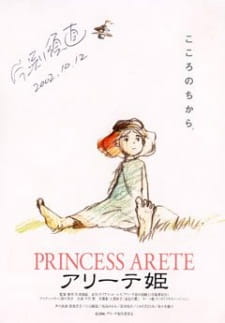
Alternative TitlesSynonyms: Arete Hime, ARITE Hime Japanese: アリーテ姫
Information
Type: Movie
Episodes: 1
Status: Finished Airing
Aired: Jul 21, 2001
Duration:
1 hr. 45 min. Rating:
G - All Ages
L represents licensing company
StatisticsScore: 7.191 (scored by 1077 users)
Ranked: #23202
Popularity: #2930
Members: 2,414
Favorites: 7 1 indicates a weighted score
My Info
Popular Tags
fantasy magic |
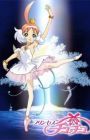
SynopsisConfined in the castle tower by her father, princess Arete spends her days watching the world outside her window. Sometimes she seeks out to watch the common people at work. The knights of the kingdom compete for the right to marry her and rule the land by competing to see who can find powerful magic objects made by a long dead race of sorcerers. Arete wants none of this. She longs to meet the common people and travel to exotic lands she has only seen in the books she keeps hidden under her bed. One day the sorcerer Boax arrives in a fantastic flying machine and offers to take Arete as his wife and transform her into a proper princess.
(Source: ANN) |
Characters & Voice Actors
Staff
Reviews
|
|
ace52387
21 of 32 people found this review helpful
|
1 of 1 episodes seen
|
| Overall |
7 |
| Story |
4 |
| Animation |
7 |
| Sound |
8 |
| Character |
9 |
| Enjoyment |
7 |
Arete Hime initially seems like a typical modern iteration of a fairy tale, ala Disney, with a captive princess who desires to see the world and empathize with its denizens. Eventually, it shapes into a multi-segmented journey of self discovery more akin to "Siddhartha" than "Rapunzel."
When looking back at the entire Journey our main character, Arete undergoes, it's quite epic. This in no way changes the fact that some stretches are completely starved for plot development, using the time instead to flash some scenic shots and play with Arete's diatribes on her predicaments. Which brings me to one of the biggest problems with this film: it is dead focused on Arete. She will continuously feed you her dispositions and her albeit, genuinely pitiful perspective. She`s a free bird trapped in a cage for most of the movie and she longs for human contact. That`s the gist of basically every line she says, and she has many, many lines. While a philosophical and spiritual journey with a poorly paced, and overall uneventful plot may still be a decent read, it`s not particularly satisfying as a film.
Arete is at once adorable and inspiring, in that fairy tale heroine manner, so all is not lost with this movie. Lectures on philosophy are one of my greatest peeves, and she throws a couple out there, but thankfully, most of her character development focuses on her perspective. Arete is not only starved of human contact, but also just the general gratification of being able to live. Her yearning for things so gosh darned basic, things as simple as friends or everyday emotions, illustrates the degree to which she is sheltered and makes her pitiful in a heart wrenching way. She`s even more affecting because she doesn`t just cry and accept the pity. Instead of lamenting her own misfortune, she always keeps her hope and her wits about her through tough situations to get the freedom which she so desires. Arete`s mild mannerisms are a break from the utter exaggerations of most Anime characters, and is a benefit to her cause for sympathy. Emotional understatement is much more effective than rampant bawling. Her rounded personality makes her more complete, more nuanced. Her timid demeanor and slight build serve to contrast and highlight her internal fortitude. When all is said and done, Arete stands side by side with the best animated heroines targeted towards children in any feature, Japanese or otherwise.
It`s too bad that Arete`s character development didn`t come with a richer plot, but at the very least, the focus she commands makes the blandness in the rest of the cast forgivable. Arete is a completely fleshed out, admirable yet pitiable, and altogether believable character who also happens to be adorable. Watching her adventure in Princess Arete is worth suffering the disjointed and hollow plot. read more
|
|
Yukariki
13 of 22 people found this review helpful
|
1 of 1 episodes seen
|
| Overall |
8 |
| Story |
8 |
| Animation |
9 |
| Sound |
8 |
| Character |
9 |
| Enjoyment |
7 |
Children’s fiction is an appealing genre for all ages. Consider Harry Potter: kids, teenagers, and adults all screamed in glee when the final book in the saga was released. All of these works are simple, straight to the point, and wonderful to look at. Reading these types of fiction influences everyone in the crucial age of adolescence. Everyone has their favorite children’s books; mine was Charlie and the Chocolate Factory. Hence, I learned to laugh at dark humor and absurd deaths at a young age.
At the age of five, I asked the unknown sentient beings with the cooties -- a worse opponent than the Bubonic Plague -- what’s their favorite books. Their response goes something like this:
“The Apple-Pip Princess! I love princesses!”
Today, young girls read Twilight. How time passes by so quickly...
Nevertheless, fantasy stories about being a princess-like figure -- Twilight’s Bella is a more contemporary (and stupider) version of the generic princess archetype -- are still popular. Us cool kids don’t like that kind of mainstream crap; we want aversions, subversions, and different settings (aka what made Twilight oh-so popular). Reinventions, especially the darker and edgier types, are fascinating to us. Think Revolutionary Girl Utena, a work that changed the shoujo demographic forever. Grown-up people are like so mature~
What about the kids? They deserve a work like that. Of course, we are not that stupid to recommend Revolutionary Girl Utena to children -- it has incest and disgusting lesbians; it’s fine with us to show gruesome deaths from CSI. As I previously said, children are sensitive to influences. What is the perfect balance of today’s busting of old conventions and kid-friendly literary devices?
Enter Princess Arete.
Appreciating the work requires a good understanding of the plot structures of the princess fairy tales: the kingdom will be destroyed by an unknown monster, the king (preferably fat and has a good sense of fashion) says, “Whoever kills SOPA wins my princess!”, a charming prince (ideally with good teeth) kills the monster, the princess (usually Olive Oil skinny) falls in love, and they all live happily ever after. Watching Disney Princess works and its kins may be enough; I also recommend watching this after Revolutionary Girl Utena and other feminist works for children. Princess Arete is like one of those hipsters and hippies in the countercultural movements in the 70s; you need to get the context to understand their reasonings.
What amazes me is that this work is old-school allegory. Arete symbolizes the feminist and existentialist aspects of the work; she feels timid, but she wants to find her own meaning of life. Stuck in the towers and objectified as a treasure, she is sick of becoming a princess -- a twist on the archetype and an attack on the Disney Princess culture. There is a gradual progression of her character development: from an isolated figure afraid of having a meaningless life to a braver and maturing female. She is logically the person you will add to your favorite characters if you liked the movie a lot. Boax, the villain, also controls a number of themes as well: the role of magic (or technology if using the work to compare and contrast today’s society), male superiority, and the villain archetype. Other supporting characters reflect the wickedness of fairy tales in a realistic lens. Anyone interested in writing or reading inventive tales will rejoice.
The soundtrack, while not memorable enough to be downloaded, complements the work. Its insert songs don’t feel out of place and introduce the scene in a more, unique way. Dreamy and soothing, the classical music soundtrack elevates scenes into something only few works can do -- now, that’s what I call art.
Having said that, it’s a pity the pacing is almost abysmal.
This is not to say I dislike slow-paced works; I enjoy them more for their atmospheric value. It gives time for our brains to compute literary analysis, hypothesize future events, and appreciate the aesthetics. Most Studio 4C works have beautiful art and this is no exception; the minimalistic art design emphasizes its fairy tale nature. What is problematic, though, is that it feels too slow. There are some scenes that feel too long-winded and should have been condensed or cut; the duration is unnecessarily lengthy. Its pacing undercuts the effects of the strong characterization and symbolism of the allegorical work.
Is this work suitable for the children today -- more hyper and attention deficit than high school students? I’m not a parent -- only an uncle of three nephews and one niece -- so I do not know. However, I will not be surprised if the answer is “no.” I, myself, had trouble watching this work, sometimes dozing off at boring moments. I can see this work, despite that, created for the past generations of children -- the mostly imaginative and curious ones. These kids can get the remote, pause, and ask questions to their parents; the work is targeting that demographic. Children don’t do that anymore. If children don’t understand something, they will switch to another channel; arguably, adults do that as well. It’s a pity a 2001 children’s fiction anime might feel dated to today’s children.
Everyone else can still like this work; I know I did. The work is likable, at the very least, and does not seem harmless at all. Consider this work if you enjoy fairy tales, shoujo works, and innovative pieces. It should provoke some thoughts and make you smile at the end. read more
Recommendations
|
|
they have strong strange princesses in a post-apocalyptic atmosphere. both nausicaa and Arete feel for creatures that are scorned be man. the big diffrence is one is fantasy and the other scifi. Post-apocalyptic fantasy?
Somehow ''Princess Arete'' reminded me of Nausicaa.
Strong female lead can be found in both anime.
Same with adventure and fantasy.
They are both great in their own way!
|
Opening Theme"Красно Солнце (Krasno Solntse)" by Origa
Ending Theme"kin'iro no tsubasa (金色の翼)" by Taeko Oonuki
| No posts for this board were found |
Fansubbing Groups
Which fansubbers do you like the best? Click + to approve of their subs for this show. Click - if you don't think they did such a great job.
Related Clubsfeminist anime collection club, Orignal Characters R' Us, Prince and Princess club, The OVA/ONA/Anime Movie club, Anime Lover Club, Random Anime Claim Club, Studio 4°C
Recently Watched By|
33 minutes ago |
10 hours ago |
05-18-13, 11:56 PM |
05-17-13, 6:48 PM |
05-16-13, 6:05 PM | |
05-16-13, 6:23 AM |
05-14-13, 10:24 PM |
05-14-13, 12:16 PM |
05-13-13, 9:25 PM |
05-13-13, 4:35 PM |
|
|