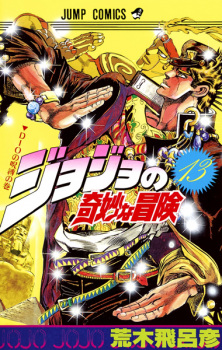
Alternative TitlesEnglish: JoJo's Bizarre Adventure Synonyms: JoJo's Bizarre Adventure Part 3, Stardust Crusaders, Dai San Bu Kūjō Jōtarō: Mirai e no Isan Japanese: ジョジョの奇妙な冒険スターダストクルセイダース
Information
Type: Manga
Volumes: 16
Chapters: 152
Status: Finished
Published: Dec 5, 1989 to Aug 4, 1992
StatisticsScore: 8.561 (scored by 3073 users)
Ranked: #1022
Popularity: #452
Members: 5,261
Favorites: 480 1 indicates a weighted score
My Info
Popular Tags
action adventure fantasy |
SynopsisIn a Japanese jail sits 17-year-old Jotaro Kujo: punk, fighter, delinquent...and possessed by a force beyond his control! Around the world, evil spirits are awakening: "Stands," monstrous invisible creatures which give their bearers incredible powers. To save his mother's life, Jotaro must tame his dark forces and travel around the world to Cairo, Egypt, where a hundred-year-old vampire thirsts for the blood of his family. But the road is long, and an army of evil Stand Users waits to kill JoJo and his friends...
(Source: Viz) |
Related MangaPrequel: JoJo's Bizarre Adventure Part 2: Battle Tendency Sequel: JoJo's Bizarre Adventure Part 4: Diamond is Unbreakable Other: JoJo's Bizarre Adventure Over Heaven Adaptation: JoJo's Bizarre Adventure (2000), JoJo's Bizarre Adventure
Reviews
|
|
Chag
57 of 70 people found this review helpful
|
151 of 152 chapters read
|
| Overall |

9 |
| Story |

8 |
| Art |
10 |
| Character |
8 |
| Enjoyment |
9 |
The fighting shounen manga is possibly the most widely read and widely published genre in circulation today. Hence, JoJo's Bizarre Adventure: Stardust Crusaders faces a great deal of competition for the attention the reader. However, JoJo's visual flare, entertainment value, and unrelenting creativity make it the cream of the crop among shounen adventures.
The story takes place 40 years after the events of Battle Tendency (the second part of the JoJo saga). The protagonist is none other than the grandson of Joseph Joestar -- Jotaro Kujo. When the coffin of the vampire Dio (the antagonist of part one, rival of Joseph’s grandfather Jonathan Joestar) was excavated off the coast of the canary islands, the ancient enemy of the Joestars awakened mysterious powers known as "stands" in Joseph, Jotaro, as well as Jotaro's mother Holly. However, Jotaro's mother is unable to control the consuming power of her stand and falls gravely ill. In order to save Holly from eventual death, Jotaro, Joseph, and Joseph's stand-user companion Avdol must embark on a journey to Cairo in order to destroy the root of her illness: Dio, while making new friends along the way. However, Dio's army of stand-users await our heroes at every turn to impede their progress.
While the outlandish premise of JoJo may not blow anyone away, the sheer creativity employed in the numerous fights will. The term "fight" is used loosely here, as many of the encounters don't rely on the trading of fists, but rather a test of wits and quick-thinking. This is largely due to the dizzying array of abilities that the enemies possess. While the stands of protagonists have more or less conventional superpowers (save for Joseph Joestar), anything is fair game for their foes, with powers ranging from bestowing magnetic pull to the bodies of opponents to the ability to merge with mineral objects, demanding a combination of brains and brawn from the heroes. The action is often visceral, suspenseful, and full of intrigue, especially as the series progresses onwards, when the more outlandish enemies make their appearances. The occasional emotionally charged encounters further enhances the intensity of the story, especially towards the end of the adventure, producing an adventure that is not merely flashy in its action, but truly a memorable journey.
The characters of JoJo are simple and straightforward, each with their own undeniable charm. The strong and reserved Jotaro is the embodiment of "cool", while Joseph makes for spectacular comedic relief with his offbeat attitude, especially for a man of his age. However, most of the villains the group encounters don't have much character behind their stand powers -- they either fall in the "hopelessly psychotic" category, or are bound by their greed for wealth and power, though there are a few exceptions. This is forgivable flaw, given the format of the story, which is a fast-paced ride from one opponent to another, with only brief introductions to the exotic locales in between. There is no mistake in that JoJo does not take itself seriously, as it gives no pretence of plot and character depth, but rather opts to focus on entertainment value, and to this end, JoJo succeeds spectacularly.
The art of Stardust Crusaders, like the previous instalments of the JoJo saga, remains one of the key selling points. The distinctly bold and detailed art style makes it difficult to believe that JoJo was produced weekly. Like the previous incarnations, the characters in part 3 all sport heavily muscled builds, though their bulkiness has taken a step towards moderation from the ridiculous flesh fortresses that appear in the previous two instalments. The fashion sense of the characters is equally wild -- one only needs to take a glance at Jotaro to notice the logic-defying style employed in the manga. Author Hirohiko Araki makes good use of his outrageously stylish artwork by producing action on the page that's ready to leap out at the reader. The fights are kinetic and brutal in presentation, locking the reader's attention and never lets go.
In the end, finding a concrete flaw in JoJo proves to be a difficult task. Its lack of depth is obviously intentional, as JoJo is meant to be a thrill ride -- and what a thrill ride it is. With style, creativity, and exciting bursting at the seams, JoJo's Bizarre Adventure: Stardust Crusaders is a no-brainer for any fan of the shounen fighting manga. Even to those who don't usually read works of this genre, JoJo has plenty to offer, and one is bound to be charmed by one of the many positive aspects of Hirohiko Araki's highly influential work.
Pros:
-- Endlessly creative
-- Outrageously stylish
-- Superb action, enhanced by stunning bold art
Cons:
-- The first few encounters don't measure well with the later encounters, though respectable in their own right.
-- Over-muscled men may be a turn-off for some readers. read more
|
|
The_Redux
12 of 22 people found this review helpful
|
152 of 152 chapters read
|
| Overall |
8 |
| Story |
6 |
| Art |
8 |
| Character |
9 |
| Enjoyment |
9 |
By far the most recognised part of the series, Stardust Crusaders is the third part in the long running manga franchise Jojo’s Bizarre Adventure. While Part 3 is a clear step in the right direction for the series to head in, it is not without the stumbles that come from the introduction into a different focus point (namely the Stand based combat) and does affect its overall effectiveness.
Notably the first thing that a fan of the previous two parts will notice right off the bat is that in terms of the narrative’s strength, JJBA is at its most linear in Stardust Crusaders. The story opens in the year 1983 on the Atlantic Ocean where a crew of fisherman have discovered a metal casket with the word “DIO” inscribed upon its surface. Believing that this casket holds a great treasure inside they eagerly open it, but soon disappear and are never heard from again. Cut to 4 years later and Jotaro Kujo has placed himself into a jail cell, fearing himself to be possessed by a demon that goes unseen to those around him. Upon meeting with Jotaro, his grandfather Joseph Joestar (the main character of Part 2: Battle Tendency) and his friend Mohammed Abdul explain that this demon is in fact the physical embodiment of Jotaro’s own power known as a “Stand” and that its awakening was most likely triggered by the revival of the Joestar’s sworn enemy: Dio Brando. Jotaro’s mother soon falls ill as a result of Dio’s presence and it is left up to Jotaro and his allies to track down Dio’s Egyptian lair and defeat him in order to save not only her, but the world from Dio’s evil influence.
This synopsis essentially sums up Stardust Crusaders’ plot from beginning to end; with what is left unsaid being more character driven or not worth mentioning and actual story progression acting more as a backdrop for the fights that are to come. While this formula was used in both of the earlier parts of the series, it is worth noting that both stories had more, smaller objectives in-between to give the characters smaller victories/losses along the way. Stardust Crusaders does not have this: it instead relies on the readers to get soaked up in the fights with the promise of Dio held above their heads in order to keep them reading. It just doesn’t work as well compared to what Battle Tendency did story wise and does unfortunately leave a blemish on what is otherwise a very entertaining series.
Making up for the disappointingly linear plot of Stardust Crusaders are the crusaders themselves, who are all memorable in their own distinct characteristics. Jotaro takes over the reins from Joseph in this part to great effect: the biggest difference between the two is that while Joseph in part 2 was very much a trickster kind of character, Jotaro is more of a Silent Badass kind of guy. Despite the difference in personalities, both characters are very analytical fighters that will seek out their opponents weaknesses to turn against them and are ultimately driven by the will to do the right thing (even if Jotaro is more static in terms of his own motivations and emotions). Joseph reappears in this part to act as Jotaro’s mentor along this adventure and appears more level headed this time around, but is otherwise the same quirky character that served the readers well in the previous part. Without wanting to give too much away, the other characters whom make up Jotaro’s ensemble are all terrific, likeable characters in their own right and each have their own distinct motivations for helping the team. In particular, Noriaki Kakyoin and Jean-Pierre Polnareff both experience great characterisation early on and receive excellent character development as they overcome obstacles from their past and those set up by the villains to hinder the heroes quest. Unfortunately the villains (with the exception of Dio) are for the most part ineffective; they are mostly confined to appearing to a mini arc (generally spanning 3-6 chapters each), are mostly bland in terms of personality (with many of their motivations being only to aid Dio’s own will) and at worst will not intimidate the reader into thinking they pose any real threat despite their Stand powers. Another gripe to be had concerns Dio; while he’s a constant presence throughout the story, he remains largely unseen and does not end up taking any direct action himself till the very end of the series. These two factors can become distracting and ultimately does take away from the overall experience.
As with the previous two parts in the series, the absolute high point and main attraction are the fights that Jotaro and company have across their journey. Gone from this series (save for a couple of brief ineffectual instances from Joseph) is the Ripple fighting style that was the protagonists main form of combatting their vampiric enemies and in its place are the Stand powers; the embodiment of a beings inner fighting spirit. The different Stands in this series are each named after one of the Major Arcana of the Tarot Cards in this part (with a couple of exceptions) and all operate in different ways with vastly different powers/effects dependent on the power of the particular Stand, making them much more varied than the previous Ripple based combat. To this end, many fights involve the heroes working out the mechanics of the Stand’s ability and either trying to overcome them with their own abilities or by tracking down the Stand’s user and defeating them to get rid of the Stand. While this new dynamic of how battles are fought is an improvement from the less original concept of the Ripple, many of the Stands in this Part lack the originality seen in the other parts of the series: there are a couple repeated concepts (namely shape shifting), a few involve element manipulation (e.g. the ability to control fire, ice etc.) and for the most part lack the utility element featured by Stands later in the series (which is forgivable for a new concept but does detract from the series). It should be noted that battles get more entertaining the further the series progresses, leading to the final confrontation with Dio which is one of the best fights ever to be seen in manga form. When all is said and done the introduction of the Stand powers was a big step in the right direction and has solidified Jojo’s Bizarre Adventure as being a truly unique and entertaining series that has left an impact on Manga as a whole forever.
In terms of art style, it was in Stardust Crusaders where Hirohiko Araki really started to change up his own drawing technique. While some things such as the overly muscled design of the main characters remained the same as what was used in the previous two parts, the way the characters were drawn shifted from the more angular and messy detail style last seen in Battle Tendency towards a more squared off style featuring cleaner lines. This change can also be seen in the design of the environments where the fights take place, with environment appearing slightly more angular as the series progresses. This is a change for the better; as this new drawing method allows for a greater distinction between different objects in a panel, makes the art easier to follow and moves away from being inspired by Fist of the North Star in order to gain its own identity artistically (something that the series up until this point had been lacking poses and fancy clothes aside). It's worth mentioning that this series can be very gory in sections; while Phantom Blood and Battle Tendency had their fair share of blood and guts, it feels as if Araki really stepped up just how horrific it appeared in this Part. Anyone who can't stomach graphic violence should therefore either avoid this series outright or do their best to overlook this.
So once all is said and done Jojo’s Bizarre Adventure: Stardust Crusaders is praise worthy, but is far from being a flawless work of fiction. If nothing else the success of this part gave the author a sense of what direction it would be best to take future Part’s towards (as it does more right than wrong) and with the invention of the Stands it now has something to make itself stand out as a truly unique series. If you’ve read the previous parts and enjoyed those then you’re in for a treat and if you’re new to the series but don’t want to read the preceding parts then it’s still worth checking out just to see if you like the concept of the Stands. It is one bizarre adventure that should not be missed.
《TO BE CONTINUED|| read more
|
|
-Both have a high school boys as characters and the time period is quite the same as well.
-Visual styles and character design are pretty similar .
-Both rely on over-the-edge and uber-cool techniques.While Jojo:SC is based on stands, Otokojuku shows off uncanny and impossibly amazing fighting techniques.
-Both of them make use of "strategy-based" fights, in which understanding the opponent's flaws is the key to victory.
|
|
|
Both of the series have a similar battle system JoJo has "Stand" while Shaman King has "Guardian Ghost" or "Soul Control" , both of the series are adventurous although JoJos adventure might be a different than what you think. The fights are well thought out and hardly little or no use of Nakama.
Shaman King may start off a bit slow but once it gets into action you'll be hooke.
Both of these series are Underrated and very good battle Shounen that are done right
|
| No posts for this board were found |
Related ClubsCNCFixins, Dreamcast gamers, Hirohiko Araki is true moe., JoJo no Club, JoJo's Bizarre Adventure Club, JOJOPedia, Jump! Ultimate Stars Clan: , Kono Dio Face, Manly Chest fanclub, Mindfuck-Club, Polski FC Tasiemców, Rockline.it, russian shounenfags!, SKETCHY LINES EVERYWHERE Appreciation Club, the best damn anime/game club ever, TMIE TRAVELLERS, ZA WARUDO, [Facial Hair]Sexy[/Facial Hair]
|
1 hour ago |
2 hours ago |
6 hours ago |
7 hours ago |
10 hours ago | |
10 hours ago |
10 hours ago |
10 hours ago |
11 hours ago |
Yesterday, 3:03 PM |
|
External LinksOfficial Site, MangaUpdates, Wikipedia
|
|