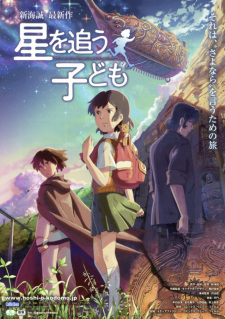
Alternative TitlesEnglish: Children who Chase Lost Voices Synonyms: Children who Chase Lost Voices from Deep Below, Journey to Agartha Japanese: 星を追う子ども
Information
Type: Movie
Episodes: 1
Status: Finished Airing
Aired: May 7, 2011
Duration:
1 hr. 56 min. Rating:
PG-13 - Teens 13 or older
L represents licensing company
StatisticsScore: 7.921 (scored by 12548 users)
Ranked: #5572
Popularity: #773
Members: 23,841
Favorites: 80 1 indicates a weighted score
My Info
Popular Tags
No tags found |
SynopsisStrange sounds in the darkness... Unearthly music from an old crystal radio... These are all the warning Asuna Watase has before a simple walk to her clubhouse catapults her into a nightmarish adventure that will take her beneath the Earth to a lost land beyond the realm of legend! Attacked by a strange monstrous creature, rescued by a mysterious stranger and pursued by a relentless enemy, Asuna finds herself enmeshed in a centuries old mystery that will bind her to a strange young defender and lead her inevitably, towards a secret that may hold the key to life itself!
(Source: Sentai Filmworks) |
Related AnimeAdaptation: Hoshi wo Ou Kodomo, Hoshi wo Ou Kodomo: Agartha no Shounen
Characters & Voice Actors
Staff
|
Shinkai, Makoto
Director, Creator, Editing, Director of Photography, Screenplay, Color Design |
|
Kumaki, Anri
Theme Song Composition, Theme Song Lyrics, Theme Song Performance |
|
Tanji, Takumi
Art Director |
|
Nishimura, Takayo
Character Design, Animation Director |
Reviews
|
|
Archaeon
202 of 337 people found this review helpful
|
1 of 1 episodes seen
|
| Overall |
7 |
| Story |
7 |
| Animation |
7 |
| Sound |
8 |
| Character |
6 |
| Enjoyment |
7 |
Stories about the dead coming back to life are a dime a dozen these days, mainly because of the current fascination with zombies and vampires, but rarely do we see a tale that's more akin to the legends of old, where mighty heroes brave the perils of the underworld to be reunited with their lost love.
Sorry, that should be a 12 year old girl. Let's try this again ...
Stories about children having adventures in other worlds are a dime a dozen these days, but rarely do we see a tale that's more akin to the stories of old, where brave youths traversed other realms on a journey that would teach them ... lots of stuff.
Nope, that's not going to work either. Let's try putting the two together ...
Hoshi wo Ou Kodomo, which apparently means "Children Who Chase Stars" but for some reason is called "Children Who Chase Lost Voices From Deep Below", is the latest work from acclaimed creator and director Shinkai Makoto. The story centres on a small town in the countryside, where a young girl called Asuna spends her time after school listening to the strange music that comes from the crystal radio that her father left to her before he passed away.
Everything is peaceful until one rather eventful day ...
At it's core, Hoshi wo Ou Kodomo is an adventure covered in a philosophical blanket that doesn't quite fit, and it shows in many ways. The plot tries to blend a variety of themes, but it never really manages to do this with the panache of Shinkai's previous works. In addition to this, there's a childishness to the narrative that some viewers may find a little annoying, and quite often events are resolved in a manner that is very "black and white". Because of this the story lacks a good measure of catharsis, especially in comparison to "5 cm Per Second" and "The Place Promised In Our Early Days", and the film concludes with a rather lukewarm resolution.
That said, the movie is interesting to a degree, but much of this comes from the way in which myths and legends regarding the underworld and resurrection are tied into the plot. Unfortunately, it's clear from the opening scenes that inspiration for the anime has come from a few very well known sources, and viewers may find that they spend more time playing spot-the-influence, and less time paying attention to the storyline.
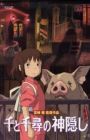
One of the first things that people will notice about Hoshi wo Ou Kodomo is the very "Ghibli-esque" atmosphere it has, but while this perception can initially be ascribed to the rural setting and the young lead character, the similarities actually run a lot deeper. The scenery is a rather pleasant blend of Shinkai's trademark panoramas and the kind of countryside imagery that one might find in "Only Yesterday" or "Spirited Away". Once the action moves beyond the gate, the background art and the settings dramatically improve, and the audience is treated to the kind of vistas that one would expect in a Shinkai feature.
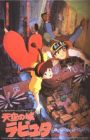
Unfortunately the same can't be said of the design, and viewers may be forgiven for thinking that the entirety of the movie is nothing more than an homage to a certain well known studio. The characters are so stereotypically Ghibli in fact, it's easy to imagine them searching for Laputa or farming in The Valley of the Wind. The similarities even extend to the animals, and while several of the more fantastic creatures wouldn't look out of place in the forests of "Mononoke-Hime", the strongest resemblance (in more ways than one), is between Asuna's cat Mimi and Nausicaä's pet Teto. Sadly, the comparison can only go so far as the characters lack visual refinement, which is further compounded by the lack of gradation in the colour palette used for them.
When it comes to the animation, Hoshi wo Ou Kodomo is a long way from the best work produced by the long-running Shinkai/CoMix Wave Inc. collaboration. The action sequences are pretty decent for the most part, but the characters can sometimes move in a stunted manner, almost as if there's a degree of uncertainty about how each person should act or react in a given situation. In addition to this there are several scenes where the characters seem to have irregularly proportioned bodies, and viewers may find themselves wondering why particular events leave them with the nagging feeling that something isn't right.
The theme song, "Hello, Goodbye and Hello" is a bittersweet ballad composed and performed by Anri Kumaki, and in all honesty it's a rather fitting song given the nature of the story. As for the background music, there's a rather nice mixture of placid or bittersweet orchestral tracks, light-hearted jingles and dramatic pieces, all produced by Tenmon - Shinkai's long-time compositional stalwart. Ironically, the movie excels when it comes to audio choreography, and with an array of high quality effects on offer it can sometimes feel as though more care has been given to making the feature sound good in a pretty setting, and not enough on developing the story.
The script lacks a degree of intuitive flow, and the characters can sometimes state the obvious or wax philosophical for no reason other than to add a veneer of intelligence to proceedings. It's a sad fact that the dialogue can sometimes be stunted, and lacks the nuance that many viewers might expect. While some people may believe that this is due Asuna's age and lack of knowledge, the simple fact is that it highlights more than anything else how inexperienced Shinkai is with this type of movie. That said, the more than experienced cast have rallied well, but even with their ability to project emotion and personality, there are moments when they're unable to compensate for the heavy handed script.
There's a strange dichotomy with the characters as on the one hand Asuna, Shun, Shin, and pretty much everyone else aren't really anything to write home about - especially if you've watched certain Ghibli movies. On the other hand Morisaki Ryuji is a very interesting person indeed, and is reminiscent in many ways of a more humane Ikari Gendou. Unfortunately he also suffers from the same problem in that he isn't given enough back-story to support his actions and decisions, but then, that's pretty much the tale of Hoshi wo Ou Kodomo in a nutshell. Although there is some development for the lead roles, it's often sporadic as the focus seems to be more on the journey itself.
Shinkai Makoto has made it no secret that the inspiration for this movie came from a story he read in elementary school, but it was during his sojourn in England in 2008 that the idea for the anime finally coalesced into something more concrete.
Which, strangely enough, explains rather a lot.
There's a childishness to the movie that doesn't quite fit with the major themes of the plot, and in many ways it feels more like Shinkai was testing the waters and his determination, which isn't actually surprising when one considers that Hoshi wo Ou Kodomo is also his attempt to prove that he isn't a one-trick pony. While there are some positives that can be taken away from the feature, there are far too many things that have been "borrowed" from other films, and these make it difficult to see the movie as little more than an homage. In all honesty it would have been nice if Shinkai had the courage of his convictions and relied more on his own style (like he did with "5 cm Per Second" and "The Place Promised In Our Early Days"), instead of trying to piggyback on that of another studio.
That said, Hoshi wo Ou Kodomo is a fairly easy movie to watch as long as the viewer doesn't delve too deeply, and it has a much lighter and more adventurous tone that Shinkai's previous offerings. In addition to this, if one considers it an experiment with a new type of story then it doesn't just become a reasonably entertaining feature, but also a glimpse into the mind of Makoto Shinkai, and that is a much more rewarding experience than the movie itself. read more
|
|
5camp
76 of 128 people found this review helpful
|
1 of 1 episodes seen
|
| Overall |
8 |
| Story |
8 |
| Animation |
10 |
| Sound |
4 |
| Character |
8 |
| Enjoyment |
8 |
The story is about Asuna, basically the female lead from every single Ghibli movie ever, a bit of a loner girl who spends her time sitting on rocky outcrops listening to her makeshift crystal radio. One day she is attacked by a monster, who got lost on his way to a Princess Mononoke audition, but is saved by Shun, who is basically the pretty boy male lead from half of every single Ghibli movie ever (don't worry, the other half of the pretty boy male lead is role is taken up by Shun's younger brother). But then Stuff Happens that I don't want to spoil, so Asuna has to travel to the magical land of Agartha with her mysterious substitute teacher, who is basically the villain from every single Ghibli movie...wait, actually he's not. He's more nuanced than that, and was far and away my favourite character of the movie.
I'm sure the clever ones amongst you must have caught on by now that this movie is rather derivitave. Yes the movie takes many cues from Ghibli flicks, particularly Laputa which Shinkai has admitted to being a big fan of, but it plays around with the formula in enough new and interesting ways to stand out from the pack. Asuna, our female lead, does start out as rather irritatingly perfect, but as the movie goes on her loneliness and fears begin to come more to the surface. Plus it does this without ever being in your face about it. Yes, the characters sometimes have to point out the direction their character’s development is going in, such as when Asuna admits to her substitute teacher acting a bit like her father, but it flows well with the dialogue and doesn't feel the need to retread these same points over and over again.
Then there's the substitute teacher, Morisaki, who I've already eluded to as being my favourite characte. He starts off appearing like he's going to be the standard deluded villain, intent on destroying all in his path to get to his goal. This is sort of what he is, but his reasoning is sympathetic and he doesn't act pointlessly evil for the sake of things. He's quick to draw his gun, but it's for his own safety and not because he just likes shooting things. His reasoning for going into Agartha makes him sympathetic too, rather than just being power-hungry or driven by sheer greed. But what makes him great is he also brings out the best in Asuna, elevating her to an interesting character in their own right. As the two travel through Agartha, they strike up a rapport like that of father and daughter, which was very fitting given what the two of them had lost in their lives. They became the family neither of them ever had and, while he was often harsh to Asuna, there was still the strong sense that Morisaki grew to care for her immensely. He's a human character with real flaws, as was Asuna, and their relationship was the real highlight of the movie.
Animation-wise, the movie is stunning. OK, this is still Shinkai, and his tendency to focus on clouds remains completely baffling, but the world of Agartha is beautiful. It's essentially the same as earth, but there's enough touches here and there to make it seem alien. Morisaki and Asuna travelling through the countryside had this almost Lord of the Rings feel to it. The world can feel a bit barren at times, lacking magical towers and sparkles at every turn, but it fit the feel of the world. It was supposed to feel empty and dying. The other thing this movie nailed was the sheer scale of some of the set pieces. Where Ghibli films excel is in the fine detail, which I don't think Shinkai got quite as well in this film, but the scopes of some of the set pieces were jaw-dropping. Particularly I have to mention the giant hole in the world that book-ended the film and that multi-eyed monstrosity that was meant to represent the god of this world. And hey, since we're talking about monsters, special mention has to go to those skeleton-like creatures that swam on the ground like sharks of the shadows. They were flat out creepy.
It's far from a perfect film though, and I particularly have a bone to pick with the music. The sweeping orchestral score has all the subtlety of a child smashing a spanner on a table to get attention. Because the same score is used for almost every single slightly dramatic scene, it robs the music the intense effect it's supposed to have on the more dramatic scenes. It's also a bloody long film, about 2 hours long, and takes a while to get going. It doesn't really pick up until the characters visit Agartha, and that takes almost an hour. This is partly down to Shinkai spending far too much time setting the scene, showing off the landscape of Asuna's home town. Which is fair enough, highlighting the ordinary world so it makes the contrast with Agartha that much stronger, but he really spends too much time on it. I really didn't need that shot of dragonflies having sex Shinkai, and could you please stop it with the bloody clouds? Yes, these scenes are incredibly important to establishing Asuna's character for the development that occurs later on, but it doesn't stop the scenes from being boring. And no, sticking in the fox-cat from Nausicca won't make these scenes that much more tolerable. That's just cheating.
Plus since it's basically Ghibli, it carries over not only the strong points of magical worlds and amazing attention to detail that these films have, but also carries over the warts too. Towards the end it really starts to get a bit silly, especially when the giant monster thing swallows the main character and jumps down a bizillion foot drop in order to transport her, looking rather like a pregnant woman crossed with those robot things from Laputa. It even brings over the forced in environmental message that Miyazaki works into his films with the grace and subtlety of a hippo doing ballet. It did only got a passing mention and, while clunky, wasn't anywhere near as bad as Miyazaki's tend to be. Besides, the movie earns so many points by adding the much needed nuance to the main character and the sorta villain that I can forgive most of the mistakes it makes. Asides from the clouds. Please stop with the damn clouds.
There is one final problem I'd like to highlight. There was something off about the pacing. The story was very well told and wove the themes of loneliness and loss in extremely well, but the transition from set piece to set piece was clunky, as though it was adapting a TV series and these were the gaps between episodes. As I said, it's a two hour movie which is really a touch too long, but I also wouldn't want to cut much out of it (asides from all the clouds). I think it may have suited a short Noitamina length TV series or OVA instead. You could have delved into some of the characters pasts a bit more, or told us more about Agartha. That was one thing I was a bit miffed about. There was an interesting conflict between Morisaki and the people of Agartha where he accused them of accepting their decay and being lazy, which tied quite well in with his own story, but it didn't really tackle the Agartha side of the story once he'd left.
While there are plenty of flaws with the movie, I did end up enjoying it a lot. Not sure how fans of previous Shinkai films will take this, as it's a drastic change from them. I suppose the themes are kind of similar (or at least I'm told the themes are similar, I was too busy gnawing my arm off in an attempt to stay awake to notice the themes of his previous films). But if you like Miyazaki's films, you'll like this. It's too long, take a while to get going, gets a bit silly at times, and someone needs to bop the composer over the head and tell him to lay off the full orchestral sweeps every once in a while, but it's a genuinely entertaining film with a well told story. And clouds. read more
Recommendations
|
|
In both movies the protagonists undertake a journey to a faraway land similar to the underworld, in order to bring back a dead person whom they love very much.
In both anime children travel to an unknown world, where it's said you can make any wish imaginable come true. Both also try to bring a message across to the viewers.
Both are about loss and finding away to accept that loss. In both the main characters end up in a different fantastical world with different creatures. They make new friends and face challenges as they journey and find what their true feelings and desires are.
The plot is very similar. They're both about people who want to bring the dead back, but they have to go through many challenges to be able to get there. In both of the movies they meet other people and go through the challenges together. It's a great movie if you have time on your hands.
|
|
|
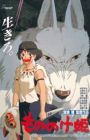
The under world for "Hoshi wo Ou Kodomo" is very similar to the world of "Princess Mononoke". The detailed payed to the art work is spectacular and the story line is a darker children's tale.
Similar atmosphere,similar character design,dealing with people who doesn't respect the rights of nature, protecting the acient world,however PM is more dramatic & cruel than HwOK
Both animes - a fantasy, with atmosphere of romanticism and adventures where people co-operate with gods. Well and of course plotting in this work of Makoto Shinkai is too similar to an anime of Hayao Miyazaki.
Both movies have incredibly similar atmospheres and basic plot lines about humans trying to be/control gods and not fully understanding what they're getting themselves into. Princess Mononoke delves much more heavily into a humanity vs nature theme, while Children Who Chase Lost Voices focuses more on how people cope with death. Both are gorgeous beyond belief and if you like one you will undoubtedly enjoy the other.
|
Opening ThemeNo opening themes found, add themes.
Ending Theme"Hello Goodbye & Hello" by Anri Kumaki (熊木杏里)
Fansubbing Groups
Which fansubbers do you like the best? Click + to approve of their subs for this show. Click - if you don't think they did such a great job.
Related ClubsItou Kanae Fanclub, The Makoto Shinkai Club, The Good Times Club, Marketplace Germany, !~~tsubasalover's Friendships~~!, Реафаны, The OVA/ONA/Anime Movie club, English Dub Fanclub, Miyu Irino Fans!!, Anime art that r0cks!!, Kanae Itou Fanclub
Recently Watched By|
1 hour ago |
3 hours ago |
3 hours ago |
4 hours ago |
7 hours ago | |
7 hours ago |
8 hours ago |
9 hours ago |
9 hours ago |
10 hours ago |
|
|