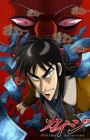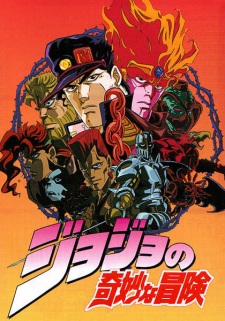
Alternative TitlesSynonyms: JoJo's Bizarre Adventure OVA 1, JoJo no Kimyou na Bouken Japanese: ジョジョの奇妙な冒険
Information
Type: OVA
Episodes: 6
Status: Finished Airing
Aired: Nov 19, 1993 to Nov 18, 1994
Duration:
35 min. per episode Rating:
R - 17+ (violence & profanity)
L represents licensing company
StatisticsScore: 7.611 (scored by 3524 users)
Ranked: #10962
Popularity: #1769
Members: 7,479
Favorites: 76 1 indicates a weighted score
My Info
Popular Tags
horror shounen |
Synopsis Kujo Jotaro is a normal, popular Japanese high-schooler, until he thinks that he is possesed by a spirit, and locks himself in prison. After seeing his grandfather, Joseph Joestar, and fighting Joseph's friend Muhammad Abdul, Jotaro learns that the "Sprirt" is actually Star Platinum, his Stand, or fighting energy given a semi-solid form. Later, his mother gains a Stand, and becomes sick. Jotaro learns that it is because the vampire Dio Brando has been revived 100 years after his defeat to Jonathan Joestar, Jotaro's great-great-grandfather. Jotaro decides to join Joseph and Abdul in a trip to Egypt to defeat Dio once and for all.
|
Related AnimeAdaptation: JoJo's Bizarre Adventure Part 3: Stardust Crusaders Prequel: JoJo's Bizarre Adventure (2000)
Characters & Voice Actors
Staff
Reviews
|
|
ParaParaJMo
26 of 36 people found this review helpful
|
6 of 6 episodes seen
|
| Overall |
9 |
| Story |
9 |
| Animation |
9 |
| Sound |
9 |
| Character |
9 |
| Enjoyment |
9 |
This anime series is based on the 3rd story arc of the manga, Stardust Crusaders. Though I strongly suggest you watch this anime, it will be confusing if you have no have familiarity with the first two story arcs of the manga which is a a major draw back. Though the DVDs do have an extra that narrates them, it’s not that fun if you don’t read them first hand because you really see the transitions each story arc goes through and they are all captivating, and still continues to be that way as the manga progresses even after Stardust Crusaders. Obviously when Araki created Jojo, he already had the first 3 story arcs in mind and does an excellent job of exhibiting his magnificent creation he intricately planned out. The manga is currently licensed by VIZ but I strongly disapprove of how they only releasing Stardust Crusaders and skipping out on Phantom Blood and Battle Tendency. You really need to see the first two story arcs to learn about the origins of Dio and of Joseph, and reading it as a whole, you just see the build up was all for that moment.
The fact that some factors of Jojo are complicated to explain does not negate its quality, but only amplifies it because it really makes you curious and alert to how its so original in a certain way. The fact its supposed to be unorthodox really makes it unique in a different way.
The supporting cast have their own unique qualities and personalities. Like Kakyoin may seem cold and distant like Jotaro from an outside point of view, he’s very loyal, compassionate, and very formal. I say it really helps when Hirotaka Suzuoki is your seiyuu. Polernarf is somewhat of the comic relief of the series despite his serious intentions. It’s just when it comes to comic relief characters in action anime and manga, they tend to be good will and natured. And then there’s Iggy, the stand using dog. Even though he is a dog, he sure has a helluva an ego.
Initially, the manga had a Hokuto no Ken like approach to it. Sometimes you’d wonder if Buronson was the artist himself because the styles were exactly alike because of the massive bodies and the execution of stiffer fights were also present. But the art tends to evolve when Araki begins to make the bodies of his characters more lean and cut. Something lets say you can compare to the designs of the Battle Royale manga. But then he’d use water colors in some of his paintings on the covers to give it a somewhat more artistic distinctive look. Especially with the weird poses. I’m not saying it’s gay or metrosexual or however you wanna call it, I say it is probably meant to reflect on how Jojo is just weird, but in a cool and captivating way.
The art is somewhat 80s with the clothing and the massive bodies, but when you look at it in comparison to the manga where it currently is with the Steel Ball Run arc, the art is becoming more leaner and more modern by current standards being more stereotypically anime with big eyes, but Araki still uses the weird poses and the water colors on his covers. So if you read the manga from start to where it is right now, like Morikawa Jyoji’s Hajime no Ippo, you’re going to see an evolution to the style. But I really like the sense of fashion he puts into his characters and gives variety. Like Jotaro’s Japanese punk clothing you might see in Bebop High School. Especially with the long school boy trench coat. And Joseph now has this Indiana Jones look. And Abdul looks culturally authentic. And Polernarf as confirmed by SNK would of course be the model of one of Team Japan’s favorite fighters, Benimaru. And in the manga, the cyborg Nazi stroheim would inspire Guile’s design in Street Fighter II.
The stands of course are just unbelievable. Some of them are weird, and some of them are just frickin’ sweet. Like Jotaro’s stand, Stardust Plantinum has an Azteck warrior look to it. I have no idea how to describe Dio’s stand, the World. It’s humanoid like Stardust Plantinum, but has all these cords and looks all tubey. It looks likes some sort of hyro powered fighter or something. Joseph’s stand Purple Hermit is just a bunch of purple vines but has its use. So you’re going to see a lot of variety with the art and design though not necessarily too distinct in comparison to some action anime or manga of this nature except with the execution of the action.
Now time to talk about what makes this anime stands out, but not necessarily that recognizable to other anime and manga fans outside of the land of the rising sun. It’s definitely the fights. The final battle is just breath taking. On my list of top anime manga fights, Dio vs Jotaro hits number one. It’s an all out battle for the fate of the world. Despite how wild and crazy this fight is, I really love how strategy and intuition is still present in the fight, though it’s not necessarily as technical as you’d see in a martial arts oriented anime like street fighter. If you had to put the mind games of L and Light from Deathnote into a physical plane or in layman’s terms, “a fist fight,” this would be it. You’re not going to see these fights in Dragon Ball Z, in Naruto, in Hajime no Ippo, History’s Strongest Disciple Ken’ichi, Flame of Recca, nowhere but Jojo. The original Jojo fights in the first two story arcs were more martial arts based being all Hokuto no Ken like and all and still entertaining in their own respective rights. But its good when you start from the beginning, you see the evolution to where it is now.
But with this anime or manga being old, I kind of don’t like the dark resolution. I understand it’s a dark anime, but for me, it’s kind of hard on the eyes.
Well, this oav series has no specific big name band doing any opening or ending themes nor is there any lyrical open and ending themes at all. I think it would have been cool if they did something like that for this anime. The background music is still very excellent and gives an eerie and spooky feel to it. I like it a whole lot. I don’t know what else there is to describe with the music. Though it is good, it doesn’t really stand out though certain songs do match the intensity and other emotions of the situation.
The voice acting in this was dead perfect. Kosugi Juurouta as Jotaro was excellent, though I don’t think this is how a Japanese 17 year old should sound. But he makes Jotaro sound very intimidating, intelligent, and tough. I love the emotion he gives and he really brings the battle cries and the phrases of Jotaro to life. Like whenever he’s throwing multiple punches, he cries ora ora ora ora ora ora ora. And he’s always saying yare yare daze you can say something is along the lines of “oh well.”
Nobuo Tanaka as Dio Brando was just amazing and couldn’t imagine anyone else doing it. I love how they give an echo effect to his voice, especially when he uses the powers of the World to freeze time. And he really brings out the psychotic sadist that Dio is with the way he yells and screams. He’s got that battle cry of “WRRRRRYYYYYYYYYYYYYYYY” and “muda muda muda muda.” Meaning it’s all useless if you wanted to translate it in a very literally loose way. I understand that in the Phantom Blood movie, Tanaka was replaced by veteran Midorikawa Hikaru. He’s done a lot of roles himself. Though I have yet to watch Phantom Blood, I just can’t imagine Midorikawa playing somebody like Dio and I don’t think he’s ideal for villains. But until I watch that movie and review it, I’ll give a more accurate judgement. read more
|
|
MasterGear
11 of 19 people found this review helpful
|
6 of 6 episodes seen
|
| Overall |
9 |
| Story |
9 |
| Animation |
10 |
| Sound |
9 |
| Character |
10 |
| Enjoyment |
10 |
This OVA series is based on the third part of the popular, long-running manga series JoJo’s Bizarre Adventure, known as Stardust Crusaders, and the condensation from a 152 chapter strong series to a 13 episode OVA series results in the removal of a lot of material from the original work, condensing it into almost a ‘summary’ of the story, with several of the key fights highlighted and detailed. In some cases, as such with the final episode and several other times during the OVA, the events are changed due to some dramatic licensing from the directors, but this does not directly impact the storyline whatsoever. It is not required, although recommended, that you read the original manga before watching the OVA series, as this shows the full depth of the story and many of the battles which the OVA series misses out, but by no means are unimpressive.
The story of the series is quite strong, with an interesting premise with the introduction of Stands to the series - psychic manifestations of the user’s fighting spirit. The somewhat formulaic presented goal to ‘defeat the big bad and save the damsel in distress’ may seem a stereotypical goal, but it is drastically subverted throughout the series, and this is one of the primary reasons as to why JoJo’s continues to excel as a brilliant series through its intuitive and genre-breaking storylines.
The characters are well developed, despite the condensing of much of the manga storyline into the creation of the OVA – Jotaro’s badass demeanour and sharp wit are complimented well by the supporting protagonist cast – the humble and loyal Noriaki Kakyoin, the lecherous and somewhat ‘comic relief’ character of the series Jean Pierre Polnareff, the light-hearted and intelligent Joseph Joestar, the direct and intimidating Muhammed Avdol and the rebellious but occasionally helpful Stand-using dog Iggy. As you can probably tell, these personalities clash quite frequently, and the character interactions are quite meaningful in allowing the audience to interpret the characters fully and become really drawn into the plot’s progression.
Stands are the primary innovative feature introduced in this series in particular, and the Stand concept is present up until the current part, Part 7 in the manga, and there are plenty of reasons as to why this is. Stands add a new dimension to combat, and just because many of the Stands look physically bulky does not mean the battles become fistfights – the vast majority of battles in JoJo’s are won not by the physical strength of the users, but by their wit and cunning, and the usage of the environment and their powers to secure an advantage. Expect many underhanded tricks and death-defying attacks, and these only add to the trope-breaking that JoJo’s exhibits.
In terms of visuals, it is clear that the directors have put a lot of effort into imitating Hirohiko Araki’s distinct and interesting art style, and in some ways, they manage to succeed, but it was always going to be difficult to recreate the flamboyant poses and eye-popping visuals that Araki creates in the manga. The 90’s animation in the later episodes is well done for its time; despite some niggles with jagged edging, but these can really be overlooked. The prequel episodes created in 2000 have a much darker and deeper animation style, and this is also quite visually impressive. The variety of clothing and fashion sense that Araki creates exudes brilliance, and this is well replicated in the OVA, adding to that same atmosphere that was created in the original manga.
Despite the lack of an opening or ending theme, the audio in the OVA is also very well done – the backing music adds a very eerie and mysterious feel to the series, and the score backs the events of the series well, with no particular songs standing out over the others, but still managing to capture the emotion and tension of the situation. The voice acting was also excellent and in character, particularly the voice actors of Jotaro and the supporting protagonists, along with Dio’s voice actor, who breathed life and emotion into the characters and captured their essence and personality that was presented in the manga.
My final rating of 9/10 is a result of the combined praises that I have given the series over the past paragraphs. The only lost point was due to the condensing of the storyline, which was indeed required to fit into the 13 episode limit, but still leaves several loose ends which can only be understood if the watcher has already read the manga, which, to be fair, really should be the only reason as to why you are planning to watch this (if you have or are planning to read the manga). While this OVA series is very exciting to watch, it does not match up to the excellence of the manga, and should not be viewed as an alternative to reading the manga, as you will simply miss so much of the experience which makes JoJo’s Bizarre Adventure so captivating.
read more
Recommendations
|
|
Over the top violence. Buff men punching bad guys at lightning speeds. Super dramatic poses!
Both series are pretty much frowning men beating each other up for their entire length, and both are unintentionally hilarious when watched with people who like to make fun of things that shouldn't take themselves so seriously.
They're also both epic tales of manliness. That should count for something.
|
|
|
Both series share some key themes: supernatural abilities determined by one's deepest wishes, the concept of soul, similar "food chain" theme of superhuman creatures and a character who can stop time.
|
Opening ThemeNo opening themes found, add themes.
Ending ThemeNo ending themes found, add themes.
Fansubbing Groups
Which fansubbers do you like the best? Click + to approve of their subs for this show. Click - if you don't think they did such a great job.
Related ClubsDreamcast gamers, JoJo's Bizarre Adventure Club, The Vampire Club , Ready? Fight!, [Facial Hair]Sexy[/Facial Hair], NCC Sci-Fi, OVA/ONA Group, GARhalla, This Is The True Spirit of Men!, Delinquents Unite!, The Internet Memes Club, English Dub Fanclub, ZA WARUDO, JOJOPedia, The OVA/ONA/Anime Movie club, Intense Anime Characters Fanclub , Rockline.it, Characters Birthday Card Club, JoJo no Club, Kono Dio FaceHirohiko Araki is true moe., Manly Chest fanclub, ..., TMIE TRAVELLERS, 2D Fighting Games, The Aironic OVA (Original Video Animation) Club see all
Recently Watched By|
5 hours ago |
5 hours ago |
6 hours ago |
6 hours ago |
11 hours ago | |
Yesterday, 11:59 AM |
Yesterday, 3:17 AM |
Yesterday, 1:12 AM |
Yesterday, 12:41 AM |
|
|