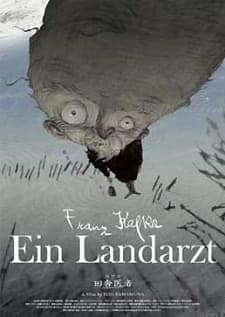
Alternative TitlesEnglish: Franz Kafka's A Country Doctor Synonyms: Kafka Inaka Isha, Ein Landarzt Japanese: カフカ 田舎医者
Information
Type: Movie
Episodes: 1
Status: Finished Airing
Aired: Oct 2, 2007
Duration:
21 min. per episode Rating:
PG-13 - Teens 13 or older
L represents licensing company
StatisticsScore: 7.091 (scored by 2735 users)
Ranked: #26412
Popularity: #2108
Members: 5,084
Favorites: 20 1 indicates a weighted score
My Info
Popular Tags
No tags found |
SynopsisA hapless country doctor describes with breathless urgency a night-time summons to attend a young patient. Events soon take on a surreal aspect as "unearthly horses" transport him instantaneously to the bedside. The doctor, preoccupied with personal distractions and grievances against those he is employed to care for, fails to find what is revealed to be a vile, fatal wound. He is humiliated by the villagers, who are "always expecting the impossible from the doctor," and doomed to an endless return trip, losing everything.
(Source: ANN) |
Characters & Voice ActorsLearn how to add characters and voice actors.
Staff
Reviews
|
|
ace52387
39 of 55 people found this review helpful
|
1 of 1 episodes seen
|
| Overall |
7 |
| Story |
6 |
| Animation |
8 |
| Sound |
7 |
| Character |
5 |
| Enjoyment |
7 |
Making sense of Kafka`s work is difficult enough in its original form as prose, but trying to throw a theatrical spin on something as introspective as Country Doctor makes it even more confusing. The story starts with a distraught country doctor who`s horse has died the night before. His maid runs around town trying to borrow a horse so that the doctor might make his urgent appointment, but no one is willing. In frustration, the doctor kicks the door on his pigsty, and he finds a groom inside, and two horses as well. The groom prepares the horses but the doctor realizes he is after the maid, Rosa. Before the doctor can do anything, the groom sends the horses off, which basically teleports the doctor to the patient`s house, though it is supposed to be 10 miles away. This is but the beginning of the surreal ordeal that the doctor will endure.
In the written story, there is a progression of the surreal. It moves from being a rather normal predicament to something vaguely inexplicable, to complete nonsense draped in metaphors and symbolism. The animation though, is trippy from the start. Strange camera angles are used, and bodies are not only out of proportion, but in constantly shifting proportions. It`s not exactly how I would have imagined Country Doctor in my head, but it provides a buffer of sorts that makes some of the more surreal events and images more tolerable, less out of place, in the already surreal looking world. The animation also sticks very close to the text, making sure to visually capture all the little described details. In the longer bits of narration, it adds some unmentioned, original imagery.
In an attempt to create the same effect as the first person perspective of the story that enlightens readers on all of the doctor`s thoughts, two black, mini versions of the doctor are used to narrate. The coldness of this narration, along with a general inability of the characters to express emotions makes this film more confusing than the story, which is already painfully confusing. In the story, it explicitly states that the doctor kicks the door to his pigsty in frustration. In the animation, he just slowly walks up to the door and kicks for no apparent reason, almost as if looking inside was his intention. Similarly, lines of narration are rendered meaningless because the cynicism and bitterness of the doctor is replaced with a completely matter of fact tone.
The sounds and animation bring to the foreground a haunting atmosphere that is very subtle in the original story, and I appreciate this. A discordant clang of triangles is one piece of music the film used. Though it can hardly be called music, it is certainly creepy. Even when there`s no music, the howling winds, and the creaking of the house just gives a feeling of unease.
In the original story, with all the inexplicable insanity that occurs, the one grounding, sensible piece is the doctor himself; the piece that gives you hope of making sense of everything through the confounding events. As ambiguous as his character is in this film, even reading an interpretive analysis of the story will only provide a detached and unsatisfying understanding. It will be little more than animated gibberish without reading the short story first, but the eeriness that pervades the film does make it an interesting representation for those that have. read more
| Overall |
10 |
| Story |
9 |
| Animation |
10 |
| Sound |
10 |
| Character |
9 |
| Enjoyment |
8 |
From the beginning of its great opening sequence, Inaka Isha catches its audience with a raw humanity right from "Go". This harrowing narrative acquaints us with an experience similar to Teshigahara Hiroshi's ' Suna no onna (Woman in the Dunes) or the opening scene of Alain Renais' Hiroshima, Mon Amour : we see beautiful animation in the way the snow envelopes the screen and in the sketchiness of the lines, making this seem more like a painting than an anime.
Also, pay attention to the wonderful shadow work in the left most corner of the screen, reminiscent of early silhouette work of Lotte Reiniger (also seen in the chorus of Revolutionary Girl Utena ).
As we are introduced to the character of the Doctor, by way of his two smaller, darker shelves who serve the film as narrators, he looks as if he were a force of nature - a tornado - or perhaps made of smoke rather than a human of flesh and blood. With wild eyes and a distperportion of size, we become engrossed in his woe of a faraway patient and stranded with no a horse or means to reach him. We are flooded with questions the longer this work progresses: How will he get there? What will happen to Rosa in the meanwhile? What's really going on here? Well, it's Kafka, so just look deeper and the answer *might* be there.
However, it's the movement and shadows that are the real protagonists here and their job is done masterfully. From the shadow work I mentioned earlier to the wonderful transistions made from human to landscape, darkness to possibility and therefore, light.
Movement is used in several skillful, clever ways in this anime, the first being to set and change the pace and perspective as needed. What's interesting here is that there wasn't one set pace that the director decided on, it changes from somewhat slow to incredibly fast rather quickly, as though you and the doctor can't quite keep up with what is happening in the events and surroundings. Which leads me to the second method of using movement in the anime, which is to convey the various feelings the characters are dealing with, from panic or sorrow to feeling stretched too thin -- literally. We are seeing these character's emotions (even those of the movement itself in certain scenes) from the perspective of their emotions rather than from the point of view of the characters themselves and the effect is nothing short of chilling.
Speaking of chilling, the music brilliantly created by Hitomi Shimizu (found also in Yamamura Koji's other work Atama Yama) fits this animation perfectly, setting an eerie mood almost immediately. As an audience we have no doubt how stark and bleak the path that lies ahead for Ein Landarzt is, because this spectral music is leading the way through the darkness, horseless and blind, while the cold and snow obstruct our path. It actually reminds me of an old production of Faerie Tale Theatre's The Nightingale, however it carries a much heavier role in this short film than the uplifting song of the latter.
For the part of the "Country Doctor," director Yamamura Kōji chose accredited Kyōgen star and national treasure, Sensaku Shigeyama, a true story teller if there ever was one. Something very powerful was happening on the screen as I watched this man with so much finesse; the music, Sensaku Shigeyama's performance and even the unadorned, severeness of the setting all gave the suggestion of early Noh performances which I stood watching, mouth agape.
Although I found myself re-watching this 3 or 4 times, I would say this is not an anime for the typical viewer but one who loves the obscure -- anime as an art form. While the presentation is stunning, the anime itself is as stark as the music that leads us and the story in true Germanic-Slavic form is both fascinating and bleak. Kafka himself was Austrian-Hungarian born to German-speaking Jewish parents, so all that struggle really comes through here as is typical with Kafka's other works. And while I gave this animation a 10, the average seems to be a 7 by other audiences and I suspect most will feel this way, despite the talent that resides here. Inaka Isha is teeming with it if one only seeks it out. read more
Recommendations
|
|
Both of them are made by the same studio (Studio DEEN) sou the animation stile is identical. Both of them have weard plot lines.
Both films are directed by Yamamura Kouji, and you can really see his creative touch. They have a unique hand-drawn animation style, and both are infused with elements from traditional Japanese art when it comes to sound and music. In "Head Mountain" the background music and most of the vocal work is done by Kunimoto Takeharu, a roukyoku singer (singed narrative with shamisen accompaniment) while in "A country Doctor" the voice-work was done by kyougen theatre actors.
|
|
|
"Aru Tabibito no Nikki" and "Inaka Isha" have a similar visual style and a content that is difficult to understand.
|
Opening ThemeNo opening themes found, add themes.
Ending ThemeNo ending themes found, add themes.
| No posts for this board were found |
Fansubbing Groups
Which fansubbers do you like the best? Click + to approve of their subs for this show. Click - if you don't think they did such a great job.
Related ClubsArtsy, Avant Garde and Philosophical anime, Surreal Anime, Also sprach Zarathustra, Obscure Anime/Manga, Anime Movie Club, Cogito Ergo Sum - Philosophy In Anime and Manga, The OVA/ONA/Anime Movie club, Unusual animation style, Unusual is Better, Mindfuck-Club
Recently Watched By|
6 hours ago |
7 hours ago |
10 hours ago |
Yesterday, 11:55 AM |
Yesterday, 11:52 AM | |
Yesterday, 10:44 AM |
Yesterday, 6:18 AM |
Yesterday, 1:40 AM |
05-19-13, 12:09 PM |
05-19-13, 9:58 AM |
|
|