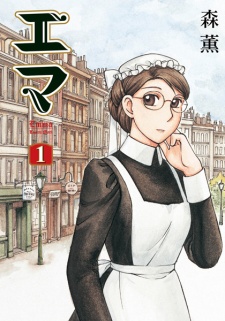
Alternative TitlesEnglish: Emma Japanese: エマ
Information
Type: Manga
Volumes: 7
Chapters: 52
Status: Finished
Published: Aug 30, 2002 to Apr 12, 2006
StatisticsScore: 8.201 (scored by 1050 users)
Ranked: #2772
Popularity: #345
Members: 1,765
Favorites: 97 1 indicates a weighted score
My Info
Popular Tags
drama historical romance |
SynopsisSet in Victorian London at the end of the 19th century, the story is about a maid who falls in love with a member of the gentry. However, the latter's family disapproves of him associating with people of the lower classes. |
Related MangaAlternative version: Emma Adaptation: Victorian Romance Emma: Molders Hen, Victorian Romance Emma, Victorian Romance Emma - Intermission Sequel: Emma Bangaihen
Reviews
|
|
Archaeon
42 of 55 people found this review helpful
|
52 of 52 chapters read
|
| Overall |
9 |
| Story |
9 |
| Art |
9 |
| Character |
9 |
| Enjoyment |
10 |
As one who was born and raised in England, and a closet bibliophile, it's no surprise that I'm familiar with many classic works of english literature from the victorian period, especially those by Dickens, Austen and the Bronte sisters. Many other works that have tried to mimic those worthies have often turned out to be trashy romantic fiction of the first order (e.g. Mills & Boon novels and the like).
Imagine my surprise then, to find a manga that was not only based on that period, but was also excellent in almost every aspect. That manga is Emma by Mori Kaoru (not to be confused with Emma by Jane Austen as that has very little to do with this manga).
Mori, a self confessed anglopihile, has attempted something rarely seen in any medium - the meticulous reconstruction of a historical setting, in this case, London and Yorkshire in 1895. The most remarkable achievement of her work though is that, barring a few minor discrepancies, she was almost dead on the mark with her efforts.
The story is a very simple, and sometimes very touching, romance between a maid (Emma), and the eldest son of a wealthy middle class family (William Jones). The manga begins with Emma working as a live-in maid (as was the custom at the time), for retired governess Kellie Stowner, who took the homeless Emma under her wing, trained her to be a maid, and taught her how to read and write (a rarity in victorian England where much of the populace was illiterate).
One morning Mrs Stowner is visited by a young man named William Jones, a former pupil of hers and heir to the House of Jones. William and Emma meet for the first time, and whilst William is quite taken by this strange maid who seems oddly composed in his company, whilst Emma is also quite taken with William because of his mannerisms and somewhat impulsive behaviour.
What is impressive about the story is not only the setting, but also the various class conflicts that occur. Emma is a maid, whilst William is middle class. To many outside of England this distinction is often viewed with some ambiguity, but in the interests of making what I will say more understnadable I will explain the class distinction in simple terms. Upper class represents the nobility - earls, counts, viscounts, dukes, knights, etc, whilst middle class represents those who are well-to-do but have no title (usually wealthy merchant families). Lower or working class represents the farmers, maids, clerks, smiths, etc.
Here's the key thing to understand about class distinctions - Upper class hate the middle class, and consider the working class to be on the same level as animals. Middle class strive to become upper class, all the while treating the working class with disdain. The working class just want to get on with their lives without too many worries. The sad part is that this hasn't really changed that much in this day and age, but that's another story.
These class conflicts add an element to the story that is so often missing from romantic manga, and stories in general. It may be a cliched idea by now, that of the knight sweeping the peasant girl off her feet and them living happily ever after, yes Mori manages to re-invigorate this theme with her characters and settings. The various class distinctions cause frictions for all of the characters, and the somewhat brutal mentality of the upper and middle classes forms an integral part of the story.
The art in Emma is, for want of a better word, exquisite. Mori, in her quest to make this manga as accurate as possible to the time period, has spared no effort in reproducing many "signs of the times", be they steam trains, horse-drawn carriages and wagons, newspapers, clothing, money, etc, etc. Everything, every object in the manga is as true to life as it could be, and the crosshatched "pen and ink" style used throughout the series adds a certain element of authenticity to the story.
Characters are also well designed. The faces are often simple yet highly expressive in their own way, and Mori's ability to bring forth the stereotypical "british reserve" of her characters is something wonderful to see. The contrast between the simple features of the characters, and the highly detailed backgrounds, clothing, objects and sundries, serves to draw one's attention to the characters rather than their surroundings.
The one aspect of the series that I found drew my attention the most was the characters. Both Emma and William extremely well developed, however Mori has not simply stopped there as she has also made a concerted effort to develop almost every character in the series. Many of the side characters in this series are also well developed, and sometimes have entire chapters devoted to them alone. This is another rarity in manga, as it is often the case that the side characters are shunted to one side in order to continue developing the story or the main characters. Mori's remarkable attention to detail, especially with her side characters, serves to draw the reader further into the victorian era, and gives each character a sense of realism that can often be lacking.
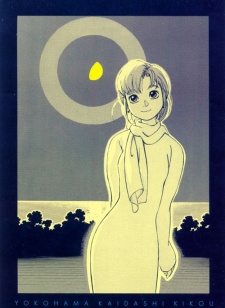
I found this to be one of the most rewarding manga I have ever read, and I would go even further and say that this is one of the most enjoyable works of fiction I have read in a long time. Only one other manga has made me consider it a work of literature rahter than popular culture, and that was Yokohama Kaidashi Kikou. Emma is a rarity in manga as it brings together a classic storyline, excellent imagery and believable characters, all within the setting of one of the most remarkable periods of world history - the industrial revolution. The sense of realism in the manga is astonishing, as is the depth of the characters.
This is definitely a series I would consider required reading for any fan of classical literature, as well as fans of romance or shoujo manga.
Emma is hands down one of the best, if not the best, romance manga out to date. read more
|
|
liltrix7
10 of 19 people found this review helpful
|
52 of 52 chapters read
|
| Overall |
10 |
| Story |
9 |
| Art |
10 |
| Character |
9 |
| Enjoyment |
9 |
Emma is something you don't see every day. It's a shoujo manga, but it's based in early 19th century England, where social standing is considered irrefutable. So it’s a little problematic when maid Emma falls in love with gentry William, and vice versa. You can probably see the arising conflicts in this story already. What is so beautiful about this story is the way Kaoru Mori displays Victorian England so accurately. You can certainly tell she did her research, just by the way the characters act, especially towards William and Emma’s relationship. At any rate, the main plot of the story is the divergences towards a maid and a gentry together, which in that time, was absolutely not acceptable.
At times the romantic emotions are portrayed across to the reader as so strong and violent, and passionate. And yet other times it’s really just a sweet beating love between the protagonists, without becoming saccharine. Their struggle to be together makes their love all the more stronger as the series progresses, even though doubt and sorrows is felt.
The art is gorgeous. Just breathtaking. It is done with a crosshatch pen and ink style. The detail put into the large European buildings and landscapes are wonderful. I really love the expressions she put on the characters, and the flow of the panel placements, which is often quite slow as the characters’ countenance would vary. It really brings more to the story.
Character development is splendid. Emma, as the protagonist of the story most of the time, was a good female lead, she was very likeable. She comes off as shy and introverted, and obedient as well, but as the story progresses she becomes a bit more strong-willed, and wants to face her conflicts instead of running away in fear as to hurting the one she loves. William is pretty likeable too, and he’s obviously very spirited in his love towards Emma in the beginning, and later does he realize the sacrifices he must make to make the love survive. However, I also liked Eleanor’s unrequited love to William, despite her being his fiancée for a part of the story. She was always giving more and more love to him, and got none in return, for he was only ever for Emma. The other, smaller characters had their quirks as well, such as Eleanor’s sister, Monica, who obviously adored her little sister to an extent where it could be considered a sister complex, and hated anyone who made her unhappy (namely William, but mostly for taking her away from him). There was also Hakim, William’s womanizing friend from India, who acts as a foil for William. In other words, he contrasts towards William’s character, causing the reader to plainly see William’s certain faces of his personality. Hakim was an interesting character, and added some sort of odd comedy to the story, with his elephants and harem of young Indian woman following him everywhere (who, if I recall don’t say anything at all throughout the entire story). Hakim also had feelings for Emma, but proceeded to encourage Emma and William when he found out their feelings for one another.
Of course, I enjoyed this series to a very high extent (though I suppose I wouldn’t buy them specifically, as I read them from the library and that’s enough for me). This is certainly recommended for the people who want a more realistic drama and romance, with believable characters and their prejudices. Emma, really, is one of the best romance manga I’ve ever come across, and I hope you’ll try reading it.
read more
|
|
Emma Bangaihen is an extension of Emma, and ties up some of the loose ends left at the end of Emma. Both are by Mori Kaoru, and have the same characters and art style.
Fans of Emma should definitely read Emma Bangaihen.
|
|
|
Both Ai Yori Aoshi and Emma are romances that are rooted in culture - Japanese for Ai Yori Aoshi, and British for Emma.
Both are excellent love stories, and both have some truly great lead characters.
|
| No posts for this board were found |
Related Clubs"Hidden Gems of Manga", マスター + バトラー = 禁断の愛ロールプレイ (Master + Butler = Forbidden Love Role Play), Critics and Connoisseurs, seinen & josei, Underrated Anime and Manga, Victorian Romance Emma Fan Club, ~*~NADJA OF TOMORROW: A fairytale~*~
|
6 hours ago |
7 hours ago |
10 hours ago |
12 hours ago |
Yesterday, 11:08 AM | |
Yesterday, 9:02 AM |
Yesterday, 6:04 AM |
11-06-09, 10:22 PM |
11-06-09, 8:10 PM |
11-06-09, 3:37 PM |
|
External LinksOfficial Site, Wikipedia
|
|