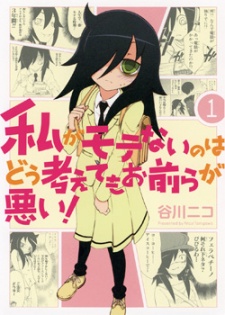
Alternative TitlesSynonyms: Watashi ga Motenai no wa Dou Kangaetemo Omaera ga Warui!, It's Not My Fault That I'm Not Popular!, Watamote Japanese: 私がモテないのはどう考えてもお前らが悪い!
Information
Type: Manga
Volumes: Unknown
Chapters: Unknown
Status: Publishing
Published: Aug 4, 2011 to ?
StatisticsScore: 7.761 (scored by 3833 users)
Ranked: #19242
Popularity: #177
Members: 10,145
Favorites: 652 1 indicates a weighted score
My Info
Popular Tags
No tags found |
Similar Recommendations Submitted by Users
|
|
Both main characters have limited contact with others and most of the dialogue takes place in the main character's head.
In Onani Master Kurosawa the main character wants to be left alone. While in "It's My Fault I'm Not Popular" the main character strives to popular but lacks even the most basic social skills.
"At just one glance, I can tell, she's just the same as I am. One who is not good at expressing him or herself. 'The aloof students.'"
Secondary education is a period often romanticized in manga, characterized by years filled with fun, freedom, and friends. But for those who fail to connect with others, be it for lack of ability or lack of trying, those years can be hell, as fewer things cut deeper than the derision of one's peers. These manga provide a look into the sexual frustrations faced by these socially-challenged students during their adolescent years. These characters are deeply flawed, sometime pitiful, sometimes amusing, and above all, brutally realistic.
Onani Master Kurosawa
Watashi ga Motenai no wa Dou Kangaetemo Omaera ga Warui!
(I will be referring to the latter by its English title: "It's Not My Fault I'm Not Popular!"
Both of these manga revolve around a character who is a social outcast with perverted hobbies; one arguably moreso than the other. This isn't all that uncommon with a lot of characters these days, so why these two manga in particular? The one thing that they have in common is the thing that will make or break either series for the reader:
Both will make you cringe of second hand embarrassment.
The characters in both manga suffer through humiliation wrought upon themselves by their own mistakes. Onani Master Kurosawa's cringe-worthy moments are dramatic and in some cases over the top, suitable for a male main character, while "It's not my fault I'm not Popular" and the female protagonist include more realistic scenarios and may hit a lot closer to home for many of its readers; male or female.
|
|
|
Both talk about people who despairingly want to fit in the society.While Kurosawa wants to be accepted by his workmates, Kuroki wants to be accepted not only by his classmates as a colleague, but as a girl and even as a normal person. Both mangas are very uncomfortable, and show us how far people go, just to fight loneliness and be accepted.
Social ineptitude and rotten luck know not the bounds of age or gender.
Kurosawa and Watamote are unique among the works of the cringecore/error comedy genre in that they do not simply portray their protagonists as well-intentioned but misunderstood and pitiable figures. Instead we get to peek into the minds of a pair of delusional and neurotic fools who, as charming as they are, often have nobody to blame but themselves. You want to see them succeed, but for some reason, they're just allergic to competence.
And that, of course, just makes them all the more lovable.
|
|
|
Both series are by the same author and have similar audiences in mind. Plus in both stories the main character's a quirky girl that you can't help but like, and who also adds quite a bit of humor to the mix.
Choku and Watashi ga both have a very strange feel to it, and when I mean strange, I mean a little disturbing at times (but in a funny way) The art style is somewhat similar, but for the most part the awkward and strangeness of both mangas are what really make it similar. Choku however focuses more on the relationship of the boy/girl, while in Watshi ga it only focuses on the girl and her attempts to become normal.
|
|
|
Both main characters are addicted to dating sims games.
|
|
|
From both manga series, there is a very shy girl who is considered an outcast and finds herself difficult speaking to others and making friends. This is often portrayed in a humorous and sometimes exaggerated way.
Both manga titles offers a slice of life feeling involving the main girl and what she does.
Both manga has a school life setting. They both also have a lot of funny dialogues and humor.
|
|
|
The protagonists of both series are unorthodox, socially inept to a ridiculous extent, and capable of providing endless comic relief as they work their way towards the normality that most others take for granted. Neither Kuroki Tomoko (WataMote) nor Nakahara Sunako (YamaNade) are anything close to the average shoujo heroine—or any generic manga heroine, for that matter. Their uniqueness allows their respective series to hold positions as two of the arguably most transgressive, norm-defying manga in circulation.
|
|
|
Both mangas show the truthful, uglier side of life. Except "It's not my fault that I'm not popular!" is painfully embarrassing but still funny, while Vitamin is emotional and tear jerking.
|
|
|
The main characters struggle to fit in and make friends in class in these shounen comedies.
|
|
|
Both main characters kind of look the same at a distance but the difference is that in one series the girl is ugly while in the other the girl is hot (But both characters still look cute) . Both characters are kind of weird and have a rather awkward social life.
Both series also share a similar setting and are both pretty funny and amusing because of the unexpected events that happen
|
|
|
If you loved the laughter that Binbougami ga! presents, you will love the insanity that is Watamote. You won't be able to put either of these down.
|
|
|
Both main characters kind of look the same at a distance but the difference is that in one series the girl is ugly while in the other the girl is hot (But both characters still look cute) . Both characters are kind of weird and have a rather awkward social life.
Both series also share a similar setting and are both pretty funny and amusing because of the unexpected events that happen
|
|
|
Both manga utilize a formula of making black comedy every chapter out of the embarrassing misadventures of the unfortunate female protagonists. In Zonbicchi, the comedy revolves around the embarrassing ecchi delusions the protagonist Sakina is forced to have, while in WataMote, the comedy is derived from the actual embarrassing misfortunes of the protagonist Tomoko.
|
|
|
Both feature lead females, who want to expand their world (horizontally in the case of B Gata H Kei). Both are hindered by their own unreasonable imaginations. Which lead them into ridiculous flights of fancy that, are so absurd, when they crash you can only wince in sympathy (and laugh so hard you cry).
|
|
|
Both run on black comedy that makes you cringe at the protagonists' embarrassment.
|
|