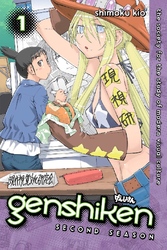
Alternative TitlesEnglish: Genshiken Synonyms: Genshiken Chapter 56, Genshiken Nidaime, Genshiken: Second Season Japanese: げんしけん
Information
Type: Manga
Volumes: Unknown
Chapters: Unknown
Status: Publishing
Published: Jun 25, 2002 to ?
StatisticsScore: 8.491 (scored by 5922 users)
Ranked: #1522
Popularity: #136
Members: 11,512
Favorites: 1,071 1 indicates a weighted score
My Info
Popular Tags
comedy otaku school slice of life |
SynopsisIt's the spring of freshman year, and Kanji Sasahara is in a quandary. Should he fulfill his long-cherished dream of joining an otaku club? Saki Kasukabe also faces a dilemma. Can she ever turn her boyfriend, anime fanboy Kousaka, into a normal guy? Kanji triumphs where Saki fails, when both Kanji and Kousaka sign up for Genshiken: The Society for the Study of Modern Visual Culture.
Undeterred, Saki chases Kousaka through the various activities of the club, from costume-playing and comic conventions to video gaming and collecting anime figures--learning more than she ever wanted to about the humorous world of the Japanese fan . . .
(Source: Del Rey) |
Related MangaSpin-off: Kujibiki Unbalance Adaptation: Genshiken, Genshiken OVA, Genshiken 2, Genshiken Nidaime Side story: Genshiken: Return of the Otaku Alternative setting: Spotted Flower
Reviews
|
|
Archaeon
146 of 216 people found this review helpful
|
55 of ? chapters read
|
| Overall |
9 |
| Story |
9 |
| Art |
8 |
| Character |
9 |
| Enjoyment |
9 |
There's a huge misconception in the Western world about the word "otaku", especially regarding it's usage. Most Westerners believe that the term refers to someone who is a zealous fan of something, in particular (but not exclusively so), anime and manga, with the word gaining a distinctly positive bias over the years. This is partly due to Gainax's tongue-in-cheek usage of the term in their 1991 movie "Otaku no Video", however the word has much darker and far more derogatory connotations in Japan, something which continues even to this day.
Bit of a sombre beginning to a review of a comedy manga isn't it? Well it does have a purpose, particularly as Genshiken is a series about otaku in their various forms, from the cosplayers and fujoshis (girls who are crazy about "boy's love" stories), to the doujinshi mangakas and the game junkies, and everyone in between.
Created by Kio Shimoku in 2002, the manga quickly filled the void left by Comic Party and established itself as a firm fan favourite due to its realistically humourous take on otaku subculture. The story focuses on a university club called GENdai SHIkaku Bunka KENkyūkai (The Society for the Study of Modern Visual Culture - the capitalised letters show where the title "Genshiken" comes from), which, in truth, is nothing more than a collection of oddballs and social misfits who are only linked by a love of anime, manga, games, and other pastimes that are the "normal" realms of the social recluse. Into this strange environment walks freshman student and closet otaku Sasahara Kanji, a shy young man who wants to join a club that he would enjoy (and where he might be able to watch/read some hentai/porn).
If there's one memorable aspect of the slice of life plot that the manga adopts, it's the quirky, and often humourous, manner in which the various characters interact with each other. Genshiken is very much a character driven piece which, ironically enough, is also the main reason why the comedy works so well. In truth, the series is very much an otaku sit-com, and much of the humour is derivative of social stereotypes, particularly the more derogatory ones.

The thing that is most pleasing about the plot though, is that it presents a broad spectrum of otaku subculture rather than focusing on one single type. Each of the characters brings something unique to the story, especially Kusakabe Saki, who is basically the only "normal" major character in the series. Whilst it's true that otaku are portrayed through rose-tinted lenses throughout the manga, Genshiken also presents the characters as plausible human beings, something that no other otaku based story has done (until NHK ni Youkoso! that is).
The plot does have its flaws, but in truth these are mostly niggling annoyances rather than anything major. The story progresses at a good pace, neither too fast nor too slow, and because of the emphasis on the characters there are very few occasions where "events" are used to move it forward. Some readers may find certain chapters rather placid, especially those where nothing seems to happen, however it should be remembered that such small tales present the characters in ways that the manga may have only hinted at before.
As far as the artwork goes, I was honestly impressed by the level of simple detail in each panel. The author has taken great care with the designs of each character in an effort to make them as individual as possible while at the same time playing on the social stereotypes. This is particularly notable in the case of Kousaka Makoto, who is unlike the other members of the club (more on this in a bit). Given the focus on the characters and the fact that they are sometimes quite literally under the microscope, it's nice to see that the author has made them expressive in both mannerisms and actions. Facially the characters are pretty simplistic, however they are extremely emotive, and it's easy to tell what each character is feeling at a given time from their expression.
The backgrounds and settings, especially the clubroom where much of the story takes place, can sometimes seem haphazardly drawn, yet they are highly detailed, with very little in the way of open space used throughout the series. Each chapter takes place in an area that is literally filled with "stuff", and while the art may be a bit messy at times, each panel has a sense of realism about it because of the detailed nature of the artwork.
The characters form the centrepiece of Genshiken in terms of both the story and the club itself. Each of them are individuals to a tee, with their own thoughts, feelings, prejudices, hobbies, etc, etc. Genshiken is nothing if not a lesson in characterisation as each of the club members, together with the supporting characters, are complete from the start of the series. One needs to remember that because the story is set in a university club, the characters are adults for the most part. This gives the whole series an edge that many other otaku based tales lack in that the humour, the relationships, the prejudices, the emotions, the hang ups, etc, etc, are all presented in a manner that is more mature, more subtly humourous, and more accessible to fans of anime and manga, especially the older ones.
One of Genshiken's biggest achievements is the degree to which the characters develop over the course of the series. This isn't simply a story based on one year of life, but covers several years during which members of the club leave, whilst new members are admitted. Over the course of the manga there are many notable progressions for each of the characters, Madarame's attempt at shopping for "decent" clothes, Sasahara being made club president, Ohno and Tanaka's cosplay based relationship, and a whole heap of other points where the characters learn something new about themselves and the world.
Probably the most notable and interesting character is Kusakabe Saki, who is very much the epitome of normalcy. She is in a relationship with Kousaka Makoto, a self confessed otaku who, against all of Kuskabe's reasoning, logic and judgement, looks nothing like the stereotypical "freak". He is handsome, smart, stylish, sociable and amiable, and cares for her deeply. He is also the king of eroge (erotic video games), an anime junkie, and a dedicated club member. It is because of his association with Genshiken that she meets the other characters, and although she has a deeply rooted dislike for all things otaku, this openly conflicts with her desire to be with Kousaka, and with her gradual realisation that otakus may not be as bad as she first thought.
Kusakabe's relationship with Genshiken is probably the most important point of the story, as even though the otaku characters are very much plays on social stereotypes, she represents the voice of "society", and her gradual understanding of otaku subculture plays a huge part in the development of the story and every other character. In truth, one could say that Kusakabe is the most important character in the story, and that while Sasahara may be the main lead, she is the one whose influence on the other characters is the most telling.
Genshiken is a series like no other, not simply in terms of its realistic portrayal of otaku subculture, but also because of its sensitivity, humour, maturity, and the depth of its characters. Any fan of anime or manga will find themselves relating to the story in ways that they probably never thought of, no matter the age of the reader, and it's this level of accessibility that makes the series truly great. The dichotomy between normal and otaku is handled extremely well, however it should be noted that this is very much based on the Japanese perception of otaku.
At the beginning of the review I mentioned that the word "otaku" is misinterpreted in the Western world, and it's understanding this fact that brings new depth and meaning to almost every aspect of the manga, from Ogiue's unwillingness to "come out of the closet", to Kusakabe's efforts to have a "normal" relationship with Kousaka. If the reader remembers that, for Japanese people at least, the word "otaku" is generally a derogatory term (although admittedly this perception is changing as anime, manga and games become more and more mainstream), then much of the story becomes more understandable.
One thing I think will clear things up a bit more is the anime series called Nogizaka Haruka no Himitsu. In that show, the lead female character is a closet otaku who was shunned, teased and bullied to a degree when her schoolmates found out she was a huge fan of anime and manga. It may surprise many to know that this sort of reaction to fans of anime and manga was once considered acceptable, as otaku were, for the most part, shunned like lepers. This is how the word "otaku" is viewed in Japan. Not as something positive, but as something purely negative and derogatory.
Genshiken may be a comedy series, however it is in no way like Comic Party, Lucky Star, or any other otaku based comedies. The series possesses a sense of realism that is unlike many other manga, especially in terms of its interactions, and key to fully appreciating the story is knowing how the word "otaku" is meant to be used.
Now that you know the difference, give Genshiken another try. You may be surprised at how different it is. read more
|
|
SDShamshel
42 of 75 people found this review helpful
|
? chapters
|
| Overall |
10 |
| Story |
10 |
| Art |
8 |
| Character |
10 |
| Enjoyment |
10 |
With a medium-sized cast of characters, Genshiken provides a rich and realistic portrayal of otaku life, showing the otaku as not necessarily a positive or negative subculture, but simply one that is.
The characters designs are unique, with distinct yet reasonably subdued designs backed by an elaborately detailed look at the otaku world around them. The artwork changes significantly over time, but it manages to remain at a high quality all throughout. The only point in which the art suffers a little is in the volume 8 4-panel comics.
The series can be divided into roughly two parts, with the arrival of the character Chika Ogiue. Her appearance results in a gradual shift from a more general view of otaku life to more personal character studies, prioritizing their lives as human beings over the fact that they are otaku. However, that should not be cause for alarm, as the characters remain true to their existence, and the story Shimoku Kio proves is emotionally satisfying.
I cannot recommend Genshiken enough.
Summary: Genshiken starts off good. Then Ogiue appears. Which turns it from good to great. No, great isn't a sufficiently positive adjective for it.
So I'll say that Genshiken turns from good to Ogiue. read more
|
|
A "normal" person slowly discovers the secrets of otaku.
Through their characters and premise, both of these titles highlight what it is like to be an otaku.
similar setting and themes , both are great manga.
|
|
|
Are you a lonely otaku, in need of love? Do your figurines and BL comics just not *do it* for you in anymore? Are you in need of reassurance that even you, with pretty boy rape fantasies, can find love? THEN READ THESE SERIES. RIGHT NOW... I MEAN IT!
Genshiken does, towards the end, deal with the subject of nutty yaoi fangirls, but the majority of the content is focused on anime, manga, and other more 'normal' otaku activities. Fujoshi, however, is all about the dark shadow that plagues MAL and makes me clench my anus in disgust: females who are into yaoi. After reading it, I actually started to think less nasty things about those who finger themselves over ladyboys, and that's saying a lot.
Read my review if you want to know why I like Fujoshi more than Genshiken. (You could also read my Genshiken review, too, but I doubt you'd survive until the end...)
Slice of life Otaku fare. If you like the girls obsession with Yaoi in Genshiken you'll enjoy Mousou Shojo Otaku-kei and vice versa.
|
Related Clubs!~~tsubasalover's Friendships~~!, #MAL_KL, -The Order-, 2D Marriage Supporters, Alcohol ♥ Animanga, Anime art that r0cks!!, Anime Connection, Bakaclub, Basement Dwellers, Closed Eyed Characters Fanclub , CNCFixins, College Anime Lovers, Critics and Connoisseurs, FC: Otaku, First President Alliance, Genshiken, Genshiken Otakus, Girls Otaku Community, Grammar Nazis, Hadōkenbu, How to Read Manga!, I'm an Otaku with a LIFE !, Marketplace Germany, Mole=Moe, Ogiue Chika Fanclub, OtAku-sb's Anime FC, Pirate Party MAL, Roppongi Engineering Anime Society and Online Network (Hungary), Sensei! - Ninomiya-kun!, society for the study of genshiken, Souls and Swords, Texas Ani-Cons, the best damn anime/game club ever, The Lighthearted Anime Club, The Otaku of Anime, These otaku's club!, UNO Genshiken, [Facial Hair]Sexy[/Facial Hair], ~OTAKU 4 LIFE~
|
10 minutes ago |
7 hours ago |
9 hours ago |
11 hours ago |
Yesterday, 8:39 PM | |
Yesterday, 3:39 PM |
Yesterday, 2:45 PM |
Yesterday, 11:09 AM |
Yesterday, 10:53 AM |
Yesterday, 10:33 AM |
|
External LinksOfficial Site, MangaUpdates, Wikipedia
|
|