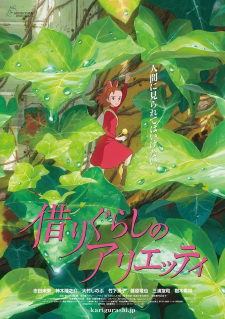
Alternative TitlesEnglish: The Secret World of Arrietty Synonyms: Karigurashi no Arrietti, The Borrower Arrietty Japanese: 借りぐらしのアリエッティ
Information
Type: Movie
Episodes: 1
Status: Finished Airing
Aired: Jul 17, 2010
Duration:
1 hr. 34 min. Rating:
PG - Children
L represents licensing company
StatisticsScore: 8.361 (scored by 11190 users)
Ranked: #1532
Popularity: #717
Members: 18,143
Favorites: 73 1 indicates a weighted score
My Info
Popular Tags
No tags found |
SynopsisArrietty, a tiny but tenacious 14-year-old, lives with her parents in the recesses of a suburban garden home, unbeknownst to the homeowner and her housekeeper. Like all little people, Arrietty remains hidden from view, except during occasional covert ventures beyond the floorboards to "borrow" scrap supplies like sugar cubes from her human hosts. But when 12-year-old Shou, a human boy who comes to stay in the home, discovers his mysterious housemate one evening, a secret friendship blossoms. If discovered, their relationship could drive Arrietty's family from the home and straight into danger.
(Source: Disney) |
Characters & Voice Actors
Staff
Reviews
|
|
Kuro4735
59 of 83 people found this review helpful
|
1 of 1 episodes seen
|
| Overall |
9 |
| Story |
7 |
| Animation |
9 |
| Sound |
9 |
| Character |
8 |
| Enjoyment |
9 |
Studio Ghibli is quite renowned for it’s rather large portfolio of acclaimed family movies, and you could definitely add Karigurashi no Arrietty to that list. Ghibli usually makes two types of movies, either fantasy movies that focus on themes that are rather critical of problems in society (Miyazaki’s Princess Mononoke and Nausicca come to mind), whereas in more recent times we’ve seen more slice-of-life fantasy adventure movies. Arrietty fits more into the latter, with it’s setting being modern day society with a small little twist; there are tiny, tiny people living under the house, and they borrow from humans to survive. Tiny as in maybe 5-8 centimeters tall.
One of the charming aspects to this movie is, without a doubt, the amount of attention paid to the little details that makes the presence of little people so believable. The creative, yet simple, ways in which Arrietty and her family are portrayed are captivating, such as the little toolsets Arrietty’s family made in order to explore the “human” house. They use everyday items like fishing hooks, double-sided scotch tape, and spools of thread to create their own little sets of backpacks filled with tools they use to make their lives a little easier, and make the characters fascinatingly believable. The creativity and thought put into the tiny details are awesome, from the fishing hooks and scotch tape, to the little neat cubes of sugar that fits like a well-sized package in the hands of Arrietty.
What I really enjoyed about this movie is how it is told from the point of view of little Arrietty as opposed to the perspective of us “regular humans”. Simple things that you could find in your everyday backyard, from Arrietty’s perspective, all of a sudden have a grandiose feeling to them. Things such as a simple vine you could find creeping across the wall of any old house transforms into an intricate ladder of leaves and stems to the rooftops, or a field of grass and flowers becomes a vast forest. This movie takes your everyday backyard, and turns it into a vast new world to explore. It doesn’t hurt that the scenery and artwork was vibrant and lush with color.
The soundtrack is especially fitting for this movie. The absense of Joe Hisashi’s music in this Ghibli film is instantly noticable, and while some of the pieces here may lack a slight bit of the grandeur of Hisashi’s works, the soundtrack is still well done. What is a bit unusual here is how the soundtrack was actually done by Cécile Corbel, a French singer and Celtic harpist, who was a huge fan of Ghibli works and sent samples of her work to the studio. The Celtic influence in the soundtrack is immediately noticeable, but it was definitely an excellent choice on Ghibli’s part.
Characterization of the actual characters wasn’t exactly anything mindblowingly original or exotic, but the main cast was rather believable for the most part, and had their own charms to them. I found the innocently curious, yet straightforward and resolute attitude of Arrietty quite likable. Her rather odd relationship with Sho, as well as how Sho perceived her, turned out to be quite fascinating and, in a sense, admirable. The subtle tension between the elusive tiny people, and the gigantic humans, are played upon quite well here, which adds quite a few tense moments between Arrietty and Sho. I’d say characterization was quite tastefully handled here for the most part.
And now, for the biggest weakness for this movie. The plot progression and characterization were all fine and all, but the conflict and villain were practically a joke in terms of setup. Seriously, what grudge did old lady Haru have against the little guys? They didn’t explain in detail why she was hunting out the little people, giving only a flimsy excuse that they’re “theives” in a degrogatory tone. The villain just felt very underwhelming, and just doesn’t fit in with this movie’s atmosphere at all. The conflict was kind of discredited in my eyes because of the poorly integrated main antagonist, and there is certainly room for improvement here. Plot progression, while fine and all, was also rather slow at times. While I personally didn’t mind the slow pacing (it lets things sink in more), there were definitely plenty of slowly-paced scenes in this movie.
What makes Arrietty a great watch is the tremendous attention to the details of it’s setting, the beautiful art and music, and the wonderful direction for it’s characters. The plot is admittingly lacking (especially the major conflict, oh boy could it have used some more work), but as a premier film for a new director, this film turned out to be an pleasant surprise. The ending does feel very open ended, though, with a lot of loose ends that feel as if they have yet to be tied up. While the likelihood of a sequel for a Ghibli movie is very slim, I would be totally fine with a sequel for this particular movie.
Animation/Art: 9.0/10
Music: 9.0/10
Setting: 9.5/10
Characters: 8.0/10
Story: 7.0/10
Overall Enjoyment: 8.5/10 (Rounded up to a 9 on MAL) read more
|
|
Mangarmand
9 of 15 people found this review helpful
|
1 of 1 episodes seen
|
| Overall |
8 |
| Story |
9 |
| Animation |
10 |
| Sound |
9 |
| Character |
7 |
| Enjoyment |
10 |
"No friendship is too small." Here I start to wonder whether or not I could relate to that. All jokes aside, this is a kid's movie.The film’s genre is fantasy that stretches out to the Shonen and Seinen crowds. The story itself holds common qualities from all Ghibli films: adventurous, graceful, enchanting and simply lovable. The plot is very simple and holds the basic concepts from the original British novel: The Borrowers. The conflict is a pretty broad concept of keeping the very existence of the Borrowers a mystery so that they can actually live safe lives. The plot progresses pretty well and shows effortless mastery.
Here our characters are all equal and just as expressive—whether they are normal sized or the size of your fingers. Arrietty: the adventurous, kind, courageous and optimistic protagonist of the film. She is a pretty strong character in terms of standing out and helps the plot run pretty smoothly. Shawn is the sickly boy that holds the curiosity of Arrietty. He is very kind-hearted, generous, understanding and gives the kids a good feel for what a true friend should be like. Homily is the paranoid mother who’s always worried and can be seen to be slightly pessimistic at times, but that’s just her worrying most likely. Then we have Jessica (Sadako in the Japanese version) who plays as Aunt Sophy from the original novel. We also have Arrietty’s father Pod who is, by the description kindly provided by Homily, “the most talented Borrower”—he is the provider of the family and proves to be pretty cool. Finally we have Hara, the house maid (serves as the parallel to Rosa Pitchhacket from the novel.) Poor Hara has the role of the antagonist who is seen as cruel to the Borrowers and treats them like insects/pests (she does keep Homily inside a jar such as one would put a lady bug inside a jar as well with a plastic cover.)
The art is up to par with the rest of the Ghibli titles. This statement is in no way a criticism, it is a praise of their work—their films always portray simple designs that somehow are always achieving an easy flow. The movements of the scenery and characters give off a majestic enchantment to the viewers eyes that could set for a relaxing view. Ghibli art is always spectacular and should always be praised.
The main theme was “Arrietty’s Song” by Cecile Corbel. Cecile is a young and aspiring French musician who so happened to produce the film’s score. She is a very, very talented musician and from the sheer quality of the score, any listener should become a fan of hers and encourage her to continue her career with Ghibli and Disney. Even the score itself still shows some Asian-like elements that give the anime feel that also nicely compliments the art while keeping the spirit of adventure in every track with united dynamics to make one ominous harmony of grace. I later discovered the U.S. theme for the film that was titled “Summertime” by Disney start Bridgit Medler, who also did the voice of Arrietty. As expected from a Disney star’s music, there is an over-used style of pop that was utilized—which in my opinion lowers the standard of Cecile’s single and serves as a great disappointment. It is mediocre; however it is designed to attract younger kids. Besides “Summertime”, I loved the score and overall sounds of the film.
I personally enjoyed the film myself enough to watch all of the translations, re-watch the Japanese on my own time and the U.K. version with my sibling a few dozen times. I saw my parents enjoy it and found it to be watchable. I give this film a good eight out of ten over all; however I would rate the U.S. version a seven out of ten. I feel it is safe to assume that most families would find this film as not only enjoyable and watchable, but to think of this film as a piece of excellence—such as the other Ghibli works are and always will be.
read more
Recommendations
|
|
the same amazing feeling you get while you watch the movie
you keep staring to the screen even after the movie is finshed for a while...!
|
|
|
Subtly romantic, naive, and melancholic.
|
Opening Theme"The Neglected Garden" by Cécile Corbel
Ending Theme"Arrietty's song" by Cécile Corbel
Fansubbing Groups
Which fansubbers do you like the best? Click + to approve of their subs for this show. Click - if you don't think they did such a great job.
Related ClubsAnime Crazy Club, !~~tsubasalover's Friendships~~!, ♥ Studio Ghibli ♥, The Will Arnett Club, Studio Ghibli Fanclub, Hikikomori, Anime art that r0cks!!, Marketplace Germany, Anime Movie Club, Cinema of Japan
Recently Watched By|
29 minutes ago |
52 minutes ago |
1 hour ago |
2 hours ago |
3 hours ago | |
3 hours ago |
3 hours ago |
5 hours ago |
5 hours ago |
6 hours ago |
|
|