



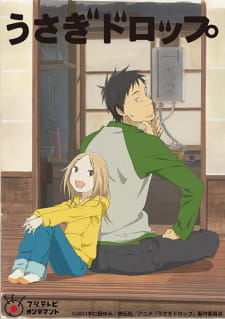
Alternative TitlesEnglish: Bunny Drop Japanese: うさぎドロップ
Information
Type: TV
Episodes: 11
Status: Finished Airing
Aired: Jul 8, 2011 to Sep 16, 2011
Duration:
22 min. per episode Rating:
PG-13 - Teens 13 or older
L represents licensing company
StatisticsScore: 8.651 (scored by 39399 users)
Ranked: #492
Popularity: #191
Members: 65,059
Favorites: 1,180 1 indicates a weighted score
My Info
Popular Tags
No tags found |
|
|
Archaeon
449 of 552 people found this review helpful
|
11 of 11 episodes seen
|
| Overall |
9 |
| Story |
9 |
| Animation |
8 |
| Sound |
9 |
| Character |
9 |
| Enjoyment |
9 |
Raising a child isn't easy, and every parent or guardian knows just how taxing all of the daily tasks can be, the sacrifices that need to be made in terms of work and social life, and the almost constant stream of considerations and worries. The truth is that looking after children is one of the biggest causes of stress and grey hairs (or hair loss), amongst adults, but given that the majority of people in the world are (or will be), parents, it's a little odd that such a major topic is still a rarity in anime.
The again, who wants to watch a show about the trials and tribulations of raising children, especially when the steady diet of fanservice, explosions, brainless muscular heroes, top heavy heroines, nonsensical plots, pseudo-psychology, quantum-hokum, etc, are apparently what passes for entertainment these days. It's a sad fact that in a medium where literally any story can be told, the ones that may actually cast anime in a positive light are constantly overlooked or ignored completely.
Which is why Usagi Drop is such a rarity.
Adapted from the josei manga by Unita Yumi, the story begins with Kawachi Daikichi, a 30 year old salesman who has returned home to attend a family funeral. During his stay he finds out that his deceased grandfather had an illegitimate daughter called Kaga Rin. Nobody knows who the girl's mother is, so the family begin arguing over who will raise her until Daikichi, who has become increasingly annoyed and disgusted by their behaviour, asks Rin if she wants to live with him.
Usagi Drop is one of those uncommon adaptations where the anime has tried to stay true to the source material, and while that does place a number of limitations on it, the series also manages to retain the charm of the manga. The story develops at a measured pace that can sometimes feel a little slow, and there's a surprising lack of over the top melodrama that is so often a hallmark of shows like this. The plot takes a much more mature approach to the issue of parenting than one might initially expect, and while certain problems that Daikichi is faced with are specific to Japanese society, the overall theme is one that will resonate with anyone who has raised children.
Which is also the reason why some viewers may not enjoy this anime, but we'll get to that in a bit.
In addition to the story, the artwork also tries to stay as true as possible to the source material. The characters are depicted in a stylized form, and the rather simplistic approach to emotions is surprisingly expressive. The design is focused on showing each person as an individual not only facially, but also in their build, posture, and even their movements. The animation is fluid, if a little utilitarian at times, and it's clear that attention has been paid to each character's physical traits and personalities. In addition to this each episode is preceded and concluded by short, but rather charming scenes that are notable for the watercolour style palette that is used in them. The dichotomy between these scenes and the style and colouration used in the main body of the narrative adds a nice, almost picture book touch to proceedings.
Between these shorts and the story proper lie the opening and ending sequences, both of which are designed with children's paintings in mind. The opening theme, "Sweet Drop" by Puffy AmiYumi (yes, they of Teen Titans and Hi Hi Puffy AmiYumi fame), is a surprisingly well suited J-pop song that's very much in keeping with Rin's character. In contrast to this the ending theme, "High High High" by Kasarinchu (a pop duo consisting of a beatboxer and a guitarist/singer), is more reflective of the overall atmosphere of the series.
As for the background music, Usagi Drop features a variety of tracks that are generally quite mellow or upbeat, but every so often the score is punctuated by a slow, simple piano piece to highlight the more sensitive moments of the story.
Now it's a trite thing to say that good acting can bring any type of story to life and give it the feeling of something new and different, but in this case it's actually a true statement. The simple yet natural script allows the seiyuu far more room to express themselves than one might expect, and with little in the way of manufactured melodrama, all of the cast (especially the child actors), are able to deliver some truly worthwhile performances.
The most interesting character in Usagi Drop is, without a doubt, Kawachi Daikichi. Part of the reason for this is because much of the story is told from his perspective, but he's also one of the most defined adult male leads in anime to date. From the start he is shown to be a complete individual with his own thoughts, habits and values, and rather than trying to develop him, the narrative is more focused on evolving him through his relationship with Rin, and the problems, worries and sacrifices he works through in order to be a good parent.
On the other hand Rin is very much how one would expect a child of her age to be - inquisitive, precocious, and somewhat withdrawn around people she doesn't know well. As with Daikichi, she doesn't really develop as a character, but instead what the viewer is shown is a little girl who is slowly coming to terms with her new life and coming out of her shell. Now this is surprising as it's a clear message about how resilient children actually are and how they are able to cope as long as they know they have the support of the adults who care for them.
Speaking of support, aside from the two leads there are a surprising number of well written characters in Usagi Drop, both adults and children, and it's their presence in the story that really rounds out the whole thing. The particularly strong friendship between Nitani Kouki and Rin for example, or the slightly befuddled attraction between Daikichi and Kouki's mother Yukari, all add to the overall charm of the series. In addition to this, one of the things that really stands out about Usagi Drop is the lack of angst where relationships are concerned. While there are events like the death of Daikichi's grandfather, these don't cast a pall over the narrative, and this allows for some interesting interactions and dynamics to emerge, the prime example of this being the bond that develops between the two lead characters.
Usagi Drop is a simple, straightforward and charming tale about what it means to be a parent, and while the story and characters are presented in an ideal form, this doesn't really detract from one's enjoyment of the show. It goes without saying that anyone who has experience of raising children will be able to relate more readily to a number of the themes in the show, but it should be pointed out that the plot is simple enough to allow anyone to enjoy it.
Which brings us back to why some people won't like this series.
Aside from the sometimes slow pace, the main theme of the show is one that many younger fans (and even a few older ones), may not like, especially if their penchant is for action, heavy melodrama, etc. On the surface it can seem as though Usagi Drop is nothing more than another lighthearted slice of life drama that's only different from the likes of Aishiteruze Baby because a full fledged adult is cast in the role of parent instead of a teenaged playboy, but there's more to the show than that.
The simple fact is that this anime is one of those rare titles that doesn't use the word "mature" as a marker for violence, gore, sexual content, etc, and this makes it almost unique when one considers the shows that have been released this past year. The emphasis on realism, albeit in an idealized form, may also be a factor as there are a few people out there who want pure fantasy and escapism.
Whatever your opinion or taste, one thing remains true - Usagi Drop is clearly aimed at a more mature audience than the norm. The fact that it doesn't demean the creators with pointless gore, violence or fanservice, or insult the viewer's intelligence by explaining everything that happens, are what sets it apart from many other slice of life shows out there. read more
|
|
spohken
225 of 299 people found this review helpful
|
11 of 11 episodes seen
|
| Overall |
10 |
| Story |
|
| Animation |
|
| Character |
|
| Enjoyment |
  |
“Daikichi… Daikichi, wake up.”
“…mmhhh… Yes.”
I’m happy. Why? Well, because this show did so much right that it’s tough not to be. Usagi Drop stayed true to the essence of the manga (before the timeskip) and didn’t stray far, if at all, from the original story progression. It captured splendidly the little nuances of an abnormal parent-child reality.
Our lives are full of insignificancies. Waking up irritable and half alert, washing your teeth, brushing your face, fumbling to find your valuables, grocery shopping without a list. The shit we wade through daily but clean up and forget soon after. These are experiences almost all can relate to but never share with one another because it’s stuff not worth sharing. Then of course, spliced in between those bits of irrelevance are the undoubtedly meaningful moments to be remembered. And we want to save those precious moments by documenting them. It’s in our nature to try and preserve the best times of our lives in some form or another. So when something like Usagi Drop comes along that personifies ‘life’, in both the boring and the beautiful, we’re able to really connect with the characters and their story on a more personal level.
Rin is modest, caring, independent, and responsible. She’s very mature but then not without those traits which you find ever-present in kids around her age. Joyful, curious, and downright adorable! In terms of lovability, she’s on par with Ushio in my book. You just want to squeeze those little cheeks and embrace her till she dies of asphyxiation. She’s that HNNNGGable. Needless to say, her expressions are genuine signs of love and appreciation, even for something like a poor attempt at tying pigtails. How she feels shows on her face clear as a sunny day. And the window through which we get to see all these sides of her is Daikichi.
Daikichi’s a very straightforward guy, both in personality and appearance. On top of that, he’s nurturing, compassionate, and protective. A little awkward at times but it comes with the job. Not to say I don’t like my dad, I love him, but Daikichi is the kind of father I wished I’d had growing up. He juggles his new responsibilities well with work and still manages to maintain a good relationship with everyone around him. Standing in as a guardian for your past grandfather’s illegitimate kid probably isn’t easy so I think he deserves a break here and there for his goofups. Watching Daikichi is a true breath of fresh air what with all the high school/university kids hogging most of the attention in anime. What you get is a middle aged guy just trying to do his best to provide for himself and his new little house warmer.
TWO little house warmers considering the frequency of Kouki’s visits. He and his mother are two more people you’ll find to be endearing as they interact with Rin and Daikichi. Aside from his apparent cheekiness, Kouki’s a good kid and it shows in his submissive yet protective behavior towards Rin. Looking at their close friendship and the overt chemistry between Yukari and Kawachi, it’s quite easy to envision them becoming a family in the near future. In fact, beyond the show’s conclusion you could say they’re already family.
And because of the relatively fluid art and animation, we’re able to see how they become so close. Soft watercolour-esque scenes start out each episode before the opening song rolls. It’s really a nice way of preceding the bulk of the episode. Character designs are markedly simplistic but there’s no need to fuss over it. With some added touches of realism, it’s nice knowing they do change clothes each day and night and that Daikichi does grow a stubble if he doesn’t shave every day like any other grown man. The backgrounds are subtle yet detailed; from pavement cracks to packaged market meat, everything in view is easy on the oculars.
To supplement the animation is the writing which shines through in the dialogue. Ayu and Tsuchida’s performance as the voices of Rin and Daikichi leave little more to be asked for. Thanks to them and all the other seiyuus, the talking that goes on in the show becomes one of its strengths. For example, in one episode, Daikichi and Harumi, Reina’s mom, have a serious discussion about Harumi’s marital problems which is eavesdropped on by Rin. But noticing this, Reina takes her aside and shows her how she copes when mom and dad don’t get along. Not something seen every day, you get both the child and parent’s perspectives of when things aren’t going so smoothly at home. Really, kids are keen in times like that and it’s great to see that the anime picks up on this detail. And it’s not only those I’ve listed who have depth of character but everyone has their own charm about them and grows, if just a little, in their own way in the span of only a year.
Now soundwise, the piano melodies and environmental acoustics fit well with whatever present surroundings were onscreen. The opening/ending songs are two very cheery jingles. Catchy it was but not enough to my taste to warrant a replay every week. Though, I would’ve never known that the group who did the opening is the same group who did the Teen Titans theme song (one of my favorites) had I not looked it up. Nostalgia, woo! From their tower they can see that all together, the music worked in pacing the way scenes played out.
Usagi Drop was an engagingly heartfelt tale of an atypical family living and learning how to adjust to their odd circumstances and the intricacies it affords. It handled themes like the importance of family values and the trials of child raising with great consideration for its audiences.
Despite its title I advise against dropping this anime because sitting down to watch Rin and Daikichi go through child/parenthood is an experience to be cherished. And I, for one, certainly have.
read more
|
|
Exkalamity
33 of 51 people found this review helpful
|
11 of 11 episodes seen
|
| Overall |
9 |
| Story |
9 |
| Animation |
8 |
| Sound |
8 |
| Character |
10 |
| Enjoyment |
10 |
Secretly funded by the Japanese government to combat declining birth rates, project "USAGI DROP" targeted a very specific, generally non-reproductive demographic of the Japanese population: the otaku. At the core of the project was a 11 episode television series that was specifically designed to thoroughly rouse hibernating paternal instincts. Researchers noted a 41% increase in the desire to have children in males in their 20s to 30s who watched a single episode of Usagi Drop. Researchers also noted that of that 41%, 77% of those males explicitly stated that they wanted daughters. One of the biggest advantages project USAGI DROP had over its predecessor, project MINDLESS ECCHI is that it instilled the desire to propagate in its viewers rather than the desire to merely fornicate. Researchers of the project also documented what later became termed as the "Usagi Drop effect;" after watching an episode of Usagi Drop, viewers would often ramble off a list of random names before being able to engage in proper conversation. After a conducting several widespread interviews, researchers discovered that these ramblings were the external symptoms of an internal debate that was common among all viewers of Usagi Drop; the viewers consistently tried to decide what name they wanted to bestow on their offspring after watching an episode of Usagi Drop. After these very promising test results, the Japanese Government gave the project the green light and the anime aired in the Summer of 2011. They are expecting great returns in nine months. read more
|
|
NonOtaku
11 of 18 people found this review helpful
|
11 of 11 episodes seen
|
| Overall |
9 |
| Story |
9 |
| Animation |
8 |
| Sound |
8 |
| Character |
10 |
| Enjoyment |
10 |
“Give me more episodes!”
That was how if felt by the end of the series. There was just something magical about the series and it started to grow on me. I started off appreciating the show but not really enjoying it, but by the last episode I could not help but feel that another season of this series would be something nice to have.
Going home from his grandfather’s funeral, thirty-year-old Daikichi is floored to discover that the old man had an illegitimate child with a younger lover. The rest of his family is equally shocked and embarrassed by this surprise development, and not one of them wants anything to do with the silent little girl, Rin Kaga. In a fit of anger, Daikichi decides to take her in himself. As Daikichi nurtures Rin, he started to understand the struggle while at the same time the joy of parenting.
The characters are realistic and are characters that you would be able to relate to. As such, you feel a bigger impact of each episode’s situations and you feel like you are part of that family as they go through their times of trouble when adjusting to the life of parenthood.
Daikichi is a salary man who has spent his life as a single 30+ years old male without much thought about the future and thus struggles with life as a parent when it is suddenly thrust upon him. His character is so confused when it comes to most of the things regarding childcare and is essentially just taking things as they come which always makes it a fun to watch when he suddenly realises some of the simple things that are important to a kid.
Rin takes on the role as the “mature/wiser” child who still retains her immaturity despite her maturity. She reminds me of kids who have gone through a lot and thus are wiser than the other kids around her age yet her behaviors and knowledge when it comes to things are still that of a kid. I think that is a good thing because that is essentially what her character is meant to be and her complicated past reflects in her behaviour and attitude. If only kids were like that these days. Oh how times have changed.
The supporting characters are also interesting to watch. Each of them have their own unique personality that are once again very nicely executed and easy to relate to.
I love the pastel tones that are used for this show as it really gives that gentle and soft feeling that compliments the style of the show very well.
The character designs take some getting used to since they are not similar to the generic style which our eyes would be used to but they are also not too drastically different.
The one slight flaw of the show is the music, and while it is not bad, it is not memorable. It works as a part of the series, but the opening, ending and all the music in between do not stay with you long. That is probably just as well because what should stay with you after watching Usagi Drop is the show, and perhaps the music is an intentional after-thought.
At eleven episodes, you really don't have an excuse to not watch this series. Usagi Drop will make you cry, it will make you laugh, and it will make you believe that there are beautiful things in this world and help you hope for a better tomorrow for all those who are shoved to the margins by society. I can't give this series a high enough recommendation, but it should suffice to say that you need to watch this show and hope that more studios are willing to break the mold in the future.
This is a relaxing, gentle family drama series that will leave you with a heartwarming feeling at the end of each episode. To me, ‘relaxing’ would be the key word to describe this series.
There is nothing over-the-top when it comes to this show and it is simply just a good and enjoyable series to watch during your off time.
Rin, why you such an awesome child?! read more
|
|
sabconth
6 of 11 people found this review helpful
|
11 of 11 episodes seen
|
| Overall |
10 |
| Story |
9 |
| Animation |
8 |
| Sound |
8 |
| Character |
10 |
| Enjoyment |
10 |
Heart-warming isn't a term most people would think to associate with anime, what with the medium relying so heavily on action, teenage romance and harem-like fantasies. Usagi Drop however is that unique diamond amongst the rough, for it will, quite literally, from start to finish, warm your very heart.
You might expect the story of a 30-year-old bachelor taking in his relatives unwanted six-year-old child to be full of twisted fan-service or, even worse, lolita wish fulfillment. Fortunately, the show doesn't sacrifice it's principles to chase those fair-weather fans, and instead focuses on telling a simple tale about the trials and tribulations of suddenly becoming a parent.
Usagi Drop doesn't shy from the very real problems that a completely inexperienced adult would face when trying to raise a child, and that's what drives most of the episodes. The surrogate father Daikichi is tested throughout, and more than once he questions his resolve. Thankfully, if ever there was a child that could restore that will to go on, Rin is it. Precocious, bubbly and effortlessly cute, she could make even the most ardent critics of children reconsider their stance.
To further make the show stand out, the art is an unusual blend of watercolor hues and soflty drawn characters. It works remarkably well, and gives the world of Usagi Drop a very dreamy, almost nostalgic sort of quality.
The into/outro songs are fitting for the subject matter, and the title sequence itself has a wonderfully colorful and childlike design.
Usagi Drop was a refreshing surprise and a welcome deviation from the current anime norm. If you're looking for an anime that will put a smile on your face from the start to end of each episode, then look no further.
read more
|
|
Jeffrey-sama
10 of 19 people found this review helpful
|
11 of 11 episodes seen
|
| Overall |
8 |
| Story |
9 |
| Animation |
8 |
| Sound |
7 |
| Character |
9 |
| Enjoyment |
8 |
Do you like the slice-of-life genre? Do you like a story that is realistic in virtually every way? Do you want to feel all warm and fuzzy after every episode? If so, then Usagi Drop is the anime for you! Continue reading and you'll see why.
Art (8/10)
To be honest, the art threw me off quite a bit for the first few episodes. It was unique, but didn't really appeal to me. Although as the series went on, I got used to it and felt that it nicely complimented the feel of the series. To me, the artwork, especially the parts before the OP, is more soft and relaxing than most of the artwork in other anime these days. This style effectively sets the mood for the series, making it a great addition to one's viewing experience.
Characters (9/10)
Excellent character development. That phrase can easily sum up my thoughts on this category. Despite the main protagonists Kawachi Daikichi and Kaga Rin being on the receiving end of most of the show's the development, it is great to see some of the supporting characters getting their fair share of development, too. But since the two mentioned above are the main characters of the series, I'll focus more on them in this category. When you first see Daikichi, it is easy to write him off as a lazy and uncaring 30-year-old man who is living a regular, boring life. But during the one year after Rin enters his life, you can see that he is actually a hard-working and caring individual. Alongside Rin, the two go through their new lives together; through both times of hardship and times of joy. Despite the story only being a year-long, it is evident that the two undergo massive transformations. Looking back and seeing them grow and mature together was heartwarming. These days, it's hard to find anime of this genre that are able to develop characters so well in such a sort amount of time. Luckily, Usagi Drop was able to to just that.
Sound (7/10)
Arguably the weakest category of the series, but still quite decent. The OP and ED are considered upbeat in my opinion - more so the OP than the ED. In the end, they, along with the BGM, didn't leave a lasting impression on me as they quickly faded from my memory. The highlight of this category was definitely the voice acting. Though there weren't many big name seiyūs in the cast, the presence of 10-year-old Matsuura Ayu was a lovely surprise. This was the first time that I had watched an anime with a child voicing a character, let alone the main character. Nonetheless, I felt that she did a great job considering her age and that the producers decided well in choosing her to voice Rin.
Story (9/10)
First off, let me say I haven't read the manga. After watching all 11 episodes, I've heard that some things in the anime version didn't match with the manga version. Nonetheless, I will base my review solely on the anime version. The story, despite it being only one year long, was really good. It didn't feel rushed nor was anything exaggerated/unrealistic. In fact, I think this has been the most realistic anime of this genre that I have ever watched - fully worthy of being slice-of-life. The story is enjoyable and heartwarming, never ceasing to entertain me or helping me to unwind after a long day. The fact that this is all done in only 11 episodes adds to its list of positive aspects. Overall, it's a lovely story that has the potential to appeal to the general audience.
Overall (8/10)
Easily one of the better anime of the Summer 2011 season, and arguably the best one out of those in the slice-of-life genre. Considering the fact that there's still material from the manga not animated, a second season is still not out of the question. The question now is if people are willing to wait for an indefinite amount of time or will they give in to the temptation to see what happens next and read the manga. Aside from that, I wholly recommend Usagi Drop to anyone looking for a laid-back and heartwarming story. None of the action, violence or gore that you find in other genres; just a lovely story about a single man learning to raise a child. Keep your heart and mind open when watching it and I am confident that you will be able to enjoy it just like I did. read more
|
|
BoaCC
12 of 23 people found this review helpful
|
11 of 11 episodes seen
|
| Overall |
9 |
| Story |
9 |
| Animation |
8 |
| Sound |
8 |
| Character |
9 |
| Enjoyment |
9 |
As a kid, I often searched for inspirations through celebrity pop stars, acclaimed sportsmen, and even fictional characters wearing underpants outside of their trousers. Whilst all that time, the tall figure holding my right hand was, and still is, the biggest hero of my life.
Kanta Kamei gained lots of fans in 2011. Prior to that, he was involved in some other works, too, but this was his biggest and most successful role. As the director of Usagi Drop, he boosted confidence in 16 and 17 year olds into thinking doing “it” without protection might not be that bad.
Daikichi attended his grandfather’s funeral and brought back with him his 6 year-old aunt, Rin. Detested by his relatives for disowning her, Daikichi couldn’t forgo his sense of duty and adopted Rin on impulse. This might make Daikichi sounds irresponsible, he isn’t. Our protagonist quickly became aware of the needs to change his lifestyle and adapt. He accepts this wholeheartedly. You will see how the rapport between the duet flourishes into a father-daughter affinity.
The relationship between Rin and Daikichi grew episode per episode. From what was an escape route becomes much more to Rin, her trust to Daikichi becomes that of a pure and innocent dependency. Throughout the 11 episodes, every little aspect, from planting Rin’s birth tree to doing Rin’s hair, add to strengthen their sense of comfort around each other. Without a mother in the house, Rin, somewhat, takes on the role and tries her best to fill the shoes. As mature as Rin might appear, she is and does act like a 6 year-old. Rin’s eyebrows curl when she’s irritated and her eyes portray a genuine surprise and excitement when she catches a glimpse of something new. You will see, but might not notice until it has happened for an extended amount of time, how Rin shifts from the sluggish girl who lost hope of being loved, to the spirited, big sister that is top of her class. Even Daikichi’s mother, who wanted to feed Rin to the wolves, begins to take a liking to Rin and labels herself as Rin’s grandma. This is, actually, a realistic character development.
At times, Daikichi’s clumsiness will make you laugh at him and his abashment behaviour would make you pity him. But it’s the times when he shows his sense of duty, which would enact you to look up to him, carving a much stronger image of his character.
The support cast carry weights as well. Daikichi’s two sisters provide insights from different angles into marriage, the conflicts that Usagi Drop didn’t make Daikichi and Rin go through, you can catch a sniff of from the supporting characters. After becoming a parent himself, Daikichi meets new people he would not have had otherwise. For example, Yujiari Nitani (voiced by the same seiyuu that voiced Lelouch from Code Geass…) gives this series an additional dimension; romance between Yukari and Daikichi is subtle but distinct. More significantly, Yukari can be seen as a mentor, for she is a more experienced and dependable single parent.
Animation is well done, Daikichi moves like a giant when he walks whilst Rin skips next to him like a child would. Art is generally, crayon and childish looking, but by no means under-detailed. The manga has lots of frames for simple and short passages and its drawings are extremely clear, but the manga didn’t hint how an anime adaptation should look. This left Production I.G to make that decision themselves; the colour pallet they chose is very fitting of what the series projects and I am happy with their interpretation.
The seiyuu for Rin did excellently for her infantile role. In fact, Rin is voiced by Matsuura Ayu, a 10 year-old girl, who later voiced for a supporting role in Eureka Seven AO. Daikichi was voiced by Tsuchida Hiroshi, whose other roles were of mostly in shounen series, from evil scientist to Wolverine. It is nice to see Hiroshi attempting such a caring and mature role with a softer voice and doses of slapstick humour. Soundtracks are gentle, the opening and ending theme songs are very nursery.
Heart-warming and comical moments help balance the serious topic of “how much one is willing to sacrifice for another’s child?” The comic-relief present here would not work in all series, it works here because Rin is just so cute. The V-shaped grin and button eyes are adorable; I too, would quit drinking and smoking for her sake and centre her as my priority. Never do I want to see those soulless eyes on her face again. The pace is slightly slow because nothing really dramatic happens in the series, but its charm accumulates through their daily activities and interaction with society.
Usagi Drop does a good job in making you think raising a child can be a very rewarding tenure, an extra pair of hands around the house, cook the breakfast and water the garden. But what it pulls off even better is aspiring how being a parent, beyond its sacrifices and uncertainties, is the sudden realisation and transformation into a knight-in-shiny-armour to an innocent and naïve little sprout that would bloom into whatever form, shaped by the guardian’s influence. The growth of this intertwining and indivisible bond is to be forever cherished. Usagi Drop allowed me to discover all this alongside Kawachi Daikichi.
(Thanks to Vis4Vanity for recommending this series.)
read more
|
|
foxnewsnetwork
104 of 205 people found this review helpful
|
7 of 11 episodes seen
|
| Overall |
10 |
| Story |
10 |
| Animation |
10 |
| Sound |
10 |
| Character |
10 |
| Enjoyment |
10 |
I have watched every single slice-of-life anime since 2005 and Usagi Drop still manages to easily stand out. A good amount of slice of life shows focus on pumping high school girls full of moe and or filling their daily lives with excessive drama and irrationally difficult people. Usagi Drop, however, portrays itself in stark contrast; unforced, un-contrived, and totally natural, the show manages to make its characters and events truly heartwarming without having to resort to overcoming some out-of-place difficulty or killing off characters.
Now more than half-way into the season at episode 6, all the characters have managed to display a definite depth of personality and emotion that most other shows never achieve. Daikichi, his mom, his sister, Rin, Haruko, and even the controversial Masako all refuse to be classified down into silly anime stereotypes. Though they each have their own problems in life, they all manage to radiate a heartwarming and real aura. In their actions and words the mature audience can easily spot a heartfelt kindness and the tender je ne sais quoi of life. The characters are, in fact, more than just characters in some story.
And although Usagi Drop still holds an intrinsically touching storyline, it delivers it in pleasant harmony with its characters, its art, and its background music. The audience is transported into the somewhat daunting life of a single Japanese salary-man and sudden father. Yet despite this bleakness, we see the world of Daikichi and Rin as a place filled warmth and a firm sense of family. The chorus of music in the background, neither harkening doom nor hollering gloom, is instead a duet of simplicity, playfulness, and nostalgia. The environmental BGM seeks to neither to overshadow nor contradict the characters, but instead augment gentle Daikichi's kindness, precocious Rin's sweetness, energetic Gotou's friendliness, etc.
Next, the opening theme, Sweet Drops by Puffy, is a touch of crayon magic mixed with a well-performed song that perfectly captures the pure and innocent love so subtly themed throughout the show. This show is quickly leaving the realm of simple afternoon entertainment and entering the realm of heartwarming artwork. read more
|
|
Jigoku-n3ko
18 of 37 people found this review helpful
|
11 of 11 episodes seen
|
| Overall |
7 |
| Story |
6 |
| Animation |
10 |
| Sound |
7 |
| Character |
10 |
| Enjoyment |
6 |
UD is a parenting manual. It is an anime that deals with the issues of raising a kid and how you must pretty much sacrifice everything for it. There are no boobs or giant robots here; this is so much slice of life it is practically bleeding.
Story:
30-year-old bachelor Daikichi decides to adopt his recently deceased grandfather's love child Rin as a way of flipping the bird to his snotty relatives. Domestic bliss ensues.
The story started off very powerfully and was very cunningly adept at tugging on heartstrings the way it portrayed a neglected but very sweet child building a trusting family relationship with an adult who was clueless about parenting but nevertheless grew to be quite good at it. Then, somehow, each succeeding episode focused more on making a point about how wonderful/terrible parenting is rather than telling a story. Much like real life, the plot shows random stuff happening within the span of a year without much cohesion. While this is not a bad thing per se, the story would have benefited from some sort of conflict and climax. A plot, in short, is missing.
Characters:
Daikichi is a stoic character taking everything in stride with admirable patience. He is a lovely character to watch as he faces the terrors being a parent: from arranging for daycare to discovering a pool of piss on his bed. His spontaneous act of reckless kindness at the beginning slowly forms into a bond of responsibility with his adopted daughter. His interactions with the other characters make him realise things he had never before thought of. Very solid character development.
Rin is the adopted daughter. Simply put, she is a fictional character. The only way a kid her age could be as cute, polite and sweet is to shoot it full of Valium. Leaving this detail aside, she also has excellent character development. Little by little she is shown to come out of her shell and finally come to trust her substitute parent completely.
Masako is Rin’s biological mother who dumped her. Refreshingly, Masako is not portrayed like a filthy demon from hell but as a real individual. She made her choice and we see her dealing with the consequences. Still, I expected her part to be slightly more important.
Rin’s classmate Kouki & his single mom are pretty much permanent fixtures in Daikichi and Rin’s life. They are a form of mirror to our protagonists, so similar in their single parent family structure yet so very different in character and dynamics.
The rest of the characters are also very realistic. Slice of life up to 11.
Animation:
Excellent animation. Realistic backgrounds, awesome details, very fluid motion. The studio worked their asses off on this one. Also, as a neat bonus, the first minute or so is done in soft watercolour-y style.
Sound:
Discreet. It underlines the emotional parts and fulfils its function simply and cleanly.
OP & ED: truth be told, they annoyed the hell out of me so I skipped them every single time.
Overview:
This is tricky. While I've enjoyed this show, its realistic characters and its window into Japan's family ties it ultimately failed to move me. The first three or four episodes were dynamite but then it fizzed out. Too much moral lecturing on the virtue of sacrifice, too little structured plot. I am glad I watched this but I don't feel the need to keep this or watch it again.
read more
|
|
Archon_Wing
16 of 34 people found this review helpful
|
11 of 11 episodes seen
|
| Overall |
9 |
| Story |
8 |
| Animation |
8 |
| Sound |
8 |
| Character |
9 |
| Enjoyment |
10 |
Usagi Drop is a breath of fresh air for those who are a bit tired with the excessive amounts of fanservice, dull characters, and even duller plots that seem to plague the medium. For once we can have an anime that touches upon issues in a serious and honest manner, while having just about the right amount of lightheartedness and humor that prevents the series from getting too heavy. The result is a heartwarming, feel good tale that manages to allow viewers to empathize with the characters and perhaps the show as a whole to be adorable without feeling that they are being insulted.
Visually, Usagi Drop is pleasing to the eye, and the watercolor style art creates a pretty distinct effect-- it also looks different. It's not the most breathtaking artwork out there, but it's consistent and you never get a feeling of blockiness that tends to happen with the cheaper animated works. It also gives off kind of a nostalgic feeling that makes me feel like I'm watching a family oriented children's cartoon, but not in a bad way.
The visuals also go really well with the audio, most notably the opening song Sweet Drops. "Yay, everything is happy and cute" is the mood I get from it. Overall, it's very upbeat and optimistic
But while we have this atmosphere of idealism and happiness, the story itself isn't all just a happy world where nothing can go wrong. Indeed, the very premise is about a child by name of Rin who has no one that wants to take her in, and a lot of her family didn't even know she existed. It's a terrible thing for a child to feel unwanted, yet here we have the relatives playing hot potato with a child. On the other hand, taking care of a child isn't exactly something you can just do, and this is what the story will go on about. Answers aren't easy and clear cut.
Enter Dakachi; a man that is still single and has no idea of how to raise a child. Naturally the folks around him aren't exactly confident, but since he's the only one that will step up to the plate.
The anime takes us along with Dakachi and Rin, as well as their friends and family on a journey of growth. Dakachi must learn to raise Rin, and Rin must learn to recognize this man that just took her in. Naturally it's not exactly an easy process, and I really enjoyed how gradual the anime made the process. Never has an experience about the typically boring routine of people's lives been so entertaining.
Usagi Drop isn't the most exciting of animes, nor is the plot the most complex, but watching the characters gradually develop into people that are more able to handle the difficulties of life makes this an outstanding watch. It truly does justice to the term "Slice of Life".
So if you need something a bit different, but is also light and relaxing, I wholeheartedly recommend this. Perhaps it'll allow you to see anime in a better light, or even be able to share this with other folks without having them look at you funny.
read more
|
|
Bringerof_D
35 of 74 people found this review helpful
|
6 of 11 episodes seen
|
| Overall |
9 |
| Story |
9 |
| Animation |
7 |
| Sound |
9 |
| Character |
10 |
| Enjoyment |
10 |
This is definitely a slice of life anime, yet something is different about it. The style both in the art and story telling is breathtakingly simple. It is the story of a 30 year old man who takes on the task of raising a child. A 6 year old girl no less. The child of his grandfather, his illegitimate child.
Usagi drop presents us with a very simple yet complicated issue which plagues society daily. How does one deal with a child? How would you raise her and what do you teach her? How do you share memories without stirring her own? Children are smart, they can make a connection if you mention the simplest things, and there is nothing you can hide from them. How do you calm her heart, when she notices that her life is different from her peers? What can you do? This show does not answer these questions, rather it explores them. The simple story is sweet and heart felt with every event. One can relate to this child as we've all felt the same way when we were children. Will he really be back to pick me up? will i just be abandoned (in this case, again)? What is death? Just like anyone else in the world but a child's especially, trust must be earned and this is made more complicated in a society where it has become customary to trust no one.
The art style is simple again just like the story and fits the feel of the show perfectly. The section before the opening theme in every episode is done in a way that feels as though the line art was handed to a child to fill in the colors with her marker set, giving that section a very strong reminiscent feeling.
The music, consisting primarily of piano solos sometimes accompanied by strings, kicks in at the perfect times fading in and out seamlessly. They are not grand scores but are beautiful none the less. At key moments the director sometimes chooses to have the music go silent, leaving only the key background noises and the voices of the characters, and he uses this to great effect. It can be said the music is as light as a child's emotions, void of the heavy ideals of a grown up, easily carried away by the breeze of the moment.
Over all this is a very sentimental show, and completely character driven. By it's nature it is very VERY slow paced, however it would not have the same effect otherwise and i would not have it any other way. As long as you do not mind a slow paced show i recommend this to anyone who likes emotional ones. read more
|
|
MadShadow42
12 of 26 people found this review helpful
|
11 of 11 episodes seen
|
| Overall |
8 |
| Story |
|
| Animation |
|
| Character |
|
| Enjoyment |
  |
Slice of life is generally a tricky genre to get right. When I say slice of life, I don't mean those dime-a-dozen high school comedies the industry has become oversaturated with as of late. Rather, I refer to series that find something meaningful to explore through the small conflicts of commonplace events. All too often, attempts at this genre come off as either excessive and unnatural or dull and listless. It stands to reason, then, that the best shows of this kind are the ones that introduce unfamiliar elements that make these characters' lives distinct from our own, while still staying in touch with the little aspects of ordinary life that make people who they are. Bunny Drop is one such work, and it executes this beautifully. It's a small, unambitious story about ordinary people but it carries itself with a certain measure of refined dignity that's rarely seen in anime in general, let alone the slice of life genre. It has genuine insight into parenthood, but it never talks down to its audience and you don't have to be a parent to get behind the story. This is quite honestly one of the most accessible anime I've ever seen.
The staff of Production IG handled this show with the sort of nurturing care rarely seen in a slice of life anime, which usually tend to get the short end of the stick production-wise. Backgrounds are surprisingly detailed, colors are warm and rich, and even when the character models go into super-deformed mode (which happens often) movements are fluid and quality control remains excellent. Of particular note are the opening segments of each episode, which are animated in a soft crayon-esque style reminiscent of a children's storybook. That's to say nothing of the charming character designs. Every character is distinctive in an understated way that isn't too far-removed from reality. Family members really do resemble one another (which is especially great since this is a show about family), but not to the point that they could be called carbon copies. The children are cute without defaulting to an overly moe-fied style as Japanese animation is wont to do. This is a spectacular visual effort that sets the tone for the show perfectly.
The music is mostly comprised of low-key string pieces, and can best be described as charming for its gentle, sincere simplicity. It can get a bit repetitive, a good portion of the soundtrack is comprised of several different instrumentations of the same basic piece, but perhaps due to the series' short length it never wears out its welcome. I've seen longer anime get away with worse, so really I have no complaints.
There's one thing about anime voice acting in Japan that makes it perfectly suited to this kind of show, and that's their willingness to fill their child roles with real children. It does happen in the States occasionally (Aaron Dismuke as Alphonse Elric from Fullmetal Alchemist comes to mind immediately) but it's not nearly as common. Rin, her friend Kouki, her cousin Reina and several minor child characters are all played by age-appropriate voice actors, which makes them sound genuine as only real children can. Ayu Matsuura in particular does a great job as Rin, and I wouldn't be surprised to hear more from her in the years to come as she grows and matures into new roles. The adults sound pretty good too, at least to my ears. The lack of a dub does create a problem for some potential viewers, though, which is unfortunate because otherwise I'm fairly confident I can recommend this series to just about anyone.
Bunny Drop is first and foremost an emotional series. It's a pretty consistently upbeat series but it never goes too far into "flowery sunshine and rainbows" territory. This show works because of how true it is to the small, understated moments that a parent and child really do share every day. These moments never feel unnecessary because Daikichi is as new to Rin and to parenting as we are (unless, y'know, you're already a parent), so we get to discover these things as he does. Both Daikichi and Rin have time to develop in small, believable ways and build a realistic family relationship. Daikichi is always well-meaning, and you never doubt he's suited to raise Rin, but he does run into a lot of problems that he overcomes with believable difficulty. Rin, meanwhile, is a well-mannered girl who is in some ways wise beyond her years, but she still faces common everyday problems for a child her age like wetting the bed, and she confronts these problems as any child would, so even when she acts a bit old for her age you never forget she's six. The two of them complement each other sweetly but never come across as saccharine--no small feat. They're not particularly complex characters, but they're still charming and memorable, and feel like real people rather than archetypes.
Actually, "charming", "memorable" and "real" are good ways to describe the entire cast. From Daikichi's family to Rin's playmates, they all act remarkably true to the people we could really meet at these various stages in our lives. The show uses its surprisingly large cast to its full advantage, with every character acting as a foil to Daikichi and Rin in some way or another. For example, there's Daikichi's mother Sachiko, who's already been through everything Daikichi is going through right now, and his sister Kazumi, who's on the cusp of starting a family of her own. Both of them initially question Daikichi's decision, but after warming up to Rin and reflecting on their own lives we do see them change for the better in little ways. The lessons are simple but important ones, and they come across naturally through everyday interactions rather than being crammed down our throats.
If there's one character in this series who deserves special mention, though, it's Masako, the mother who abandoned Rin with her father. When Daikichi meets her, she's nothing like he expects her to be, and it turns out her reasons for leaving Rin are more complex than pure apathy. She's focused on her own career and not at all suited to being a mother, but despite her efforts to distance herself she can't help but care about Rin in her own way. She doesn't feel that she was ready to be a mother, and maybe she's right, but that doesn't make her a bad person. That the show managed to portray her in such a light is probably its greatest achievement, and the closest the series comes to delving into the dark side of parenthood. Her character arc is so good, in fact, that it casts the show's greatest flaw into sharp relief.
You see, Bunny Drop falls into a bit of a comfort zone, in that it's severely limited in its thematic and emotional spectrum. Not that it doesn't bring anything meaningful to the table, but the picture it paints of parenthood is a little too rosy to encompass the full experience. Daikichi never really messes up, the little mistakes he make and the details that slip through the cracks are quickly forgiven and forgotten, and many of the difficulties he and Rin might have to face are discussed but never actually portrayed, such as the possibility that Rin might be teased for her family circumstances. Am I being too cynical? Perhaps, but it's arcs like Masako's that prove that the show can strive for something more without sacrificing its purity and sincerity; Masako wasn't in the right, exactly, but what she did was still understandable, sympathetic even, and it shed light on some truths about parenthood that are rarely addressed. The show needed more material like that, but aside from that one arc and a pretty powerful opening episode (the scene where Daikichi takes Rin home is actually a great moment), Bunny Drop systematically dodged every opportunity to become something more. I mentioned Daikichi's mother earlier, and on a whole I didn't dislike her character, but one thing that bothered me was that even after she warmed up to Rin she never apologized for treating her so coldly early on. That's something the show would have been better for confronting rather than tiptoeing around it the way it did, and this series does quite a lot of tiptoeing in its short run.
What we're left with is a rather baffling creation. Bunny Drop is primarily a feel-good anime, but I can't write it off as meaningless fluff. It does have some genuine depth and weight to it, and it's true to life in its portrayal of the joys of family, but a limited scope does take its toll on the series. The final episode is just like every other episode: nothing particularly powerful, conclusive or poignant, life just goes on. Perhaps that's for the best, as I've had the ending to the source manga spoiled for me and it does not sound like a good direction to take the story, but even if the inconclusive ending we got was preferable that certainly doesn't make it good. Not that it's bad, mind you, it's certainly better than seeing it try for something conclusive only to fall flat on its face. Still, the series as a whole never really strives for greatness, and that's too bad. To be fair, maybe too much weightiness would have damaged the series' charming tone, so I can't fault it too much. Some anime just aren't meant to be great, and for what it is Bunny Drop is still undeniably good.
Bunny Drop is a gentle, extremely lovable look at parenting and family. It's not a grand or complex or particularly thought-provoking story, nor is it the peak of what slice of life anime can achieve, but it is sincere from start to finish, with hardly single beat that rings false in the entire show. Lack of a dub notwithstanding I think this is something even non-anime fans can enjoy. I recommend it wholeheartedly. Watch it, enjoy it, maybe you'll get more out of it than I did. read more
|
|
obtrice
9 of 21 people found this review helpful
|
11 of 11 episodes seen
|
| Overall |
9 |
| Story |
|
| Animation |
|
| Character |
|
| Enjoyment |
  |
This is my first slice of life anime and I have to say, if this is what to expect, I'm going to be a big fan. Usagi Drop starts with a simple yet entirely novel premise: after his grandfather dies, middle-aged bachelor Daikichi Kawachi and the rest of the family discover that the old man had an illegitimate daughter, Rin Kaga, by a much younger woman. With her mother nowhere in sight, Rin is not only alone but also shunned by her only family. When someone raises the prospect of sending her to an orphanage, a fed up Daikichi offers to take her home. The story follows Daikichi's struggles in raising a young girl alone, and the development of the bond between them.
Usagi Drop is heart-wrenchingly beautiful. I had to hold back the waterworks on multiple occasions (and once or twice to no avail). It's the sort of story that will make a grown man bawl, especially if he has kids. Because the plot is necessarily mundane - a slice of life about raising a child - the show focuses almost entirely on character development, and as a result Daikichi and Rin are wonderfully dynamic. It is simply delightful to watch Daikichi's entire person evolve as the result of a single selfless act. Initially a bachelor who smokes and frequently works overtime, he gradually gives up his entire life in order to care for a child who is not his own. Rin is easily one of the sweetest, saddest, and cutest characters ever created, and thanks to Daikichi is able to develop from a scared and lonely child left behind by the world into a confident, warm, and genuinely happy little girl. Although the story is generally about Daikichi and Rin learning to live together, there are several nice subplots that keep the story from getting stale: Daikichi's interactions with Rin's mother; Rin's interactions with the other kids at school, especially Kouki; and Daikichi's potential romance with Kouki's single mother, Yukari. These also help to add a sense of suspense over whether Rin's mother will try to take her away from Daikichi, and whether Daikichi and Yukari will end up together.
While I clearly loved this show, I have to pause for a moment to let out some frustration, and I'll be sure to tread carefully so as not to spoil anything. In the final three or four episodes, the story focuses heavily on a particular subplot and hints at a resolution. Yet rather than finishing strong with a decisive and happy ending, we're left with a cliffhanger. Understandably dissatisfied and confused, I took to the forums to see why things ended the way they did, only to find that the manga provides a clear, and frankly deeply disappointing, explanation. Conscious of my role of reviewing Usagi Drop the anime rather than Usagi Drop the manga, I can nevertheless say that this revelation fundamentally altered my perspective of the show, and I strongly recommend against reading the manga. End unfortunate digression.
Beyond a very touching story, Usagi Drop features a surprisingly beautiful and memorable collection of piano tracks that complement the story's emotional side perfectly, (e.g., Ketsui), as well as some nice slice-of-life themes (e.g., Koigokoro). The animation, which essentially feels like you're watching a children's storybook come to life, also complements the show well, despite its lack of detail or beauty. The voice actors are on the whole very good, and Ayu Matsuura was an excellent pick for Rin.
In the end Usagi Drop is unlike any anime I've ever seen. Perhaps it's par for the course for slice of life anime, but I really felt connected to the characters and their story in a way that few shows have ever been able to accomplish. Maybe I'm just a sucker for sweet stories, but this is absolutely a show I would recommend, and definitely one I won't soon forget. read more
|
|
LuckyKrystal
10 of 24 people found this review helpful
|
11 of 11 episodes seen
|
| Overall |
9 |
| Story |
|
| Animation |
|
| Character |
|
| Enjoyment |
  |
Usagi Drop is a cute and charming anime that tugs at your heart strings and makes you want to grab it and pinch its cheeks. This anime is very different from what I, or maybe you too, may be used to. There's no heart pounding action, no violence, no giant robots, no panty shots, and no swords and sorcery. But its still just as good and just as entertaining.
[Story]
The anime is very short, only 11 episodes.This is a perfect number of episodes for this specific anime. Since its not dragged out, each episode manages to be well paced and interesting. The story is character driven, focusing solely on the relationships between the characters. Each of these characters manages to be interesting and contribute some sort of wisdom or wit to the story. As the story progresses, we see the kids as well as the adults of the show (specifically Daikichi and in a way Masako) mature and/or change. The anime shows Daikichi going from your average salaryman with no wife or kids who only thought about himself and his needs, to a loving and caring parent towards Rin. Each episode gives you a little bit to chew on and think about. The topics of marriage and parenting frequently come up. If you're young like me, this anime really makes you think more about the challenges of parenthood, and what you're parents went through just to raise you. If you're a parent, you'll probably sympathize and understand Daikichi's troubles. Regardless, there is a little something for everyone. 9/10
[Characters]
This anime's cast of characters really shine. They're realistic and you can relate to them. Again, the story is largely character driven, so it really helps that each character is so interesting. And most get at least some sort of character development. I don't want to spoil anything, so I'll refrain from specific details and examples. All I'll really say is, Daikichi is an entirely different person at the end of the anime. Its amazing how only a year with Rin changed him so much. You may also dislike Masako at first, but later feel sorry for her due to how she chooses to deal with her thoughts of Rin later in the anime. I did not find a single character that I disliked in this anime. 10/10.
[ Art and Sound ]
The art in this anime is very...different. Its not bad though. It has a nice, colorful, and soft hand drawn look to it. The character designs are very simplistic, no odd hair colors or big hair. To me, this, coupled with their great personalities, makes the characters more realistic. The soundtrack is decent. It consists of soft and mellow songs along with a few more upbeat ones to match the tone of the anime. 9/10
[ Enjoyment ]
I found this anime very enjoyable. Its very cute and I didn't become bored during a single episode. This is coming from someone who usually avoids most slice of life anime, because I find them uninteresting. Not in this case. 9/10
[ Overall ]
Overall, the anime is great. I'd highly recommend it. Its short and sweet, easy to get in to, and even provokes some thought in the viewer. That doesn't always happen when you watch an anime. 9/10
read more
|
|
Paulwillson26
7 of 17 people found this review helpful
|
11 of 11 episodes seen
|
| Overall |
10 |
| Story |
10 |
| Animation |
10 |
| Sound |
10 |
| Character |
10 |
| Enjoyment |
10 |
Every now again there is an anime that sets it apart from everything else. Usagi Drop is one of them.
Daikichi is a 30 year old that works hard and plays hard, living the single life to the full although without much success with the ladies. Whilst at is grandfather's funeral he sees a strange girl, called Rin, playing by herself, ignored by the rest of his family, who he is told it his grandfather's daughter. Appalled at the suggestion to put her in care Daikichi decides without thinking it through to take her home and his life changes forever.
Daikichi's life changes completely. He has to deal firstly with a frightened and insecure little girl, find day care for Rin when he is at work, skepticism of his family that he can cope and a new life work balance.
Firstly Daikichi's work life changes as he has to take a lower paid job in his company as being a salesman doesn't allow him the time to look after Rin. This isn't a bad thing. It means he builds new relationships at work with people at work who have children and are more than happy to give him advice whenever he needs it.
Daikichi also finds that being a single Dad gives him a lot of female attention including the good looking divorced mother of Rin's best friend at day care.
When Rin starts elementary school Daikichi's changes dramatically. Out goes heavy drinking sessions and in comes trips to the park with other parents and their children.
Daikichi also gets new respect from his family for coping with the task of raising a child by himself and accept Rin very quickly as one of them.
Usagi Drop has some very strong characters. Daikichi is becomes more and more likable as he warms to the task of looking after Rin. Rin is cute without being annoying. There is also the difficult story of Rin's mother, Masako, a manga artist who throws herself into her work to the point of affecting her health to forget the guilt of abandoning Rin and Daikichi's cousin, Haruko, who is trapped in an unhappy marriage caused by an overbearing and interfering mother-in-law.
The art has a soft water colour feel to it and fits the anime perfectly as the the opening song and animation.
It may seem there are a lot of spoilers in this review but trust me there isn't and it is difficult to fault Usagi Drop.
I hope there is a second season as the story of Rin's mother and her reasons for abandoning her aren't really resolved and whether Haruko will find happiness in her marriage.
This a josei anime but it is really an inspiration for any fathers or fathers to be out there. read more
|
|
steve076
53 of 128 people found this review helpful
|
1 of 11 episodes seen
|
| Overall |
10 |
| Story |
10 |
| Animation |
10 |
| Sound |
10 |
| Character |
10 |
| Enjoyment |
10 |
To: Anime Fans
Since there is only one episode of this out and I can't speak for the whole thing, of course, but I do want people to know that this one, so far, is definitely worth watching and why I think in the future it will be well worth your time.
FIRST RESPONSE (Literally minutes after finishing my first watch through of the first episode. I actually posted it as a comment then copied and pasted it here because I thought it fit well.)
Wow, simply beautiful and intriguing, this episode alone could stand on it's own. I know there's going to be more and that awesome but in retrospect it may not, hopefully will though, live up to what this has episode portrayed and what I expect to be the standard for the rest of this anime's duration. Overall it's a great set up to what could have a wonderful, touching, deep, story with vivid and evolving characters to bout. But that's to be seen; for now, my hopes are high.
Now for the review portion of this review.
STORY: I don't want to say much into this regard as there has been only ONE episode but I can say confidently that it will be good...if not played out, but good never the less. I say this only because I have seen these types of anime before and if the birth mother is ever out of the picture to start then, naturally, she will re-enter the frame. But as a famous quote states, it's not the path you take but it's how you walk it. Ok that's not famous (I actually just made it up) but you get the picture. I read some complaints about how you don't know enough of the story and how people are feeling lost. My only response to that is...IT'S THE FIRST EPISODE! Give it time. If they revealed all at the start why would you watch it? Suspense is key to good ratings and they know this. I think they did a great job, but I'll talk about that later. Moving right along,
ART: Now I'm no art major nor do I claim or want, no offense, to be one. As a person who can only draw stick figures, anything that has any sembalnce of resembalnce to reality is good (that's a tongue twister), does that make this anime good? Yes, to me at lest. I have seen plenty of anime and have come across ones that even I don't care for but the art style here really seems to flow with the feel of this show. It's calm and smooth. It's dull and faded. It's bright and happy. It's perfect, in my none expert's opinion. The art will add a level of feeling to the show that mere story or characters could bring (not saying those aren't equally as important). And so we're off to the next one,
SOUND: ...? Um...Hmu.....I...no that's n...it's...I...well its sound. I have never really understood this one. The again I watch streaming anime so the sound quality is not on par all the time. But, I expect it's more for the action animes, the one with a lot going on and what not, but for this anime I am at a lose for words (I know! Me! Well actually you don't do you? O well) Lets just say the voice acting is stellar, as usual (SUBS NOT DUBS), anyway, the music all fits well, nothing played that seemed out of place or that distracted me in anyway from the anime and the goings ons. Moving ons,
CHARACTERS: Oh My God! (I know who types that out anymore?) That's just how excited I am to see how these characters will progress! The first episode did an amazing job at setting up each important character. Not letting on to much into anyone's past but giving enough background information so that you can feel a certain level of understanding towards most of them. Lets go down the list:
Rin. Quiet and reserved, never went out of here way to defend or react to anything that happened, with one exception. She only had about 4 or 5 lines but actions speak louder then words (who said that? Hold up one second...to Google! Well I heard that Mark Twain said it, also that some old German writer coined it, also that a 5 year old said it as his first words. That was a pointless expedition, lets return to the review, shall we). The one exception that I mentioned earlier...um spoiler I guess...is when Daikichi asks if she wants to live with him and she runs to his side. Can't wait to see what changes she bring to Daikichi and herself.
Daikichi. I was having troubles trying to pinpoint his specific character. At first I thought he was a loner and not socially aware, someone who throws them self into there work, that's how I justified a social loner getting a phone call in the beginning. But he acts and reacts to well in a social setting. So I moved to, not a social loner, but a self proclaimed loner, no matter what, I can tell he is a loner in some form or another. He was always segregated just a little bit from the group, even though they are his family, like sitting away from the table, actually noticing and paying attention to Rin, simple things that are both in his personality and his manner of speech. Cant wait to see how he changes, as fore-mentioned in the paragraph above.
Haruko. I don't know why but I feel like she will become an important character later in the show (god I hope I'm not wrong here). I cant say much about her character as she had little lines and even less air time but her presence made an impact on me, though that was probably because her child was quiet prominent. I'm going to go out on a limb and say she will, most likely, be Daikichi's love interest; however, if they are related disregard all of this. I say this because there was no indication that she was related to Daikichi. I know she has a child but there was not the slightest inkling of mention to a husband. Though it troubles me why she was, at all, at the funeral. Also, Daikichi was caught starring at her. This is what probably peaked my interests. For know just note I said this and disregard it if I'm wrong.
In summary (of the character portion) Rin is quiet, Daikichi a loner, and Haruko possibly a insectual love interest, all show great promise and I cant stress enough how much I can't wait to see their growth.
I have high hopes, very high hopes. Don't let me down Usagi Drop.
P.S. Rin has the most adult face I have ever seen on an anime child. There normally so bubbly and cute but hers is stern, beautiful and elegant and reminds me of some other female (adult) character I've seen somewhere...can't quiet place it though. Also, disregard the ratings I just thought I had to rate it and it wont let me change it back to nothing so I set them to all 10's in expectation of my high hopes being fulfilled.
From: Steve read more
|
|
Dredgy
6 of 16 people found this review helpful
|
11 of 11 episodes seen
|
| Overall |
9 |
| Story |
9 |
| Animation |
10 |
| Sound |
10 |
| Character |
9 |
| Enjoyment |
10 |
“What life is…”
Story…
Usagi Drops gives a heartwarming story where a man meets a little girl, not knowing what path they will take towards their life, as both of them doesn’t know at first that fate brings them together. It is sort of a realistic story as this man “Daikichi” came into the life of this little girl “Rin”, due to their status in life and the gap between their ages, both of them are having a hard time expressing their feelings towards to each other. Being the older one, he must take the responsibility to understand the situation that she is currently experiencing.
The main attraction would be the simplicity of enjoying life that turns to be extraordinary by being true to their selves. As the story goes, there are happy and sad moments, obstacles, and new encounters that gave me some second thought. Even though it was a bumpy ride for them, it always gave a perfect smile that it must not be over thought. It may be a simple storyline where daily task are done in an ordinary manner, but the way it flows, it became extraordinary when just giving it a smile and not over thinking it.
Even if the story is just like that when the turn of events, the flow, and the right execution are made right it will make a great and nice story.
Art & Animation…
All is great with art & animation. The shade of colors that is used in the background, characters, and scenery really matched well in the theme and as a slice of life story. Art in OP and ED are also beautiful and adds a plus to the series. Characters are drawn in a detailed manner, sharper and clearer. The way it animated where they show different emotions, faces and gestures brings additional feelings towards it which is also nice.
Sound…
It has a happy OP song that makes a good start and a soft and tender ED song to end it on every episode. Even inside an episode there are times that sound will make you happy, though there are times it makes you sad. As a slice of life, sound effects can cast a valuable role where it brings out the emotions of characters, on what they really felt.
Characters…
Daikichi is a caring, responsible, and neat guy who sees that everything will be fine while Rin is a caring, responsible, and adorable child who seeks somebody who will love her. Maintaining their relationship as a guardian and a child makes this anime interesting as they unfold their emotions towards each other. Also the greatness with it is the supporting characters that help them to achieve what they truly desire in life and reveal who truly they are.
Enjoyment…
The enjoyment takes place by being who they are and what they imply in life. It is the reason that gives entertainment and a heartwarming feeling. Everything in the setting like the plot, the sounds & backgrounds, and the characters, if they are mixed all together, it ends with an awesome slice of life story.
Overall…
It is a simple yet outstanding slice of life story. A refreshing anime to watch, a definitely must not missed anime. 9/10 overall…
read more
|
|
roriconfan
41 of 115 people found this review helpful
|
11 of 11 episodes seen
|
| Overall |
8 |
| Story |
5 |
| Animation |
9 |
| Sound |
9 |
| Character |
8 |
| Enjoyment |
8 |
Before I start let me clarify that I don’t care about slice of life shows. I find them to be the second most simplistic and passable genre, with moeblobs topping them by a few miles for going overboard. In this particular case I sat down to watch it simply because the anime became top ten in almost every site in just a few weeks. I wondered “hey how is this possible; it is just another everyday show”.
I read the description of the story and it doesn’t seem like much. Some guy finds out his grandfather had a kid in an old age and decides to raise it after he passed away. Ok, so why is this so great to bother? Some said it was because of the really weird thing that happens in the end of the manga (which I will not reveal since it is a spoiler) and others because it is very good at what is supposed to be about (meaning that you watch it mostly for the feelings it transmits to you). The story is otherwise very basic, the characters are very basic, the ending is not really there, so I am already not seeing this as a perfect show, all in a very objective and undeniable manner.
Other than that I do admit that as far as presentation goes it does a fine job. It really feels like everyday life. More than the usual too. For example, there was an anime I watched some years ago with a rather similar story. It was called Chocotto Sister and unlike Usagi Drop it had a lot of silliness in it, from lolicon, to harem, to ecchi, to female Santa Claus gifting naked girls to teenagers. Its slice of life feeling was fine too but quickly became stupid and the rather low production values made it passable and even forgettable.
Usagi Drop on the other hand does things a lot more subtly and artistic. The visuals are made at times to look like cute pastel-drawn pictures, the characters have lively motions that make them look interesting to pay attention to, the voice acting is appropriate and never overdone. The characters are also behaving in a much understood reason; you won’t find energetic, angsty-filled teenager cop-outs here. The protagonist is an adult working, and the girl needs psychological support. All these everyday aspects of a normal life are very rare in anime and it is quite interesting to see them being given such attention. Most shows would skip all that, give the characters magic money, their hardest problem would be their scores at school and everybody would accidentally bump on one another while undressed. And do I even need to remind you how mature parenthood was portrayed in Astarotte no Omocha?
Usagi Drop avoids all that and focuses solely on portraying realistically what it means to have an actual working life, while having to take care of a melancholic child. It shows all the things you need to sacrifice after you have kids to take care of and it’s not holding back to be sad about it. This unfortunately makes it a show which is hard to be appreciated by anyone who doesn’t like realism in his shows, and by that I mean around 99.98% of any anime, cartoon, movie, dorama, or Hollywood movie out there. Heck, I myself am no fan of too much realism. At the same time the show is far more mature and down to earth that anything else I have watched regarding parenthood. I know for example many who consider the second season of Clannad to be realistic, but the ending alone yells it was just an escapism fairy tale and nothing more. There is another one called Kurenai, which felt realistic in how a young boy needs to take care of a little depressed girl. It also had a fair amount of action, dementia, and even incest. Was it better than Usagi Drop for having action and dementia? No, because the protagonist was a super powerful fighter who was beating crooks every day and yet acted in school like he was a meek wimp and nobody ever questioned his injuries. It became too far fetched after awhile too.
Now before you start thinking I am praising the series too much for it realism, I must still clarify that it also has its minor issues in terms of storytelling. For example, the way Daikichi took Rin under his wing happened very easily. He just took her home and that’s it! She was also accepted to the kindergarten without any paperwork to clarify who, what, where, when. The whole adoption thing happened really easily.
But it is not the story or the development that matter but the feelings it transmits to you. And sure, any stupid fan catering/poser/moe show out there can do the same but none of them manage to succeed by being normal. They are just exaggerated, throwing in lots of sex, violence, death, immorality, and then call themselves “mature” when in reality they are just over the top and eventually poke your disbelief too much. The characters are also good for being basic, without any unnecessary extra, such as being defined by quirks, hairstyles or dress fetishes. They are good at their role and in no need of extra spices. This is what I appreciate in this show; it manages to be simple and quite realistic without being dull right away even if you are not a fan of the genre. And this comes from someone who tried colossi like Aria, Wandering Son, and Yokohama Shopping Diary and found them unbearably BOOORING.
So is it a good show? Well it definitely is an uncommon one, and I say this in a positive way. It is getting really hard to see something out of the ordinary in most recent anime and Usagi Drop succeeds by being about REAL life and not some wannabe “mature” story. At the same time, I doubt it would be so famous if it weren’t for “that event” in the end of the manga (which was deliberately left out in the anime version).
You liked it and want more? The only similar ones that come close to being good for me are Koi Kaze and Aishiteru ze Baby. There is also Aka-chan to Boku but it is old and it was never fully subbed so good luck on watching it raw. Yet even those are barely as artistic and captivating as Usagi Drop, which for me now belongs in the best realistic anime I have ever seen.
… Not that there are that many of those around.
p.s. Dear noitaminA, you are doing a great job when you stick to slice-of-life shows. Please keep the frakk away from science fiction, because over there you stink badly. read more
|
|
Reckoner
11 of 31 people found this review helpful
|
11 episodes
|
| Overall |
9 |
| Story |
9 |
| Animation |
9 |
| Sound |
7 |
| Character |
9 |
| Enjoyment |
9 |
Some of the best stories have always been about the most simple things in life, and in this respect Usagi Drop manages to excel greatly.
The story of Usagi Drop revolves around the 30-year-old Daikichi who decides at the funeral of his grandfather to adopt an unwanted and illegitimate 7-year-old child, Rin. The very premise of this story lends itself to quite the heart warming tale, but the story is at the same time undoubtedly mature. In a nutshell, Usagi Drop is a story about parenting, and the societal worries and responsibilities that come with parenting, and in this case, adopting a child. As it so happens, Daikichi's act of kindness would lead to a complete restructuring of his day to day life.
Some of the most enjoyable aspects of Usagi Drop are its explorations of some of the simple responsibilities being a parent entails. Things like feeding your child, taking your child to school and trying to pick her up at a reasonable time, shopping for school supplies, shopping for groceries, and much more. These are all simple activities and tasks for most people that we take for granted, but become all the more complicated with additional layers of consideration when raising a child. Usagi Drop manages to bring up issues like these and more generally in a a very interesting manner.
Furthermore, Usagi Drop never becomes heavy handed in its approach. It does not show the process to be without reward, nor does it overly idealize parenting. It tries to present the topic realistically, and does not try to ham fist any sort of hidden agenda. Rin is very cute and/or moe, but the anime never tries to overly exploit her in a way that many more otaku shows would. It is just a very genuine story, that really feels like it came from the heart of the creator. All the meanwhile, it manages to blend enough fun and comedic moments to make this a very entertaining experience, but again in a mature manner.
Like the story itself, Usagi Drop just has such genuine characters. The interactions of the characters are never expressively overly dramatized, and they just seem to feel very natural. Daikichi and Rin in particular have a very enjoyable relationship that really resembles that of a father and daughter. Generally empathy is felt for Rin and Daikichi throughout this story both because Rin is such a great young girl in an unfortunate circumstance, and Daikichi is an incredibly admirably human being for taking on child rearing head on.
For the production side of things, Usagi Drop excels at visuals while it's audio merely sufficed. The audio was not bad certainly, but nothing really worth remembering on that front other than perhaps the OP, which really manages to brighten your mood upon entering each episode of the show. The visuals deserve praise though. The water color effects reminiscent of another Notamina block show, Wandering Son, are very pleasing and they generally compliment the tone of the show very well. Usagi Drop's style is something I would love to see in more shows.
Usagi Drop manages to cement itself as one of the best slice of life shows around. It manages to transcend anime in the fact that I think the story is one that can be enjoyed by both anime and non-anime viewers alike. The story is very heart warming and provides many uplifting emotions throughout its run. It is a show I would recommend to almost anyone, and it is definitely deserving of much accolades. read more
|
|
Last_Sinner
4 of 12 people found this review helpful
|
11 of 11 episodes seen
|
| Overall |
8 |
| Story |
9 |
| Animation |
8 |
| Sound |
7 |
| Character |
9 |
| Enjoyment |
8 |
Series with lighter moods and simplicity have risen in popularity within anime in the last few years. While the late 90s wave rode on the popularity of action, cool protagonists and lively soundtracks, things have become rather sedate in recent times. Which isn’t necessarily a bad thing – quieter series have their place within anime and can heal the soul from the perils of modern life. Although there’s a fair case that things have perhaps gone too far from one extreme to another. Moe and slice-of-life series are numerous these days and while they are quite fulfilling if given good production quality, a good voice cast, solid characters and a fulfilling story, there’s a glut of titles that have been stripped back of anything negative to the point it feels rather bland. Last time I checked, life encompassed that which was bad as well as that which was good. But what can one expect when K-ON!’s gargantuan sales have set the bar for how to sell a series in the current anime environment, particularly for more than one season, to the point it thrives long-term with merchandise value to boot.
However, over the last six years there have been a few titles that haven’t been over-simplified or refined into a smooth sugar-coated pill for the masses to consume without any fear whatsoever. Titles that remembered that it is possible to give a story that warms the heart and revolve around cute, charming young girls while having tension and seeing said characters go through the harsher side of life as well as the gentler side, yet take it in their stride. Anime doesn’t always have to be made easy and frills-free to be a good watch – something I think that has been forgotten in the last five years as moe series have been more prevalent in sales.
Bunny Drop (called Usagi Drop in Japan) is a title that doesn’t take the easy path. Originally a nine volume josei manga series – recently concluded - written and drawn by Yumi Unita, a mother of two in her 30s, the manga-ka’s intent was to detail what it was like for males to raise children. The story’s premise is an intriguing one. 30 year old male lead Daikichi Kawachi is at his parents’ home to attend the funeral of his recently deceased grandfather. While there, he meets Rin – a 6 year old girl who is quite unlike other children her age. She’s somewhat quiet, well-behaved and quite aware of what’s going on around her. Then comes the bombshell to rock the family – Rin is the illegitimate daughter of the deceased grandfather. Tensions flare as the family fails to agree on how to handle this and who should take custody of Rin. Disgusted by the slandering of Rin and her imminent fate of foster care, Daikichi spontaneously decides to take care of Rin. And thus the oddball pairing begins – 30 year old bachelor who’s hardly in adult mode yet and a 6 year old girl who’s mature beyond her years and so well behaved it’s spellbinding. Over the following episodes, the two adjust to having each other in their lives and to becoming better people, while the rest of the cast is gradually won over by Rin.
No surprise that the anime adaption aired within the noitaminA time slot on Japanese TV – this is a show that will mainly appeal to adults. And it’s also not that surprising that Production I.G. took this title on – they have shown they are capable of making good adaptations of manga/novels with more serious/non-typical material in recent times. Sadly, they have not been big sellers for the greater part – Toshokan Sensou (Library Wars) was the only notable seller. (10k sales per volume. 5k+ per volume for a TV series with an average budget is required to return a profit according to the Manabi Line model.)
That said, the ingredients for a ‘good’ series are all here. The wispy lines and pastel colours style of the source manga are faithfully carried on to the anime version. This style can be hit-and-miss generally but it suits the mood and vibe of this series very well, giving it a warm, organic touch – kudos to Yuu Yashimata for getting this right, because comparing a volume of the manga to what is in the anime – they’re almost identical. Director Kamei Kanta and series composer Taku Kishimoto are to be commended for getting the pacing right for a title that was clearly only getting a budget for one season. noitaminA’s tendency for 11 episodes per season has sometimes made for headaches regarding whether a series had proper story development from start to finish, but Kanta picks his timepoints from the source manga well, resulting in a story that flows throughout and ends at a point where one feels they have been given what they wanted to see. (Note – The source manga was split about halfway with a timeskip from Rin’s young childhood to her teen years. This adaptation solely covers Rin’s younger arc.) The character cast is very solid. Rin is a delight and has a charm and magnetism that just makes her instantly likeable. Ayu Matsuura gets her seiyuu debut voicing Rin but is a perfect match for the role, able to switch from Rin’s innocent, snappy and mature modes with ease. Hirochi Tsuchida’s previous roles are mainly shounen yet he does a good job with Daikichi, conveying his awkward, continual worrying yet generally responsible nature accurately. 90s seiyuu legend Maaya Sakamoto (The Major in the Ghost in the Shell movie, Hitomi in Escaflowne) makes a cameo as Masako, Rin’s mother, but has great impact voicing the most oddball character in the show. Kana Ueda (Rin in Fate/Stay Night, Hayate in the Nanoha series, Yumi in Maria Who Watches Over Us) shows depth in her tonalities by voicing Haruko, one of Daikichi’s sisters, who is a source of advice for Daikichi as he struggles through the earlier episodes. Suguru Matsutani’s (Nodame Contabile) musical score is a pleasant compliment to the visuals, with a focus on providing a soothing enhancement to a scene’s mood rather than being the focus of the scene. PUFFY and kasarinchu provide appropriate opening and ending theme songs, with the former doing cameo voices in Episode 9.
It’s important to keep in mind that this title will not be for everyone. There are no explosions, there is no fanservice, there is no SPAM of anime clichés/character styles found in the more popular series. Nor does this series ever claim to be anything spectacular. It doesn’t need to. Rin and Daikichi make such a great oddball duo that will provide plenty of moments to smile and feel warm on the inside. But it does also provide some flipsides to remind the viewer that while there are feel-good times to be had, raising a child is no picnic. It is a very time-consuming role that heavily compromises one’s lifestyle and will permanently impact how you live, what you can do and when. There will be agonising moments. One of my favourite moments of the show was the episode where Haruko, Daikichi’s older sister, has a breakdown when she falls into despair with how her life has turned out since she became a mother. Her eventual resolution is somewhat shocking yet very admirable and typifies the sacrifice and resilience needed to be a responsible parent. Masako is a character that will polarise people. You almost wonder whether her brain is sometimes on the dark side of the moon, but it becomes clear that she is a career woman and knows she can’t be a responsible mother to Rin. Gotou-san provides a sobering example of a person who willingly gave up her own personal ambitions to focus on her family. The mother of Kouki – the boy who Rin is friends with during their early years – is a good example of a single mother toughing it out against the odds and finding a way to provide a decent life for her son. Now nothing is spectacular about these people, per se. But all in their own way, despite their shortcomings and humble natures, they are people that are remarkable in their own way. They do what is needed to cope with life, to get through a day and do what is needed for the benefit of others. There is tension, heartbreak and worrying. Because those are integral parts of life. It’s a good thing those things are present and I’m damn grateful for that because while a lot of recent series are so sheltered like a bubble and stripped of negativity to the point of oblivion, Bunny Drop doesn’t shy away from them. It utilises those aspects to make its characters that much more likeable.
All in all, I quite enjoyed this series. I’m normally not one to like kids, but Rin is such a delightful character it’s impossible to hate her. While I occasionally felt things were a bit too light or slow, I didn’t feel that to be much of a hindrance. Raising a child isn’t action central or drama laden. It’s testing and a long-term commitment, but a fulfilling one in more cases than not. In the final episode, Daikichi reflects on how his life is now and wonders if the fact his whole life now centres around Rin and the things he used to do are no longer doable is a bad thing. As Kouki’s mother tells him, isn’t that enough to get through a day? The act of raising a child is meant to be its own reward and fulfilment. Bunny Drop is an accurate, heart-warming portrayal of what it means and entails to raising a child. It’s refreshing to see a title avoid taking the easy way out and not follow the crowd blindly. Bunny Drop won’t be topping the sales charts, but it is a feel-good series that nourishes the soul and doesn’t leave you with diabetic symptoms after viewing. Simply put, this is the best series I’ve seen from the three seasons of 2011 anime thus far.
Personal Score – 8.5/10.
General Score – 8-9/10 for those who like this kind of series.
Essential viewing for: Those who like their ‘Awww!’/soul-food moments with the lumps included.
Don’t watch if – You can’t live without your mechs or moe. read more
|