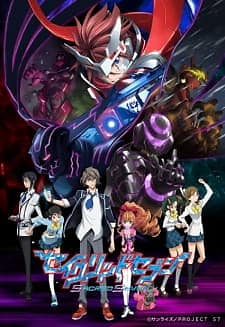
Alternative TitlesSynonyms: Sacred 7 Japanese: セイクリッドセブン
Information
Type: TV
Episodes: 12
Status: Finished Airing
Aired: Jul 3, 2011 to Sep 16, 2011
Duration:
24 min. per episode Rating:
PG-13 - Teens 13 or older
L represents licensing company
StatisticsScore: 6.781 (scored by 12732 users)
Ranked: #37242
Popularity: #713
Members: 25,506
Favorites: 41 1 indicates a weighted score
My Info
Popular Tags
No tags found |
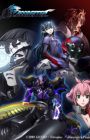
SynopsisAlma Tandoji lives a lonely life. One day, Ruri Alba, a girl accompanied by her butler and maids, visits him. Knowing the power of Sacred Seven is latent within Alma, she asks him to lend her his powers. However, he refuses and drives her away since he injured many with his unusual strength in the past.
Meanwhile, a fiendish Dark Stone creature suddenly appears in this peaceful town in the Kanto region. Only Alma's power of Sacred Seven can fight against it. But Alma just lets his power run amuck and things begin to get worse. Ruri raised her gemstone in order to release his true abilities, My Soul I give to you.
With Ruri's wishes engraved in it, will Alma be able to defeat the Dark Stone? |
Related AnimeAdaptation: Sacred Seven Summary: Sacred Seven: Shirogane no Tsubasa
Characters & Voice Actors
Staff
Reviews
|
|
Archaeon
128 of 210 people found this review helpful
|
12 of 12 episodes seen
|
| Overall |
6 |
| Story |
5 |
| Animation |
6 |
| Sound |
7 |
| Character |
5 |
| Enjoyment |
6 |
"Haste makes waste."
Entertainment is a cut throat industry, and while every studio and publisher scrabbles around in a desperate search for the next big thing, they must continue to make ends meet in some way. When it comes to anime this is usually achieved by creating a one season adaptation of an existing manga, game or light novel, and the aim of these shows isn't simply to generate revenue, but also to test the market for potential franchises. There are other methods though, one of which is to string together several well known base concepts, add something resembling a story, and release the finished article as an "original" work.
Now while the latter method can produce some very good titles, more often than not the results are ... underwhelming.
Sacred Seven follows the exploits of Tandoji Alma, a seventeen year old high school student who leads a solitary life on the outskirts of a port city. One night he sees a ship on fire in the harbour, and whatever has caused the incident also triggers a reaction in him, one that he desperately fights off. The next evening Aiba Ruri, the CEO of the Aiba Foundation, pays him a visit in an attempt to recruit him, and she seems to know more about his secret than he does.
One of the problems with bringing together several "popular" themes is that all too often something fundamental is sacrificed in the process, and that's pretty much what happens here. The plot may initially seem interesting, but once the story gets going it quickly becomes clear just how rushed this show actually is. In addition to this there's a distinct methodology to the composition of the series, almost as if director Ohashi Yoshimitsu and writer Yoshida Shin adopted a "check-box" approach. Unfortunately this brings the major issues to the fore, one of those being the rather obvious drive to include certain scenes and events - some of which have no bearing on the story. There's also an automatic limitation placed on the narrative, and while the lack of imagination and creativity is palpable, it's the knock-on effect on the development of both the plot and the characters that really stands out.
In contrast to the lacklustre storyline Sunrise appear to have done a half-decent job with the visuals, and there's some interesting design work on display - especially where the monsters are concerned. The animation is a little on the utilitarian side, but there's a surprising fluidity and range of movement during many of the action scenes. In addition to this the characters are well realised, but this is tempered by the fact that they're also rather mundane and a little too reliant on certain stereotypes. This is also reflected in the banality of the settings and background imagery, and these factors attest to the speed with which this anime was completed.
Sadly, these aren't the biggest problems with the visuals.
There are several errors that any sort of basic quality control would quickly spot and rectify, one of those occurring at an auction in England where Aiba is bidding on a new gem. The auctioneer clearly states the closing price is £990,000, but the display reads £9,900,000, and while this may seem like nit-picking, it's the ridiculousness of the mistake that lowers the viewer's expectations of the show.
That said, the auctioneer does have one of the best British accents in anime, but that's one of the few high points where the acting is concerned.
No amount of preparation or talent can resolve the problems with a script that, like several other aspects of Sacred Seven, is too reliant on what has gone before. While the actors try to do the best they can, it seems to have been impressed upon them that their characters should speak or behave in certain ways. The dialogue is far too manufactured, and with little in the way of natural flow to balance conversations, this results in some severely wooden performances.
The strange thing is that the music seems to have received more care and attention than any other part of this anime, with much of the background music being well suited and choreographed to the on-screen action.
To many people it can seem as though Sacred Seven features two opening and three ending themes, when in truth all that happens until the end of the final episode is that the first OP and ED swap places. "Stone Cold" by FictionJunction is quite the upbeat techno track, and the opening animated sequence does a good job of introducing the main players whilst being stylized enough to be eye-catching. The second theme, "Kiseki" by Nanri Yuuka, is a more traditional blend of J-pop/rock, and its accompanying animation is well choreographed and suitably heroic. As for the third track, "Tsunagaru Made" by Nakajima Megumi is a much quieter song that plays out at the conclusion of the final episode..
Now some of you may have noticed that there has been no mention of ending sequences. The reason for this is simply because Sunrise, like so many other studios, don't think it's worth the effort of making a decent one, and aside from some spinning jewel thingies in the first ED, both rely on still images.
Strangely enough, this sentiment also appears to ring true where the characters are concerned, although admittedly part of this is due to the check-box approach taken by the director and the series writer. This is a heavily manufactured anime, and this fact becomes very clear when one considers not just the portrayal of each character, but the manner in which they develop as well. While it's true that Alma grows more than anyone else, the simple fact is that he starts the series as nothing more than a blank sheet with little to no personality, and given that situation it's very easy to make the character appear more defined by the end of the story. Sacred Seven uses age old methods to ensure this happens, including Alma's solitary lifestyle, hidden power and traumatic past.
Throw in some alien meteorites and you're supposedly on to a winner.
On the other hand Ruri is rather well defined from the beginning, but alongside this is the fact that she doesn't really change at all over the course of the anime. The only supporting character to receive any kind of back story is her personal butler Kagami Makoto, but aside from giving the viewer a reason for his dedication to the Aiba family, he remains nothing more than a stereotype (you know, the intelligent, dark haired guy with glasses who's always stern and serious).
Everyone else is treated as narrative furniture, and given that Sacred Seven attempts to include some kind of human drama, this is nothing short of wasteful.
Even with its many flaws, Sacred Seven is still a surprisingly watchable series, and Onigawara offers some genuine moments of amusement that break up the monotony. While it falls just short of being "no-brain entertainment", the simple fact is that the heavily manufactured storyline and characters make it both familiar and easy to follow. Unfortunately the price of this is that far too many questions remain unanswered by the end of the anime, which is a shame as there were a few interesting ideas that really should have been given more detail. The sad part is that if more time had been given over to developing the series before it hit production, many of its issues could have been resolved - but as everyone knows, anime is a serious business.
One of the most basic rules of storytelling is that it should never be rushed, but in a world where time is money, such sentiments are normally viewed as idealistic nonsense.
read more
|
|
brass2themax
60 of 137 people found this review helpful
|
5 of 12 episodes seen
|
| Overall |
3 |
| Story |
1 |
| Animation |
5 |
| Sound |
3 |
| Character |
2 |
| Enjoyment |
1 |
I'm going to keep this review rather short, because frankly, even thinking about this show bores me to death. Writing a review about it is even worse because it makes me think about it harder than watching it.
STORY: 1 (Pathetic)
This show has no direction. Main character automatically has hidden powers from the get-go, of which the origins are glossed over within a few minutes and we are just expected to accept it. He fights to... Fight... And save... Something... Because the Darkstones (the enemies in this show) are... Evil? Because... They just are. Really. There's nothing to this at all. I'm not expecting a deep plot out of a show like this, but having a point to fighting is usually pretty important.
ART: 5 (Mediocre)
The art's not bad, but it's far from anything different than the other shows airing around this time. It's just the same plain-Jane stuff we've seen so many times already, and even if it's too high an expectation to expect this show to "break the mold", it certainly isn't beautiful on it's own. Just okay.
SOUND: 3 (Poor)
I'm being nice here. The music is repetitive, and doesn't change much from a slow, relaxing scene to a fast-paced action scene. It lacks real dynamics. For what little it does have, I at least acknowledged it by not rating it "pathetic".
CHARACTER: 2 (Dreadful)
The characters are cookie-cutter and bland, but more-so than your typical shounen. There's been literally no thought put into any of them which is evident even if you give it up to 5 episodes to establish itself like I did. After all, that's one episode shy of the halfway point. They could have done better than this.
ENJOYMENT: 1 (Pathetic)
To me, this is the most important part of watching anime: how much you enjoy it. Watching this show has been a chore. It's been extremely boring, but I kept giving it a chance. After last episode's train-wreck, I'm finally out of second chances. It's actually a relief not to have to subject to myself to this garbage week after week anymore. It's just so boring, and considering they're going for an action anime here, that's just sad.
OVERALL: 3 (Poor)
There's worse anime out there, but only just. This is pretty bad, but I was generous in giving it a 3 rather than a 2, only because gg's "White and Dirty" OP replacement made me chuckle. That's not even a credit to the show itself since the original creators weren't even able to make me chuckle with the original content, but I'm a nice guy, so I'll pretend it was them.
Stay away from this show. It's garbage and a complete waste of time. Bandai and Sunrise should want to wash their hands of this. read more
Recommendations
|
|
Both of these anime are quite similar if observed in-dept. These pair of mecha starts with a girl appearing before both of the male protagonists, give them powers and use them for their own agendas. Obviously, another one of those similarities is the art. Their character styles have these easily-noticed long, slender arms and legs plus Lelouch and Alma's facial structure are quite alike.
Same type of drawing and it shows some remarkable caracteristics in both Animes (The factor for example)
The art is similar based on the fact that one of they both share Yuriko Chiba as one of the people in charge of character design. Alma's face is basically Lelouch's face and they share the commonality of having color changing eyes. Lelouch has the Geass while Alma has the Sacred Seven power that turns his eye red.
When watching this the animation felt very similar. The knight guy looks pretty similar to lelouch too.
|
|
|
both anime involve Greek mytology and same sorts of suits hero's etc wear
|
Opening Theme#1: "stone cold" by FictionJunction (eps 1-6) #2: "Kiseki (輝跡-kiseki-)" by Yuuka Nanri (eps 7-11)
Ending Theme#1: "Kiseki (輝跡-kiseki-)" by Yuuka Nanri (eps 1-6) #2: "stone cold" by FictionJunction (eps 7-11) #3: "Tsunagaru Made (つながるまで)" by Megumi Nakajima (ep 12)
Fansubbing Groups
Which fansubbers do you like the best? Click + to approve of their subs for this show. Click - if you don't think they did such a great job.
Related ClubsAny&All, Sacred Seven FC, Miyu Irino Fans!!, The All-Over Otaku Club Okawari, Itou Kanae Fanclub, Anime Revolution ♡, Terashima Takuma FC!, super power romance anime, ~The Yuki Kajiura Fanclub~, Kanae Itou Fanclub, Okamoto Nobuhiko FC, MangaKids -(fansub)- Club, ***FictionJunction YUUKA (Yuuka Nanri) Fanclub***, FictionJunction, Nakajima Megumi Fan Club!!!!, KAORI Fans!!, KEIKO Fans!!
Recently Watched By|
2 minutes ago |
2 hours ago |
3 hours ago |
3 hours ago |
3 hours ago | |
6 hours ago |
10 hours ago |
11 hours ago |
Yesterday, 9:07 PM |
Yesterday, 7:21 PM |
|
|