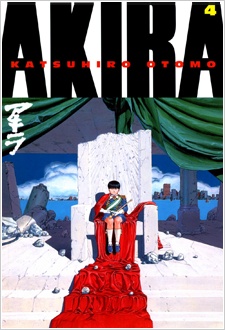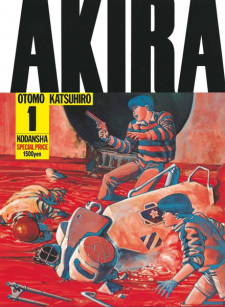
Alternative TitlesEnglish: Akira Japanese: アキラ
Information
Type: Manga
Volumes: 6
Chapters: 87
Status: Finished
Published: Dec 20, 1982 to Jun 25, 1990
StatisticsScore: 8.781 (scored by 5384 users)
Ranked: #222
Popularity: #150
Members: 11,081
Favorites: 985 1 indicates a weighted score
My Info
Popular Tags
action psychological sci-fi supernatural |
SynopsisIn the year 2038. A police state, scheming politicians, religios sects, revolutionaries and a secret scientific project all combine to produce an explosive mixture in Neo-Tokyo. The rival groups all have their eyes on one prize: control of Akira, a boy of such destructive psychic ability that he has been held in cryo-stasis for over 30 years. A coup is planned, but there is a wild card in play: the psychic Tetsuo, an impetuous young biker who releases Akira and so forces all of the groups to make their move.
|
Related MangaAdaptation: Akira
Reviews
|
|
TuesdaysDusk
4 of 7 people found this review helpful
|
87 of 87 chapters read
|
| Overall |
9 |
| Story |
9 |
| Art |
10 |
| Character |
9 |
| Enjoyment |
10 |
Akira is arguably one of the most influential manga ever created. It turned Otomo into one of the gods of manga, even though he never again penned of a similar scale. It is his opus, as it rightly should be. The landmark film adaption, one of the most important anime ever released and one of the films responsible for the popularity of anime in America, is an achievement, to say the least. What one does not typically realize, though, is that, while the 2 hour adaption does remain true to the original for the most part, it covers less than 2 volumes of the manga before more or less fast forwarding to the end. It is actually laughable to think that Hollywood thought they could turn this masterpiece into a live-action, star studded film trilogy set in Manhattan.
The book’s art is gorgeous. Otomo has a very distinct style that not only makes his work very recognizable but also contains incredible amounts of detail. I never questioned the emotion on the character’s faces, and I recall particularly a moment in a fight between Kaneda and an overpowered Tetsuo in which their fear was almost tangible. The wide shots of Neo-Tokyo and the Great Tokyo Empire are incredible. Each and every panel is full of things that make the world of Akira so real that I felt as though I could have boarded a plane and taken pictures of the place.
Katsuhiro Otomo has directed two feature animated films, as well as a number of shorts. Akira and Steamboy both contain the impeccable eye for composition that Otomo displays in Akira. The book plays out like a movie, the panel layout directing the eye smoothly through the story in a way that is more cinematic than a large amount of actual cinema. There are no true breaks in the story, with the exception of natural lulls and scene changes. As I was reading, I often wondered how the manga was split up when it was published originally or reprinted by Marvel in the late 80s.
The story itself is intriguing. The writing is clever and well done, all of the dialogue serving to not only further the story but to give us more of a sense of each character’s personality. It does, at times, get a bit confusing. There is a lot happening all at once, and some of the similarities between character names can cause some difficulty in the beginning. But the tale of psychic teenagers and children and the immanent destruction of the world around us or society as we know it is played out quite well. Often the scale of things seems ridiculous when one takes a step back, but it is so well written that it completely works within the book.
Akira is one of the most important manga ever written. It is a piece that no one should miss. If you are fortunate enough to pick up all 6 volumes at once (an act I would highly recommend), I can almost guarantee you will finish the entire thing in a day. The book is, however, deeply steeped in Japanese culture and post-WW2 ideology. This can take away from it somewhat if you are unfamiliar/unwilling to try to understand. That being said, if you have not read this book, you are doing a great disservice to yourself.
For more of my reviews, go to tuesdaysdusk.tumblr.com/tagged/review read more
|
|
martusf
29 of 52 people found this review helpful
|
38 of 87 chapters read
|
| Overall |
10 |
| Story |
10 |
| Art |
10 |
| Character |
9 |
| Enjoyment |
10 |
Story:
The story is nothing short of amazing, so well done and with lots of consistency. It develops nicely through the 6 volumes, with a nice ending. Very few things to pick on, but I guess it isn't for nothing this is considered a great work of art. Nonetheless the progress is a bit slow in the middle (specially volume 3), but it isn't enough to do anything about the greater feeling that the story has. Also, I have some mixed feelings about the position of the bikes in the story, it seems kinda a bit too important.
Art:
Nothing bad about this. The art pleased me all the way through, both in the actionscenes and when it was more slowpaced. Characterdesign was also really cool, and panoramic views totally awesome.
Character:
The characters are really well done, with the title character topping it all (no spoilers, but he was really cool). Kei and Kaori are well done, moreso than in the anime I imagine. Most of the others were devolped in a great manner, with a good bunch of mysteries and intrigues. But I must say that the protagonist, Kaneda, got on my nerves some times, though many male protagonists are like that. I can't really explain, but I didn't like him as much as the rest of the characters.
Enjoyment:
Enjoyment is really important, and that's where Akira is the best. I finished it in about 5 days I think, it was really thrilling, and I couldn't wait untill the end, so that I could discover how it all ended. Nothing less than highly entertaining, and I enjoyed every second I was reading it. I just had to read a bit more and a bit more. On the other hand, it didn't feel to long either, thus making it almost perfect.
Overall:
I discovered it on a whim, and I'm happy I did. It's the best manga I've read, by far, and I recommend it to everyone. It was really great. read more
|
|
When you read Akira and Eden, second one looks like some lineal heir of Otomo's work. The same setting - post apocalyptic future without any useless hopes, brutal world that will kick your ass without hesitation. Main protagonists are almost the same too - young guys trying to help their friends to live in this world, they will use everything to get what they want and won't strain to spill some blood. Art looks similar too.
Both manga are set in post-apocalyptic settings and show the aftermath of rebuilt society and all the corruption and violence that entails. Full of visual detail and cyberpunk depth, Eden and Akira are great companion pieces.
Well-written post-apocalyptic mangas. Similarities with story and atmosphere. Seinen works, genres action sci-fi. Similar art - visuality.
|
|
|
I know, it may not seem similar but again looks may be deceiving. On a surface level, Akira and Nausicaa were the two momumental animes and mangas of the 1980's with their historical importence almost eclipsed only by the rise of Gegika, Osamu Tezuka, and Neon Genesis Evangelion.
On the story, both are layed with socialogical and political themes imbedded into the story. The themes are different, but that really doesn't matter sense since mangas with social commentary are few and far between. The scale of both of them are epic with headscratching ending that are surprisingly dense and the culmination of all of the subtext. On the actual stories, they are very well thoughout and crafted, so everything happens for a reason and nothing comes out of the blue.
Artistically, they are both almost unparralled yet share one very rare similarity that few mangas share. Both are profoundly influenced artistically by the french comic artist Moebius (the setting and world of Nausicaa is heavily influenced by Moebius' Arzach and that is where the her glider comes from (I have the picture that is on the cover of one of the editions on my profile page if you don't believe me)). From him, Otomo takes the staggering amount of detail and the emotional moments while Miyazaki takes the surreal world and atmosphere and what Moebius described as quality (see Moebius vol. 4).
Overall, both stand at the pinnacle of all of manga. It will be a long time before either of them are ever surpassed.
AKIRA and Nausicaä are both epics in every sense of the word, both were written in the '80s, and both are extremely influential manga. Whilst themes and setting may be very different, they both give off a similar feel, and had popular movie adaptations that only covered the manga up to a certain point. The two are masterpieces of graphic storytelling.
|
| No posts for this board were found |
Related Clubs***Legend of Anime***, After the Apocalypse, Akira, Anime & Manga Recommendation, Anime Break, Anime History Association, Armitage's Dimension Radio, ★Pictorial Culture Miscellany★, Cinema of Japan, CNCFixins, Cogito Ergo Sum - Philosophy In Anime and Manga, Criminal Minds, Critics and Connoisseurs, Cyberpunk Club, Dark Horse Manga, Full Color Club, Haitou, Intoxicated ʘ‿ʘ Sexy Dreams, Manga > Anime, Manga And Light Novel Lovers, Manga Experience, Manga Masterpieces Club, Marketplace Germany, my little testing facility, Old School Manga Club, Old School Mangas - Brasil , Overrated or Underrated Animes and Mangas, Read Everything And Discuss: Manga, Recommendation Club, Scooter Girls, The Akira Club, The All-Over Otaku Club Okawari, The Classics Club, The manga is always better, The Noble Heroines, Virus
|
2 hours ago |
4 hours ago |
8 hours ago |
Yesterday, 8:08 PM |
Yesterday, 6:59 PM | |
Yesterday, 1:05 PM |
Yesterday, 12:37 PM |
Yesterday, 11:48 AM |
Yesterday, 11:08 AM |
Yesterday, 10:16 AM |
|
External LinksMangaUpdates, Wikipedia
|
|