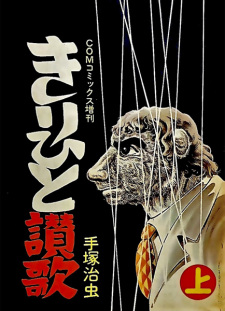
Alternative TitlesEnglish: Ode to Kirihito Synonyms: Eulogy to Kirihito, Kirihito Sanka, Kirihito Japanese: きりひと讃歌
Information
Type: Manga
Volumes: 4
Chapters: 20
Status: Finished
Published: Apr 1970 to Dec 1971
StatisticsScore: 8.371 (scored by 603 users)
Ranked: #2622
Popularity: #2448
Members: 1,226
Favorites: 48 1 indicates a weighted score
My Info
Popular Tags
drama |
SynopsisTwo young doctors, the passionate and well-liked Osanai and the ambitious Tatsugaura, are both investigating the mysterious 'Monmo' diesease, found only in one remote village, which causes bizarre bone deformation, making its victims take on a beastlike appearance before their deaths. Osanai, caught between the allure of his urban medical world and the rural peace offered by the remote village, does his best to help the victims retain their humanity in the face of a medical establishment which views them only as guinea pigs and oddities. Meanwhile, Tatsugaura schemes against Osanai and tries to infect his rival with the disease in order to gain fame from researching the results. |
Reviews
|
|
Merridian
9 of 10 people found this review helpful
|
20 of 20 chapters read
|
| Overall |
9 |
| Story |
9 |
| Art |
10 |
| Character |
9 |
| Enjoyment |
10 |
It isn’t difficult to see why Osamu Tezuka is considered to be the godfather of manga. With extremely influential titles like Astro Boy/Tetsuwan Atom, Black Jack, and Buddha to his name, there should be no doubt that the man had an extraordinary talent for delivering quality storytelling in comic form. Ode to Kirihito is no exception.
What begins as a story about a bizarre disease that results in horrid deformations turns into an intense psychological journey through the paranoid and the depraved, journeying deep into the mind and adventures of a man whose mutation has turned him into something that is both inhuman yet beyond the definitions of a beast. Coupled with the unfortunate absurdity of Doctor Osanai’s twisting reality is the story of his colleagues, the psychotic-yet-well-intentioned Doctor Urabe, and their boss, the overly ambitious Doctor Tatsugaura, as each of them strives to find an explanation and cure for the disfiguring Monmow disease.
Although the content of the story is quite important and noteworthy, it is the way in which it is presented that makes the story most worthwhile. Tezuka’s penchant for juxtaposing cartoonish caricatures against starkly realistic backgrounds with heavily-nuanced moods and atmospheres is as eerie and unsettling as it is well orchestrated. Yet paradoxically, this ‘realism’ also contains strange proportions that identify it thoroughly as an unrealistic work, and as such, the world depicted in Ode to Kirihito is very effectively revealed to be as surreal as the plot demands.
Even beyond these aesthetics, the layout of the frames on the page demonstrates a highly intriguing use of space and movement that parallels, but does not imitate, a rather cinematic form that his work is known for. It wouldn’t be hard to see much of this comic adapted into a film, for instance, but it would be nigh-impossible to merely use the comic as a storyboard due to how thoroughly the man understands how the reader’s eye moves about the page—something that is best demonstrated through how he manages action, manipulates tension, and creates emphasis through techniques as varied as they are effective.
This book is not without its flaws, however. Ode to Kirhito is noticeably heavy handed in the depiction of many of its core themes, but there are plenty of subtleties to be found by anyone willing to look further than some of the more the exaggerated melodrama. The level of cruelty portrayed also may seem to lack a certain shock value or power that many modern readers have come to expect, but I do not believe this lessons the impact of the story in the slightest—if anything, it is the masterful execution of these acts that makes the comic all the more powerful an experience. The thing to keep in mind is that the story is not one whose story revolves solely around the depiction of cruelty; it is a hardboiled romp through the psychosis of insurmountable stresses and anxieties, coupled with the often-bittersweet nature of real life, that makes this story what it is.
Recommended to any fan of the printed medium, be it comic books, manga, or prose, as well as any fans of film noir, psychological and/or hardboiled fiction, or readers just looking for philosophical undertones in their entertainment. read more
|
|
corychang
3 of 6 people found this review helpful
|
20 of 20 chapters read
|
| Overall |
9 |
| Story |
|
| Art |
|
| Character |
|
| Enjoyment |
  |
When faced with a strange new illness that seems to turn people into beasts, Ode to Kirihito follows the titular character as he tries to solve the mysteries surrounding the disease. Under a fashion similar to North by Northwest, Kirihito is thrown into a series of bizarre and extreme circumstances which he becomes inevitably involved despite his innocence, giving a whole new meaning to “out of the frying pan, into the fire.” While the manga is often considered a precursor to another one of Tezuka's great works, Black Jack, they really share very little beyond featuring doctors in the story. While still feeling like classic Tezuka, Ode to Kirihito is really another great manga to add to his repertoire that stands well on its own.
If you have read any of Tezuka's other works, then the artwork will come as no surprise. The Disney influences are as apparent as ever, with cartoony characters that are often drawn with long and exaggerated body parts. However, there are times when the mangaka goes for shocking realism, which really adds to many of the scenes. Tezuka takes more risks in this work, going for a darker, almost film-noir feel with overwhelming shadows and interesting uses of lighting. Characters are even sometimes drawn in a sketchy style, lending significantly to the manga's dark and uncertain feel.
And it is not just the art: the entire graphic novel is one of the darkest pieces that Tezuka has ever written. Like with The Book of Human Insects, Osamu Tezuka has seemed to check his humor at the door. I noticed only two instances of gags in the whole work, despite the fact that Tezuka is well known, and often criticized, for his all too frequent use of jokes, especially at inappropriate times. This is probably for the better since Ode to Kirihito deals with some heavy themes such as persecution, rape, isolation, psychological damage, slavery, and humanity to name a few.
Characters are interesting and varied, with most given enough time to grow and become fully fleshed out. They can be far more complex than they first seem, with even the most vile of characters given human emotion and a chance for redemption. Tezuka really uses the entire cast to his full advantage, blurring the lines between beast and man and making each person feel important to the story as a whole. Unfortunately, with such a strong overall cast, it does sometimes feel like there are some missed opportunities with Kirihito, who does not even feel present for a large part of the manga. We often see him jump between many stages of his life but not the actual transitions. However, this is a minor point in category that Tezuka excels in.
When Tezuka is at the top of his game, he can forge together a story that interesting, poetic, poignant, important, and imaginative. In Ode to Kirihito, Tezuka is undoubtedly at the top of his game. The story follows many different story lines, all of which take interesting turns and all contribute to what Tezuka has to say about what it really means to be human. Without spoiling too much, you can rest assured that the actual plot is on par with Tezuka's most revered works, such as Phoenix. Sometimes the situations can seem a little too extreme, but that's also part of the fun.
Tezuka's story-telling is extremely experimental, with panels that spiral in or explode out of the page. Some pages seem to mimic a film strip, emphasizing the progression of character expressions. When done well, his style really pays off, though sometimes the overemphasis on certain scenes can mess up the pacing a bit. Furthermore, the experimental style, though interesting, can take readers out of the experience and make them all too aware that they are reading a manga, which is not generally desired. The manga is also filled with Christian imagery, which unlike in Neon Genesis Evangelion, feels important without being overbearing.
With Ode to Kirihito, Tezuka beautifully weaves together a fascinating drama that is fantastic in almost every aspect. His medical background often makes it difficult to separate fact and fiction, and indeed, the manga shapes up to be one Tezuka's most realistic works, both in story and in style. Tezuka is one of the few artists who seems to be able to seamlessly blend art and entertainment, creating one of his finest tales with Ode to Kirihito. read more
|
|
In both mangas main protagonists are doctors that have been cut off from the society and are trying to clear their names.
|
|
|
Both of these are darker "Gegika" works from master manga creator Osamu Tezuka. Both feature psychological story lines about the dark side of humanity.
|
| No posts for this board were found |
Related Clubs"Hidden Gems of Manga", Creepy Anime/Manga Club, Marketplace Germany, Old School Manga Club, Osamu Tezuka - God of Manga, seinen & josei
|
10 hours ago |
Yesterday, 1:08 PM |
Yesterday, 7:07 AM |
05-20-13, 4:22 PM |
05-19-13, 5:11 PM | |
05-19-13, 9:43 AM |
05-17-13, 10:32 AM |
05-17-13, 6:34 AM |
05-16-13, 5:54 PM |
05-16-13, 1:40 PM |
|
|