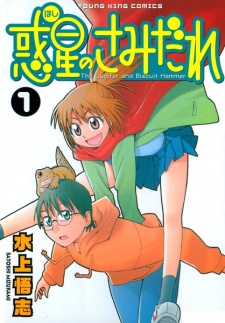
Alternative TitlesEnglish: The Lucifer and Biscuit Hammer Synonyms: Wakusei no Samidare, Lucifer and the Biscuit Hammer, Lucifer BH Japanese: 惑星のさみだれ
Information
Type: Manga
Volumes: 10
Chapters: 65
Status: Finished
Published: Jun 30, 2005 to Aug 30, 2010
StatisticsScore: 8.581 (scored by 4577 users)
Ranked: #852
Popularity: #200
Members: 9,244
Favorites: 864 1 indicates a weighted score
My Info
Popular Tags
action |
SynopsisThe world is in mortal peril. Sir Noi Crezant, the Lizard Knight, has been sent to gain the aid of the great warrior Amamiya Yuuhi in hopes of finding the Princess Samidare and protecting the planet from the incredible "Biscuit Hammer" poised to crack the Earth in two. Unfortunately Yuuhi wants no part of it, and the Princess doesn't prove to be the shining "hero of justice" role model that Noi had hoped for.
(Source: MU) |
Reviews
|
|
Pusswookie
13 of 14 people found this review helpful
|
65 of 65 chapters read
|
| Overall |
9 |
| Story |
9 |
| Art |
8 |
| Character |
9 |
| Enjoyment |
10 |
As a forewarning, this is my second review and consequently I’d like to try something a little experimental, so this review is going to be very Trope Heavy. For those of you who don’t know what that means: pull up a tab and go to TvTropes.org, then, when you emerge some hours later blinking into the sunlight, head on back over [and congrats on breaking free of your Small Secluded World].
Lucifer and the Biscuit Hammer [also referred to as Hoshi/Wakusei no Samidare] is basically what would happen if you took What the Hell, Hero? and made an entire story around it. Hoshi no Samidare initially presents itself as an action/adventure-romance-comedy [or is it a comically action packed romance?] that, quite fittingly, grows into a Coming of Age Story [see what I did there?], with clever Genre-Savvy humor and noteworthy character development all throughout. The manga begins with Amamiya Yuuhi, introverted misanthrope and bespectacled college student, who wakes up to find a lizard in his bed, which he throws outside and promptly goes back to sleep, The End.
…
Alright I’m just foolin’: This lizard, a certain Noi Crezant, informs him that it is The End of the World As We Know It and asks for his cooperation as one of the 12 “Beast Knights” in protecting The Princess and defeating The Mage, the latter of whom plans on destroying the Earth with his gargantuan Biscuit Hammer, which is Invisible to Normals [Note: the Biscuit hammer isn't actually made of baked flour, but it IS named after a song by The Pillows].
Much to Noi’s surprise, Amamiya doesn’t exactly Jump at the Call, as not only does he want no part in the war; he seems to be completely apathetic to the whole ordeal. That is, until he is attacked by one of the mage’s Pet Monstrosities and subsequently saved by the princess, who turns out to be his neighbor, Asahina Samidare. Sami, being the resident Hero Antagonist, and Woobie, Destroyer of Worlds, wastes no time in recruiting Amamiya to her cause; her ambition of course being to save the Earth from the proximate danger of the Biscuit Hammer…
…so that she can destroy it herself. She confidently proclaims to Yuuhi and Noi, wearing awe and horror stricken faces respectively, that if the Earth is going to meet its end then it’s going to be her Fists of Mass Destruction that do the job [well, that, or the fearsome power of moe]. Amamiya, having always wanted to Put Them All Out of My Misery , or perhaps inspired by the inherent determination of her words, vows to be her “demon knight,” and so begins their battle to defeat the Mage Animus and his increasingly powerful golems; all while hiding their secret agenda from the other Beast Knights.
On the outset, Hoshi no Samidare is a comedic adventure story about a 3-way battle [with the main duo being the secret third party] to either save or destroy the world, but soon it becomes quite apparent that there is, in fact, a fair amount of depth to be found as well. While I couldn't find an exceptional amount of thematic relevance within the story, the relatively simple themes that it does touch on; such as the significance of family and friends [and conversely, the dangers of isolating yourself from them], the value of unity when faced with an overwhelming and enigmatic foe, and even [though briefly] what it means to be human, are only made that much more impactful by their relative scarcity. Not to mention that, despite there being a fair amount of loss, the plot never really descends into the morbid or depressing, as the action [and hardship] is interspersed with a fair amount of levity. Hoshi no Samidare’s story treads a fine line between tragedy and humor, poor handling of which can result in Mood Whiplash, but thankfully the comedy is implemented in such a way that it never seems out of place, instead facilitating character development and serving to lighten up an otherwise somber atmosphere. This and the relatively smooth pacing provide the framing for an adventure chocked full of Plot Twists, Crowning Moments of Awesome, Tear-Jerker moments, Villain Protagonists, Panty Shots [subverted, it’s only used as a joke in the beginning], and everything else that makes for an engaging, well-written story.
Art: Normally I care very little about the art in manga, but in this particular instance I have to point out that the Biscuit Hammer in and of itself is cleverly used in a variety of ways to symbolically illustrate emotional tension, with the manga often panning to it looming ominously in the sky, poised to destroy Earth, during times of emotional turmoil or desperation. It’s also used as a visual aid to hammer in [:D] the ever-present direness of their situation, even during times of relative calm. If there is one thing that I could complain about, it’s that tears are drawn somewhat oddly, flowing down the characters faces in cartoonish rivulets. This wouldn't be much of a problem, but there’s a pretty hefty amount of [justified] crying during certain parts of the story, and it somewhat ruins my immersion when the characters look like they just finished being water-boarded. Aside from that, the art is alright and the paneling paneling is excellent; they both serve their respective purposes.
Characters: While Sami and Yuuhi’s subversion of your typical “knight and princess” cliché alone is well worth the read, I found myself quite enamored with Yuuhi’s depth of character in particular. Yuuhi is an astoundingly likable character and, despite his initial villainistic leanings, is surprisingly relatable as well. In a fine example of Becoming the Mask, he begins as an Anti-Villain who feigns being one of The Good Guys in order to fool the other Beast Knights [and regards the imminent destruction of Earth with little more than passing disinterest] but, through his interactions with the rest of the cast, he gradually grows into his role as [one of] The Hero(s).
Likewise, Yuuhi’s journey from asocial Stepford Smiler to someone with a genuine appreciation for his life and that of those around him is conveyed in a compelling and realistic way, and I never once found any of his interactions to be implausible or contrived; though, to be fair, his back story with his grandfather was...odd. That of course isn't to say that everyone else in the story falls by the wayside; in fact, the other knights’ back stories [barring the detective, I found his to be comparatively mediocre] were interesting as well and, remarkably, all receive some manner of character development or another. The sheer variety of novel interactions in this story ensure that character progression never stagnates and, between the most Gar characters being an overweight man and a twin-tailed middle school girl, you can guarantee that the writer doesn't follow typical conventions, instead opting to create a distinguished group of refreshingly unconventional “heroes.” By the time I had finished reading Lucifer and The Biscuit Hammer, I was rather fond of the cast [including the mage Animus, who is pretty Affably Evil]; their individual growth, which occurred as a subsequent result of their experiences [and losses] on the battlefield, really resonated with me. All in all, the characters are charming and endearing, and I found myself quite moved by them and [most of] their struggles.
Summary: I chose this particular format because seldom have I seen an anime/manga that managed to coolly subvert or lampshade so many shounen tropes, and all while weaving a charmingly hopeful tale about what it means to be an adult and the importance of serving as a good example for the next generation. Lucifer and the Biscuit Hammer, admittedly, has it's ups and downs, with it's ups being quirky at that, but I can say with all confidence that though it may start out in a deceptively easygoing manner, it finishes in a spectacular and satisfying way [with a Name Drop, no less]. At any rate, whether you've read 10 manga or a thousand, I sincerely doubt that you’ll find another story quite like this one. read more
|
|
BigJim4652
64 of 101 people found this review helpful
|
65 of 65 chapters read
|
| Overall |
10 |
| Story |
9 |
| Art |
7 |
| Character |
10 |
| Enjoyment |
10 |
At first glance The Lucifer and Biscuit Hammer may not look like anything special, however looks can be very deceiving. It very quickly blossoms into one of the most engaging, funny, and at some times tragic stories that I've ever had the pleasure of reading.
The story may not be anything particularly original, but it easily makes up for its lack of originality with numerous twists and quirks that make for an enjoyable read that never fails to surprise, right up until the last chapter. Little things, such as the Princess' motivations for wanting to save the world, or unexpected character designs keep it interesting. One of the things I appreciated most about the story was its uniformity. There were no noticeable plot holes or contradictions that most manga are filled with. Most mangaka seem to make things up as they go along, which leads to inconsistencies in the story. It was clearly planned out, at least loosely, from beginning to end.
The humor is an integral part of the manga. The author makes use of an extremely dry sense of humor, that I'd expect from something out of Britain, not Japan. The thing is though, it works. I honestly laughed out loud a number of times, which is rare for me. It constantly pokes fun at typical shounen cliches, such as characters naming their techniques.
The characters are particularly interesting. The author makes very little use of character archetypes such as tsunderes, which have become increasingly common. Nearly every character is unique and given the attention they deserve. They're all given a proper back story, and each has very different reasons for why they fight. I also can't say enough about the growth that Yuuhi exhibits throughout the story. It was fascinating to watch him grow, and not just in the traditional sense. He gets physically stronger, yes, but he also matures tremendously throughout the story, all in an extremely natural way.
The art, while nothing impressive, is still quite good for the most part. The characters are all instantly recognizable. The fights are easy to follow. The author also makes extensive use of capes for dramatic effect. If something epic is happening, it's almost always accompanied by a cape or something similar blowing in the wind. I consider it to be the authors trademark, as it's present in all of his works that I've read.
This is one of my personal favorite manga, and I haven't talked to anyone who hasn't liked it. If you're still skeptical though, take five or ten minutes and read the first couple of chapters. I guarantee you'll be hooked. read more
|
|
An alien guide appears and tells a small group of humans that the fate of the world lies on them. A series of duels between them and foreign entities will take place, and loss will result in the destruction of the world. But this is a group of flawed humans, and they are neither united in their cause nor equal in their abilities. How they deal with the continuing battles while losing allies and finding out more about the nature of the fights is the focus of the story.
Samidare is more interesting to watch, as everyone participates in the battles, but they are similar in the degree to which they cover the psychological battles they all must face. The characters in Samidare are a bit more off the deep end though.
Both feature a group of people that end up being forced into a must-fight scenario in which, as a team, they must defeat the enemies that are beyond their comprehension one at a time with breaks before battles. Their loss results in the destruction of our planet. Both contain heavy character development while dealing with the psychological state of the participants.
Both are about a group of people whose life changes in one day. They start to fight against enemy and are the only hope of the world. Both have side stories about the character past and how they are connected to each others. Both also have nice psychological side on them which is made in same type of way. Both handle characters and them emotion in similar way and are somewhat dramatic. Atmosphere is really similar and art style is "light" in both manga. Recommended highly.
|
|
|
The two of them are both battle shonen titles, and yet both have a darker sort of tone to them, and an excellent setting.
An epic "save the world" theme. In Hoshi no Samidare, the "Biscuit Hammer" will eventually crack the Earth in two, while in Sensei no Bulge the planet is plunged into an endless war. Both protagonists are forced to fight in order to protect and save the planet. With the help of a mentor, they grow stronger through training and each battle. They are both motivated by the same goal: to protect their loved ones.
|
| No posts for this board were found |
Related ClubsCool Manga to anime, Deadpan Humor, Recommendation Club, The All-Over Otaku Club Okawari, The Lucifer and Biscuit Hammer Fan Club, Trinisete Scanlator - Brasil
|
2 minutes ago |
5 minutes ago |
2 hours ago |
4 hours ago |
5 hours ago | |
5 hours ago |
5 hours ago |
8 hours ago |
8 hours ago |
9 hours ago |
|
External LinksOfficial Site, MangaUpdates, Wikipedia
|
|