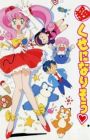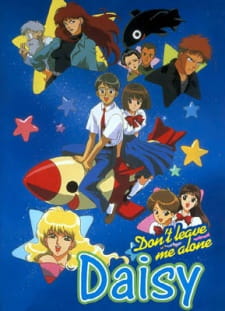
Alternative TitlesEnglish: Don't Leave Me Alone, Daisy Japanese: みすて♥ないでデイジー
Information
Type: TV
Episodes: 12
Status: Finished Airing
Aired: Jul 2, 1997 to Sep 17, 1997
Duration:
24 min. per episode Rating:
None
L represents licensing company
StatisticsScore: 6.241 (scored by 129 users)
Ranked: #52472
Popularity: #5450
Members: 400
Favorites: 0 1 indicates a weighted score
My Info
Popular Tags
No tags found |
SynopsisThe story begins when an innocent, but busty, young schoolgirl goes to recover her hat from what she thought was an abandoned house. But within that house, spying on her, is a deranged madman. Seeing her he becomes obsessed with controlling her, owning her, bending her to his every whim. He, and his array of high tech tools, will threaten her with death, mutilation, control, humiliation and the loss of her own will and identity. Terrors biological, chemical and nuclear will come into play in the nightmare that is her new, controlled, life.
(Source: AniDB) |
Characters & Voice ActorsLearn how to add characters and voice actors.
Staff
Reviews
|
|
Dick_Saucer
3 of 5 people found this review helpful
|
12 of 12 episodes seen
|
| Overall |
9 |
| Story |
7 |
| Animation |
7 |
| Sound |
8 |
| Character |
9 |
| Enjoyment |
7 |
My girlfriend and I watched this over the last couple weeks. It was a childhood favorite of hers that she picked up at some point back in her initial period of otakudom. I was totally absorbed watching Misutenaide Daisy with her, and I loved that this was something she had been keeping near to her heart for all these years. I love iconoclasts, and there are a couple here.
On the other hand, maybe this is where she got some of her profoundly scary ideas about what it is like to be with someone in her formative years. Maybe this is what messed her up for life. Well, everybody gets those ideas from somewhere- so at least if that is true, the one that I love got theirs from something I approve of. As opposed to, say, the Twilight franchise.
This anime, by virtue of its central themes, should be put in a category shared with Evangelion both in shared style and generation as well as that central theme; which could most easily be described as "Love".
It is not. People take the characters in this series seriously as moral actors in an imaginary world whose ethical physics is supposed to match their own view of how things are, or should be, in real life.
Apparently people generally have far less trouble imagining that someone could fly, or lift a tank, or kill fifty men with no negative consequences for themselves, than they can imagine someone behaving in a sexually reprehensible way and still being treated as a privileged main character. Somehow I am not entirely sure this example represents a positive step for gender equality or the forward progress of society. But maybe civilization will be fine, and it is just the progress of literary criticism that is being retarded by social mores. We can all of us only hope.
We are talking, of course, mostly of this series' most memorable and most detailed character: Reijiro Techno, the "smart boy" who can't understand how to socialize. He is easily the lead character, by most any measure.
Now, there is nothing special about that stereotype. It is like shooting a barrel full of anime protagonists and hitting an orphan, or someone with hair that does not seem to obey gravity. It is one of the ingredients in the original Betty Crocker cookbook recipe for a Japanese Cartoon Show.
But this guy, yeesh. I can almost understand the universal lynching this series got in professional reviews when it was released. After all, professional means that it matters to you what your customers think. What would anyone think of this character?
For one thing, despite being the main character, he is also the primary antagonist of the show. He is the one who does bad things. He has his own mischief making obstacles a la Team Rocket standing in his way, but it is never played for Drama. If something is happening to someone and it is seriously bad, he is responsible. I don't think I am spoiling anything by saying this series is not about him getting his comeuppance. That does not happen. He gets rewarded for his violence.
What kind of antagonist is he then? Well; if he were a real person, he would be a felony sex offender. The police would be called on him shortly after he meets the female lead of the series, by her, in the first episode. Or anyone who saw him with her. International kidnapping, forced abduction, stalking, harassment, along with the standard blowing things up and frying people. He is also a Mary Sue topper of a Mad Scientist: all his superdevices essentially amount to the game children play where they say "Bang, I shot you, you're dead... No I'm not, I was wearing a bulletproof vest... Well then, I used armor piercing bullets...I was in a tank..." ad nauseam. His technological singularity is reaching the end of infinite series of boasting technobabble one-upsmanships. He is never seen solving or studying a regular problem a real person encounters in their education, but he has a time machine and an Illudium Q-36 Explosive Space Modulator. If you are a STEM graduate student, there isn't a lot to sympathize with. Again, suspension of disbelief fails the average viewer. "This is the smart guy who can't relate to people" it says. Underlined twice for emphasis.
The "real" protagonist, the real moral decision maker and actor of the series, is the female romantic lead, Hitomi. We know way, way less about her imagination, her psychology, her history, her belief system- she is treated and expresses herself as a blank slate, as a statistical average of what a Japanese girl Is or Is supposed to Be. To whom they are supposed to be that, or what that average is, I have very little idea. All that is said, repeatedly, is that "Average" is her identity. She acts by being acted on by the "Unusual". Her struggle is in how she looks at circumstances she does not seem to have much agency to control or steer. Her agency is all in manipulating her own subjective frame of reference. She has no way of actually opposing the villain, and in the end he wins, after a fashion, because she changes her mind.
There is no love triangle. A romantic couple is presented as a dynamic of male antagonist and female protagonist that slowly move toward one another and toward moral zero as the series progresses. Secondary characters are abusively teased and abandoned as elements of the narrative. Everything ends up being internal to the male and female aspect of a unitary narrative. Oh, and the series is a cold war resolution fantasy in the same way that 99 Luftballons was, or Dr. Strangelove. It is one of the most sentimental examples of that I have ever seen, and it actually got me for a second, like It's a Wonderful Life occasionally manages to.
And yet, I believe that is the essential, remarkable strength of this show, that characterization. Both of them, even. Either the authors knew what they were doing and constructed a conscious satire, or they earnestly believed in the simple truth of the positive outcome of their narrative. If a character this profoundly dissonant with the standard expectations of an audience, the expectations of their value system and how they apply that system to a story- if this was accidental it is almost cosmic in its character arc.
Here is a partial reading list: Orlando Furioso, Mating Intelligence: Sex, Relationships, and the Mind's Reproductive System by Geoffrey Miller, The Catcher in the Rye, et cetera. Ad nauseam.
You should also watch A.O. Scott's review of Chris Marker's La Jetee. I mean, if you read this far down, you might as well. Any of the above mentioned sources certainly make my point better than I ever could. Watch that review, among many other things you could watch, also to the point of nausea. Gorge yourself on this topic as a young person in love would gorge themselves on the attentions of their first and only love. Go watch Misutenaide Daisy, and then laugh at Macho sex advice writers like Athol Kay and the basic notion of the "Captain/ First Officer" heterosexual relationship dynamic. Laugh at the notion we are evolving towards some supercritical point of mental celerity. Laugh at the real-life Techno Reijiro; that takes every bit of cognitive effort they can muster to wrap their minds around their own biology. Laugh as the writer intended, at the Cole Porter song. Let's Do It, Let's Fall in Love.
This was a good show! It had a me thinking about how I think, and about how other people think. It is a shame it doesn't have more of a cult following. It is mostly a shame that people seem to mostly hate it because they cannot empathize with the characters, or admit to other people that they do.
It is a shame I will probably get more mileage out of this series by using it as a litmus test for other people that I meet than I will by actually discussing it with them, but I can always turn to my one and only. She will happily discuss it with me. I hope one day everyone finds what they are looking for in that way, and flies off into outer space on the rocket of their dreams. read more
|
|
formosan
10 of 17 people found this review helpful
|
3 of 12 episodes seen
|
| Overall |
1 |
| Story |
1 |
| Animation |
5 |
| Sound |
6 |
| Character |
1 |
| Enjoyment |
1 |
Great stories can be told about psychopaths who are obsessed with imprisoning their victims, whom they love and fear. Stephen King's _Misery_, for example, is a decent story about a writer who is held captive by a mentally imbalanced fan of his work.
"Don't Leave Me Alone Daisy" casts the psychopath as a lovable boy and the victim as a lovable, but terminally stupid and passive, girl. And then it deals with this horrific premise as if it were a light romantic comedy.
The opening theme song is notably good. The art is mediocre.
The characters are unlikable. It's bad enough being a madman who wants to imprison the object of his affection, but maybe a good actor could make such a character sympathetic -- much like Hannibal Lector became a sympathetic anti-hero. But when the madman is basically a boring nobody with a poorly-explained trove of advanced weapons and technology, there is no drama.
It's painful enough to watch a story about a girl who passively suffers, or a story about a girl who makes a doomed rebellion against her unjust fate. But the victim in this story communicates nothing other than her lack of consent. She will say something like, "Hey, don't do that, I won't let you," and then lapse into idiotic passivity. Somehow, watching a brainless doormat get tramped on is even worse than watching a sympathetic character get trampled on.
This anime is beyond salvaging. The victim-girl is already a doormat. Don't be a doormat. Don't watch this anime. read more
Recommendations
Opening ThemeNo opening themes found, add themes.
Ending ThemeNo ending themes found, add themes.
| No posts for this board were found |
No discussion topics have been made yet, how about starting one?
Fansubbing Groups
Which fansubbers do you like the best? Click + to approve of their subs for this show. Click - if you don't think they did such a great job.
Related ClubsFanArtsClub
Recently Watched By|
3 hours ago |
05-15-13, 6:25 PM |
05-11-13, 1:22 PM |
05-08-13, 6:46 PM |
05-07-13, 7:27 AM | |
04-25-13, 11:40 PM |
04-24-13, 10:00 PM |
04-13-13, 11:42 PM |
04-13-13, 9:01 PM |
04-13-13, 2:06 PM |
|
|