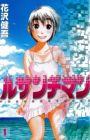
Alternative TitlesEnglish: Mætel's Feelings Synonyms: Me-Teru's Feelings Japanese: め~てるの気持ち
Information
Type: Manga
Volumes: 3
Chapters: 28
Status: Finished
Published: 2006 to 2007
StatisticsScore: 7.221 (scored by 314 users)
Ranked: #39622
Popularity: #1206
Members: 543
Favorites: 3 1 indicates a weighted score
My Info
Popular Tags
drama romance |
SynopsisKoizumi, Shintarou is 30 years old, a virgin, and has isolated himself in his room for 15 years. He has become a burden on his father, Koizumi Yasujirou. one day, Shintarou makes a proposition that if Yasujirou gets a girlfriend, Shintarou will come out of his room. It turns out that Yasujirou has already made a girlfriend, a young beautiful woman, Yoshinaga Haruka, who is with Yasujirou for her own personal reasons.Yasujirou and Haruka decide to get married, but Yasujirou dies on their honeymoon. Now Haruka decides to take care of Shintarou, and so this weird "mother and son" are now living together. |
Reviews
|
|
tehnominator
28 of 44 people found this review helpful
|
28 of 28 chapters read
|
| Overall |
8 |
| Story |
6 |
| Art |
9 |
| Character |
7 |
| Enjoyment |
8 |
What makes an attractive, intelligent fifteen-year-old boy lock himself up in his room, refusing to see anybody while insisting that only his manga and the internet are good enough for him? Now what makes him stay isolated in his room for the next fifteen years?
Me-Teru no Kimochi is a short manga series that looks at a topic that has been popularised by works such as Welcome to the NHK: the life of a hikikomori. Shintarou is a thirty-year-old who shuts himself away in his room after the death of his mother. He refuses to look at his father. He refuses to leave his room. The only contact father and son have is exchanging manga, meals, and notes through Shintarou's perpetually closed door. The monotonous life of this hikikomori is shattered when his father passes away and a young woman, his new "mother", comes to live with him. This woman, Haruka, tries to rehabilitate him and make him an acceptable member of society. But how do you turn a thirty-year-old boy into a man?
What makes this manga absorbing is that it quickly sets up a situation where a man has to be taught maturity by a woman younger than him. We see Shintarou struggle--really, really struggle--to do simple tasks such as walking down stairs, speaking to a woman, and learning how to adapt. However, while the story has a good setup, somewhere in the middle of this series, it starts falling apart, and by the time the conclusion is met, you'll be wondering if you're reading a completely different manga. It turns what is a deep drama with comic appeal of a man trying to get along with his stepmother into a sexualised romance with some unbelievable and uncharacteristic twists and turns that border ridiculous and almost completely (if not totally) destroy what was so carefully built in the earlier chapters.
The art for this manga is pretty spectacular. While the backgrounds leave much to the imagination as most of the manga takes place inside of Shintarou's room and the hallways in front of his room, the character design is absolutely well done. The style is more realistic, and the characters have very detailed looks, facial features, and expressions. Also, there is consistency with the artwork and the personalities of the characters. Take Shintarou. When he walks, he hunches over and this is maintained throughout his scenes whenever he feels nervous or exposed.
Speaking of Shintarou, his character is a very strange one. He has absolutely no social skills and has maturity of a young boy. He misinterprets any feeling of amiability and kindness as romantic feelings. Being emotionally stunted, he has very little understanding of most of his emotions. He desires praise for the most minuscule of accomplishments, and very soon, you realise that he's just starving for affection and rejecting it whenever it is given to him.
Then there is Haruka, his new "mother". She is younger, and her naive disposition on Shintarou is clearly evident with how she tries to deal with him. However, while she does not understand him, she has tremendous amounts of patience and kindness to stick by him and try to learn more about him. Her character is not as developed as Shintarou's, but you see she has her own personal issues, such as an unresolved issues with her own father's death.
Shintarou and Haruka's relationship with one another starts off strained and awkward, and it is really interesting to see how they interact and how they learn to communicate even in the most dysfunctional of ways. However, again, coming towards the end of the manga, it seems that characterisation took a complete nosedive. If anything, you begin to wonder where Shintarou and Haruka went and who are the two people you're now reading about. The events that take place afterward and their changes would have probably been less dramatic if there had been proper transition. Apparently they might have grown, but we never see this, so the only interpretation left is that the characters had been hacked up to pieces for a few chapters and then coming to the end, the mangaka tried to sew them back together again.
Despite the questionable ending, Me-Teru no Kimochi manages to have a slow start that builds up progressively to be a very good manga depicting the lives of two people who need one another. Or mainly, just one person who needs the other really badly, since Haruka's need of Shintarou is completely understated and up to reader speculation.
Me-Teru no Kimochi is the sort of manga that, when it's good, it's really good and when it's bad, it just makes you want to burn things. Is it a recommended read? It is, because the first half of the manga is utterly magnificent as a character study, though the second half completely ruins everything the first part tried to create. This manga actually manages to have a conclusion, and though it may not be an acceptable one, the overall messages are presented with moderate success in the end.
Because as we get older, there's that growing up, understanding the value of parents, and taking responsibility for your own life that we all have to deal with. read more
|
|
A grown man needs to come out of his room and face the world. And who can help him? Why, a younger woman, of course!
Both Welcome to the NHK and Me-Teru no Kimochi are about failures of society who would prefer to stay hidden away from the world because they get nauseous when they step outside. While the reasons for the characters' hikikomori lifestyle are different, they both however have women in their lives who want to rehabilitate them and help them become functioning adults.
|
|
|
Manga created by the same author. By the way they are illustrated and written, both are extremely fast reading mangas and you will notice that in just second you've read a lot of chapters.
Both has uncommon topics and the facts are shown in a way that keeps you sat for a while.
|
| No posts for this board were found |
Related ClubsHikikomori Kyoukai!, SKYclub ~ SKY Animes
|
Yesterday, 9:14 AM |
11-06-09, 11:18 PM |
11-06-09, 7:50 PM |
11-06-09, 4:34 AM |
11-05-09, 3:31 PM | |
11-05-09, 2:20 AM |
11-05-09, 12:37 AM |
11-02-09, 1:28 PM |
11-02-09, 4:10 AM |
11-01-09, 5:49 AM |
|
|