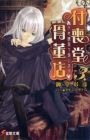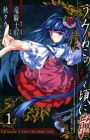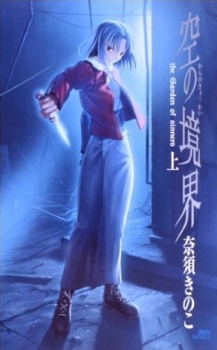
Alternative TitlesEnglish: The Borderline of Emptiness Synonyms: Kara no Kyoukai, Borderline of Emptiness, Rakkyo Japanese: 空の境界
Information
Type: Novel
Volumes: 3
Chapters: 7
Status: Finished
Published: Oct 1998 to Aug 1999 Genres:
Dementia, Demons, Mystery, Fantasy, Horror, Magic, School, Sci-Fi, Super Power, Supernatural, Psychological Serialization:
None
StatisticsScore: 8.671 (scored by 677 users)
Ranked: #572
Popularity: #896
Members: 2,993
Favorites: 124 1 indicates a weighted score
My Info
Popular Tags
horror psychological supernatural |
SynopsisKara no Kyoukai is a Japanese novel series, authored by Kinoko Nasu and illustrated by Takashi Takeuchi (who were later to form the group TYPE-MOON).
A teenaged girl, who possesses the "Mystic Eyes of Death Perception", a supernatural ability that allows the user to see the "death" of everything in existence and kill the object by destroying its "origin". She recently recovered from a two-year coma caused by a traffic accident. Prior to the traffic accident, she originally had two personalities, a male personality named Shiki (織), and the original female personality Shiki (式). Children born into the Ryōgi family are generally male and are raised with two personalities, so the male personality is customarily called the "yang" personality, while the female is called the "yin" personality. It is easy to tell which Shiki is speaking at a given time because they both have a distinct style of speaking, most notably that the female Shiki refers to herself with the pronoun watashi (私), while male Shiki refers to himself as ore (オレ). After waking from her coma, Shiki discovers that she can no longer feel the male Shiki's presence and assumes that he died because of the accident. She also feels a detachment from her memories before the accident, and while she knows she is Shiki, she does not feel that she is. In the hopes of regaining herself and the "dead" Shiki, she puts on a cold facade that somewhat resembles the male Shiki's and tries to act as the female Shiki did. Tōko understands the sense of detachment Shiki feels, but considers the current Shiki a third, new personality.
The series is regarded as being set in the same world as another TYPE-MOON series, Tsukihime, with Aoko Aozaki's sister Tōko Aozaki being featured in this series and the protagonist of the series, Shiki Ryōgi, possessing the same abilities as Tsukihime's protagonist, Shiki Tohno.
(Source: Wikipedia)
Note this includes the non-numbered chapters:
Intermission
Boundary of Emptiness
Gospel in the Future |
Related MangaSide story: Kara no Kyoukai Mirai Fukuin Alternative version: Kara no Kyoukai ~the Garden of sinners~ Adaptation: Kara no Kyoukai: Epilogue, Kara no Kyoukai Remix: Gate of Seventh Heaven, Kara no Kyoukai 2: Satsujin Kousatsu (Part 1), Kara no Kyoukai 7: Satsujin Kousatsu (Part 2), Kara no Kyoukai 3: Tsuukaku Zanryuu, Kara no Kyoukai 1: Fukan Fuukei, Kara no Kyoukai 4: Garan no Dou, Kara no Kyoukai 5: Mujun Rasen, Kara no Kyoukai 6: Boukyaku Rokuon Alternative setting: All Around Type-Moon
Reviews
|
|
i_c___c_i
43 of 73 people found this review helpful
|
7 of 7 chapters read
|
| Overall |
8 |
| Story |
8 |
| Art |
7 |
| Character |
8 |
| Enjoyment |
8 |
"The Boundaries of Emptiness" is a collection of very good ideas woven together in an interesting way on the cloth of a world with a texture of its own. However, some of its patches are formed from warps and wefts that don't really come together well, as if some parts of it were written by a man who had just witnessed some spectacular thing, but they did not really have the means to describe what caught their sight. The characters described and the events they go through are in themselves interesting, maybe surprisingly so. The way in which these things are related, the writing style… it isn't always that good however; especially in the first few chapters. As pages are turned it all steadily gets a little bit better, perhaps as the author got more "comfortable" with writing it. But, almost one third of the novel - the larger part of the first volume - can at times be pretty awkward to read. 'Rakkyo' really comes into its own only during the second volume, and that's more than 200 pages into it. It's still a pretty good read (for something that started as a doujinshi novel, at least) but it feels as if it was published a couple of drafts too early.
I won't say the novel's writing style is bad however, because it's not. Actually, as a whole, or "on a large scale" - depending on how or from where you are looking at things - the novel is pretty well written. You'll only encounter problems "on a small scale", with stuff that can't be seen from afar, small bumps here and there. The narrative style is pretty interesting. The novel is written from fourteen different perspectives and pretty much all the main characters will borrow you their eyes at one point or another during the narrative. This way of writing wasn't used only as a method of painting a clearer picture of the characters and their motivations by giving you direct access to their thoughts; it also made the story more interesting, by hiding or revealing certain pieces of information - since just one character doesn't have access to all the pieces of the puzzle, and their narrative isn't always completely reliable - and setting the stage for a new turn or plot twist in the story, which wouldn't have had the same effect if the entire thing was written from a third person perspective, because then you'd have a hint about everything from the beginning... and that would kill half the tension from trying to anticipate how things will progress. Of course, there are also many passages that are in fact written from a third person perspective, which offers a complete view on everything and everyone in a particular "scene". There are even passages with absolutely no narration, in plain, direct dialogue written as it's spoken with no elements to frame it in a narrative (like "she replied" or "they wondered"), between the nurses of some hospital in novel's fourth part "The Hollow Shrine" . There are even a couple of passages written as lyric poetry. All these variations in the narrative were pretty good and well placed, and the end result is far from being a writing gimmick or some such.
Another prominent aspect of the narrative is the scrambled timeline. At least for the first half or so of the novel. The first four parts which make up the first volume and a little over a third of the second (the "Overlooking View", "Homicide Inquiry (Part 1)", "Remaining Sense of Pain" and "The Hollow Shrine" chapters) jump from one period of time to another separated by a time-skip of about two years. After "The Hollow Shrine" however, the story progresses in a pretty straightforward, almost linear fashion. The non-linear narrative was pretty interesting. You'd think this needlessly complicates the storyline but that is not the case because each section fo the novel reveals sufficient information for the story to progress at an appropriate pace. For example, we learn from its very first pages that Ryougi Shiki had been through an accident and was in a coma for quite some time, even though it is only in "The Hollow Shrine" that we learn most of the story behind this, and pieces of it are still revealed later everything coming into place at the end of the novel in "Homicide Inquiry (Part 2)".
The novel begins in medias res and reveals just enough information about the characters' past and their circumstances to give some context to the story. Most of the characters that will play a major part later are either directly or indirectly mentioned (like Kokutou Azaka, Araya Souren, Aozaki Touko) in the novel's first segment "Overlooking View" but for the most part the story revolves around Ryougi Shiki and Kokutou Mikiya (the book's pair of protagonists) and Fujou Kirie. So the novel is at first focused on offering some exposition for just these two. I prefer this kind of storytelling to one where all the exposition is crammed up in the beginning, however, "Overlooking View" simply doesn't do a good job at drawing you in. It's the weakest part of the entire novel. At first you'd be inclined to think that it's just because you don't know enough about the whole thing, that there are perhaps too many loose ends and all this will make more sense later. But that's not the case. "Overlooking View", while strongly connected with the other parts of the novel (and of course, especially with "Paradox Spiral") is sufficiently self-contained. Even after finishing the novel, and going through it for a second time with all the extra information already known this first segment is pretty bad compared with the rest of the novel. Its flaw is the writing style… As I already mentioned, the writing at the beginning of the novel is severely lacking and nowhere is this more noticeable than in "Overlooking View". It has a series of very awkwardly written dialogues between its characters meant to reveal more about them and familiarize the reader with who and how they are… These dialogues succeed at almost everything but that. They made for a pretty bad if inaccurate first impression as the novel improves considerably later, but the characters get a pretty big hit from this. Especially Mikiya, and since his characterization isn't that consistent for a big chunk of the novel, he "recovered" very slowly from this unintentional sabotage done by the author.
That's because Mikiya is also used as a literary device. The author doesn't know how to separate the two well and ends up with his characterization all over the place. The novel makes a lot of references to but has its own versions of various occult, magical and philosophical practices, aspects or notions. These have to be revealed to the reader otherwise you're left scratching your head asking yourself what in the world could be going on. The strange thing however is that even though there are so many available ways for the author to do that, since as I said, there are more than a dozen characters who also narrate some of the story - especially through Azaka who is Aozaki Touko's apprentice (a mage) - a lot of this information is revealed through Mikiya's dialogues with Touko, as if Mikiya is an extension to the reader. That in itself isn't too problematic. Sure, teaching the reader about these things while Touko teaches Azaka would've been a much more natural thing to do but as long as the flow of information goes from a knowledgable character to an ignorant one everything is believable, it makes sense in the story, exposition disguised as such a dialogue isn't vexing. The problem is that this isn't done too well in Rakkyo. Kokutou Mikiya is supposed to be a very analytical, smart individual. A quick learner. He is 'supposed' to be that but there are a few times when he makes some pretty moronic remarks and asks some pretty stupid questions. This in itself would also be okay, if done well - not everyone is perfect; as intelligent as a character may be there are times when they're not at their best. The thing is, Mikiya's intellect oscillates at the whims of the plot. When the story needs to move along faster Mikiya is quicker to understand things, no matter how esoteric or complicated… when the author wants to take more time explaining things, Mikiya becomes dumb.
This is done quite poorly and is particularly jarring in "Overlooking View", for example when Mikiya starts wondering whether jumping from a high building can be considered a suicide or an accident… Yes, he begins to ponder about "accidentally jumping" from a building. How in the world can someone accidentally do an intentional act is beyond me. Maybe if I get really drunk and hit my head a few times I'll begin to understand it. At first I thought I misread "jump" instead of "fall"… You can indeed accidentally fall from a building, as redundant as that wording is seeing as falling is an unintentional or accidental act anyway. So why did the author write such imbecilic things and thus paint Mikiya with a thick stroke of cretin? Because this "discussion" is part of a build-up to a later discourse about "flying" (living a purposeful life, going wherever and whenever you want in the sky) and "floating" (living a life without purpose, drifting in the air, thrown around by the wind) which is an important theme of these chapters. This connection between the dialogues is possible since the verb "to fly" 「飛ぶ」、can be (and is) used as "to jump" in Japanese. Still, this little play on words doesn't change the fact that what Mikiya is saying doesn't make any sense whatsoever.
Blunders like these are increasingly rare as the novel progresses however, and by the end Mikiya is a relatively rounded character. And the other characters are much more consistently written and they're interesting, the novel has pretty good characters. Shiki for example, has a very complex personality and I found myself pretty empathetic to her character. I won't say more about her though because she is connected in many ways to some major plot points in the story so describing her would also mean that I'm spoiling parts of the novel.
Even though not much of her character is revealed (she narrates the last part of "Overlooking View" but even then what you can see is that she is someone who keeps to herself), Aozaki Touko is a pretty interesting character as well. Maybe exactly because of that, since there is an air of mystery about her the entire time. She has an important role for most of the story as the character that glues and makes sense of a lot of the things happening, and she's a very skilled mage, skilled enough that she received the Sealing Designation from the Association of Magic - an honor but something not entirely pleasant, and one of the reasons why she is such a private person. A pretty interesting character quirk is that she acts differently, to the point where you could say she has a different personality, when she wears her glasses. The character I liked the most however, is Kurogiri Satsuki even though he appears only in the sixth part of the novel, "A Recording of Lost Memories". He has a very interesting backstory and without spoiling too much, due to certain circumstances anyone who interacts with him puts a mask over his face - they see what they'd want to see, they hear what they'd want to hear. Due to the same circumstances he no longer perceives the world like other "normal" human beings. Experiences are attached to him like words to a book, not as memories to a mind. Of course, in Rakkyo he is described in a different way. Which brings me to yet another aspect of the writing style that is lacking and I didn't like much...
To describe Satsuki the author resorted to borrowing terms from cognitive neuroscience, something needlessly pretentious and pedantic. The point would've come across pretty well even without them, and the wording would've been a lot less awkward. Not only that but he also threw in a new aspect of his own that is pretty redundant to the whole process of memory, recognition. So everything resulted in an example of shaky display of knowledge or some kind of weird technobabble. Another example of such needless wording is repeated use of the word "entropy", dozens and dozens of times throughout the novel. Of course most of the time its use has nothing to do with information theory or thermodynamics and it's just thrown around as a "cool" ten-dollar-word metaphor for death. One of the reasons you can use to argue that this word is out of place is also the reason you can argue that its right at home in the novel - it has a different, mystical meaning here. But then, while it would be appropriate or to be expected that Aozaki Touko uses such terms… why is a highschool drop-out like Enjou Tomoe also throwing "entropy" around? It's like the author had just discovered about the heat death of the universe and thought "this entropy thing is so fascinating and cool; I'll write it on every tenth page". And that is really ironic because at one point during "Paradox Spiral", the author compares (through one of the characters, Mikiya of course, of all people) the way Azaka explains her new-found knowledge of magic to someone who was fascinated by science as a child,but now became a scientist and realized how everything is what it is, how that special mystifying aspect of science was lost.
Back to the better aspects of "Kara no Kyoukai", there's a good deal of foreshadowing and there are a lot of connections between the different parts/chapters of the novel, some of which can be missed the first time around. So the novel lends itself well to a second reading. The main story can be separated into "before" and "after 'Paradox Spiral'" - which makes up most of volume two - both chronologically but also thematically. This part is like a central point in the novel and everything else is connected to or revolves around it. By the end of "Paradox Spiral" all the pieces are pretty much in place, at least those that have to do with the setting of the story and the background of most of the characters. All that's left is to see how the story is concluded, how everything is wrapped up, and the novel does that quite well, I liked the last volume, everything that happens after "Paradox Spiral", the most… Well, with the exception of the Epilogue. Even though it explains a pretty important aspect of the story - and something about Shiki herself - without which a certain thread would be left in an ambiguous state (if not cut outright by a plot hole), it could've been integrated better with the rest of the novel. As it is, it's more like an appendage rather than something incorporated into the main body of the writing.
In short, some parts of the novel are pretentious, pedantic, obfuscating for the sake of sounding intelligent, and even plain non-sense. Other parts are much better written though. For example, compared to the use of more academic or scientific terms in the novel, the frequent references to various religions (from Christianity to Buddhism and Shinto), various mythologies and occult or mystical teachings (like references to the I Ching and the hexagrams used for divination or various greek gods) are more often than not quite fitting and they make a lot of sense considering the setting of this story.
Ignoring the occasional mishap of bad writing though, the content is pretty compelling, I have to admit that in the end I liked it in spite of its flaws. Its characters stand out. It has an interesting story and a unique world. There's even a love story somewhere in there. And when you consider that this was Nasu Kinoko's first work the fact that it has some cracks here and there isn't such an unforgivable thing. If you're familiar with other things written by him, like the "Tsukihime" and "Fate/Stay Night" visual novels and you liked them, then you'll probably like "Kara no Kyoukai" too. Being a novel it has just one route, but that route is very good... read more
| No posts for this board were found |
Related ClubsAozaki Aoko ( a.k.a Miss. Blue ) And Aozaki Touko ~FC~, Asagami Fujino Fan Club, Brother Complex Club, Enjou Tomoe Fan Club, FIRE POWER, Kara no Kyoukai, Kokutou Azaka Fan Club, Light Novel Club!, Lio Shirazumi fans, MAL Theme Club, MAL's Writers Club, Manga And Light Novel Lovers, Media Chat , Odd Eyes Club, One-eyed characters, Ryougi Shiki Fan Club, Shiki Ryougi Fan Club, the best damn anime/game club ever, The French Poet - Mikiya Kokutou, Trinisete Scanlator - Brasil, Type-Moon, Type-Moon BR, Type-Rn/Mobius of Echelon: A Type-Moon Roleplay
|
4 hours ago |
6 hours ago |
10 hours ago |
Today, 2:10 AM |
Yesterday, 9:07 PM | |
Yesterday, 1:54 AM |
Yesterday, 1:24 AM |
05-18-13, 7:36 PM |
05-18-13, 7:28 PM |
05-18-13, 12:37 PM |
|
External LinksMangaUpdates, Wikipedia
|
|