
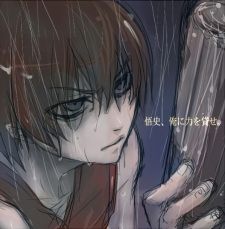

In my opinion, one of the most genuinely heartfelt praises one can bestow upon a work of fiction is “I don’t want this to be over.” I had this feeling hit me pretty strongly about three quarters of the way through Umineko When They Cry—which is saying a lot, given that the game took ~130 hours to complete. It is possibly my favourite work of fiction I’ve experienced, and cements my opinion that creator Ryukishi07 is a genius. Well… A genius who could benefit from an editor; but a genius nonetheless. It is a complex, mystifying, emotional tale which has more layers than I could even begin to break down here. Rather than immediately trying to sum the game up, let’s instead start by talking about what it is.
Every year, relatives of wealthy Kinzo Ushiromiya gather on the private island of Rokkenjima to discuss the division of the head of the family's estate. On the night of October 4, 1986, however, a storm hit the island, cutting off all communication with the outside world. Among them, there is a mysterious killer who, from time to time, comes to exterminate the members of the family. The culprit's modus operandi suggests that he acts with magic, so much so that his identity is almost immediately attributed to Beatrice, the Golden Witch protagonist of the "folklore" of Rokkenjima. Only Battler Ushiromiya can't believe this version, determined to explain the various murders rationally, and at the end of the second day, after the death of all his relatives, he gets to fight the witch herself. The boy is then transported to a metaphysical plane to continue Beatrice's game.
After three sessions of grueling battles, Beatrice has finally been neutralized, but not yet defeated, now reduced to a state of unconsciousness. Battler then decides not to rage on the impotent body of the witch, temporarily abandons the challenge and leaves the game in the hands of the witches Bernkastel and Lambdadelta. Upon his return, he discovers that the story has already come to an end, and a new inhabitant of the island, Erika Furudo, openly reveals the identity of the culprit: her name is ...
Similarly to the saga of Higurashi When They Cry, the Answer Arcs are positioned symmetrically with respect to those of Question: for example, in EP5 the relationship between Natsuhi and Kinzo is deepened which in EP1 was only hinted at, in EP6 the relationships between Kanon and Jessica, and Shannon and George return to being the focus of the episode, while in EP7 the true past of "Beatrice" is revealed along with the solution of the epigraph.
For the first three episodes, Umineko Chiru maintains the gameplay typical of the When They Cry series, devoid of choices and therefore, completely linear; the last chapter, however, takes a radically different direction, so much so that fans have jokingly referred to it as a "parody" of Professor Layton (Level-5 videogame franchise): in EP8, you have to solve some intelligence games , whose resolution allows you to discover the latest background of the Ushiromiya family and to obtain a token from each character. At the end of the game, you will get a symbolic prize based on the number of coins you have accumulated.
In addition, towards the middle of the episode, you will be called to participate in the latest Bernkastel enigma, a game where the murders of Rokkenjima take place regularly and in which the identity of the culprit must be deduced; in this part, the magic is completely absent and the only aids available are the various Purple Declarations, true sentences if spoken by the innocent but false in the mouth of the guilty, and the Clues section, where Battler and Beatrice present their arguments.
Compared to the first series, the script reaches an exquisitely sublime level, taking the narrative to a higher level, higher and higher until it sensationally breaks the fourth wall.
The battle against magic is no longer understood according to an "anti-fantasy" thought, but through a "mystery vs fantasy" position, with all the rules that the yellow genre typically adheres to.
Let's analyze this break starting from its characters, in particular, from the new detectives introduced:
Erika Furudo, the great investigator and Witch of Truth. She appears in End of the Golden Witch as Bernkastel's avatar to replace Battler in the lead role. From the start of the game, Erika is awarded the Detective's Authority, a special power that allows her to elevate her sensory perception and analytical ability to Unquestionable Truth, and to gain the support of the Eiserne Jungfrau, the executors of Knox's Ten Rules. (to write an intellectually correct mystery). Initially the girl appears to help Battler, until at some point she reveals her true nature of her and she begins to abuse her powers to humiliate others and create a false culprit, all to prove her intellectual superiority of her.
In all of this, why has such a negative character managed to rank so high in the fandom popularity polls? Simply, because Erika Furudo is part of the fandom itself: she is a troll, a charismatic intellectual, she wants to be right, even at the cost of prevailing over everything and everyone. She is not only Bernkastel's “Mary Sue”, but she represents that hidden desire of readers and users to feel satisfied with their own acumen, and to satisfy their own personal curiosity.
Another character quite self-inserted but morally opposed to Erika is Willard H Wright, the Chief Inquisitor of the great celestial court. Willard is the detective of the seventh game, Requiem of the Golden Witch, a world in which Battler does not attend the 1986 family reunion. Here, he is forced by Bernkastel to investigate Beatrice's death, and befriends Lion Ushiromiya. In addition to the Detective's Authority, Willard also holds the Spectator's Authority, which allows him to question his interlocutors on a metaphysical level simply by touching them.
The substantial difference between Erika and Will is that if the former has a Lawful Evil character, the other has a Neutral Good temperament; this is manifested in their solution method. While Willard is far more powerful than the Eiserne Jungfrau, strong in her Twenty Rules, he chooses to use only four of them. Not surprisingly, he has a great respect for all those involved in the mysteries, even for the guilty ones, since according to him it is important not to neglect their motives.
Willard represents that particularly distinguished user of the forums, intelligent, apparently shy, but in reality kind and welcoming, who emerges from the toxic atmosphere of the virtual community.
Last but not least, I would also like to mention the goat demons, servants of witches, who in the last episode reveal themselves for what they represent in the real world. I can't reveal any more spoilers, but I'm just saying that anyone who hasn't experienced the collective frenzy in Umineko's fandom won't find much familiar with them.
Umineko manages to delight with her excellent introspective analysis of the characters. The realism of character and social dynamics is transmitted through the interactions of an increasingly vast cast, especially in the seventh episode where, instead of the classic game addressed in the previous chapters, there is a real etiological excursus designed to probe the human psyche. The story of Beatrice thus becomes an elegy of the purest feelings, corrupted by mental disorder, the distortion of reality and emotional dependence. In fact, the theme of true love here becomes the central pivot of the entire series, the element that "moves the sun and the other stars", as well as the means to reach the solution of the mystery. In addition, Ryukishi07 has shown a profound sensitivity in talking about very current hot topics, such as sexism, gender identity and social alienation.


