Total Clubs: 10 Autumn 2009 Anime Group, International Saimoe League / ISML, Hei! AKA Li Shengsun!, The Claymore Club, Hayate the Combat Butler!, One Shot Fans, Wang Yao fanclub , Axis Powers Hetalia Club, Nobue Itoh, Toradora! Official Fanclub!
Total Friends: 11 happy0lady, Katua, 76ers-kid, StabbyPWNS, kerryking, zetsuboshita, Usagimi, AStrangerInside, hounddog, staypee, kevo
|
24 of 36 people found this review helpful
| Overall |
9 |
| Story |
7 |
| Art |
8 |
| Character |
9 |
| Enjoyment |
9 |
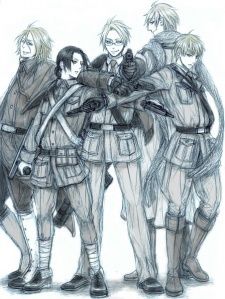
Axis Powers Hetalia is the ongoing project of Japanese web-comic artist Kitayume. The gag manga features the antics of anthropomorphic countries in bishonen and bishoujo form. Italy (after whom the manga is named), Germany, and Japan - the "Axis Powers" - are the primary protagonists, followed by the US, UK, France, Russia, and China - the "Allied Forces." Other characters include N. and E. European and a handful of Asian/Mediterranean countries.
Kitayume follows a routine of briefly introducing country-characters' historical backgrounds before situating them in comical and often ecchi interactions with other powers, ie. Lithuania as US's housekeeper, China as an emo drunk, Hungary as a fujoshi, Russia mistaking Canada for a couch, France (& Korea) hitting on everyone, etc.
This reviewer acknowledges that APH does, on occasion, wander across the fine line of political insensitivity, not only in its racial profiling, but also in the absence of historically incriminating subjects. In its defense, however, Hetalia is intended to be light political satire (or straight comedy), and darker themes would, in fact, undermine its purpose.
Story (7/10):
The scanlated manga (LJ, found here: http://nisecal.googlepages.com) consists of 4 chapters and a good number of side comics. Despite the initial description that APH concerns WWII, the storyline spans ancient history to present-day, and is mostly achronological. There is NO coherent plot, and only highly specific, free-standing references to historical events.
However, you will find personified nations (mostly male, hence the BL), GROPING EACH OTHER.
Art (8/10):
Crude, sometimes inconsistent, but stylish. New readers might have some difficulty distinguishing between countries (particularly Northern European), but all characters have physical idiosyncrasies (when in doubt, refer to their ahoges and pets) that facilitate their identification.
Character (9/10):
The horsepower behind Hetalia's appeal. All nation-characters personify the behavioral quirks (true or not) generally attached to its people: America is blindly heroic (and often obnoxious), Japan is a suicidal otaku, the UK has a terrible crush on the US (and a terrible grudge against France), China wears panda-print boxers, etc.
And Russia. Armed with a bloody water-pipe and spontaneously-appearing vodka bottles. Stalking people. See for yourself.
Enjoyment (9/10):
Excellent as a daily dose of political incorrectness. The fanfiction/fanart potential for BL enthusiasts is also fantastic (and made all the more titillating by the fact that, yes, interactions between countries can, indeed, be yaoi-licious). read more
15 of 22 people found this review helpful
| Overall |
10 |
| Story |
9 |
| Animation |
10 |
| Sound |
9 |
| Character |
8 |
| Enjoyment |
9 |
Of Makoto Shinkai's three best-known pieces, "The Place Promised in Our Early Days" possesses the most pronouncedly plot-oriented narrative: An ambiguous love triangle, a symbolic separation of worlds, and characteristic to Makoto, an open-ended and beautifully depressing conclusion.
Makoto is renowned for his narrative simplicity and stylistic detail: the viewer should expect a gently-delivered and largely "unexciting" story (until the final quarter of the film). Die-hard action-adventure fans are advised to keep their distance. What battles and mecha are absent from Makoto's work are wonderfully compensated with perfect art. Makoto's colors are something else: brave, original, unpretentious, and strongly conducive to speechlessness. More so than in "Voices of a distant star" and "5 cm per second," music in "Promised Place" is of a more theatric, but equally unearthly quality. Art and score combined produce an intensely "otherworldly" aura.
The characters of "The Place Promised in Our Early Days" are rather stationary, and similar to those in Makoto's other productions, are young, quiet, wounded, idealistic, and marvellously uninteresting - a return to realism from the moe/angst-fest unfortunately common to mainstream anime. Above other merits, characters here (and elsewhere in Makoto's projects) are representative (without explicitly stating so) of good sense, human integrity, and beautiful resilience to losing love, being alone, and growing up. Recommended to all admirers of "introspection" and maturity in anime. read more
|