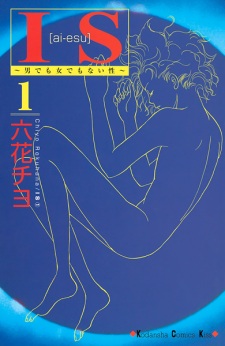
Alternative TitlesSynonyms: IS, Intersexuality, Inter Sexuality, Aiesu, Otoko demo onna demo nai sei
Information
Type: Manga
Volumes: 17
Chapters: 79
Status: Finished
Published: 2003 to ?
StatisticsScore: 8.221 (scored by 540 users)
Ranked: #4602
Popularity: #1592
Members: 1,841
Favorites: 40 1 indicates a weighted score
My Info
Popular Tags
drama |
SynopsisFrom JanimeS:
I.S. (Pronounced Aiesu in Japanese) is not your everyday manga. This manga strictly deals with cases of intersexuality. I.S. stands for Inter Sexuality.
This manga deals with very serious issues with intersexuality people. The pain they go through, the troubles they confront, and ultimately their inability to reproduce and even find a partner who will accept them as they are - It's all there in a form of manga.
The series is consisted with cases, each deals with different people though some cases are much longer and more dramatic than others. |
Reviews
|
|
wakka9ca
56 of 73 people found this review helpful
|
27 of 79 chapters read
|
| Overall |
10 |
| Story |
8 |
| Art |
7 |
| Character |
10 |
| Enjoyment |
10 |
Don't be discriminatory towards the strange title of this manga. Don't worry, this is not yaoi, nor yuri, nor ecchi or hentai. In fact, this is one of the most touching and most mature shoujo/josei manga I have read. Of course, the main characters are intersexuals.
Story: the first bolume is composed of short storis while the rest is Haru's story. Although you will not encounter very deep plot (remember, this is a shoujo manga), the different chain of events that are changing the characters' life and personalities are very original and refreshing. The narration is very interesting as it swtiches POV back and forth from the main character and her/his friends, relatives and even strangers that met him/her.
Art: classical shoujo manga art. Very modest artwork (nothing flashy) with its own touch of cuteness when needed.
Character: the strongest point of this series. The characterization of Haru is just awesome. Combining both mal and female personalities together has created one of the most original character I have ever seen in shoujo manga. On top of that, we get to see the evolution and change of the main character and more importantly, the ones close to him/her and their perception of IS (intersexuals).
Enjoyment: I was actually in a manga "dead-period" when I started reading this series. It means that I have temporarily reduced my manga readings dramatically for a few months. However, this series was so good it drew me out of this dark period. So that tells you all.
Overall, this manga is really impressive and touching. At certain point, I was on the verge of tears. This is the first review I wrote because too few have read this manga (and didn't give high ratings) and I feel an obligation to promote such amazing works.
However, if you feel unconfortable reading this manga, then you are not open-minded enough yet. After all, intersexuals have a prevalency of up to 0.1% or 0.01% depending on the definition. This means one in 1000 to on in 10000 are intersexuals at birth. It is very wrong to discriminate against intersexuals just as it is wrong to discriminate against males or females. read more
|
|
Pachi
5 of 11 people found this review helpful
|
79 chapters
|
| Overall |
7 |
| Story |
6 |
| Art |
9 |
| Character |
7 |
| Enjoyment |
5 |
Warning: This review is a bit long and a bit long winded at times.
I.S. initially drew me in because hey-- how many manga are out there that are about intersexed individuals? I'm a fan of Hourou Musuko among a few other manga that deal with gender identity and sexual orientation so upon seeing this, I got excited and immediately went on a hunt for it.
If this were a review of the first story, Case 1, I would score it like this:
Story: 9
It's short, but very sweet. I easily was able to feel for the protagonist Hiromi and though the translations were rough, I was nearly brought to tears on a couple of occasions. The characters weren't developed a whole lot, but the Hiromi was developed plenty for me to find it enjoyable.
Art: 9
The art doesn't really change through the series and it's cute and pretty. Very clean too.
Character: 8
I would have liked it if the other characters had been a little bit more developed, but hey, it's a one shot. Hiromi was developed plenty for my liking and she felt very believable. She was strong and determined and her decisions were logical for the situations she was in.
Enjoyment: 10
Can't you tell I adore the Case 1 oneshot yet?
Overall: 9
Only a nine because I did some half-assed averaging. I love how a lot of real world issues were discussed.
Continuing on, Case 2 sort of felt repetitive. Maybe I shouldn't have been trying to read it all in one sitting. But the repetitive feeling of the protagonist made me bored in this one shot, though I stayed intrigued enough to finish it because of the slight differences in the protag and the larger difference in those surrounding her.
Now, onto Case 3, which is what the main scoring is about. Here, our protagonist is Haru. Raised as intersex rather than male or female, and using female pronouns for a large part of the story while more identifying as male, before using male pronouns. For this duration of my review, I will be using the male ones.
Story: 6
The beginning was very interesting, seeing things from the parents perspective. What to do about their child being intersex and the way to raise them and how society will handle them. All huge questions for someone who's going to be raising an intersex child. Force surgery on an infant? Let them decide on their own but have them possibly ostracized by their peers? Health of the child is another question as well as whether the child will be happy or not. The portion that focused on the parents, and then when Haru was small were fantastic. Up until high school, the portrayal of Haru and his family was fantastic, fun and believable enough.
However, when we reach the portion where Haru is in high school, the story becomes very weak.
Over and over, on and on Haru can't seem to think about anything other than being intersex. Understandably, this is going to be on someone's mind if they're worrying about how people are going to judge them, but through almost the entirety of Case 3 so far it's "I am intersex. I accept that I am intersex. I must educate about intersex. It's okay to be intersex." Every. Single. Page. It's fine that you're intersex, Haru. It's understandable that it can take a lot to accept your body for what it is and be happy with it. Education is fantastic as well. Hiromi and the Case 2 protag did it too. People do need the education. Letting people who need to know that it's okay to be intersex is great too. Someone who's having trouble with dealing with the fact that their intersex could really use words of guidance.
But I swear on every single page I see "I.S." at least once, if not more. I was happy when Haru was a bit of a lovesick schoolboy/schoolgirl because for once, he was thinking about something ELSE. Moments with his best friend were great too.
When the story switches perspectives, it's a fantastic refreshment. Well, usually. Unless all they're thinking about is the fact that Haru's intersex. Then it's pretty much the same.
In short, the story stopped developing and kept bouncing back to the same plot points over and over and over again.
Art: 9
As I said before, the art is wonderful and easy on the eyes.
Character: 7
Initially, the development of Haru and his family is really, really good as you watch him grow into what seems to be a strong character who has to deal with his own problems about gender identity, puberty and everything else. He thinks about the fact that he's intersex, especially during moments of development that apply to, say, girls. It works fine. However, this drags on through the entire thing and the same thing is revisited far too many times for it to leave any impact on me. It becomes numbing, and Haru's severe lack of development left me clicking and praying for something new.
Now, I'll briefly talk about Miwako, who manages to undergo a LOT of development in just a few chapters. More than Haru has in several volumes. She is intersex and while Haru was raised KNOWING he was intersex, she was not. She was raised as a girl and surgeries were hidden from her and then denied. When she found out, she felt betrayed and all trust she had in her parents vanished. She thinks about the fact that she's intersex a lot, and she goes through her period of being entirely depressed about it before deciding she'll live how to live. While Haru decided that ages ago, the things that pushed HER to do it were developed in brief amounts of time and didn't drag on and on.
Enjoyment: 5
When something is repetitive and I'm having anvils dropped on my head about accepting intersexuals (preaching to the choir), it numbs me. It stops being good and it stops making me feel anything for the characters that I was sure I was going to cry over.
I think at this point I'm still reading in hopes that something amazing will happen.
Overall, Case 1 is fantastic, Case 2 is okay and Case 3 is getting steadily worse. If you want to read the same thing over and over and over again, you'll love Case 3. If you like a character that drags on their development to the point that it stops meaning anything, you will adore Case 3. Otherwise, go with Case 1, maybe Case 2, Case 3 if you're bored out of your mind and want to see some fantastic parenting for awhile.
Oh and almost everyone in this manga cries a helluvalot. I mean a LOT.
Note: If anyone feels that I have used offensive terminology, feel free to PM me so that I can correct it. I tried my best not to say anything offensive, but I know there are times where I say unintentionally offensive things when I don't aim to. read more
|
|
Both titles help the reader learn about a real medical condition that many people know nothing about through the story of a family. A child with this unusual condition is born to an unknowing family who slowly learns how to take care of them and love their differences, despite the trials they face for being different.
Realistic characters with "real-world" problems; raising a child who is different.
Serious real life conditions are explained and conveyed by manga.
|
|
|
If you read one or the other you can see why I recommended it. They are both similar in certain aspects, situations, and more. Trust me.
Both stories are thought-provoking and beautiful, they challenge standard notions of set gender roles and more.
Both series feature Intersexuals as protagonists. I.S. is a heartwarming, true-to-life story and exposé about the lives of Intersexuals. After School Nightmare is less sensitive about Intersex issues, and uses it more of a plot device, albeit a brilliant one. Both series feature Intersex protagonists who struggle with their gender identity and romance, and both are worth the read.
|
| No posts for this board were found |
Related Clubs★Josei Anime★, Manga Experience, Parents in Anime and Manga, [[ Live Action Adaptations ]]
|
27 minutes ago |
1 hour ago |
Yesterday, 12:28 AM |
05-24-13, 12:11 AM |
05-23-13, 4:28 PM | |
05-23-13, 3:14 PM |
05-23-13, 9:16 AM |
05-23-13, 7:53 AM |
05-23-13, 1:53 AM |
05-23-13, 12:38 AM |
|
External LinksMangaUpdates, Wikipedia
|
|