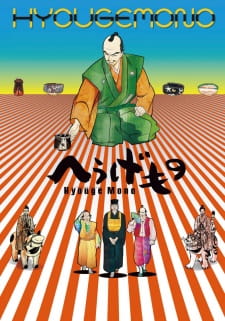
Alternative TitlesSynonyms: Hyougemono Japanese: へうげもの
Information
Type: TV
Episodes: 39
Status: Finished Airing
Aired: Apr 7, 2011 to Jan 26, 2012
Duration:
25 min. per episode Rating:
R - 17+ (violence & profanity)
L represents licensing company
StatisticsScore: 7.881 (scored by 462 users)
Ranked: #6152
Popularity: #2365
Members: 3,925
Favorites: 20 1 indicates a weighted score
My Info
Popular Tags
No tags found |
SynopsisThe story is set during Japan's Sengoku Jidai (Era of the Warring States) and centers on Furuta Sasuke, a vassal of the great warlord Oda Nobunaga and a man obsessed with tea ceremony and material desires in his pursuit of a fortuitous life. Having learned from Oda and the legendary tea master Sen no Soueki, Furuta walks the way of the Hyouge Mono.
(Source: ANN) |
Related AnimeAdaptation: Hyouge Mono
Characters & Voice Actors
Staff
Reviews
|
|
ggultra2764
11 of 15 people found this review helpful
|
39 of 39 episodes seen
|
| Overall |
9 |
| Story |
10 |
| Animation |
8 |
| Sound |
8 |
| Character |
9 |
| Enjoyment |
9 |
About freakin' time I get a chance to complete and review this. I can't believe it took two years for fansubbers to complete all the episodes to it. But anyway, on with the review...
Hyouge Mono did quite a bit for me in sticking out from the mold of many recent anime offerings. The series offers a mix of comedy and drama in its focus on Furuta Sasuke's love of tea ceremonies and the complicated politics surrounding the war for territories in Japan's Sengoku era. The series is a historical title with emphasis on famous figures of the time period and its politics. With the large focus on Japan's history in the period, one should have enough knowledge of the era to get the most enjoyment out of this series, especially on the differing schools of Japanese aesthetics commonplace in the era. Plus with its rather unique storytelling and comical style, the series won't be for everyone.
The comedy element of the series comes from some of the exaggerated depictions shown of the characters, which was quite hilarious for me in many instances throughout the show's run. Examples of this include Furuta Sasuke's devotion to tea ceremonies and aesthetics bordering on fanaticism, Oda Nobunaga being quite over-the-top in showing off his wealth and Date Masamune acting out dramatics kabuki theater style. The show also shows off some of the most exaggerated facial designs I've seen from a recent anime title whenever something unexpected happens with the characters, adding more to Hyouge Mono's charm.
Aside from the comedy, Hyouge Mono still has its serious moments, though in a way different from how most historical Japanese titles depict older times. Rather than focus mostly on the battles occurring within the Sengoku era, Hyouge Mono is more focused on political banter and the large role aesthetics have on Japanese society at large. On the political end, Hyouge Mono shows the tensions and corruption of the period such as influential figures making grabs at power to expand their territory, negotiations between warring daimyo, planned assassinations of major figures and relations with other Eastern countries. While this aspect to the plot may seem dull, it does add more dimension to understanding life in the Sengoku era in a different way, beyond the glorifying of battles seen in samurai films.
The focus on Japanese aesthetics is a little more complicated for me to cover, based on both my limited understanding of it and the differing schools of thought with it. I do know aesthetics is a big thing for Japan's cultural identity, which Hyouge Mono shows in a big way by highlighting the clashing beliefs that several characters in the series have on what kind of aesthetics the country should have moving forward. This is especially prominent in later episodes of the series when a prominent character gains power and tries enforcing his beliefs on aesthetics, adding also to the show's political elements.
The series isn't all plot though, as it also explores how the various historical characters in the series are affected by the various changes occurring within the country. Loyalties get tested, personal beliefs are put into question, some put their status and lives at risk to challenge the present status quo, some feel the pain of being used or losing loved ones due to the era's politics. It's quite the engaging stuff, especially with Sasuke Furuta's character who gets major focus in observing how those influential to his way of life suffer thanks to the era's politics and this usually gets quite dramatic.
Visually, Hyouge Mono is pleasing on the eyes with clean details and vivid color used in designing the various settings and characters of the show. The character designs stick out quite prominently as characters are drawn to be more realistic with their details, having a diverse number of features present with characters and none of the typical beautiful, rainbow-color and big-eye drawing style employed with designs. The mentioned exaggerated facial designs look silly and do well at adding to the anime's comedy. While animation isn't the major highlight of the series, it does its part to depict character movement and showing the actions of characters in both serious and comical moments.
Overall, Hyouge Mono made for a rather unique watch for me as it mixed comedy and drama in exploring elements to Japan's Sengoku era that I've never seen focused on in past historical titles. The lack of action and its unique storytelling style won't be for everyone, but is a definite watch if you are looking for something that sticks out quite heavily from more recent anime offerings.
read more
|
|
Sturmizan
48 of 71 people found this review helpful
|
22 of 39 episodes seen
|
| Overall |
10 |
| Story |
10 |
| Animation |
10 |
| Sound |
10 |
| Character |
10 |
| Enjoyment |
10 |
I will give very high ratings for this anime, and I am sure as hell that a lot of people will disagree with me. But it all comes down to the argument about whether grass root popularity determines the quality of the show. I am aware that this anime is not for everyone. Average anime fan may only enjoy it to a moderate extent, but for those who are interested in the Sengoku Period, this is a must-watch. I for one am familiar with the history and I can safely say that this is THE most well done anime of the year, if not of all-time. Again, I am here to represent myself and not appeal to the people who are not interested, so take my ratings with a grain of salt.
The English subs are updated very slowly and most people are not up to date. At the time of this review I watched 22 episodes out of 39. So I will not give any spoilers. But after these 22 episodes, I think I have a pretty good grasp of the show in general, assuming there's not extreme decrease in quality in the last few episodes.
In my opinion, to FULLY enjoy this anime, you MUST know the history. However, this is not to say that it is impossible to enjoy it if you don’t. I have friends who recently got into it without knowing any of the history at all. But maximum enjoyment is still reserved for the sengoku fans. If you watched the first 4-5 episodes and decide that you don’t like it, DON’T waste your time. Pick something you could really enjoy.
In the following blocks of text I will talk about this anime’s relationship with real history, if may bore you to death of you are not a fan of it, so skip ahead if it makes you dizzy.
This anime does a great job and filling in the gaps of history. There are a lot of things that are obscured in the historical records. The author provides a hypothesis as to how those events have occurred. The main character, Furuta Sasuke, is a real historical figure. He was influential in art but was not as prominent as a samurai as the show suggests. The author's version of Furuta Sasuke provides alternative explanations to a lot of known facts of the other historical figures at the time. If you are familiar with the history, you would find it very amusing and satisfying. Not to mention that the author has a really bizarre sense of humor.
For example, as its first attempt at a major event, this anime takes a closer look at the Incident at Honnouji and the events that lead up to it. The author has an alternative explanation of what really occurred internally without changing the incident's appearance to a common bystander. You still get Akechi Mitsuhide's betrayal of Oda, but with a significantly more astounding flavor of conspiracy.
The anime walks you through the major events of Sengoku from the perspective of Furuta Sasuke, as insignificantly as he was actually involved in these events historically. It starts off with the siege of Shigisan, where Matsunaga Hisahide immortalized himself with his explosion with his Hiragumo. Later it moves on to Araki Murashige’s betrayal in Arioka, the building of Azuchi Castle, Oda’s campaign against Takeda Katsuyori, incident of Honnouji, Battle of Yamazaki, etc. Interestingly enough, the author perfectly fits the protagonist in these important events and creates original stories for him without altering the outcomes at all. Animes these days about sengoku really loves to bend the history to fit the plot, but this is not one of them. It does a much nuanced job at it and leaves the viewer satisfied. At the time of this review, Hideyoshi is engaged in the Kyushu campaign. And many clever interactions between Furuta and historically important figures are depicted.
It should also be noted that although this is a historical anime, it does have its focus on aesthetics and tea art. As much as you think this is just history channel, it isn’t. After Hideyoshi defeats Akechi Mitsuhide at Yamazaki, the anime skips the Kiyosu Conference, the battle of Shizugatake, the siege of Kitanosho, and lands right at the second half of the battle of Komaki-Nagakute(Fans of Hideyoshi battles may be disappointed, but oh well). It has a good balance of tea aesthetics and historical events. Sen no Rikyuu, obviously, will be the focus of many episodes. And the anime will provide a novel approach to the reasons behind his death in the upcoming episodes. I’m assuming fewer people are fans of tea than fans of sengoku, but it really broadens your horizon even if you just half-heartedly listen to their explanation of aesthetics. Personally, I think aesthetics is extremely subjective and is all bull, but knowing a bit of this arbitrary art may serves as a good conversation piece.
Many people either love or complain about the extreme facial expression of the protagonist. I, however, see this as the most fitting thing the author can come up with. I couldn’t find a better way to depict Sasuke’s obsession with his art and his dilemma of balancing art with the way of the samurai. At the end of every episode, you are reminded of this dilemma, and it really is a major conflict of the show. Every decision he makes regarding this has serious ramifications. From the way the show is going now, it may lead to very shocking outcomes toward the end of the series. I can certainly identify with him. In fact, I think the majority of the otaku would find it analogous. For me, it’s like this: Sasuke tries his hardest to be a successful samurai while keeping his passion for his hobby of tea art. I try my hardest to obtain a successful job position while maintaining my passion for my sick hobbies of anime figure collection, dakimakura and other niche otaku stuff. To succeed in this society, you always have to do what is proper to do. But your mind wants what it feels good to do. This internal conflict is present in all of us. This was the main reason I was drawn to the show when I started watching it.
I think the art and music of the anime is very appropriate. Not outstanding, but 100% adequate. I wouldn’t change a bit of it.
In summary, this is THE PERFECT ANIME for any hardcore fan of sengoku. I’m not sure if you NEED to know the history to grasp the sick sense of humor, but I sure did. It had been the anime I look forward to every week since it aired. I have been watching anime for a long time, and for the longest time, Evangelion had been my top anime of all time. It might be a temporal bias, but this anime recently dethroned Evangelion for me and became my top anime of all time. It may be an unfair assessment because the show is not over yet, but I’ll see what happens when the show is over.
read more
Recommendations
|
|
The main topics of both series are the connoisseur's appreciation of objects of art, and the unfolding of intrigues that often surround them.
The series are partly episodic, and although Gallery Fake is set in late 20th century japan, they have a similar feel and are both somewhat educational.
|
|
|
Historical anime for aesthetes, including old men, comedy and anachronisms
|
Opening Theme#1: "Bowl Man" by IKZO (eps 1-4) #2: "Naghol Jumping" by qusimode (eps 5-10) #3: "Ebi Sukui" by ☆Taku Takahashi of m-flo (eps 11-)
Ending Theme"KIZUNA" by Yuki Saitou
Fansubbing Groups
Which fansubbers do you like the best? Click + to approve of their subs for this show. Click - if you don't think they did such a great job.
Related ClubsSamurai & Ninja Club, Tea Appreciation, Unusual is Better, Anri Katsu Fanclub ☆
Recently Watched By|
3 hours ago |
3 hours ago |
4 hours ago |
6 hours ago |
6 hours ago | |
6 hours ago |
8 hours ago |
8 hours ago |
11 hours ago |
12 hours ago |
|
|