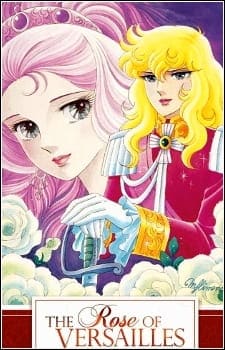
Alternative TitlesEnglish: Rose of Versailles Synonyms: Versailles no Bara, Berusaiyu no Bara Japanese: ベルサイユのばら
Information
Type: TV
Episodes: 40
Status: Finished Airing
Aired: Oct 10, 1979 to Sep 3, 1980
Duration:
23 min. per episode Rating:
PG-13 - Teens 13 or older
L represents licensing company
StatisticsScore: 8.311 (scored by 1731 users)
Ranked: #1482
Popularity: #1043
Members: 3,760
Favorites: 187 1 indicates a weighted score
My Info
Popular Tags
drama historical romance shoujo |
Recommendations Submitted by Users
|
|
Both feature young women blurring the gender line with sword fights.
Rose of Versailles seems an obvious inspiration for Revolutionary Girl Utena. Set in Revolutionary France the main character is a woman raised as a man fulfilling a man's role. Much of the setting from Versailles seems to be the inspiration for the style of Utena.
Rose of Versailles and Revolutionary Girl Utena bring to the front the issues of gender identity. The titular heroines in these series choose to take on traditionally male roles which create a tension in these characters as they struggle to conciliate feelings with duty. In both series there is a recurring theme of roses and sword fighting; they both deal with Revolutions albeit of a very different nature and are concerned with moral nobility. Rose of Versailles has a more social and linear approach while Utena spins into a heavy psychological study that renders narrative almost obsolete. Breaking through illusions, be them class based or emotional hang-ups, is at the heart of these two anime.
Both have strong female leads. Both of which meet their fragility and strive to over come it, while dealing with battles, schemes and traces of love.
If you liked Utena this is another anime/manga I believe you should enjoy. Utena drew inspiration from this both in setting and characters. While Rose of Versailles takes place in the country of France and isn't confined to a school setting, the focus on fighting with swords plays a big part in both anime. The decadent European lifestyle that is acted out in Utena is very much the same as is acted out in Oscar's France (balls, food, elaborate dressing, even many high culture interests).
The main character in Rose of Versailles is Oscar, a woman who got a mans name because her father was stricken with grief that his wife bore a girl,and who was then raised as a male. You can see that Utena's 'Prince' complex (her desire to become a prince) is very much comparable, such as dressing like a boy acting like one but maintaining a certain unbreakable feminine beauty and fragility in both looks and personality (as Oscar is unable to overcome her feminine qualities even dressing more like a guy plus cutting her hair). Both characters are also tested by male characters who try to get them to lose this strength they have by treating them as women but not equals. The main difference between the two characters is Utena has chosen to become what she likes to call a 'prince' while Oscar was raised like a boy.
|
|
|
Versailles and crossdressing, anyone?
So lets see. The only reason why I finde this 2 series verry similar is the main charachter and the historic theme of bouth animes.In Le Chevalier D'eon as well as in Rose of Versailles we have the main charachter who is stucked betwen 2 faces. The face of a woman or the face of a man. In Rose of versailles Oscar was raised as a man, but she is going to love as a woman. Determinated, courageous and proude as a man, but fragile like a woman. In Le Chevalier D'eon our main charachter, a male is possesed by his twin sisters soul who want's revenge. Traped between the 2 personalites he is confused and at a point doesn't even know who is the real him.In bouth series the confusion because of the 2 faces life apear at some point and finishes when the charachter is finaly accepting the person that he is. In Le chevalier D'on this crisis is a bit more stronger because he is actualy controled by his sisters spirit.If you watched one of this movie for his historical tipe you will surely like the other for the same reason. In bouth the action is situated in France.Corruption, kings failing and the thirst for power. You can finde them all in this animes.Conclusio: if you liked one of them you'll surely like the other.
Both BeruBara and Chevalier feature crossdressing and genderbending main characters in a revolution-era French setting that's as accurate as possible, sans the liberties that, of course, had to be taken to create the story.
Both stories take places in history at the same time and both contains same historical characters, but Le Chevalier D'Eon is much darker and includes supernatural accidents.
|
|
|
Based on manga of the same author Oniisama E nad Lady Oscar has a similar spirit. In spite of telling about completly diffirent things both anime has a similar way of the storyline- every little thing has a meaning. Other thing common in both animes is a way of creating characters- they aren't bad or crystal, everyone has pros and cons- like in real life.
These series are very dramatic.
|
|
|
Both stories take places in history and have some well-known historical characters. Both main characters are strong willed woman who pretend to be a man (not all the time though).
|
|
|
Both are set in France around the same time and the main characters are both girls who know how to handle an épée. The Rose of Versailles is more historically correct though and its success was the main reason for "La seine no hoshi" being produced in the first place. So if you like this series, you should definitely check out The Rose of Versailles as well ^^
|
|
|
While the main theme of these two series is considerably different they both take place in Pre-Industrial France and cover their respective time periods with some historical accuracy. In both there is the theme of social injustice and the scars it leaves on people. There is plenty of drama in these series and the artwork invokes an old school ambience that is very similar. Furthermore, both deal with forbidden loves; Rose of Versailles deals with class differences while Song deals with the growing romantic attachment between two boys. These are bittersweet anime through and through. RoV focuses both on political aspects as well as individual conflicts with plenty of history, and Song deals almost exclusively with the tortuous relationship between the two main characters in a very slow paced and poignant manner.
|
|
|
this is the movie made after the tv series
|
|
|
Another series by the same director, Tadao Nagahama. Both shows share the major theme of revolution, and both feature plenty of melodrama, swordfights, horses, frilly dresses and crying.
|
|