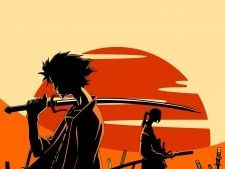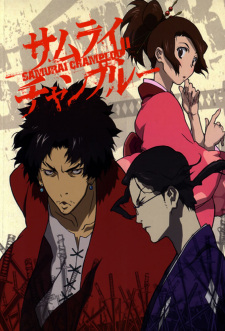
Alternative TitlesEnglish: Samurai Champloo Japanese: サムライチャンプルー
Information
Type: TV
Episodes: 26
Status: Finished Airing
Aired: May 20, 2004 to Mar 19, 2005
Duration:
24 min. per episode Rating:
R - 17+ (violence & profanity)
L represents licensing company
StatisticsScore: 8.531 (scored by 31194 users)
Ranked: #602
Popularity: #22
Members: 45,209
Favorites: 2,532 1 indicates a weighted score
My Info
Popular Tags
action adventure comedy samurai |
|
|
kiriska
70 of 93 people found this review helpful
|
26 of 26 episodes seen
|
| Overall |
9 |
| Story |
9 |
| Animation |
9 |
| Sound |
9 |
| Character |
9 |
| Enjoyment |
9 |
Historical anime don't usually interest me, but when it's as tongue-in-cheek and as full of anachronisms as this, I'm not sure it really counts as a historical anime anymore.
STORY - Like its predecessor Cowboy Bebop, Samurai Champloo is a very episodic series, and it's perfectly safe to miss a few episodes here or there. Even the overarching story remains incredibly vague for almost the entirety of the series and the audience is sometimes left to wonder if there really is a point to all of that searching when they knew virtually nothing to begin with. There's something about the lack of details that makes this story appealing though -- it never seems that important, so you just continue along, but deep in the back of your head, you remain curious about it. So it's the perfect situation; there's immediate gratification within each mostly-standalone episode, but there's also the thread that ties all of those little adventures together, and in the end, there is an ending.
CHARACTER - As with many other slice-of-life or episodic series, much of the entertainment relies on the characters, and herein is a very strong point for the series. All three of our protagonists are rich, interesting characters with backstories that don't seem to clash with their general personalities. As strangers that all met coincidentally in the first episode, their histories are gradually revealed throughout the course of the series in a perfectly paced, even casual way. Though this involves a bunch of chance encounters with figures from their respective pasts, none of them ever really seem to intrude upon the story for the sole purpose of explaining things, which is great. And their stories all actually do contribute to their personalities as a whole, making them all fully-rounded characters with an enjoyable amount of depth to them.
The characters also really contribute to the sometimes satirical nature of the series. Jin could be, at first glance, your stereotypical samurai. Or maybe he really just is, but the fact that they poke fun at him for it makes his whole stance all the more questionable. Mugen is just ridiculous; after all, his fighting technique is rooted in break dancing. And Fuu... well, I suppose Fuu is the least notable of them all, though I sort of feel like I can conclude her a mockery of typical women in samurai anime if I'd seen more samurai anime. Even given the normalcy of her character, she has enough emotion and perseverance to keep her from being called flat.
ARTSTYLE & ARTWORK - Given the time period of the series and all the anachronistic elements, Champloo's art style is very fun and unique. The opening and ending sequences are a great example already. The blending of modern ideas with such a traditional setting is brilliant and very interesting to see. One of the best examples within the series would probably be the graffiti episodes, where yes, there's totally a town in feudal Japan with a street graffiti problem and two rival gangs that won't stop tagging everything. The animation itself is of good quality throughout and it's definitely an aesthetically pleasing series.
MUSIC - Yoko Kanno once again demonstrates her musical prowess by tackling genres others generally don't and mixing them all together. It never ceases to amaze me just what kind of eclectic ensemble the woman comes up with. The music in Champloo suits it perfectly with its clash of ancient and modern, traditional Japanese folk music and present-day hip hop. The opening and ending themes are also wonderfully appropriate to many aspects of the series.
VOICE ACTING - I've seen both the sub and dub, and I must say, both are quite excellent. While I wouldn't necessarily venture to say that the dub is better than the sub (as was certainly the case with Bebop), it definitely stands on at least the same level. Dub-wise, it might have been the easy choice to cast Steve Blum as Mugen, considering Spike Spiegel and Mugen not only had similar personalities, but also looked similar, but damn, the man sure does the job well. (Admission of bias: I love Steve Blum's voice.) Jin's and Fuu's English voices were also quite awesome and actually sounded rather similar to their Japanese counterparts. The characters introduced in each episode also maintained above average voices for the most part, with appropriately sinister voices for the sinister and bumbling voices for the bumbling. All expressed emotion well and were generally convincing all around.
OVERALL - Samurai Champloo was a very fun series. Almost all the episodes were excellent in themselves with a great story, as well as great technical aspects. But the overarching story, when it finally did come together in the end, was actually really nice too. And simple as the ending was, I liked it, was satisfied, and thought it was worth it.
read more
|
|
darkmac
22 of 30 people found this review helpful
|
26 of 26 episodes seen
|
| Overall |
9 |
| Story |
8 |
| Animation |
10 |
| Sound |
9 |
| Character |
9 |
| Enjoyment |
10 |
Samurai Champloo is frequently compared to Cowboy Bebop, but there's one thing that really sets it apart: the action. There wasn't anything bad about Bebop's action, but Champloo's action is among the best of any anime out there, especially among TV series. Though the main characters both use swords, they fight with wildly different styles (Mugen's use of shoes is particularly brilliant), and the fights against enemies with various weapons throughout the series all manage to make themselves interesting and different. Even if the rest of the series were terrible, it would be worth watching simply for the action.
But the rest of the series manages to be entertaining as well. The main story's not anything special, but the stories told in individual episodes range from hilarious to heartbreaking. Each story is genuinely unpredictable due to the bloody nature of the series, and you can never tell whether the encounter's going to end well or not. That's not to say that the show revels in violence for the sake of violence, as conflicts are frequently solved peacefully as well.
The main characters themselves are all solid, but where they truly shine is in their interactions with other characters. The series is never content to just follow one character's story. All three of the characters will often split up, meet separate characters, and go through development of their own while the tertiary characters develop as well. Sometimes the stories will all be related, while other times they share only thematic links, but this structure keeps the show interesting and fast-paced at all times.
The style of the show likewise contributes to making everything more interesting. The artstyle is gorgeous, and the animation is always pretty. More important is the way hip-hop themes are integrated into the show. I'm not a fan of hip-hop in general, but the style here is absolutely perfect, contributing greatly to the humor of the show. It never dominates an episode completely, but it provides little touches that make otherwise ordinary characters and scenes special. A rumor might be told as a rap, and the episode might otherwise be completely devoid of hip-hop references. The music does have some hip-hop influences, but they never dominate the score, so don't worry that you'll dislike the music if you don't like hip-hop.
The humor of the show in general is likewise top-notch. The comedy episodes are some of the best in the show, partly because they tackle serious themes (such as Japan being invaded) in very comical ways. These episodes are also just as violent as the rest of the show, and include the same hip-hop styling to make things stay fun. Mugen is frequently the source of most of the laughs, but Fuu and Jin also frequently amuse, as does the side cast. Even the serious episodes often have jokes at very inappropriate times, and because of the style of the show, those jokes work.
I watched Samurai Champloo for the action, but every other aspect of the show completely surpassed my expectations. While I wouldn't call it perfect, as one or two of the episodes aren't very good and only a few are truly exceptional, I will say that I was never bored, and I usually had a smile on my face. Samurai Champloo is just plain fun. read more
|
|
Jin
76 of 107 people found this review helpful
|
26 of 26 episodes seen
|
| Overall |
9 |
| Story |
8 |
| Animation |
9 |
| Sound |
10 |
| Character |
9 |
| Enjoyment |
10 |
Samurai Champloo is the latest work from Writer/Director Shinichiro Watanabe, who is most recognized for his work on Cowboy Bebop. One of the very few things Champloo and Bebop have in common is their great scores. Champloo mixes two subjects which would never be put in one sentence together, western hip-hop and eastern samurai swordplay. Yet the mixture comes out with a brilliant result. The fights scenes are hyped up with the speed and flow from the music and come out magnificent. But Champloo isn't all about fighting. Many things happen along the road for the three main characters: Mugen, a rough mouth vagrant with a fighting style similar to capoeira with a sword. Jin, a quite and intelligent ronin who fights with deadly lightning speeds. And Fuu, the ditsy waitress that brings these two together in search of a samurai who smells of sunflowers. Between these three we see many moments of humorous antics, whether it's Mugen poking insults at her flat chest or Mugen and Jin’s constant attempts on each others life. Samurai Champloo is fueled by Action, Comedy, and Drama. Together with an original story Samurai Champloo has a unique spin on the old samurai era making it a great find for any fan of anime.
Story
The story of Champloo is an original work from Shinichiro Watanabe. The story centers on Fuu’s search for a samurai who smells of sunflowers. As the wanders continue on their travel they encounter many problems, mostly dealing with how to make money for their various expenses some times causing trouble for the three. In the travels many humorous things occur like Mugen entering a beetle type cock fight, Jin and Mugen’s adventure in to the red-light district, or the three entering an eating contest. As the three get closer to the samurai who smells of sunflowers, things begin to unravel leading the three to the most trouble they have ever seen.
Animation
Champloo has crisp clean stylistic animation. Characters are draw clean and clear with many details. The landscapes of Champloo are filled with beautiful shots of Japan’s country side. There are even a few scenes were the animation becomes only black and white and seem as they where draw straight from sketches to add to the scene. There is also one part were the colors and animation becomes so lively that it gives the impression of a whacked out hallucination.
Sound
The score of Champloo is what sets its self apart from any other anime in its genre. The background music is filled with urban hip-hop to give it a loose free flowing fill to it. A big portion of Champloo is focused on its original sound and it shows. For action scenes we get a fast flowing sound that gives the sword fights a more stylistic feel to them. For the more dramatic scenes we get deeper sounding background music. There are even moments during some flash back scenes were the music that we get to hear a rich Japanese sound to give a deeper feeling to it.
Characters
Samurai Champloo focuses around 3 core characters. Mugen is a straight loud mouth anti-hero. Mugen is the wild one of the group, always flying by the seat of his pants. Mugen also seems to have a problem with authority. Mugen is the first to draw and the last to leave a fight. Jin is a noble ronin in the search of a purpose. Jin although quite and wise, he too has some distaste with authority like Mugen, although with different reason mainly because he sees the one’s in charge as waste. Fuu is a young girl in the search of a samurai who smells of sunflowers, she keeps these reasons to herself for some reason. Fuu is clumsy and some times naive. Fuu is constantly being kidnapped even though she has two strong bodyguards. And for some reason she keeps a flying squirrel with her to help out sometimes.
Enjoyment
Any one who is a fan of samurai action will surely like Champloo. Filled with enough action to keep those hard core action fans at bay, Champloo sprinkles some comedy and drama on top. If you are someone who doesn't like the hip-hop aspect of Champloo, then at least give it a try, you may be surprised. read more
|
|
FarewellToWords
30 of 44 people found this review helpful
|
26 of 26 episodes seen
|
| Overall |
10 |
| Story |
8 |
| Animation |
10 |
| Sound |
10 |
| Character |
10 |
| Enjoyment |
10 |
The premise is simple, three complete strangers drawn together by fate to embark on a long, very parlous journey across unfamiliar territory. However, it's not the plot which makes Samurai Champloo note worthy, but rather the characters themselves. There is a very strong relate-ability present in the main characters Jin, Mugen and Fuu; no matter who the viewer happens to be it's a more than safe bet they will instantly find common ground with at least one if not all three. This element within it's self is the very one which drives the series forward, it offers added interest and added suspense as each of our three travailing companions find themselves in some rather tense situations quite regularly. The true paradox in Samurai Champloo is that it's actually the main characters' normality which makes them so extraordinary.
Jin is a quiet, very strong willed, mysterious man of few words and it shows through greatly in his swordsmanship. Gin fights the same way he lives, with decisiveness, with great resolve, and with honor. Jin is a man of tradition, and a man of respect. It comes as no surprise he isn't one to allow someone under his skin during the heat of battle, he remains un-rattled and content with his abilities even in times of great adversities.
Mugen can easily be considered Jin's polar opposite; unlike Jin, Mugen has no concept of reserve, always speaks his mind despite the outcome, he is an extremely reckless individual who is easily the most cut throat free spirit in existence. Mugen inadvertently thrives off of defying the laws and 'order' around him, but in reality he's simply seeking an opponent who he feels would prove as a worthy match for his skill and ability. There are some who claim they'd laugh in the face of death, Mugen would beat each and every one of you to it.
Fuu is unlike either of the two samurai who accompany her. Although she's a bit of a klutz and slightly clueless at times, Fuu proves to be a lot more cunning and determined than first impressions are willing to let on. Fuu is the type of girl who once her mind is made up, nothing except death could stop her from chasing and attempting to reach her goals and aspirations, but like everyone, some times she just needs a bit of motivation.
Samurai Champloo is able to excel where most other series fail, it's ability to balance both comedic elements with serious, very deep subject matter is a direct result of the characters themselves. Nothing seems forced, every line of dialog is believable, everything seems to fit with the personality, actions and dominate traits Jin, Mugen and Fuu possess; although most would think this should be expected, it's not an easy feat to accomplish. The multi dimensional perspective of Jin, Mugen, and Fuu's outward actions, as well as inner feelings more than make up for the lack of complexity in the story's plot. After all, who here hasn't seen an anime about samurai?
Most importantly this series left me fulfilled, it didn't leave any questions unanswered, and to me the ending, although somewhat anti climatic was in my opinion a more than suited one to close the final pages on what is one of my favorite animes of all time. You'll laugh, maybe even cry and through it all you'll enjoy every minute of it, and chances are you'll want to experience it all over again in the not to distant future. read more
|
|
YoungVagabond
10 of 15 people found this review helpful
|
26 of 26 episodes seen
|
| Overall |
10 |
| Story |
|
| Animation |
|
| Character |
|
| Enjoyment |
  |
For anyone who has watched Cowboy Bebop, they know that director Shinichiro Watanabe loves blending completely disparate elements together, be it science fiction, physical comedy, spaghetti Western, bebop jazz, or space epic, all into the same story.
As diverse as "Cowboy Bebop" was, it has nothing on the sheer schizophrenia of "Samurai Champloo", Watanabe's most recent effort. On the surface, it's a mixture of comedy and samurai epic about Japan in the mid 1600s. However, that doesn't do the series any more justice than calling "Cowboy Bebop" a space western.
One episode is a Shaolin Soccer-esque comedy about a baseball game. Another is a zombie horror story which doubles as an allegory for World War 2. The series presents historically accurate facts about the spread of Christianity in Japan side-by-side with rocket launchers, talks about Edo-style painting and Vincent Van Gogh in the same episode as punks with switchblades and green mohawks.
There are young street gangs painting graffiti, near-invincible blind warriors modeled upon Zaotichi, honorable samurai warriors, arrogant fashion designers, mid 17th century Japanese beat boxing rappers, and eating competitions.
Hip-hop and rap music is as prominent as traditional Japanese and Aina-style music.
Most directors attempting such a crazy mix would be met with failure and ridicule. However, Shinichiro Watanabe manages to succeed, and he does so thanks to several different elements;
1. Comedy- Samurai Champloo might well be the funniest anime series I've ever seen. Whether it be over-the-top action scenes, great situational comedy, or the absurdity of so many different elements in the same time period and place, there are certain moments in the series that will have one gasping for air.
2. A hard, brutal, uncompromising story- The above works especially well because of how gritty, bloody, and tragic the majority of the story is. Most of the characters die. There is rarely a happy ending. Even in the instances when the good guys "win", it's not clear whether they're better off than they were originally.
3. Misdirection- In every series or movie, a director can leave lots of minor hints and clues about what's going to happen. Most of the time they are fulfilled. In this series, though, Watanabe does the exact opposite of what one is expecting.
A small example of this is when an old man is giving one of the samurai protagonists, Jin, a lecture about going with the current to catch a fish. The man is clearly wise, the music becomes serious, and like lightning, his hands dart through the pristine, blue river. His hands rise above his head, clenched hard, golden in the light of the sun.
Suddenly, the record scratches, the man opens his hand, and it turns out there's no fish.
"Well, sometimes they get away, anyhow!" the man exclaims with a laugh.
There are dozens of such examples throughout the series. The ending is probably the best case of misdirection, being the complete opposite of what I expected.
4. Memorable characters- While the former pirate and violent vagrant Mugen is probably the star of the show, and the source of most of the laughs, he does not completely outshine straightman, and traditional, honorable samurai Jin, who is every bit as interesting of a character, and provides plenty laughs of his own. Even Fuu, the girl guiding them, isn't the typical annoying Japanese anime heroine, and is a great set-up and comedic foil for the two mismatched warriors.
This series is an absolute classic, my favorite anime ever. read more
|
|
Kyo_Kyuuby
6 of 9 people found this review helpful
|
26 of 26 episodes seen
|
| Overall |
10 |
| Story |
9 |
| Animation |
10 |
| Sound |
9 |
| Character |
8 |
| Enjoyment |
10 |
My experience in anime revolves mostly around fighting animes, and with that point in mind ill start off by saying that it's one of the best fighting animes I've ever seen. Let's break it down:
Story: Rather than being one continuous arc, the series is broken down in small adventures that usually start and end withing the frame of one episode.While some may complain that it's hard to keep track of what has happened in past episodes, I think that for an anime less concerned with feelings and more with fighting, it's an excellent configuration.It also fits well the theme of the anime which, instead of being the heroes' self-improvement and conquests is rather a take on subtle aspects and issues of japanese culture and history, such as Bushido, Baseball, corruption, sexism, honor, The West, and Yakuza. AND FIGHTING!!!!!!! The developpers also threw a recap episode in there. 9/10
Art: Stunning. Absolutely marvelous fighting sequences. I had to wait 120 episodes of Naruto to come slightly close the the fluidity and choreography of the fighting sequences in this anime. The drawing style is also unconventional, rending the ugly uglier and the beautiful more so when necessary, making certain moments look like something you could frame. Excellent. 10/10
Sound: Since the anime is somewhat meta, instead of trying to look serious with hardcore samurai music, it mostly relies on jazz, hip-hop and chill-out music, making it elegant. Also, once, it used beatboxing as backround music. You gotta like that. ;) 9/10
Character: The characters are well defined and have very clear personalities.
The heroes' backround stories are rather frustratingly vague, but if they had more it would've weighed the anime down and detracted from it's intention. 8/10
Enjoyment: I very much enjoyed this anime. It made me laugh, it brought tears to my eyes and it made me stare in awe at the awesomeness of the fighting scenes. It did exactly what it had in mind to do: To make the spectator enjoy it and to plant a pleasant memory in his mind. 10/10
Overall, this anime is awesome. It will satisfy your thirst for fighting in a very elegant and pleasant way, making you sad once it's over. Watch it. Trust me. 10/10
read more
|
|
Monkey_D_Luffy
19 of 32 people found this review helpful
|
26 of 26 episodes seen
|
| Overall |
9 |
| Story |
9 |
| Animation |
9 |
| Sound |
10 |
| Character |
9 |
| Enjoyment |
10 |
Story:
The story has a main central plot. Two samurai (although I think Mugen shouldn't really be considered a traditional samurai) and a teahouse waitress meet and the swordsmen end up accompanying her on a journey to seek out the samurai who smells of sunflowers. However, each episode, or occasionally every two episodes, really has its own story, but still falls into the main storyline perfectly because these episode stories are really the stories of their travels.
In the beginning the whole sunflower samurai thing was somewhat vague and unexplained, but the truth of it becomes revealed throughout the series. I think it was a great story that was well developed and the ending was actually pretty good in my opinion. It really didn't leave you hanging at all because the main storyline was entirely resolved (despite what the idiots who believe it wasn't resolved say.)
This story takes place in Japan's Edo Period (1603-1868,) however is really a revisionist historical series, meaning that the makers added some modern day elements that are anachronistic, predominately because the show contains hip-hop cultural attributes (i.e. break dancing, turntables, graffiti, Mugen's style, etc.) Also baseball did not arrive to Japan until 1878, ten years after the end of the Edo era, but the episode that contains a baseball game does fabricate a story that would make it possible. On the other hand, it does still actually show a lot of Edo historical aspects (such as the persecution against Christians, the nation's restriction of foreign affairs, Ukiyo-e paintings, and even a fictionalized version of a real life samurai (Miyamoto Musashi.) This blend of historical traits mixed with some modern themes makes the show very enjoyable.
Art:
Superb. The art style was very cool and the animation was nicely done. Consistently, throughout the whole series that is, the art was great, showing that they didn't slack off and really wanted to do a good job with this. The fighting scenes were brilliantly animated and always fluent, and the variety of camera angles and movements made it all very exciting.
Sound:
Yes, outstanding, definitely. The music is meant to reflect the hip-hop genre, and it does so very well. The OP is a cool song that fits the style as well as the samurai theme of the series. The ED is also a nice song for the show, and on several episodes there is an alternate ED, and then it goes back to the main ED, so the changes every once in a while are nice.
The background music is top notch, especially during the action sequences. The music gets you so into the feel of the battle and makes it quite exciting. The sound effects are awesome. In the middle of the episodes when that screen shows up that says Samurai Champloo (where like a commercial would usually be,) as well during the actual episodes when one scene changes to another, there are cool sound effects like turntables and such that further add to the hip-hop feel.
There's all this talk about the hip-hop, but maybe you don't like hip-hop. However, trust me, it makes the show so enjoyable and adds greatly to the overall feel of the show, generating a remarkable outcome.
Character:
The show primarily revolves around three characters: Fuu, Mugen, and Jin.
Fuu is a 15 year old girl who lost her mother to illness and was always told she never had a father. Thus, at the start of the show, she was alone working as a waitress at a teahouse. It is her goal to find the samurai who smells like sunflowers, for a reason I can't disclose because I believe it'd be considered a spoiler. She loves to eat despite her small stature often bickers primarily with Mugen.
Mugen is a swordsman who really helps give off the hip-hop feel. His fighting style incorporates a break dancing like art with swordsmanship, making it very cool, original, and enjoyable to watch. At the start of the show he's displayed as a lone wolf sorta guy who is a troublemaker always on the hunt for a tougher opponent. Anything about his parents or family is basically unknown to him, however the focal point of his history is revealed, which is enough to satisfy the viewer.
Jin is more of a classical, orthodox, and traditional samurai. He remains as a rather cryptic and sophisticated type of dude. Always being more calm and quiet, he differs greatly with Mugen, which is great. However, their sword skills are equal, and thus they agree that after their journey with Fuu is complete they would kill each other. Jin's history, like Mugen's, isn't given to you in its entirety, however I think more than enough is given about him, telling you basically what you need to know.
The contrasting personalities and styles of this trio makes the story extremely enjoyable because it always creates great comedy and humor. I think everybody could come to love these characters due to their separate traits. The supporting characters are usually pretty interesting and perform their roles nicely, all that is needed for a supporting character really.
Enjoyment:
Unique and top-notch samurai sword fighting mixed with other weapons such as kusarigamas and the occasional firearm. Great humor produced by three significantly different characters. A story that every episode keeps you occupied and drawn in. A wonderful soundtrack and magnificent artwork that boost the quality of the show.
What more could you ask for in a shounen series? It's a great action show that shouldn't be passed up, if anything simply for how incredibly enjoyable it is. read more
|
|
daimira
22 of 37 people found this review helpful
|
26 of 26 episodes seen
|
| Overall |
8 |
| Story |
8 |
| Animation |
10 |
| Sound |
10 |
| Character |
8 |
| Enjoyment |
9 |
Fuu is a young orphaned girl doing her best to survive while working in a teashop. But her world as she knows it begins to unravel the minute a wandering Okinawan swordsman by the name of Mugen slouches into the shop while the daikon's abusive son and his rude cronies are also having some fun. When Fuu becomes the victim of their nasty games, she immediately offers Mugen fifty dango if he saves her from them. At the same time, a masterless samurai named Jin bears witness to the daikon's cruelty and quickly intervenes, easily dispatching the daikon's "best of the best" guards. Mugen also beats everyone in the teashop up, starting with cutting off the arm of the man threatening Fuu, and demands better opponents from the daikon's son.
Jin wanders in after the lordling threatens Mugen with his father's elite guard, unaware that Jin has already taught them all a lesson. Mugen mistakes Jin for the "really strong" warriors but is quickly corrected. It makes no difference because Jin is now the strongest opponent available. To Fuu's chagrin, the pair of them immediately decide to duke it out in her teashop. The fight, however, ends abruptly when the man whose arm Mugen has just chopped off sets the place on fire.
That is how the story starts, and how three strange, wildly different people get together. Due to a strange series of events, Fuu has contracted both Mugen and Jin tol help her find the mysterious "samurai who smells of sunflowers". But how long can a young girl keep a pair of battle-crazy swordsmen under control, and how can they find a samurai by his scent alone (especially when Mugen doesn't even know what a sunlower is)?
Samurai Champloo is Shinichiro Watanabe's next great animated venture that came right on the heels of Cowboy Bebop. It's quite funny and insane and just as initially apparently plotless as Bebop but once again proves to be a masterpiece in character studies. Unlike Bebop (which I can't help comparing Champloo to), there isn't much of an overarching plot. Though Fuu's quest to find the mysterious sunflower samurai is the main plot point, it isn't as heavy or deep or as present as the Spike/Vicious conflict throughout Bebop. Most of the time, it's just Jin, Mugen, and Fuu wandering across Japan, getting into trouble, starving, almost dying, and fighting with random people for no true purpose. It is occasionally dramatic, sometimes gory, and frequently violent, but it is never too heavy. It's more entertainment than actual story, although there are several stories and themes that intertwine.
The art is breathtaking, of course. The landscapes and backgrounds are so amazingly beautiful and complete while animation is dazzlingly fluid. The fight scenes are absolutely excellent and exciting. The music appears inappropriate in theory but sounds perfect in actuality. Hip-hop and lounge music in a samurai anime? Was the director on crack? Not really. Just brilliant. With artists such as Tsutchie and NUJABES on board, the soundtrack is unexpectedly fitting and over-all quite good.
My final verdict is: it's a good and entertaining anime but lacks the depth that made Cowboy Bebop a masterpiece. Still, I wouldn't pass Champloo up. The characters and setting are just too awesome and realistically done. However, some aspects of the stories and humor may be hard to grasp, as they are much too deeply rooted in Japanese history to easily translate or understand. And if you're one of those people who think that, after seeing one samurai anime, you've seen them all - trust me. You haven't. Samurai Champloo has it faults, certainly, but it is most definitely unique. read more
|
|
cerisey
7 of 12 people found this review helpful
|
26 of 26 episodes seen
|
| Overall |
10 |
| Story |
9 |
| Animation |
10 |
| Sound |
9 |
| Character |
10 |
| Enjoyment |
10 |
--Story: 9--
The story of a girl searching for "A samurai who smells of sunflowers" sounds terribly simple. Which is fair, that's what it is. But considering what the series aims to give, it's quite suitable. So instead I've based the 'story' on the average rating I'd give each episodes story line. Samurai Champloo often has a different plot/story for each episode, the story spanning over 2 episodes max. Though this may not be suitable for someone interested in a story intense anime, it allows the creators to fill it with much action, humour, and entertainment. Even with the somewhat cliche stories used, they were done in such a way that I was completely drawn in each time
--Art: 10--
I absolutely loved the art and animation. The character designs were unique (while still making them fit in with the era). I personally found the art style one of the best I've seen. As were the designs, it was unique, and expressive, but still very much anime. The animation as well was brilliant, the fight scenes were smoothly animated, and the simpler scenes were done just as well. Easily a 10.
--Sound: 9--
I'm not a big fan of hip hop, so my opinion here may be a little bias, or I'd have thought so. Even with a strange music choice, it seems to blend in with the mood of the series perfectly. It just depends if you like it.
--Character: 9--
At first glance the characters seem overused, and basic. Fuu, a young cheerful girl who often gets herself kidnapped. Jin, a very traditional and silent samurai. And Mugen, Jin's completer opposite, a self taught fighter who acts before he thinks and seems to have no concern for those around him (unless it's a beautiful woman). And in a way, I suppose that's exactly what they are. But they're perfectly suited for the mood the series wishes, and succeeds to portray. Not only that, but I felt all three characters did have their own little quirks which separate them from the typical characters they seem to mimic.
--Enjoyment: 10--
I was especially fond of the mixture of moods through Samurai Champloo, some episodes are quite melancholy, tragic even. Usually the longer stories. While others are, to simply put it, strange. The humour in the series meant it could be enjoyed in more than one way.
--Overall: 9--
At first glance Samurai Champloo seems full of cliche's, with a pretty basic setup. But this series isn't about intense story or character development, it's about action and entertainment. And on that level, I feel it succeeded, or even surpassed what I had hoped for. read more
|
|
arme
6 of 12 people found this review helpful
|
26 of 26 episodes seen
|
| Overall |
9 |
| Story |
7 |
| Animation |
10 |
| Sound |
8 |
| Character |
9 |
| Enjoyment |
9 |
Champloo can be translated as combination. Indead, Samurai Champloo is a very good combination between comedy and drama, it uses elements from hip-hop culture like graffitti, break dance style. What I liked about Samurai Champloo was its soundtrack which was composed on hip-hop beats and it was outstanding.
When I watched Samurai Champloo, I had the feeling that nothing really important was happening. Someone said to me: there are some type of events that do not change completly the personality; those events are meant to icrease the experience level.
In conclusion, I consider Samurai Champloo to be an experience trip, not only for Jin, Mugen and Fu, but also for us, the viewers. read more
|